Load gauge time series from netCDF file
Under development for the Cascadia CoPes Hub project, supported by NSF.
This notebook uses a datafile containing gauge time series the 36 ground motions developed for the Cascadia CoPes Hub, at gauge locations near Westport, WA, for a 2-hour simulation using GeoClaw with 1/3 arcsecond resolution on the finest grid level.
This data file can be found from the Design Safe Jupyter Hub in ~/MyProjects/PRJ-6005/GraysHarborBridges
The gauge locations are on an interactive map that can be created in this notebook.
Data used can be found on DesignSafe in
~/MyProjects/PRJ-6005/GraysHarborBridgesor downloaded to your local machine via:
scp username@stampede3.tacc.utexas.edu:/corral/projects/NHERI/projects/7f2e74be-d7ca-4e0e-b69a-22c24840b078/GraysHarborBridges/*.nc ./%matplotlib inlinefrom pylab import *
import xarray
import os,sys,glob
from pathlib import Path
from IPython.display import FileLinksys.path.insert(0,'../../src')
import CHTuserfrom CHTuser import CHTtoolsRead the netCDF file containing all time series
Make sure ncfile includes the correct path to the netCDF file with gauge results.
pwd'/Users/rjl/git/CHTuser/sites/GraysHarborBridges'if 0:
# on Design Safe
datadir = '~/MyProjects/PRJ-6005/GraysHarborBridges'
else:
# local data
datadir = '.'
# full path:
datadir = Path(datadir).resolve()
print(f'netcdf files in {datadir}:')
glob.glob(f'{datadir}/*.nc')netcdf files in /Users/rjl/git/CHTuser/sites/GraysHarborBridges:
['/Users/rjl/git/CHTuser/sites/GraysHarborBridges/NorthGray1_gauges_4events.nc',
 '/Users/rjl/git/CHTuser/sites/GraysHarborBridges/OceanShores_gauges_18BuriedEvents.nc',
 '/Users/rjl/git/CHTuser/sites/GraysHarborBridges/SouthGray2_gauges_4events.nc',
 '/Users/rjl/git/CHTuser/sites/GraysHarborBridges/OceanShores_gauges_4events.nc',
 '/Users/rjl/git/CHTuser/sites/GraysHarborBridges/Hoquiam1_gauges_4events.nc',
 '/Users/rjl/git/CHTuser/sites/GraysHarborBridges/Aberdeen_gauges_4events.nc',
 '/Users/rjl/git/CHTuser/sites/GraysHarborBridges/AberHospital_gauges_4events.nc',
 '/Users/rjl/git/CHTuser/sites/GraysHarborBridges/SouthGray1_gauges_4events.nc',
 '/Users/rjl/git/CHTuser/sites/GraysHarborBridges/Suncrest_gauges_4events.nc']
Set location to one of the locations in the directories above.
location = 'Aberdeen'
ncfile = f'{datadir}/{location}_gauges_4events.nc'

print(f'ncfile = {ncfile}')
ncfile = /Users/rjl/git/CHTuser/sites/GraysHarborBridges/Aberdeen_gauges_4events.nc
gauge_x, gauge_y, gauge_t, gauge_vals = CHTtools.read_allgauges_nc(ncfile)Trying to read /Users/rjl/git/CHTuser/sites/GraysHarborBridges/Aberdeen_gauges_4events.nc ...
All gauge output for Aberdeen
Loaded 7201 times from t = 0.0 to 36000.0 sec at 15 gauges
for 4 events, with qois ['h' 'u' 'v' 'eta' 'level']
print gauge_vals.coords for more info
Examine the data:
gauge_valsConvert to an xarray dataset
gauge_vals is one large 4-dimensional array indexed by the quantity of interest qoi as well as by event, gaugeno, and time.
For most purposes it’s easiest to convert is to an xarray.Dataset, a collection of DataArray’s split up by the qoi:
ds = gauge_vals.to_dataset(dim='qoi')dsall_events = ds.coords['event'].data
all_gauges = ds.coords['gaugeno'].dataprint('\nEvents: \n',all_events)
print('\nGauges: \n',all_gauges)
print(f'\nAt {len(ds.coords['time'])} times up to {array(ds.coords['time']).max()/3600} hours\n')
Events:
 ['BL10D_instant' 'BL10M_instant' 'BL10S_instant' 'BL13D_instant']

Gauges:
 [ 11  33  43  56  68 137 138 354 367 368 390 509 558 561 562]

At 7201 times up to 10.0 hours
Make an html file with interactive map showing all gauges:
Still need to clean up this function and move to CHTtools....
def folium_plot_gauge(gaugenos, center=None, zoom_start=13):
    import folium
    import numpy as np

    if not isinstance(gaugenos, (list, tuple, np.ndarray)):
        # If it's not a list, wrap it in one
        gaugenos = [gaugenos]

    #tiles = 'OpenStreetMap'  # default tiles
    tiles = 'OpenTopoMap'   # show contours

    m = None

    for gaugeno in gaugenos:

        xg = gauge_x.sel(gaugeno=gaugeno)
        yg = gauge_y.sel(gaugeno=gaugeno)
        #print(f'Gauge %i is at (%.5f, %.5f)' % (gaugeno, xg, yg))

        if m is None:
            if center is None:
                location=(yg, xg)
            elif isinstance(center,int):
                xgc = gauge_x.sel(gaugeno=center)
                ygc = gauge_y.sel(gaugeno=center)
                location = (ygc, xgc)
            else:
                #assume center is (y,x) location
                location = center

            m = folium.Map(location=location, tiles=tiles, zoom_start=zoom_start)

        folium.Marker(
            location=[yg,xg],
            #popup = f"<b>Gauge {gaugeno}</b>\n ({xg:.6f},\n{yg:.6f})",
            popup = f"<b>Gauge {gaugeno}</b>\n {yg:.6f}N\n{-xg:.6f}W",
            tooltip="Click for info",
            icon=folium.Icon(color="red")  #, icon="cloud") # Customize the marker's appearance
        ).add_to(m)

    return m
all_gauges = ds.coords['gaugeno'].data
map_with_all_gauges = folium_plot_gauge(all_gauges, center=None, zoom_start=12)
fname = f'{location}_bridges_gauges_folium_map.html'
map_with_all_gauges.save(fname)
print('Created ',fname)
# to display the map here, uncomment the next line:
#map_with_all_gauges
FileLink(fname)Created Aberdeen_bridges_gauges_folium_map.html
# plot one gauge on interactive map

#map = folium_plot_gauge(mygaugeno)  #  argument can be single gauge or list of gauges
#print(f'Location of Gauge {mygaugeno}:')
#map
Adding new qoi’s
Now we can refer to ds.h, for example, to get the h variable (rather than having to use gauge_vals.sel(qoi='h').
We can also easily add new quantities of interest to the dataset that are computed from others, e.g. the momentum flux.
ds['momflux'] = ds.h * (ds.u**2 + ds.v**2)momflux_max = float(ds.momflux.max())
print(f'ds.momflux has shape {ds.momflux.shape}')
print(f' and the maximum value over all events / gauges /times is {momflux_max:.2f} m^3/s^2')ds.momflux has shape (7201, 15, 4)
and the maximum value over all events / gauges /times is 53.64 m^3/s^2
dsFiltering out coarse-grid values
Note: This will not be needed if finest grids are turned on before gauges start recording, as in more recent runs in Grays Harbor.
With the AMR strategy now being used, the finest level grids are not added near the gauges until the tsunami is arriving. Plots of the water depth before this time may show non-physical discontinuities at times where the AMR level changed, since on a coarse grid the topography is different and the water depth may be deeper or shallower as a result. (Plotting the surface level eta = h+B, where B is the topography value, would give smoother results at offshore gauges but might show discontinuities at onshore gauges. See this example for more discussion.)
The gauge quantity ds.level contains the AMR level from which the time series data was captured at each time, so we can use this to filter our coarse grid times and define a new variable hfine that is masked at these points and only has data from the finest level:
hfine = ma.masked_where(ds.level != ds.level.max(), ds.h)ds['hfine'] = (('time','gaugeno','event'),hfine)Some gauges never had fine grids!
For the WestportBridges location, some gauges never got wet and the AMR algorithms never refined around them, so filtering out coareser grids leaves nothing to plot.
Since these gauges are all on dry land, do not do the filter for the plots below...
Select one gauge for one event
mygaugeno = all_gauges[0]
myevent = all_events[0]
xg = gauge_x.sel(gaugeno=mygaugeno)
yg = gauge_y.sel(gaugeno=mygaugeno)
print(f'Gauge {mygaugeno} is at x = {xg:.6f}, y = {yg:.6f}')
Gauge 11 is at x = -123.811574, y = 46.976019
Plot all the data and also the filtered data from the finest AMR level only:
hfine = ds.hfine.sel(gaugeno=mygaugeno, event=myevent)
h = ds.h.sel(gaugeno=mygaugeno, event=myevent)
figure(figsize=(10,6))
tminutes = gauge_t / 60.

plot(tminutes, h, 'r',label='all data')
plot(tminutes, hfine, 'b',label='finest AMR level')

grid(True)
legend(loc='upper right', framealpha=1)
xlabel('minutes')
ylabel('meters')
title('Water depth at Gauge %i (%.5f, %.5f)\nEvent %s' % (mygaugeno,xg,yg,myevent));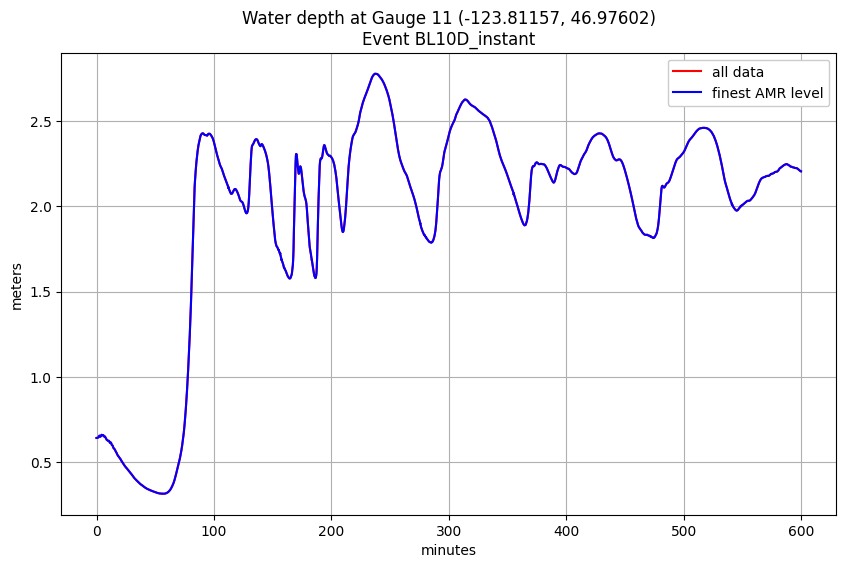
Plot all events at one gauge
Plotting h rather than hfine
all_events = ds.coords['event'].data  # all events
h_all = ds.h.sel(gaugeno=mygaugeno, event=all_events)

figure(figsize=(10,6))
for ev in all_events:
    plot(tminutes, h_all.sel(event=ev), label=ev)
legend()  # not very useful with 36 events
grid(True)
xlim(20,8*60)
xlabel('minutes')
ylabel('meters')
title('Water depth at Gauge %s' % mygaugeno);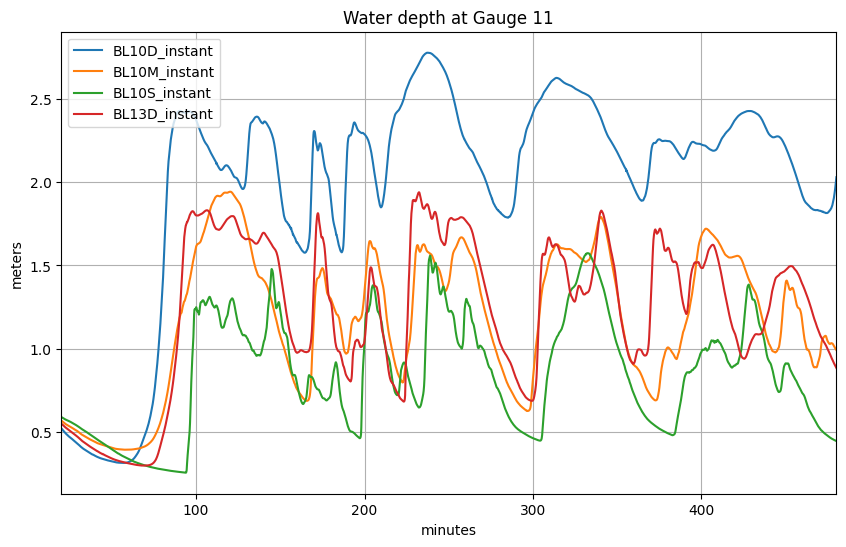
What’s the maximum value at this gauge over all events, and which event is largest?
From the plot above it’s hard to tell which event corresponds to the upper-most curve, so let’s look at the maximum depth at this gauge for each event:
print('The maximum depth over all time for all events is %.2f meters' % h_all.max())The maximum depth over all time for all events is 2.78 meters
We can plot the maximum depth for each event separately:
hmax = h_all.max(dim='time')  # 1D array of 36 values for each event

figure(figsize=(6,3))
ievents = range(len(hmax.coords['event']))
plot(hmax.data, ievents)
yticks(ievents, hmax.coords['event'].data);
grid(True)
xlabel('meters')
title('Maximum water depth over 90 minutes at Gauge %i' % mygaugeno);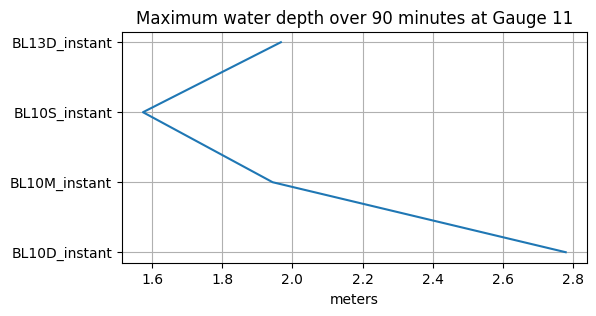
A more programatic way to determine which event has this maximum value is to use argmax:
imax = int(hmax.argmax(dim='event'))
emax = all_events[imax]
hmax = float(ds.h.sel(event=emax, gaugeno=mygaugeno).max())
print(f'Event {imax} named {emax} has the largest maximum depth at Gauge {mygaugeno} with value {hmax:.2f} m')
Event 0 named BL10D_instant has the largest maximum depth at Gauge 11 with value 2.78 m
Plot this largest event to confirm:
figure(figsize=(10,6))
tminutes = gauge_t / 60.
plot(tminutes, h_all.sel(event=emax), 'b')
grid(True)
xlabel('minutes')
ylabel('meters')
title('Water depth at Gauge %i (%.5f, %.5f)\nEvent %s' % (mygaugeno,xg,yg,emax));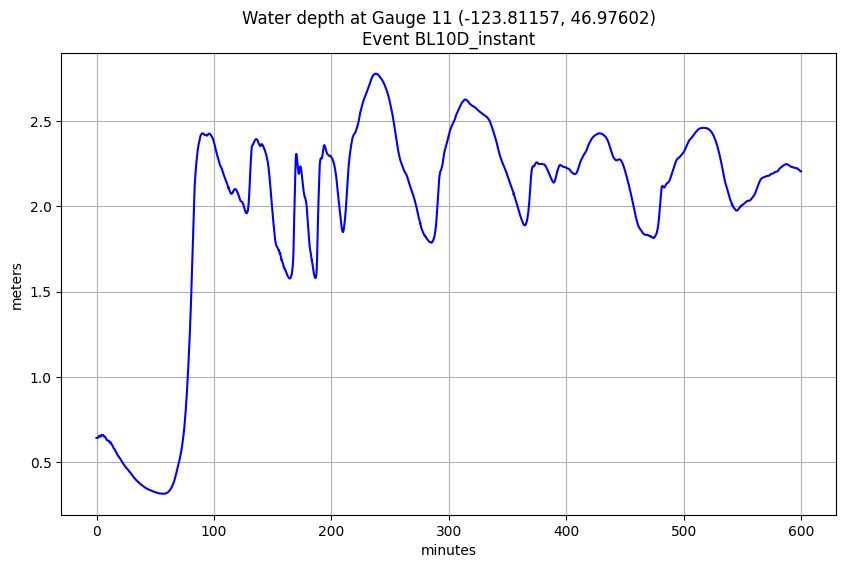
Plot all gauges for all events
For a small number of events and gauges, this is reasonable...
if 0:
    all_events = ds.coords['event'].data  # all events
    all_gauges = ds.coords['gaugeno'].data

    for gaugeno in all_gauges:
        h_all = ds.h.sel(gaugeno=gaugeno, event=all_events)

        figure(figsize=(10,4))
        for ev in all_events:
            plot(tminutes, h_all.sel(event=ev), label=ev)
        legend()  # not very useful with 36 events
        grid(True)
        xlim(0,8*60)
        xlabel('minutes')
        ylabel('meters')
        title('Water depth at Gauge %s' % gaugeno);
hazard curves
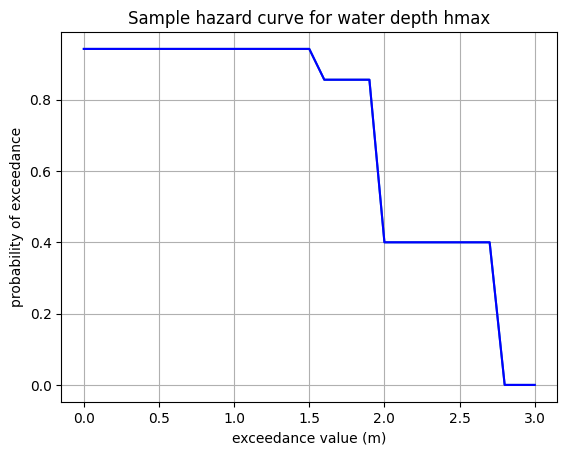
Work in progress: A simple example with non-realistic probabilities assigned to the 4 events to illustrate how to construct a hazard curve.
weights = xarray.DataArray([0.4, 0.4, 0.6, 0.6], dims=('event'),
                           coords={'event':ds.coords['event']})
print('Non-physical weights for illustration:')
for event in ds.coords['event'].data:
    print(f'  {event}:  {weights.sel(event=event):.5f}')
Non-physical weights for illustration:
BL10D_instant: 0.40000
BL10M_instant: 0.40000
BL10S_instant: 0.60000
BL13D_instant: 0.60000
#all_events = ds.coords['event'].data  # all events
h_all = ds.h.sel(gaugeno=mygaugeno)

hmax = h_all.max(dim='time')  # 1D array of maximum h over all times, for each event
print(f'For gaugeno = {mygaugeno}, hmax has shape {hmax.shape}')
For gaugeno = 11, hmax has shape (4,)
hmaxFunction to compute values on hazard curve
def probs(hazard_qoi, exceed_vals, gaugeno, weights, events=None):
    if events is None:
        events = hazard_qoi.coords['event'].data  # all avaliable events
    pvals = zeros(exceed_vals.shape)
    for j in range(len(exceed_vals)):
        for eventk in events:
            if eventk not in hazard_qoi.coords['event']:
                raise ValueError(f'*** event {eventk} not available in hazard_qoi')
            if hazard_qoi.sel(gaugeno=gaugeno, event=eventk) > exceed_vals[j]:
                pk = weights.sel(event=eventk)
                pvals[j] = pvals[j] + pk - pvals[j]*pk
    return pvals
figure(figsize=(6,3))
ievents = range(len(hmax.coords['event']))
plot(hmax.data, ievents)
yticks(ievents, hmax.coords['event'].data);
grid(True)
xlabel('meters')
title('Maximum water depth over 90 minutes at Gauge %i' % mygaugeno);hmax = ds.h.max(dim='time')
exceed_vals = linspace(0,3,31)
pvals = probs(hmax, exceed_vals, mygaugeno, weights, events=None)
plot(exceed_vals,pvals)
plot(exceed_vals, pvals, 'b')
grid(True)
xlabel('exceedance value (m)')
ylabel('probability of exceedance')
title('Sample hazard curve for water depth hmax');
#savefig('sample_hazard_curve.png')