
MODULE 7: Medical Nutrition Therapy for Specific
Conditions - Infants
Intro
Special Health Care Needs
Prematurity and Low Birthweight
Slow Weight Gain
Over- and Under- Feeding Related to feeding cues
Maternal (or parental) responses to infants’ feeding cues are important in the short-term (will the infant get the nourishment she needs?) and in the long-term (will eating be a positive experience and healthy responses to hunger and satiety reinforced?). Both overfeeding and underfeeding can result when a caregiver misinterprets an infant’s cues. There are three components to parental responsiveness and sensitivity: perception of the child's cue, accurate interpretation of the cue, and appropriate response to the cue.
Hunger and Satiety Cues
Hodges, et al (2013) developed the Responsiveness to Child Feeding Cues Scale to observe and measure the dyadic feeding interactions relevant to developing controls of appetite and obesity for caregivers of children under two years of age.
Mothers have been shown to be more responsive to child hunger cues than fullness cues potentially as a part of a conditioned response to survival. In infants active hunger cues are more common than early hunger cues. Teaching parents the common cues to indicate hunger or satiety may help decrease rates of overfeeding and underfeeding. (Hodges, et al, 2016)
| Child Feeding Cues | Early | Active | Late |
| Hunger/Receptiveness | Suckling | Rooting/nuzzling | Moving head frantically from side to side |
| Opening/closing mouth repeatedly | Asking for food/excitatory or affirming vocalization | Crying | |
| Smacking/licking lips | Excitatory limb movement | Temper tantrum | |
| Increased alertness | Leaning/crawling/walking toward food | ||
| Bring or show bottle/spoon/cup/food to caregiver | |||
| Hitting caregiver on arm/chest | |||
| Motion to be placed in feeding location | |||
| Postural attention | |||
| Settling into feed/decrease in tension | |||
| Open mouth wide/latching on/feeding self | |||
| Fidgeting or squirming | |||
| Fussing or whining | |||
| Fullness/Disinterest | Hand-to-face | Pushes tray or feeding hand away | Crying |
| Decreased muscle tone | Gives back food/utensils/bottle/cup | Sleeping | |
| Does not open mouth until spoon at lips | Pull/turn away abruptly | Physically struggling/arching | |
| Takes interest in surroundings/looks away | Falling asleep | Vomiting | |
| Decreased activity level | Maximal lateral gaze aversion | ||
| Lip grimace/pout/frown | Refuse to open mouth | ||
| Slows or pauses | Takes off bib/attempts to leave feeding location | ||
| Gaze aversion | Biting spoon/nipple | ||
| Turning head in response to food | Detatch from nipple | ||
| Saying "no" or shaking head "no" | |||
| Plays with food or surrounding items | |||
| Spitting or ejecting food from mouth | |||
| Fussiness or whining | |||
| Physically agitated/squirming | |||
a Receptiveness only |
|||
Note: Above table requires paid permission or we will need to adapt it.
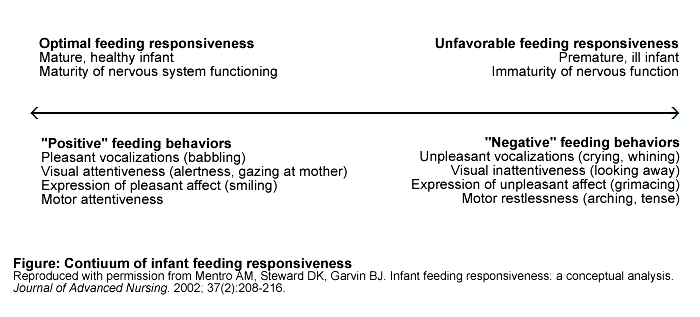
Continuum of infant feeding responses
Mentro et al (2002) describe a continuum of infant feeding responses and describes examples of model, borderline, related, and contrary cases. (See Figure)
Model Case: Julie
Borderline Case: Daniel
Related Case: Brian
Contrary Case: Sarah
Julie is a healthy female infant of 3 months. After awakening from a long morning nap, she is wide-eyed and alert. Her mother picks her up from the crib, and Julie's body rests comfortably in her arms. She is offered a bottle, and eagerly sucks on the nipple when it is offered, prompting her mother to exclaim, "My, aren't you hungry!" Upon hearing her mother's voice, Julie directs her gaze toward her mother's face and begins to smile. Her body remains relaxed, and she does not attempt to turn away from her mother while receiving the bottle. When her mother pauses to burp her, Julie babbles happily.
Julie reacts to the feeding attempt of her mother, demonstrating positive visual, affective, vocal, and motor behaviours attributed to feeding responsiveness. She is awake and alert, makes eye contact with her mother, sucks eagerly on her bottle, maintains a relaxed posture, and makes pleasant vocalizations.
Borderline case: Daniel
(A borderline case contains some, but not all, of the concept's
critical attributes)
Daniel is a 6-month-old infant. Wide-eyed and alert, he is placed in his father's arms. He gazes at his fathers face and reaches for his glasses while smiling and making happy babbling sounds. When his father offers Daniel a bottle, he arches his back, turns his head away, and makes repeated upward movements with his arms. When his father removes the bottle, he continues to reach for his father's glasses, making happy squeals and kicking his feet.
This scenario represents a borderline case because not all the defining attributes are present. Although Daniel is revealing appropriate visual, affective and vocal behaviours, as evidenced by alertness, gazing at his father, smiling, and happy vocalizations, he is not exhibiting motor feeding behaviours. He does not attempt to move away from his father; however, he refuses to open his mouth and moves his arms and legs. Daniel is not responding to the feeding but is rather interested in playing with his father's glasses.
Related case: Brian
(A related case is one that is related to the concept, but does
not have the critical attributes)
Brian is an 8-month-old healthy infant playing on the floor with his mother. He reaches for a nearby bottle, which is far from his reach. As he points at the bottle, his mother rolls a red car across the floor, which catches his eye. Brian grabs the car and beings to play with it, banging it loudly on the floor. When the telephone rings in a nearby room, his mother runs to answer it, leaving him alone. He drops the car and begins to cry loudly upon his mother's departure.
This is an example of the concept of attachment. (See "Read More" earlier in this module.) Although it is similar in some regards to the concept of responsiveness, it does not have the same defining attributes. The scenario is not a feeding interaction, and the caregiver makes no attempts to feed the infant. Therefore, no visual, affective, vocal, and motor feeding reactions are elicited.
Contrary case: Sarah
(A contrary case provides a clear example of what the concept is
not)
Sarah is a 4-month-old infant girl with a diagnosis of failure to thrive. She is in the lower 5th percentile for body weight, and is crying loudly in her mother's arms despite the soothing attempts of her mother. Four hours have passed since her last feeding. Thinking that she may be hungry, her mother offers her a bottle. When Sarah's mother tries to place the nipple in her mouth, she refuses to accept it, and instead screams loudly, arches her back, and faces away from her mother. Exasperated, her mother removes the bottle and returns her to her crib.
The above example illustrates what infant feeding responsiveness is not. Although Sarah may be hungry, she reacts poorly to her mother's feeding attempts. Her behaviours of crying, refusal to suck the nipple, and arching and facing away from her mother are interpreted as lack of interest in feeding. Because Sarah is not exhibiting motor, visual, affective, or vocal attentiveness to her mother, optimal feeding responsiveness is not occurring.
Insert interactive element:
KNOWLEDGE CHECK
What types of behaviors indicate hunger?
What types of behaviors indicate satiety?
Answer:
Hunger behaviors may include sucking, fussing, fidgeting, increased alertness, rooting/nuzzling .
Satiety behaviors may include falling asleep, turning head away from food, increased interest in surroundings, crying, spitting out food or giving it back.


Copyright 2007 | Disclaimers
Last updated: 12/07/2018