This interview first appeared as an episode of the Science Positive podcast. You can check it out here on Youtube or here on Spotify!
Emma: All right, welcome to Science Positive, a podcast dedicated to sharing the stories of biologists and scientific investigations at the Department of Biology at the University of Washington. My name is Emma Guerrini Romano, I will be your host for today’s episode. Joining me today is the wonderful and awesome Anthony Garcia. Welcome to the show!
Anthony: Thank you so much for having me.
Emma: Yeah, Anthony is a fourth-year graduate student here at the University of Washington. He’s a PhD candidate, passed candidacy exam, and today we’re going to be talking a little bit about plants and flowers. So Anthony, briefly tell me about who are you? Where’d you come from? What are you doing here? How’d you get here?
Anthony: Yeah, I’m Anthony, I’m a fourth-year graduate student in the Biology Department. I grew up pretty much just in Washington, so I’m a local. I’ve been here for many, many years. And yeah, I went to UW as well for my undergrad and liked it so much that I decided to stay and do a graduate degree here as well.
Emma: Oh, awesome. Well, I didn’t know that. So you’re a tried-and-true Husky, you would say?
Anthony: Yeah, definitely. My mom was also a Husky as well.
Emma: So we’re in the family.
Anthony: Yes!
Emma: So when you were doing your undergrad here, were you involved at all in research? Were you in science? Or did you come into this during graduate school?
Anthony: Yeah, so I actually started out at UW interested in neurobiology, microbiology, but eventually found my way back to plants. And that was in the third quarter of the intro bio series, Bio 220, when we were learning about plant immunity. And that was so interesting to me because it opened up a whole different perspective about plants for me. I had always loved nature and plants, but learning that plants have different ways to defend themselves against herbivores, against pathogens, that was what was really interesting to me because now the entire world became a battlefield between plants and bacteria and fungi and caterpillars and even humans a little bit when we’re mowing the lawn. So that was really interesting to me, and I was able to get an undergraduate research position in Adam Steinbrenner’s lab. There I was working on studying different aspects of the plant immune system. And then yeah, from there, I’ve been studying plants ever since then.
Emma: Awesome. And so you study plants. There’s a lot of types of plants. I know minimal about plants, so what I realized is that there’s a lot of types. So what kind of plants do you specifically study? Do you dabble in other types of plants? Are you a loyalist to one type?
Anthony: Yeah, yeah. So at the moment, I currently study several plant species from a family called the Ranunculaceae. So that’s the Buttercup family, the yellow flowers we are very familiar with. Just a little fun fact, in the Ranunculaceae, the word Ranunculus is the root word in there and that is Latin for little frog, which is very cute and comes from the fact that a lot of the species in the Ranunculus genus tend to grow in wetlands. So, they like to grow where you might also see little frogs.
Emma: Yeah, little ribbit ribbits.
Anthony: Yeah, yeah. So there’s a few different species within the Ranunculaceae that I study. But yeah, I really like them because they have a lot of different morphological diversity and floral variation that is really interesting to study from an evolutionary perspective.
Emma: Awesome. So yeah, you look at plants from an evolutionary perspective, what does that kind of look like for plants? I mean, do you grow plants and then look at them through generations? How does that work for you?
Anthony: Yeah. So I guess I study more on the macroevolutionary scale, so how species and genera have changed and adapted to be pollinated by different insects or different methods of pollination, for example. So rather than looking at across like generations of a single species, I do a lot of comparative research. I’m trying to compare how flowers, for example, develop in Ranunculaceae and compare that to some other models like Arabidopsis, which is like kind of the lab rat of the plant world. And from there, we can try to see what different developmental processes, what different genetic mechanisms are similar or different between the two. And that allows us to begin to piece together how these different traits in the flowers evolved in the first place.
Emma: Yeah, that’s fascinating. So, Anthony, do you have a favorite trait of your Buttercup flowers that you really do love?
Anthony: Yeah, I guess, well, I study particularly the carpels.
Emma: What are carpels?
Anthony: Yes, that’s a great question. So the carpels are the defining feature of all flowering plants. You often forget about it, because usually when you look at a flower, the petals are the things that are the most brightly colored, the largest, the most showy, very elaborate, right, lots of people breed plants specifically for the petals. But the carpels are what allowed flowering plants to really take off from an evolutionary perspective, because the carpel is basically a modified leaf that surrounds the developing ovules, which will eventually develop into the seed. So the carpel is what becomes the fruit. Any, well, not any fruit, but fruits like watermelons, bananas, blueberries, they developed from a carpel originally, which was just a small structure in the center of the flower. And after it is pollinated, the seeds begin to develop and the fruit begins to develop. Yeah, a lot of the things we eat come from carpels.
Emma: So when you’re studying carpels, are you dissecting them out of the plant? How do you get to the carpel is my question? And what do you look at in the carpel?
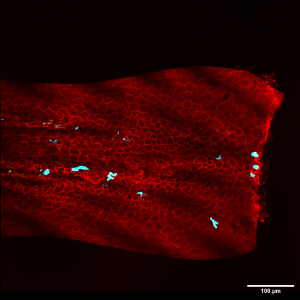
Anthony: Different plants have different carpel structures, but in the buttercup family, they’re actually relatively easy to get to. So I do a lot of microscopy, just light microscopy or scanning electron microscopy to look at the surface of the of the carpels. At the moment, I currently study the very top of the carpel, and that is a special structure called the stigma. And the stigma basically has a bunch of modified hair-like cells that are really important to the plant, even though they’re so tiny, because those are the cells that capture pollen. So if you don’t have a stigma, you wouldn’t capture pollen, you wouldn’t get pollinated, you wouldn’t make seeds, you wouldn’t make fruit. And different species that are pollinated by different mechanisms have different stigma features. So for example, wind pollinated species like grasses or oaks have carpels with long feathery stigmas to be able to catch pollen from the from the wind.

Emma: That makes sense.
Anthony: Then you have other species that are bumblebee pollinated or insect pollinated. And instead of having long feathery stigmas, they have stigmas that secrete an exudate to help catch the pollen that might be stuck to like the belly of a bumblebee or on the forehead of a hummingbird, for example.
Emma; Yeah, that’s fascinating. I know that in the UW greenhouse, we have plants that are ant-pollinated. Gnarly looking things really troll-like.
Anthony: Yeah, there’s so many different methods that plants use for pollination. There’s bat pollination, gecko pollination, there’s even shrew pollination and fly pollination, with flowers that look like dead animals. And so, yeah, it’s really cool to think about how flowers have been shaped by their interactions with animals and abiotic factors and how those different structures have developed using similar genetic pathways.
Emma: Totally, totally. So I guess a question I have for you outside of your work is, are you a plant person? Do you have a garden? Do you have a green thumb?
Anthony: I guess, I would say I really like native plants, so I grow a lot of native plants. And those are just plants from seeds that I bought from a native plant company or found out in out in the wild, collecting a few. Not in national parks or anything, but just places where it’s on the side of the road or something. Yeah, we need to protect our national parks. But I really like growing native plants, because they’re the plants that, you know, are adapted to living where we are. So they don’t need as much water, they really don’t need that much care. But they also create an ecosystem. There’s birds that come and pick the fruits that develop or different kinds of hoverflies and bumblebees that come and visit the flowers. And once you plant native plants, it feels like getting back out into the forest and getting to create a little piece of the ecosystem that exists around us.
Emma: Oh, that’s beautiful. I guess, what are some native plants that you’re currently growing? Or because we are in the Pacific Northwest in Washington state, what are some native plants of the area? You grew up here, so you would say that you’re, you know, you’re of this area.
Anthony: Yeah, yeah, it grows like a weed, is pearly everlasting. It’s in the Asteraceae, so that’s the daisy, sunflower family. But yeah, it’s a really fun plant because once it dries, you can keep the flowers for a long time. They’re kind of papery, so you can use them for dry bouquets, that kind of thing. But they also are huge pollinator magnets, so you get lots of different kinds of flies and butterflies and bumblebees that come and visit. Some other ones that I grow are thimbleberry. So that’s kind of like a relative to like raspberries.
Emma: Yeah, those are the red ones, the really soft red ones. And there’s only ever like three ripe ones in there. A question I have for you is, what makes something a fruit? I mean, I know that there’s a whole debate about tomatoes being a fruit or vegetable. So, you know, let’s put it to rest right now.
Anthony: Yeah, yeah. So, I guess I’ll only talk about fruits from the botanical sense. There’s things that we can use as vegetables in the culinary sense, like tomatoes, we think of as savory and so kind of more vegetable aligned in a culinary sense, whereas we tend to culinarily assign fruits to the more sweet things. Sure. But from a botanical sense, when we’re really thinking about the structures that these fruits developed from, a fruit comes from a carpel. So that’s what we consider the fruit. Things like pumpkins and bananas, even though we don’t really think about them, they’re technically, from a botanical sense, berries because it’s a fleshy fruit that’s contains multiple seeds and comes from the carpel. Whereas like a strawberry, the red fleshy part that we eat actually comes from a modified receptacle. That’s like the structure where the rest of the floral organs develop from. And then the fruits are tiny little achenes, those are like the little seeds on the outside of the strawberry. And so yeah the only reason it’s important to distinguish between that is because if we can figure out what structures they develop from, then we have a better understanding of what factors make a strawberry taste good versus a banana taste good and how these different structures evolved in the first place. So yeah, from a culinary sense, it’s not too important whether something is a fruit or not. But from a botanical sense, the carpel provides us a lot of information for how these different plants evolved.
Emma: That’s awesome. So a pumpkin is a really big berry, that is a shocking fact. It’s really good for trivia, I would say to keep that in your mind. So that’s really interesting that you can talk about this kind of stuff and directly relate culinary interests and food and the things that we eat to your own research. I think that’s something that a lot of people have a hard time being able to do with their own work. A question for you now that I have is, since you’re a fourth year, you’ve already developed your thesis, you’ve passed candidacy, what are some difficulties that you had throughout this process, whether it was in your methodology or in the actual program of graduate school that really challenged you and forced you to kind of step up?
Anthony: Yeah, I think that’s a very interesting question. Well, there’s a certain amount of stress that when you’re first starting in the program about what you’re going to study. You often feel coming into it like, I don’t know enough, I just started, how could I already be coming up with a whole research project that will be impactful to the scientific community? And so that kind of imposter syndrome has probably been quite pervasive throughout my graduate program. And so just finding ways to realize that other people also feel like they shouldn’t be here. But that’s you know, that’s completely false, because everyone who wants to do science should be able to do science. And yeah, you don’t have to be a certain way, look a certain way, talk a certain way. Everyone has their own strengths that they can contribute to science. And so yeah, I think, realizing that I am in fact not an imposter is probably one of the challenges that I would say I have had to deal with.
Emma: Well, that makes total sense. Imposter syndrome is prevalent in all aspects of graduate school. I mean, I have imposter syndrome all the time, so I totally get that. Candidacy is something I kind of want to ask about. So, the process of doing your candidacy exam, for those of you that don’t know, is you form a committee, which is typically made up of your advisor, a person who is outside of the department, another person in the biology department, and then typically some sort of graduate school representative. So from that process, where you basically had to go in front of your committee and defend your thesis ideas, what was the hardest part about that? Was that something that was anxiety inducing for you? Or did you come into it like very secure and kind of ready to rock it?
Anthony: No, yeah, I wish I would have come in very secure and ready to rock it. But I think, yeah, it’s a similar thing. It feels quite intimidating. You know, you feel like you’re going to be really grilled, like they’re going to tear you to shreds all your science that you’ve been thinking so hard about and everything. So yeah, I just, I just really tried to focus on the fact that the faculty that are on the committee aren’t really trying to prevent you from getting candidacy or anything, right? They are trying to support you. Whereas like in the past, you know, who knows what was done in academia in the days of old. But nowadays, it’s much more supportive. And instead of trying to prove that you are worthy to be a candidate, it’s more just going through all the thought processes that go into designing a project and making sure that you have thought about the different logistical challenges, the different methodological pros and cons, and making sure it is something you could do in a five year program. Because by the time you do your general exam, that’s like two years. So you have three years left to do it. So yeah, it’s not a lot of time.
Emma: Yeah, yeah, it goes by very quickly. Yeah, I feel like there’s a lot of conversations around the fact that a graduate school or a PhD is a long, long degree. And it, I mean, speak for I speak for myself, it doesn’t feel as though it’s that long.
Anthony: Yeah, yeah. I mean, I’m a fourth year now. And it feels like I still just started last year.
Emma: I guess, going back to a little bit about what you were talking about for imposter syndrome, what is something that you’ve done or told yourself or someone who’s helped to kind of get over that feeling and push that a little bit to the side so that you can be productive and feel like you belong and all that jazz?
Anthony: Yeah, yeah, I think I think it comes down a lot to your community that you have around you, just finding people who are, you know, passionate about similar things as you, maybe have like similar cultural backgrounds or just similar like perspectives about the world and everything like that. Finding other people who you can connect with and create a community with. I feel that for me was really important because once you find people that you feel like you belong with, you don’t have to feel like you’re pretending anymore, or feel like you’re putting on an act. And so, yeah, I would say that building that community is quite important for that.
Emma: That’s great advice. I guess a couple of other things I want to ask you, Anthony, is what is some advice that you would give to young scientists who are starting to want to get into specifically plants or generally science?
Anthony: Yeah, I guess I would say I have maybe a few things. First would be that you don’t have to be so fancy. You don’t have to have all the fanciest microscopes, all the newest technologies to be a scientist. You can just get started just by downloading iNaturalist onto your phone and like going out and looking at the plants. Why does this plant look the way it does? Why does this bumblebee seem to like this particular species over the other? I think there’s those kind of ways of just appreciating science and being a scientist just by observing the world as you go around. And then actually pursuing science and becoming a scientist from a career perspective. I would say it’s probably similar to what other people have said, but just reaching out and not being afraid to ask people and connect with people. Because I think professors, faculty, are actually a lot more open to talking with people and just like answering questions and being like a resource. So, and even graduate students. I would say go to the bio website or our department website or whatever department that you’re like curious about and just see, is there someone I can talk to? Someone who is doing something that I find interesting and just ask them, can I just talk with you and see what are you doing exactly? What does your career look like? Yeah, that’s what I would say.
Emma: That’s great advice, and I think also a good way to emphasize that all these people, professors, graduate students have dedicated their lives to studying these small niche topics. And any time given the opportunity to talk about what they love is a very exciting thing, even for them.
Anthony: Yeah, yeah. It’s definitely, when as graduate students and I’m sure PIs, when you find someone who’s excited about what you’re excited about, it’s really nice to be able to talk with them about it.
Emma: My last question for you, Anthony, is in this tumultuous time of science and sociopolitical situations, what is something that’s giving you joy? What is something that’s getting you through it? What’s letting you be positive about science?
Anthony: Yeah, I guess I would have to go back to that community aspect. Just being part of the department and getting to hang out with all the other graduate students and undergrads who are in our labs. Because we are still, you know, we’re still out here, we’re still moving forward and trying our best with the resources we have. And because ultimately, like we’re driven by science, by asking these questions and figuring out how the world works and how we can help people by giving people knowledge and also by finding new concepts that explain how our world works. And so I think, yeah, just getting to be a part of our community that we have is something that I would say, you know, it makes it more possible to keep going forward.
Emma: Yeah, we don’t do anything alone. So as we wrap up, I want to ask you, is there anything you want to say to the people watching, listening about being positive about science, about our podcast?
Anthony: Yeah, I guess I would say go out and look at some flowers. There’s a whole world in every flower that exists, that’s waiting for you to explore.
Emma: That’s amazing. Well, thank you so much, Anthony, for joining us today on Science Positive. Hopefully we’ll see you again. And with that, thank you all for watching and listening. See you next time.