This interview first appeared as an episode of the Science Positive podcast. You can check it out here on Youtube or here on Spotify!
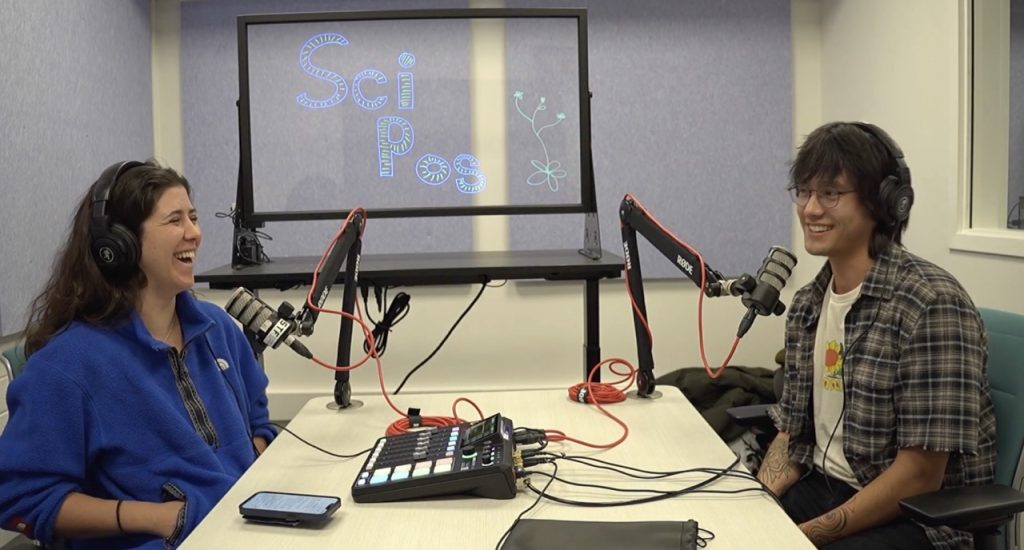
Emma: All right, everyone. Welcome to Science Positive or SciPos for short. I’m your host, Emma Guerrini-Romano, and today we’re joined by the amazing William Albers. Welcome to the studio, William.
William: Thanks for having me.
Emma: How was your day? How are you feeling?
William: My day’s been good so far. Feeling good. Excited to talk. Excited to talk about plants, hopefully.
Emma: Yes. I mean, I know that you love plants. You drew a really gorgeous one up here on the board. Arabidopsis, correct?
William: That’s Arabidopsis thaliana.
Emma: Sweet. And this is your study organism.
William: Yes, this is my model organism. The organism I’ve been spending, I think I’m on my sixth year working with Arabidopsis now.
Emma: Wow. Do you ever get sick of it? Can you eat it?
William: I think you can eat it. I believe it has like a peppery taste to it.
Emma: Have you ever tried?
William: I can’t go on record saying I tried my transgenic plants. But let’s just say I know what it tastes like.
Emma: Okay, peppery, we said. Like arugula. Well, William, welcome. So you told us a little bit now you study Arabidopsis. What kinds of topics do you look at for Arabidopsis and what are your questions that you look at?
William: Yeah, I came into this lab in my time at UW thinking about how plants flower. So plants are these amazing organisms that once they start growing, oftentimes they stay right where they are. And that means that they have to integrate all the signals from their environment into their developmental responses, which way to grow, how big to make your leaves, how long to make your stems, and precisely when to flower because flowering is a plant’s gamble. It’s its gamble to reproduce, hopefully time it in synchrony with a pollinator to come and pollinate it and secure the next generation. Especially with climate change and the climate crisis, plants are starting to receive lots of crazy signals from the environment that they’re not used to. They’re very inconsistent. And that could throw off a plant’s pollination window or a plant’s flowering window.
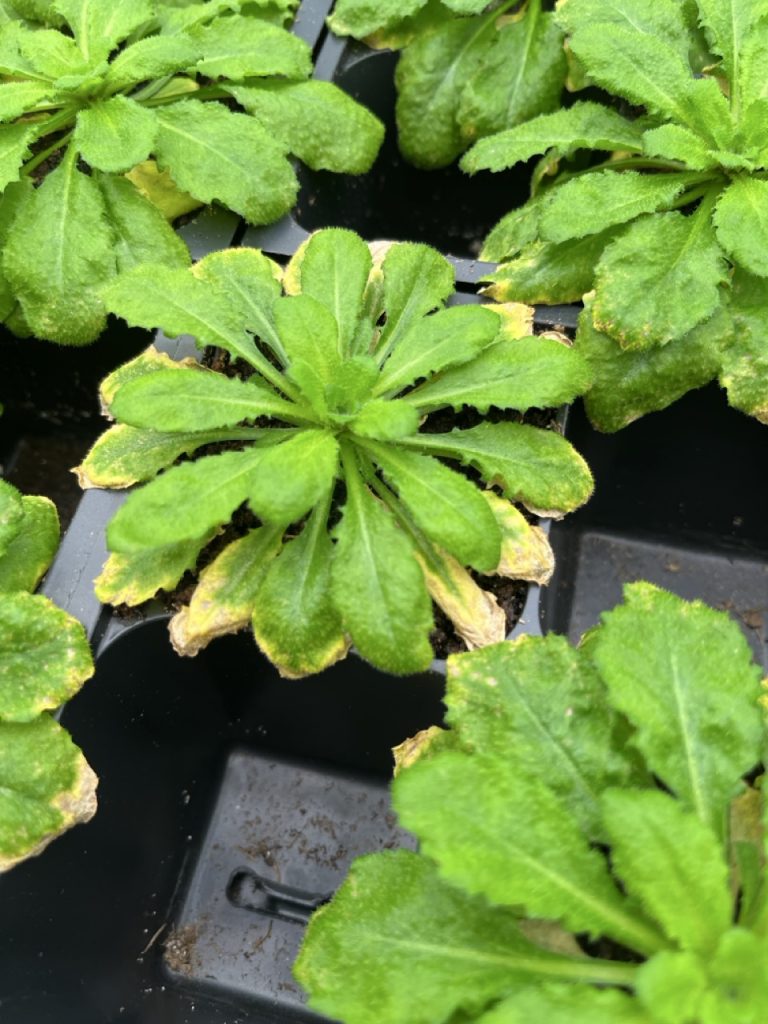
Arabidopsis is a great model organism for studying that because it makes it very clear when it decides to flower. It grows as a rosette of leaves on the ground, very flat on the ground. And when it’s time to flower, it sends up a beautiful central bolt, which we can see in the picture here. And that’s what we use as a symbol of its time to flower. And in my lab here, I’m particularly interested in the protein signals that are involved in flowering. Because the leaves sense the response or sense the environmental signal, but it’s often a different organ that has to respond. So a leaf may sense something, but the stem needs to grow longer. So there needs to be a signal from the leaf to the stem or to the flower to initiate a response. And that’s what I’m interested in.
Emma: Wow, that’s really interesting. So earlier, you said the word transgenic, so you’re talking about plants that have been modified in some way or another. What kind of modifications are you doing to your plants? And does that affect the flowering?
William: Yeah, we’re modifying the genetics. Sometimes we’re mutating a gene. Sometimes we’re adding in a gene. The most fun experience come from adding a gene from a different species, something you can do with plants that you couldn’t really do with animals. But you could take a gene from a grass plant or from a fern or from a moss and you can put it into any other plant that you want, well, not any other plants, some plants that you want and see what it does to it. And we’re particularly interested in flowering genes, manipulating those. Maybe they make the plant flower earlier. Maybe they make it grow tons of crazy petals that look weird. It’s a cool field because you can really see the effects of what you do.
Emma: Totally. How long does it take from genetically modifying Arabidopsis to flowering?
William: Yeah, that’s a great question. Assuming nothing goes wrong in your experiments, and everything works well, you could transgenically modify Arabidopsis in a month. And I had to refresh my Mendelian genetics when I found out that in order to accurately describe a phenotype from a transgenic plant, you need homozygous lines. So you have to draw your Mendelian Punnett Square like he used to do with his pea plants in the monastery, and you have to cultivate generations of this transgenic plant in order to arrive at a homozygous carrying plant.
Emma: Wow, that’s a lot of work. And I’m sure that you have a lot of squares doodled around in your notebooks. Question for you, so a lot of times with plants and plant research, you’re working in greenhouses. Do you do your work primarily in a greenhouse or is it more in lab?
William: I do my work in the basement.
Emma: Oh, cool. There we go.
William: We grow our plants in these medieval chambers, not medieval because they’re actually quite high tech and they cost like hundreds of thousands of dollars. But they’re very controlled environments because in plant biology, especially something with flowering, they’re so sensitive to their environment that if you’re not controlling every aspect of the environment, the humidity, the timing of light, the quality of light, those will all influence your flowering phenotype. And those could confound your results. So we grow them in the basement, in the dark, dark depths of LSB (Life Sciences Building). Yeah. And not often in the greenhouse because the greenhouse is more exposed to the elements and surrounded by other plants that might affect the phenotype.
Emma: Totally. That makes way more sense now that you’ve said it. So you said, William, that you’ve been working with Arabidopsis for six years, you said? But you’re only in your fourth year of your PhD, correct?
William: Yeah.
Emma: So you had two years prior to UW working with this plant. What were you doing with them before? Were you doing a similar thing with transgenics?
William: Yeah. Before I came to UW, I worked at the Salk Institute in La Jolla, which is down in Southern California. And during that time, I worked on a project called the Harnessing Plants Initiative. This is a project founded and funded by Jeff Bezos and Amazon money, where we’re interested in combating climate change through growing more robust root systems. So as we know, plants are taking carbon dioxide from the atmosphere and sequestering it in their tissue. They’re building with it. And one of the main problems we face in climate change is increasing carbon dioxide in the atmosphere. But if you could grow plants that have robust root systems that even go deeper into the soil, you’d be capturing carbon dioxide from the atmosphere and planting it in the soil where it will stay there. So sequestering carbon from the atmosphere and hopefully even through having better roots, you could improve growth. And that was the project we were working on. So with Arabidopsis, instead of flowers, I was looking at roots, which is a very different field.
Emma: Yeah. But so now you know the plant top to bottom pretty much.
William: Yeah, I guess so.
Emma: That’s pretty neat. So you said you were in La Jolla working on this project for the two years prior to your PhD. What were you doing before that? Where did you study and how did you kind of get into looking at plants specifically?
William: Yeah, I was doing my undergrad up in the Bay Area at UC Berkeley. I majored in genetics and plant biology and I never did any research experience in undergrad. I felt like at the time that was contributing a lot to my imposter syndrome where I wanted a job as a research assistant, but I was competing with lots of people who had undergraduate research experience and that made me insecure especially. And being lucky enough to land a research assistant position, I felt like it was my first experience in a lab and I was really curious to see if I would like it because I’m in this career field now and I had never had actual experience in the field. Luckily I ended up liking it. But yeah, that was my path.
Emma: Neat. That’s amazing. So when you were at UC Berkeley, you said you were studying genetics and plant biology, which it seems like you stuck with that pretty well. But while you were in your undergrad, did you always know that you wanted to do research or was that something that just kind of came to you over time?
William: Yeah, I think I came into undergrad and especially came into that major with an interesting path where I had a goal going into undergrad where it was a very interesting time. It was 2016 and marijuana had just been legalized in California and marijuana was like this booming industry, like set to be a billion dollar industry. And I had just also finished reading the book Oryx and Crake by Margaret Atwood and in that book, in that series, there’s lots of genetic engineering where they make lots of interesting organisms. And I had it in my mind that I wanted my job title to be genetic engineer. I wanted to be manipulating genes and making weird organisms. And plants are definitely the organism to do that in because they are really amenable to the process of genetic engineering.
Back to marijuana, I felt like at the time there was money to be made in the field. And at the time I was more money hungry than I am now. And I particularly felt like there was an easy opportunity where there was a trend in marijuana growth of selectively breeding for stronger strains or strains that had higher THC content. And I felt like through genetic engineering, you could manipulate certain genes to produce a lower THC strain, which maybe wouldn’t have as severe symptoms that can occur when you consume more THC than you should. And I felt like, wow, I’ve got this Shark Tank million dollar idea. All I got to do is get the degree, get into the field and I can cultivate this and I’ll become a millionaire selling my strains of marijuana. And I get into the field and I lose sight of that vision and I get caught up in Arabidopsis and learning about plant physiology. And then it turns out to be that plants are these amazing organisms that are so much more diverse than just this one that I had been fixated on. And I’m very happy with where I ended up now. That was a fleeting dream that simply got me to where I am now.
Emma: Awesome. Would you ever go back to that dream after PhDs?
William: Yeah, I think I think I’m still open to it. I don’t think anybody’s capitalized on that market, to be honest. And I just need some startup money if there’s any private equity firms listening or venture capitalists.
Emma: Shout out. Let’s call dibs though on this idea. We did the official dibs.
William: You guys are on the ground floor.
Emma: Yeah, it’s serious now. Well, that’s amazing. So going into your undergrad, you said it was 2016. So before that, were you always inclined towards science when you were younger in high school or what was your kind of first introduction into science and were you gifted at it naturally or did you have to work?
William: Yeah, I think I think I must have been gifted because in elementary school, I came up with this awesome science project. I dared to ask the question, what would freeze faster, hot water or cold water? And I made a whole presentation on it, a poster even, and you wouldn’t believe the results. I’m going to let you do that experiment yourself. I think science definitely came naturally to me from that. But in all seriousness, I enjoyed science. I felt like studying living things life made a lot more sense and I was god awful at math and god awful at physics. So I was narrowed into us funneled into the sciences and specifically biology through my ineptitude at other at other fields.
Emma: Totally. I can kind of relate to that. I think that I was I was pretty, pretty bad at math in school. Interesting. Well, this hot water and cold water project, I don’t know if it could become a thesis idea later on in life, but you know, we always have to uphold theories.
William: Well, I’m going to publish that.
Emma: Yeah, let’s keep it on the down low. Amazing. Well, let’s go back to a little bit about the lead up to your PhD. Who was one of the most impactful people in your lead up to your PhD and someone that really encouraged you to come pursue it?
William: I feel like maybe something unique about my path in science was that I tended to have really like short lived mentors where when I got my job at the Salk Institute,
I had a mentor and he was teaching me this was my first time in a lab, like holding a pipette, being responsible for all these things. And he ends up leaving his position a few months in and they didn’t have a replacement lined up. So I was not only on my own, but being dropped onto various other scientists who were willing to take me on for a little bit. And in that way, it was never really one central mentor to look up to. It was this amalgamation of all these different perspectives. And it made me realize that scientists are so eclectic and also so set in their ways and so different. And some are stubborn and some will use gloves with ethidium bromide, some don’t even believe in ethidium bromide and its toxicity. And it was just so funny to me to see how different scientists can be and how science can be done in so many different ways and still get you to reproduceable results. So shout out to all the other hands that have worked to cultivate me as a scientist.
Emma: Totally, pushed you in this direction. So now you’re being mentored by your advisor. What is something that you value in your mentorship and something that — I know that you’re an amazing TA for BIO 220, which is an introductory course here at the University of Washington — what is something that you have taken from a mentor, maybe your current one or a previous one that you integrate in your own mentorship?
William: Yeah, I wonder if Takato is going to listen to this. But my favorite thing about Takato, my mentor, and what I would advise all grad students to seek in their mentor is the feeling of being safe with their mentor. Because there’s nothing worse than being in a meeting with your mentor and you feel afraid of humiliation, afraid to say what’s on your mind, afraid to speak up when something’s too much or when you need some support. At the end of the day, Takato has always made me feel like I can come to him with any information that he will be receptive and he will meet it with sincerity. And I think that as grad students, we are very vulnerable. We don’t make a lot of money. We don’t have a lot of power. And to have an advisor who recognizes that and will support you through this time of vulnerability is the most important thing. And seeking that out and refusing to accommodate an advisor who doesn’t give you that will allow us to push advisors in particular to only be of that type of supportive. Because everyone’s heard scary stories of toxic advisors and those frankly should no longer really be a thing in the field.
Emma: Totally agree. Like almost you genetically select for genes. We select for advisors that are supportive and amazing. Awesome. Well, so now a question I have for you, so when you were at the Salk Institute and you were first applying to graduate school, what kind of drew you specifically to a Ph.D. at the University of Washington? Was it your specific advisor? Was it something that you had heard about? What was the kind of process for that?
William: Yeah, I think something that really drew me to the Ph.D. is the way funding works compared to pursuing something like a master’s. I knew I wanted to reach different positions in my career that were only attainable with higher education, like a master’s or a Ph.D. And during a Ph.D., you seek funding that allows you to live on a stipend while you do your funding versus in a master’s you’re living off of your savings in order to eventually reach a higher paying job. And I felt like, you know, it takes a bit of the like passion and joy out of science to reduce it to like, can I live while pursuing this? But that can be a really valid question for a lot of people. And for me, having six years of funding, UW guaranteed, at least at the time that I enrolled, guaranteed five years of funding through TAships in your Ph.D. program, which to me was a huge sell because being able to have funding while I do research was a big deal to me, versus in a master’s you’re more like paying for your education.
Emma: Yeah, that makes total sense. So kind of switching back to a little bit more of like the research idea and like the characteristics of a Ph.D. So you’re doing your experiments and you’re looking at these really amazing questions. How do you grapple with like the absolute vastness of knowledge and knowledge that you don’t have? And how do you kind of deal with that day to day?
William: Yeah, I think one way to deal with that is to feel excited about what you don’t know. So there’s so much in plant biology and in most fields of stuff we don’t know. Like you guys were in the previous podcast episode, you guys were talking about the night sky and the way Ph.D. theses are like little pinpricks of light that come through. And the more I read about science, the more I learn in my field, the more I realize this world is so big and broad and works in so many different ways. It just makes me excited to find more things. And it’s easy to be daunted by everything we don’t know. But then you look at your Ph.D. advisors and you realize they’re learning too and they’re keeping up with the field. And at every stage in academia, we are always still learning. You could be a retired professor feeling like you’ve done 60 years of research and you’re still learning. And everyone in this field typically likes learning. So just remembering that we like what we’re doing is the key.
Emma: That makes sense. I think also something that we touched on a little bit in previous episodes and stuff, but there’s an idea in graduate school about imposter syndrome. And that’s a very common feeling that a lot of people get. So when you were at the when you said you were doing your research at the Salk Institute, you said it was your first time holding a pipette. So how is the kind of learning curve for you into learning basic science skills? And how do you what do you think really propelled you to kind of get to the level where you’re at today?
William: Yeah, a lot of trial and error. It’s a shame that mistakes in science are so expensive. Sorry to all the enzymes I’ve wasted. But it’s true that everyone’s going to make mistakes whether you have lots of experience going in or not. And speaking to the imposter syndrome, I feel like a great way to combat the imposter syndrome that you might feel from from being in your position is to do some mentoring yourself, where the beauty of academia is that at every point you are mentoring and being mentored. You’re learning and teaching at the same time. And when I got some undergraduate research assistants working with me, I needed to live up to an example that was being set. I was now responsible for their career trajectory and whether they want to stay in science or whether they enjoy the research process. And that helps combat the imposter syndrome because now you want to live up to an example and that helps you feel like that in your mind as you do it in practice.
Emma: Yeah, that’s an amazing way to think about it.
I think, yeah, working with undergraduates is also really interesting, right?
Because if you can work with them in a research context or in a TA context and the way you approach those kinds of relationships probably differs for the both.
William: Yeah, yeah.
Emma: All right. Let’s we’re going to pivot a little bit to talking more broadly about advice that people you have for people who are trying to get into science. So having gone from your undergrad into working for two years and now you’re in your PhD, what kind of advice do you have or do you wish that you had had when you were first starting, whether that was when you were first starting at the Salk Institute, when you were at Berkeley as an undergrad or right before you started your PhD? Up to you to choose which one of those are all of those you want to tackle.
William: I think what I would tell people or even tell my past self is to talk to more people and talk to more people about science because scientists love talking about science. And by talking to more people, you open up so many doors and opportunities. It’s kind of like, I hate reducing it down to like networking because it makes it less like organic, and to talk to people about science in different departments, in different fields, professors, grad students, postdocs. You are cultivating your passion for science. And you’re also opening doors for yourself where people may have opportunities or you might find yourself in a position to inquire about opportunities. And the name of the game in academia is often opportunities. So just getting to know more people, learning more about yourself, learning more about others in their fields. Those are all going to help grow you into a really well-rounded scientist who has lots of different options and lots of different versatility in where you can go and what you can do.
Emma: Yeah, that’s great advice also, because sometimes we have conversations and learn something that excites us that we previously didn’t know about and that can literally change our lives. So, I guess the next question I have is more geared towards the present day. So in the present day, we have a lot of tumultuous time going on. There’s a lot going on in the world and also within science specifically. What kind of things give you comfort and where do you find community?
William: Yeah, I think I find comfort in community and community is often built around us. And we have to, I believe, play a role in building the community around us and getting involved.
One thing that helped me build community is I had read this essay by Robin Wall Kimmerer. She wrote Braiding Sweetgrass and Gathering Moss. And she had written this essay called The Service Berry. The Service Berry was an essay about gift giving and community exchange. And she even posited this economic theory called the gift economy. And the basis behind this philosophy is that let’s say you have a beanie. And you went to Target and you bought a beanie and it cost 20 bucks. And you like this beanie? Whatever.
But let’s say instead on your birthday, your best friend gave you that same beanie and you hadn’t bought it before. You would cherish that beanie more. And every time you see it, you would think of your friend. And somehow, even though the beanie hasn’t changed physically, its value to you has changed significantly.
And she goes so far as to say if we treat nature as a gift given to us, we might see it with more value, that same sentimental value. And we might treat it better. And we might share that value more even. And taking from this essay and feeling inspired by it, I put on this community exchange last year in the department, or earlier this year. I wanted to do another one actually.
But the concept was that in our lives we have so much stuff. Like stuff we don’t wear, stuff we don’t use, stuff we don’t need. We could just bring it to this community exchange. We all gather in this big room. And it’s like an open market thing, but nothing’s being sold. Everything’s just being given. And you could take as much as you want. You could give as much as you want. And through throwing this event, we had great attendance from like 20 to 30 people. And people were so generous and they’re giving these things. And everyone was so excited walking around and seeing things they want or need. And being able to give things that they had had for years and maybe didn’t want anymore. And it was bringing people together. It was getting people to talk.
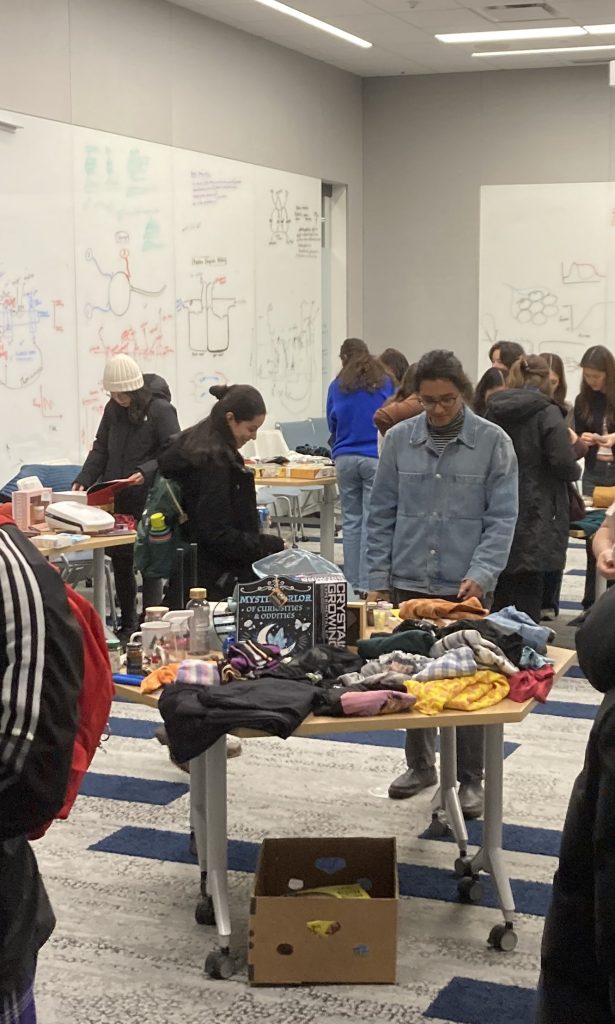
I feel like more events like this that build camaraderie and build networks and connections within our community are going to strengthen us and allow us to persevere through tumultuous times. Because really in the end all we have is each other to get through these tough times.
Emma: Totally. I love that. Actually, I attended this amazing event. And the tea kettle I use every single day to make my tea, because I drink a lot of tea, is from the Gift Exchange.
William: That’s so great. That’s so fantastic.
Emma: I also have a potato peeler that I use very often from there.
William: That is awesome.
Emma: Amazing. Well, so in the last couple minutes I just wanted to ask you, what is a piece of advice that you would give to aspiring scientists? So you said a little bit about really talking to as many people as you could and really getting into the idea of talking to graduate students and your TAs and your professors. What other advice might you have specifically towards being able to get into science or even sticking with science?
William: This is a question I’ve thought a lot about and I feel like I have strong opinions about. I think like academia, especially working in U-Dub, we’re exposed to scientists coming into themselves. Scientists who are just starting to discover themselves. And what I believe is really important in your journey and your career is talking to yourself and getting to know yourself. So engaging in creative hobbies or spending time with yourself, going for walks. Because oftentimes we are walking down a path that might have been set for us originally. Maybe you had parents who are doctors who are really pushing you to be a doctor too. Or maybe you felt like you only had an option of pursuing this career or that career. But really we should be asking ourselves like what do we want to do and what are we passionate about? Because it’s a service to yourself and to your community to find where you belong and your niche in the world. And so by talking to yourself more, getting to know yourself, you can feel more sure in your path. And I guarantee we got thousands of pre-med students, but you got to look inside and find out whether that’s really what you want to do. And whether that’s really your passion. And the sooner that can come, the better for you.
That’s what I believe. Self-reflection. Enjoying your time with yourself. Doing hobbies, making art. All those things help you find yourself.
Emma: Amazing. Well William, that is all the time we have for today. Thank you so much for coming on. This was so much fun.
Emma: Thank you to the viewers at home. And yeah, hopefully we’ll see you soon for another time.
William: Shout out to the family and friends. Shout out to the family and friends. If you made it this far in the podcast, I love you guys.
Emma: Amazing. Well, we’ll see you soon.
Check out the previous SciPos Podcast interview with Vaibhav Chhaya here!