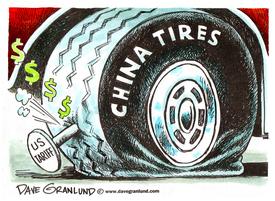
US Does Not Have A Monopoly On Obscure Tariffs

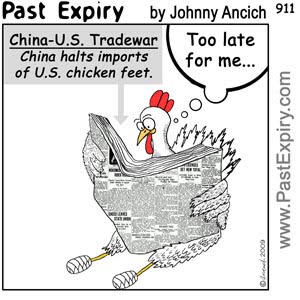
Bloomberg reports on the EU’s 42.3% low-tech “ironing board tariff.” The goal is to protect 10 EU producers who employ about 700 workers in Italy and Poland “dumped” ironing board imports. “Ironing boards are among a group of more than 50 Chinese products subject to EU anti-dumping duties, making China by far the most frequent target of such European levies. Other Chinese goods that face such import taxes include aluminum foil, ceramic tiles, ring binders, and tableware.” Also on that list: bikes and since 2019 also e-bikes.

Apple’s Mac Pro And The Effects Of Bilateral Tariffs

The new Apple Mac Pro is a good example of how bilateral tariffs work – work as in “outlining the mechanics” not as in “achieve the goal of making America great again through insourced production.” Trump tweets on Sept 30, 2019: Great news! Apple announced that it is building its new Mac Pro in Texas. This means hundreds of American jobs in Austin and for suppliers across the Country. Congratulations to the Apple team and their workers!

Apple Inc was contemplating it would move the production of the Mac Pro abroad, but decided instead it decided to continue production in America – but only after it received crucial tariff exclusions. (Over 2500 firms asked the US government for such exemptions from the Trump Tariffs, but few have been granted. Lucky Apple!) Here is the process: To qualify for a tariff exclusions firms have to prove to the U.S. government that

  1. The item is available only from China, and whether it (or a comparable product) is not available in the U.S. or a third country
  2. The additional duties on the item would cause severe economic harm to the applicant, or other U.S. interests
  3. The item is strategically important

According to Bloomberg, the Mac Pro qualified for a tariff exclusion on its metal PC case, although it seems preposterous that a “stainless steel space frame” could not be manufactured anywhere but in China. NASA is sending spacecraft to the moon but no US company can make a steel case? The power cable, on the other hand, was denied a tariff exception — will it now be made in the US? Unlikely, the most likely supplier is said to be Taipei-based Delta Electronics Inc., which already supplies to Apple from factories in China, Taiwan, and Thailand. It plans to invest $1.8 billion in Taiwan to boost production and R&D. The case of Delta Electronics highlights the problems with the tariffs-to-repatriate-employment program: When US manufacturers cannot buy from the cheapest producer (China) the do not move production home but they go to the second cheapest producer which is likely in another country. Mac ProPhoto by Nilay Patel / The Verge


Trade Diversion – The Mysterious Pencil Factory

NPR reports on a wonderful trade diversion story. Here is the edited version:

An American investigator traveled to the Philippines last year in search of the origin of the pencils, what he found was a dusty factory that was simply repackaging pencils from China. Chinese pencils have long been subject to a stiff US anti-dumping tariffs of 114.9%, which more than doubles the cost of Chinese pencils.

According to a U.S. customs report, the manufacturing equipment at the Philippine plant “appeared to have been covered in dust and cobwebs indicating that they had not been used for some time.” The inspector saw no evidence of manufacturing, though some pencils were being sharpened. And there were boxes and boxes of finished pencils, with labels saying they were made in China. The inspector “witnessed staff repacking what appeared to be Chinese origin products into boxes labeled ‘Made in Philippines,’ ” the report said.

Mislabeling the source of products to avoid tariffs is not a new scam. But it’s likely to grow more prevalent as the trade war between the U.S. and China drags on and tariffs are extended to nearly everything China exports. Each new brick in the president’s tariff wall brings new incentives for business people to tunnel under – classic trade diversion.

Here is the Mexican version of the story:

Roberto Durazo helps set up factories in Mexico. Lately, he has been getting a lot of calls from Chinese companies eager to avoid the mounting import taxes imposed by the Trump administration. “They tell us, like, ‘Hey, I build a TV,’ ” Durazo said. ” ‘And I want that TV to be made in Mexico so I [don’t have to] pay the duties.’ ” “They just want to put it in the box, add labels and claim that it’s made in Mexico,” Durazo said. “And we tell them it doesn’t work like that.”

When the U.S. imposes tariffs on China, it’s only natural that some production really does move to other countries. Customs investigators grow suspicious when they see what appear to be abrupt moves, especially those that involve complex manufacturing or heavy machinery. “If on Monday a company is sourcing all their product from China and on Tuesday all of it is suddenly now coming from Vietnam or some other country, depending on the nature of the commodity, that’s just not realistic,” the customs spokesman said. “If that abrupt shift occurs the day after Chinese tariffs are raised, that’s another indicator.” U.S. imports from Vietnam jumped 33% in the first seven months of the year, compared with the same period a year ago.

Recession Indicators

Bear markets give investors about eight months warning that a recession might be on the way. But, how do we define a “bear market” formally to take this hypothesis to the data?

The make things even more difficult, Nobel Laureate Paul Samuelson’s famously quipped “the stock market predicted nine of the past five recessions.” Meaning that

  • a) that bear markets lead recessions
  • b) bear markets sufficient but not necessary conditions for recessions.

If we define a bear market as any -20% decline in the stock market for at least one month, there have been 13 bear markets in the postwar era, but only 7 recessions. So In this case, bear markets have about a 50-50 chance of predicting recessions.

Here are some leading indicators of recessions which may or may not predate bear markets.

A Special Kind Of Trade Deal (US-Japan)

President Trump said Japan would open its markets to $7 billion of American agricultural goods, calling the trade deal a “huge victory for America’s farmers, ranchers, and growers.” The WSJ comments “the Japan deal may be the President’s biggest trade victory in his first term. But he made it much harder than it should have been.”

Understanding this trade deal is important.

  1. The US gets some access to Japan agricultural markets
  2. Japan gets what it already has (no increases in US tariffs on Japanese Cars).

Trump was excited to show he had given nothing but gotten something, simply by threatening Japan with new tariffs brought Japan to the table.

Not so fast…

The access that US gains to the Japanese agricultural markets is equivalent to what had been agreed upon by pacific nations in 2016 under the multilateral Trans-Pacific Partnership trade pact (TPP).  At that time, Trump stated that “The Trans-Pacific Partnership is another disaster done and pushed by special interests who want to rape our country, just a continuing rape of our country”. One of Trump’s first acts in the office was to cancel TPP. All other countries eventually signed it.

Today the “new” US Japanese trade deal delivers for the US what it would have gotten already in 2016 under TPP and it delivers what all other TPP signatories already got years ago: better access to Japans agricultural market.

Here is another juicy detail: All trade deals be approved by Congress, but Trump kept the agreement to “and initial mini trade deal” suggesting that this is just the first part of a large trade deal, to avoid that Congress gets to approve it and to avoid that the WTO will examine its provisions.

As Bloomberg states: “All of this is doubly ironic because this week’s “mini deal” is a consequence of Trump’s decision to pull out of a far larger one — the Trans-Pacific Partnership, which included Japan and 10 other U.S. trading partners. It will also borrow heavily from the agricultural concessions the Obama administration spent years negotiating with Japan for the TPP… The end result: a partial deal that will leave out whole industries, undermine the global order and look a lot like parts of an agreement that Trump walked away from less than three years ago.

Image result for US Japan Trade pactsource

Why Do Only Farmers Receive A Tariff Bail Out?

Many think that Trump is compensating farmers because they are especially hard hit by global retaliation to Trump’s tariff war. Or because they loom large on Trump’s electoral re-election map. Not so. Farmers are compensated because this is the only group that CAN be compensated without a broad Congressional action to overhaul the taxes and subsidies on a grand scale.

Curiously it is a quirky welfare measure, the Commodity Credit Corporation that was established by President Roosevelt in the 1930s to help farmers during the depression dustbowl which allows Trump to pay farmers directly – 28 billion to date. Here is the full explanation from an article in the Magazine “Successful Farming.” Here are the highlights:

Agriculture is the only sector of the U.S. economy to receive a trade-war bailout and that’s because of the broad powers given to the CCC, created during the Depression to pay for New Deal farm subsidies. After revisions over the years, it can borrow up to $30 billion from the Treasury to support commodity prices and farm income. The Reagan administration tapped the CCC to finance an export subsidy program in the early 1980s. There has been uneasiness over the unprecedented scale of Trump’s trade-war spending; $10 billion for 2018 crops and livestock and promises of up to $16 billion for 2019 agricultural damage.

Agatha Christie Answers The Question: Who Lost Argentina, Again?

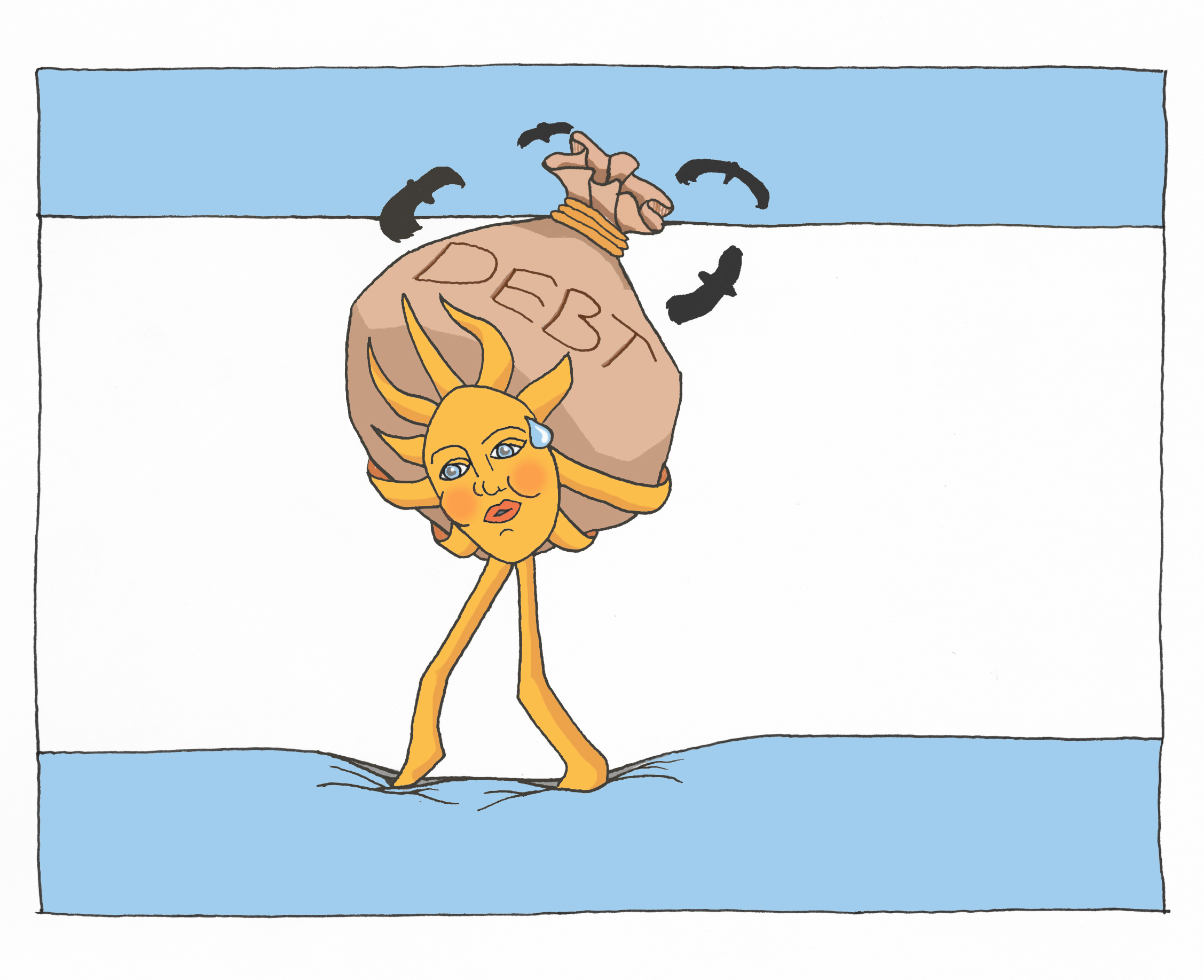
Argentina is back in crisis mode, only 2 short years after selling 100 year (!!!) bonds at 7.9% to the “unsuspecting” global public. Who is at fault? El-Erian explains:

“With a presidential election approaching next month, Argentina is once again on the cusp of a crisis that could end in depression and default, owing to mistakes made by everyone involved. Should President Mauricio Macri secure another term, he must waste no time in reversing the country’s economic deterioration.

CERNOBBIO – Investors and economic observers have begun to ask the same question that I posed in an article published 18 years ago: “Who lost Argentina?” In late 2001, the country was in the grips of an intensifying blame game, and would soon default on its debt obligations, fall into a deep recession, and suffer a lasting blow to its international credibility. This time around, many of the same contenders for the roles of victim and accuser are back, but others have joined them. Intentionally or not, all are reprising an avoidable tragedy.

After a poor primary-election outcome, Argentinian President Mauricio Macri finds himself running for another term under economic and financial conditions that he promised would never return. The country has imposed capital controls and announced a reprofiling of its debt payments. Its sovereign debt has been downgraded deeper into junk territory by Moody’s, and to selective default by Standard & Poor’s. A deep recession is underway, inflation is very high, and an increase in poverty is sure to follow.

It has not even been four years since Macri took office and began pursuing a reform agenda that was widely praised by the international community. But since then, the country has run into trouble and become the recipient of record-breaking support from the International Monetary Fund.

Argentina has fallen back into crisis for the simple reason that not enough has changed since the last debacle. As such, the country’s economic and financial foundations have remained vulnerable to both internal and external shocks.

Although they have been committed to an ambitious reform program, Argentina’s economic and financial authorities have also made several avoidable mistakes. Fiscal discipline and structural reforms have been unevenly applied, and the central bank has squandered its credibility at key moments.

More to the point, Argentinian authorities succumbed to the same temptation that tripped up their predecessors. In an effort to compensate for slower-than-expected improvements in domestic capacity, they permitted excessive foreign-currency debt, aggravating what economists call the “original sin”: a significant currency mismatch between assets and liabilities, as well as between revenues and debt servicing.

Worse, this debt was underwritten not just by experienced emerging-market investors, but also by “tourist investors” seeking returns above what was available in their home markets. The latter tend to lack sufficient knowledge of the asset class into which they are venturing, and thus are notorious for contributing to price overshoots – both on the way up and the way down.

Undeterred by Argentina’s history of chronic volatility and episodic illiquidity – including eight prior defaults – creditors gobbled up as much debt as the country and its companies would issue, including an oversubscribed 100-year bond that raised $2.75 billion at an interest rate of just 7.9%. In doing so, they drove the yields of Argentine debt well below what economic, financial, and liquidity conditions warranted, which encouraged Argentine entities to issue even more bonds despite the weakening fundamentals.

The search for higher yields has been encouraged by unusually loose monetary policies – ultra-low (and, in the case of the European Central Bank, negative) policy rates and quantitative easing – in advanced economies. Systemically important central banks (the Bank of Japan, the US Federal Reserve, and the ECB) thus have become the latest players in the old Argentine blame game.

Moreover, influenced by years of strong central-bank support for asset markets, investors have been conditioned to expect ample and predictable liquidity – a consistent “common global factor” – to compensate for all sorts of individual credit weaknesses. And this phenomenon has been accentuated by the proliferation of passive investing, with the majority of indices heavily favoring outstanding market values (hence, the more debt an emerging market issues, like Argentina, the higher its weight in many indices becomes).

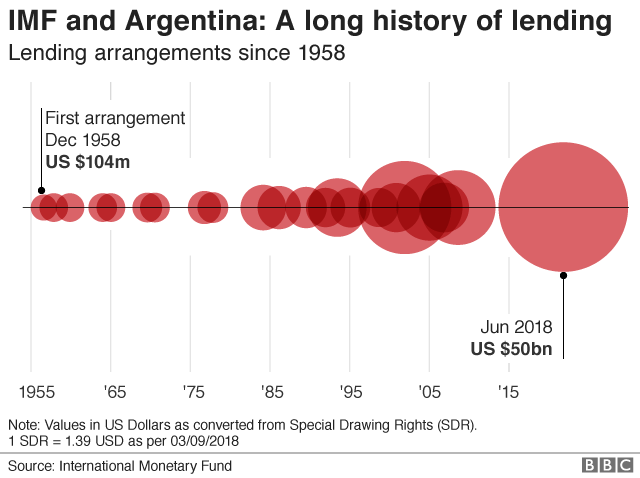
Then there is the IMF, which readily stepped in once again to assist Argentina when domestic-policy slippages made investors nervous in 2018. So far, Argentina has received $44 billion under the IMF’s largest-ever funding arrangement. Yet, since day one, the IMF’s program has been criticized for its assumptions about Argentina’s growth prospects and its path to longer-term financial viability. As it happens, the same issues plagued the IMF’s previous efforts to Argentina, including in the particularly messy lead-up to the 2001 default.

As in Agatha Christie’s Murder on the Orient Express, almost everyone involved has had a hand in Argentina’s ongoing economic and financial debacle, and all are victims themselves, having suffered reputational harm and, in some cases, financial losses. Yet those costs pale in comparison to what the Argentine people will face if their government does not move quickly – in cooperation with private creditors and the IMF – to reverse the economic and financial deterioration.

Whoever prevails at next month’s presidential election, Argentina’s government must reject the notion that its only choice is between accepting and refusing all demands from the IMF and external creditors. Like Brazil under then-President Luis Inácio Lula da Silva in 2002, Argentina needs to embark on a third path, by developing a homegrown adjustment and reform program that places greater emphasis on protecting the most vulnerable segments of society. With sufficient buy-in from domestic constituencies, such a program would provide an incentive-aligned path for Argentina to pursue its recovery in cooperation with creditors and the IMF.

Given the downturn in the global economy and the rising risk of global financial volatility, there is no time to waste. Everyone with a stake in Argentina has a role to play in preventing a repeat of the depression and disorderly default of the early 2000s. Managing a domestic-led recovery will not be easy, but it is achievable – and far better than the alternatives.”

WTO At Work: Finally, A “Justified” US Tariff Measure

The purpose of the WTO is to facilitate multilateral trade liberalizations. Its elementary international economics to show why it is helpful to entice large countries with substantial market power to agree on trade liberalizations. Both countries win.

Countries that violate WTO agreements are taken to WTO court and eventually, they have to pay compensation to those countries that were injured. That is why the Trump administration has been trying to stifle any further WTO judicial processes — too many complaints have been filed against the US in response to Trump tariffs.

While the WTO judicial panel is still active, it has found for the US in part I of the Airbus-Boeing dispute and the US is now allowed to collect compensation. Politico reports that the won the right to collect a total of €7.5 billion, somewhat of a disappointment to the White House, which had prepared a list of EU export tariffs worth $21 billion.”

Part II of the Airbus-Boeing case is still pending at the WTO, which has already decided against the US in part II of the dispute, but the compensation is still being worked out. Are the US and Europe better off collecting compensation in this two-part conflict?

Bloomberg has the scoop: “Here’s how the international trading system is supposed to work: If a country gets upset with another country’s trade practices, it can file a dispute at the WTO where a panel of experts offers a judgment. If the losing country doesn’t comply with that ruling, the WTO allows the winning country to retaliate. For most of his first term in office Trump has preferred to cut to the chase and levy tariffs that he says are exempt from WTO oversight because they are necessary to protect America’s “public morals” and national security. But in the instance of Airbus, Trump and his predecessors have pursued and succeeded in a landmark case against the EU that’s been a decade-and-a-half in the
making.

Last year the WTO ruled that the EU hasn’t ended its illegal subsidies, which Boeing and the U.S. claim give Airbus an unfair advantage, and the WTO will soon green-light new U.S. tariffs on billions of dollars worth of European goods.

But the other shoe has yet to drop. In a similar action that’s still winding through the Geneva-based WTO, the European Commission is readying its own tariffs on
U.S. exports in retaliation for unfair subsidies given to Boeing. EU Trade Commissioner Cecilia Malmstrom summed up the situation on Monday by saying “both we and the U.S. have sinned” and the time has come to settle the dispute rather than resort to tit-for-tat tariffs. The multi-billion dollar question now: Will Trump see an opportunity to forge a comprehensive aerospace accord with the EU or kick off a transatlantic trade war of epic proportions instead?”

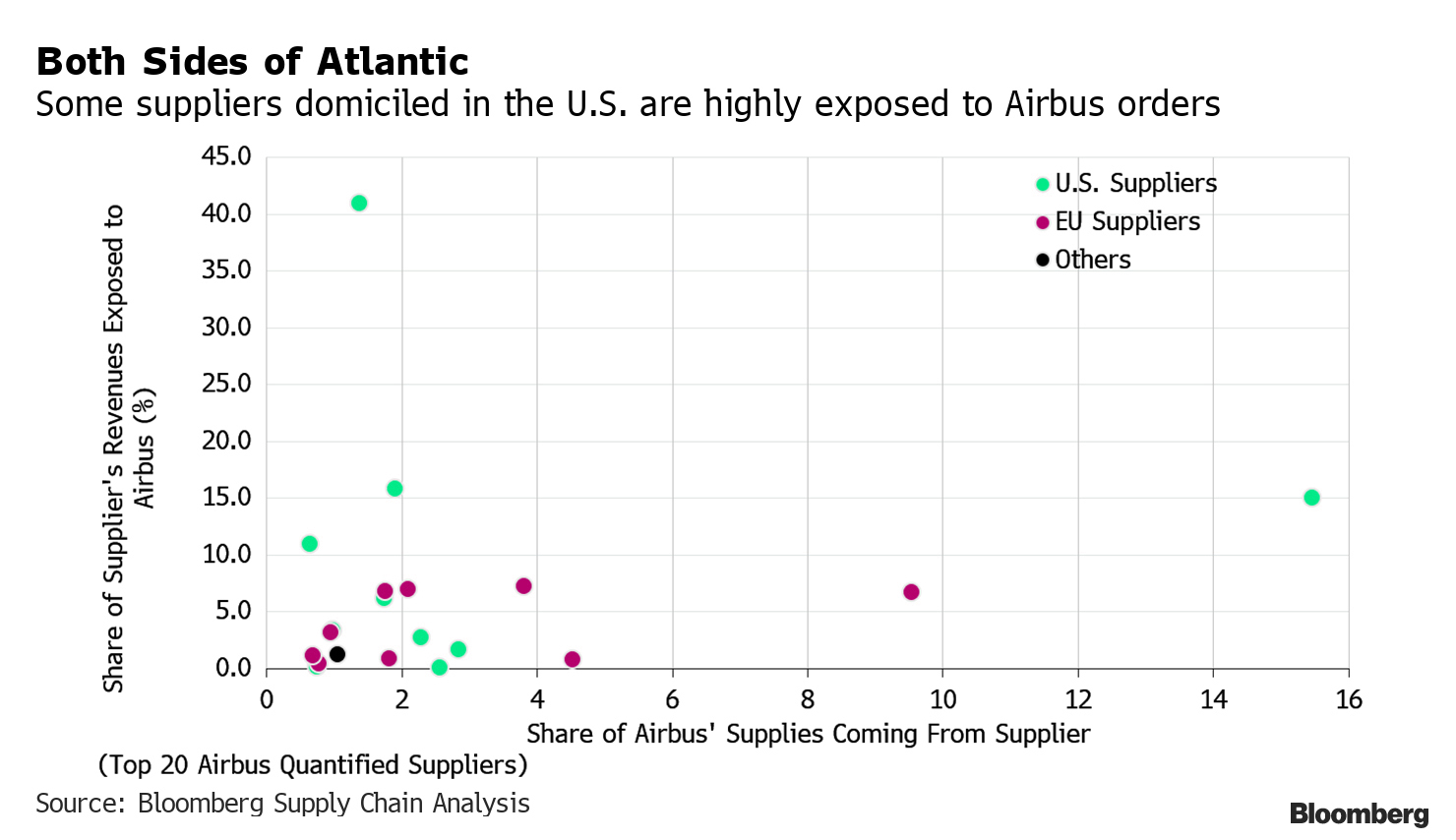
Finally, while the tariff/retaliation-compensation may be “justified” under WTO rules to “keep the peace” and enforce multilateralism, there are also the usual unintended consequences. Bloomberg reports that a substantial share of Airbus parts is sourced in the US… 

Charting the Trade War

World Trade Organization authorized $7.5 billion in U.S. duties against the EU would hit export orders for U.S. manufacturers, according to Bloomberg Economics.

UPDATE 10/4/2019:

The US just released its tariff list, targeting among other things European whiskey, most likely to compensate US whiskey producer for their market loss in China, which retaliated by reducing market access for Kentucky Burbon/Whiskey produced in the Senate Majority leader’s home state… Other than that we have tariffs that help US agriculture (olive oil, cheese, meat, wool) which already received a $28 billion bailout when China stopped buying US goods. 

Non Tariff Barriers Proliferation

Kinzius et al dig through the Global Trade Alert database, which features wonderful visualizations of trade interventions (positive liberalizations and negative tariff measures).

Number of newly implemented protectionist interventions by type, 2009 – 2017

Note: Numbers in the bars represent a rise in protection by specific policies: we count the change in tariff increases (tariff changes), newly introduced anti-dumping, anti-subsidy and safeguard measures (trade defense), and newly introduced non-tariff barriers (non-tariff barriers) e.g. new national regulations.
Source: GTA.

Figure 2 illustrates that over the past years tariffs were not the major trade policy tool to protect domestic economies. Instead, NTBs have been most often applied. Since 2009, only 20% of all implemented protectionist interventions could be attributed to an increase in tariffs. In contrast, NTBs accounted for on average 55% of the implemented protectionist interventions.

Number of NTBs imposed by country, 2009-2017

ECB Is Resuming Quantitative Easing

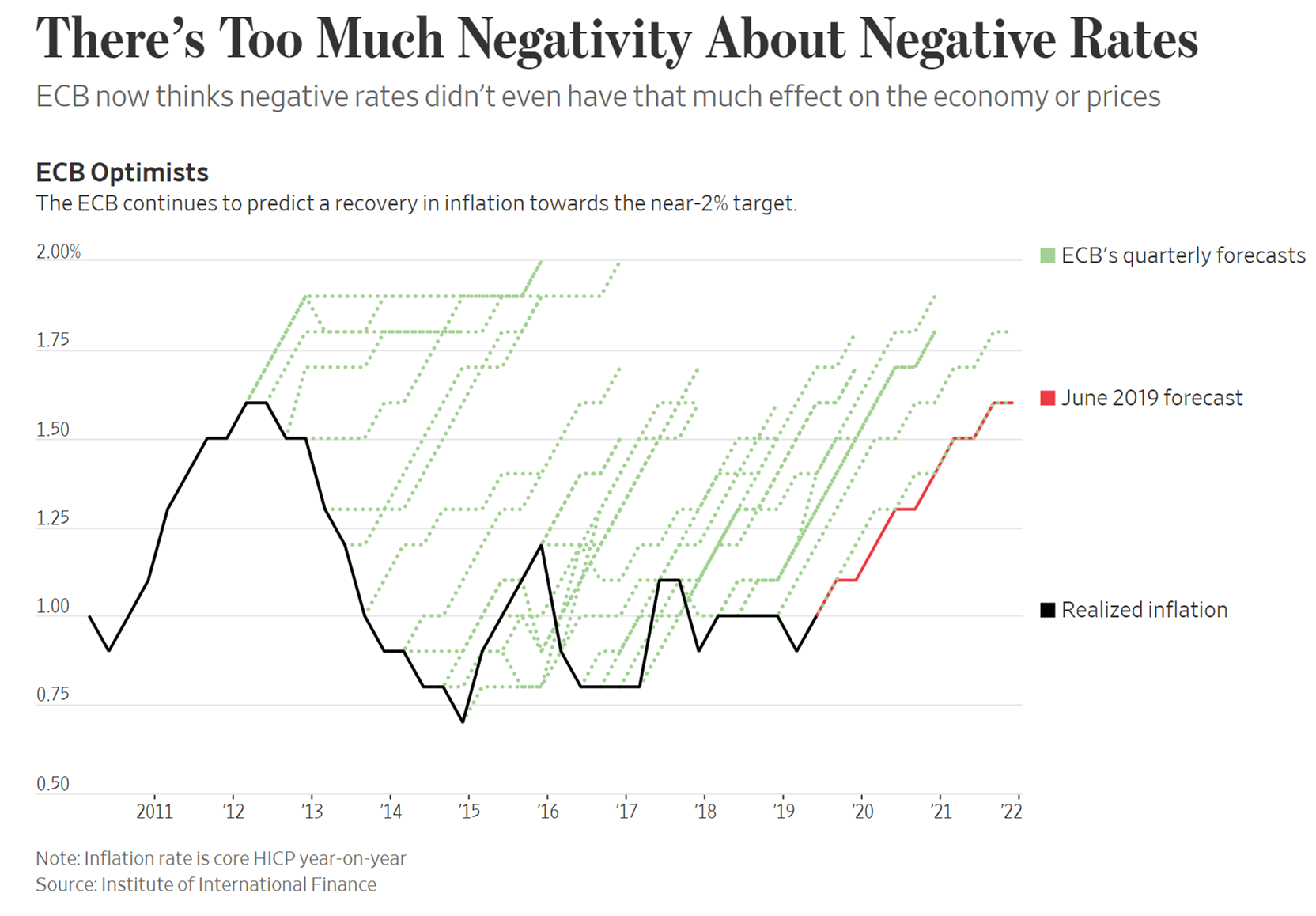
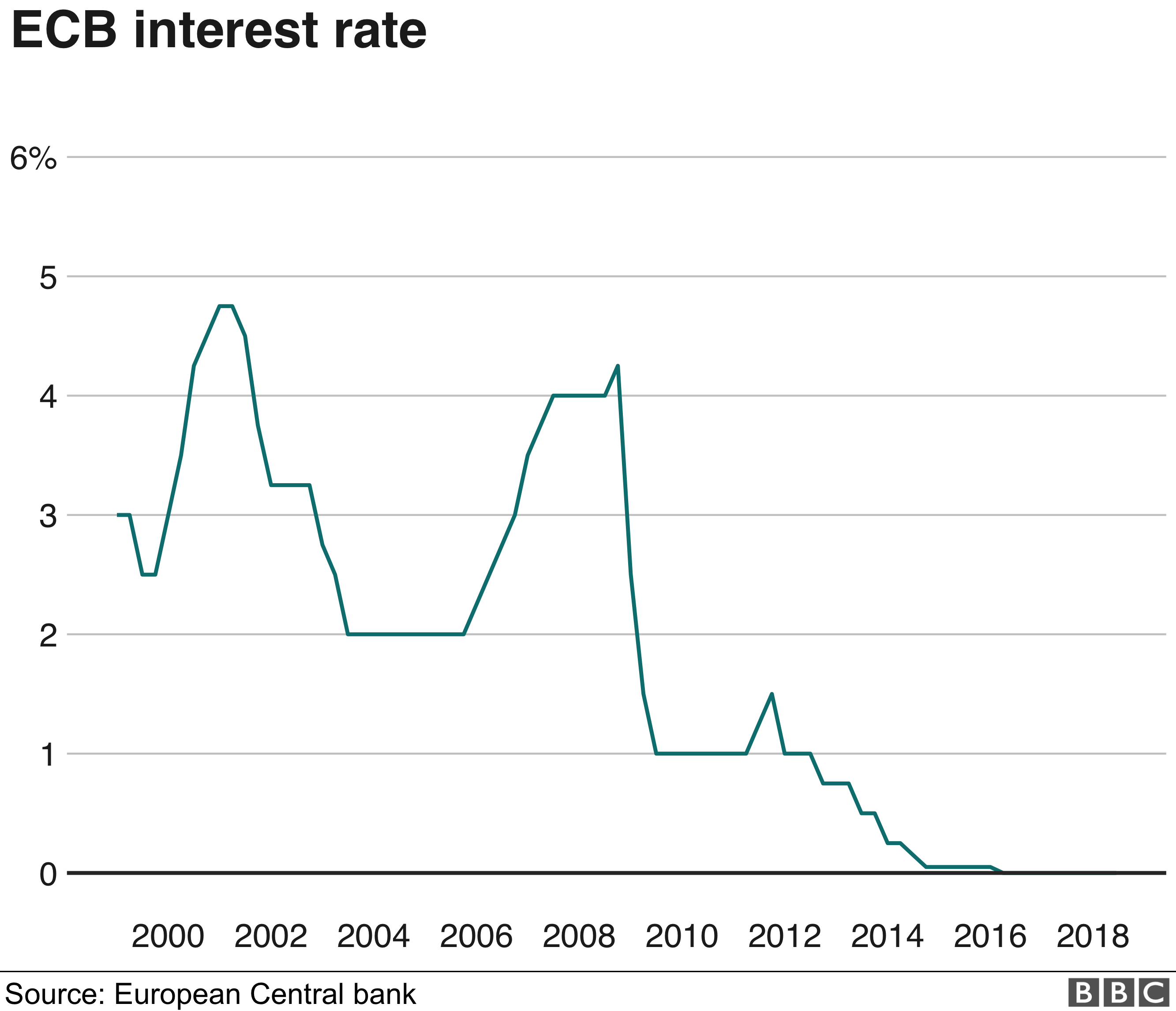
The European Central Bank cut its key interest rate and launched a sweeping package of bond purchases. It is the ECB’s largest dose of monetary stimulus in 3½ years and a bold finale for departing President Mario Draghi, who looks to be committing his successor to negative interest rates and an open-ended bond-buying program, possibly for years, Tom Fairless reports. The ECB’s pre-emptive move was aimed at insulating the eurozone’s wobbling economy from a global slowdown and trade tensions. But it triggered opposition from a handful of ECB officials and an immediate response from President Trump.

A quick application of interest parity will yield some insights on the effects on the value of the US dollar.

While Trump loves what the ECB is doing, it should be noted that the Eurozone is at the brink of a recession with contracting output, while the US is at the pinnacle of its expansion.

End Of A Common Market: Brexit

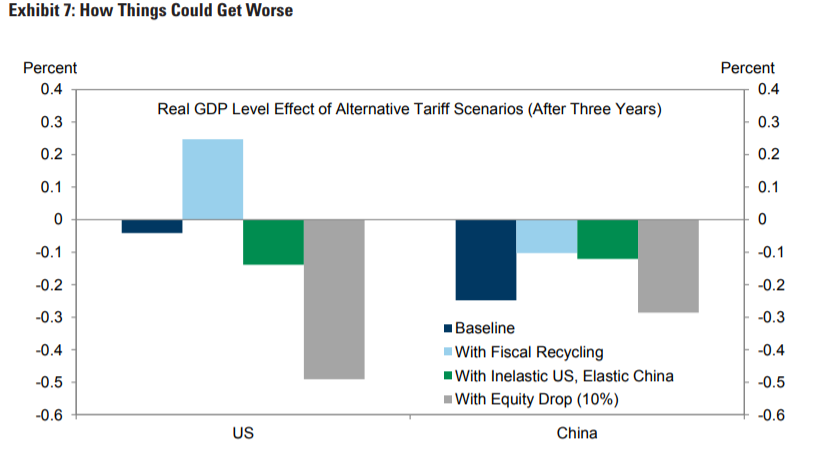
Large Open Economy Effects Of the US/Chinese Trade War

The Wall Street Journal reports on the global effects of the local/bilateral US/Chinese trade war. A perfect application for the large open economy diagram! Can you work out the effects of a US tariff imposed on Chinese goods and then the Chinese retaliation. Who wins/looses? Then Draw the US on the vertical axis and “The Rest of The World” on the horizontal axis to show the impact of the Trade War in the US on the rest of the world. Who wins/looses?

China Files Another WTO Complaint

China lodges tariff case at WTO against the U.S. reports Reuters.

HONG KONG/GENEVA (Reuters) – China has lodged a complaint against the United States at the World Trade Organization over U.S. import duties, the Chinese Commerce Ministry said on Monday. The United States began imposing 15% tariffs on a variety of Chinese goods on Sunday and China began imposing new duties on U.S. crude oil, the latest escalation in their trade war. China did not release details of its legal case but said the U.S. tariffs affected $300 billion of Chinese exports. The latest tariff actions violated the consensus reached by leaders of China and the United States in a meeting in Osaka, the Commerce Ministry said in the statement. China will defend its legal rights in accordance with WTO rules, it said.

The lawsuit is the third Beijing has brought to challenge U.S. President Donald Trump’s China-specific tariffs at the WTO, the international organization that limits the tariffs each country is allowed to charge.

Trump, Shelton and the Gold Standard

A return to the gold standard will not win Trump’s trade war,

says Barry Eichengreen in the Guardian. But it does highlight the confusion of Trump and Shelton as to what the Gold Standard does and how it would run counter of their ideas of low interest rates.

Treasury Secretary Mnuchin inside the US Fort Knox Gold Vault, 2017.

EU Trade Rep Cecilia Malmström On Fake Trade News. How Truth Will Prevail

BEWARE FAKE TRADE NEWS: Outgoing European Trade Commissioner Cecilia Malmström made a not-so-subtle swipe at Trump’s trade worldview as she countered some of the president’s most commonly held views during a speech Wednesday.

“The biggest misconception I have seen on the rise now is about tariffs,” she said. “People who advocate tariffs seem to base their arguments on two things: Tariffs target foreign business when they in fact the consumers. And tariffs are the tool of narrow interest seeking to protect industries at the expense of broader society.” Another wrong perception is believing that producing all goods at home is cheaper and better for the economy, she said, adding that this idea goes against the idea of comparative advantage.

Here is the whole speech

Ladies and gentlemen,

Today I want to discuss truth. In the age we live in – of instant communication, simplified messages and government by Twitter – truth can be difficult to hold on to. There is a quote, attributed to Mark Twain: “A lie travels around the globe while the truth is putting on its shoes.” It is a famous quote, and very apt – especially given that there is no evidence that he said it.

Today, many in this room will agree on most things – but we will disagree on others. And in my experience, it is always good to find a mutual point to start on.

So let me suggest one: Ladies and Gentlemen – the earth is round. Or to be accurate: an oblate spheroid. Life would be easier if it were flat:

  • cartographers could make maps more easily
  • lunar eclipses would not ruin our view of the moon
  • all of the stars in the sky would be perfectly visible every night

But unfortunately it is not flat – a fact first proved in the 3rd century BCE, when Hellenistic astronomy calculated its shape and circumference. Since then, the evidence has mounted up. From astronomical calculations to simple observation. From ground-level views to photos from aircraft and spacecraft.
So why, despite all of this evidence, does the International Flat Earth Research Society maintain a membership? Why is there a small, but active, online community? Because they follow instincts over evidence. When they look around them, they see a flat earth.
I am afraid, however, that they are wrong. We sit here and we laugh about people believing the earth is flat, based on intuitive presumptions. Yet, these days many similar presumptions are made about trade – ones that feel intuitively true but are backed up by nothing of substance.
Often you hear people say that they are entitled to their opinion – That’s of course true, but even so, your beliefs should guide you, but not all decisions can be gut decisions. If you want to disagree with something, you have a responsibility to look at and understand the evidence.

This is something that has become very clear to me in my time as Commissioner for Trade. I am a proud liberal – I believe in open borders and free trade. My ideological beliefs have guided me – but sometimes I must recognise the reality of a situation that is constantly evolving, even where I have had some initial doubts.
So today I want to talk to you about a few things in trade – specifically: the things that feel intuitively true, but are in fact not, and what lessons we can draw from this for the future.

TARIFFS TARGET FOREIGNERS

The biggest misconception I have seen on the rise is about tariffs. People who advocate for tariffs seem to base their argument on two things: The first is that tariffs target foreign businesses – when they in fact target the consumer. Tariffs are the tool of narrow interests seeking to protect industries at the expense of broader society.
The second is that if we make a product at home, we save money, strengthen the economy and create jobs. This is a tempting argument, but it is not true.

A basic principle of trade – that of comparative advantage, that specialisation is more efficient – seems to be increasingly forgotten these days. This type of thinking could lead to:

  • unsustainable business models
  • higher prices for ordinary citizens
  • and a more fragile economy in the long run

Tariffs are not the answer to a transforming global economy – they are rarely the answer to anything – they are the equivalent of shooting yourself in the foot to hurt the shoe salesman.

EXPORTS ARE PROFITS

Another big mistake people make these days is confusing a trade balance with a bank balance. They misread “exports” to mean profits and “imports” to mean losses. This ignores a range of economic realities.

For example, the increasingly service-oriented economies in Europe, or the fact that getting hold of low priced and reliable imports is vital for our companies. Or that in a modern global economy, good will cross borders many times before they are finished – bringing prosperity and jobs wherever they go.
In fact, a surplus in trade can be a bad sign. It is a sign of weak domestic demand – this can make countries sensitive to changes in the global economy. Balancing the books on trade is not like a household budget.

TRADE IS ONLY FOR THE BIG GUYS

Another common misperception is that trade is only for big companies. But I know a few people who would disagree with that – Laura Fontan and Diego Cortizas, for example. They are the Spanish owners of Chula Fashion, a company based in Hanoi. They are a family-owned company with 68 employees. Our agreement with Vietnam will simplify rules of origin to make it easier to export to the EU.
Trade is important to companies, both big and small. However, it is true that small and medium-sized companies are underrepresented in global trade. Exporting can be hard. In a new market there are many barriers – customs, language, marketing. Throw tariffs and other trade barriers in and it becomes very difficult indeed.

Often larger companies can absorb these costs, but smaller companies might not be able to. This is why we have started to include provisions focusing on them in our trade agreements. These often include measures like:

  • providing information online on market requirements
  • an SME Helpdesk, where EU companies can protect themselves from unfair practices
  • access to helpful contacts, like the Enterprise Europe Network

In the coming years, it is estimated that 90% of global growth will originate outside the EU. Developing and emerging markets will account for 60% of world GDP by 2030. Smaller companies are well placed to take advantage of that – taking up their role in global supply chains. Trade is not just for the big guys – it is an opportunity for all.

TRADE HARMS THE ENVIRONMENT

Another presumption is that trade is automatically bad for the environment. In fact, the picture is much more complicated than that. For example, it is better for the climate for northern Europeans to buy tomatoes from Spain, despite the transport costs involved – it cuts back on other causes of emissions, such as heated greenhouses.

Lamb from New Zealand has been similarly shown to have its transport emissions offset by other factors. Both are counter-intuitive but that doesn’t mean they aren’t true. We must aim for a lower environmental impact – but we should keep our approaches evidence-based. Trade can have other indirect, positive spill-overs on the environment too:

  • encouraging innovation
  • spurring investment in low-carbon production to meet standards in other countries
  • lowering the costs of environmental goods and services

Indeed, a critical part of fighting climate change is improving local production processes. Trade and investment liberalisation can provide firms with incentives to adopt the high standards from elsewhere. Changes needed to meet these requirements, in turn, flow backwards along the supply chain. This stimulates the use of cleaner production processes and technologies throughout a country.
To encourage this, we have inserted environmental provisions into our agreements. Each of our comprehensive agreements has a chapter on Trade and Sustainable Development. Crucially, this helps us lock in commitments to implement international climate conventions, such as the Paris agreement. This is partly why our recent agreement with the four Mercosur states is so important.

It binds these four countries together with the EU at a time when the US has left the Paris accord and is encouraging others to do so. Nevertheless, there are times when the evidence is there right before our eyes. We all saw the reports over the last couple of weeks of the fires raging in the Amazon rainforest.

This is deeply worrying – the Amazon provides much of the world’s oxygen and must be protected. I firmly believe that the EU-Mercosur agreement can be part of the solution. But I want to make it very clear that we expect Brazil to live up to its commitments on deforestation. These are not just empty words.

Unfortunately things currently seem to be going in the wrong direction – and if it continues this could complicate the ratification process in Europe.
Looking forward, the new Commission President-elect Ursula von der Leyen has said that she would like to look at border adjustment measures on carbon. This could encourage our trading partners to reduce their CO2 emissions. Instinctively, many have voiced doubts, referring to international trade rules. Any measures must be non-discriminatory and WTO compliant, of course, but that is not to say that it cannot be done. New challenges mean looking beyond what we think we know and breaking down our preconceptions. As ever with trade, the devil will be in the details.

FREE TRADE IS OUR ONLY GOAL

Upgrading and enforcing protections for the environment is just one area where trade can make a positive difference, but sustainable development is more than that. Our Generalised System of Preferences and Everything But Arms initiatives also play an important role. Both offer privileged access to EU markets to developing countries for meeting these environmental standards and more – in labour rights, human rights and social rights too. Because at the end of the day, trade is about much more than goods and services.
This is another presumption that we should tackle – that the endgame is pure free trade. Because trade is about economic prosperity, but it is also about:

  • Culture
  • People
  • Values

It is about lifting people out of poverty, and it is a way to promote peace and trust between countries. Indeed, looking at our busy trade agenda, you see deals closed with many important partners. Mexico, Mercosur. Canada, Vietnam. South Korea, Singapore, Japan.

Each deal closed is the basis of a deeper relationship – many of which act as strategic alliances. This is important to our trade strategy at the moment. The EU needs friends – because we are trying to overcome one last misconception. Arguably the most dangerous one facing trade at the moment. The idea that the WTO is useless.

SLOWER MEANS WORSE

Not a lot of progress has been made at the WTO in recent years. This has led to some losing faith in it – whilst others take it for granted or disregard its rules But it is the system that has underpinned trade for decades. It is like oxygen – you would not notice it until it is gone, and then you are in serious trouble.
The end of the WTO would be the end of predictability in international trade. Businesses could no longer rely on exports as they once did – trade would become chaotic, unstable. Our trade policy, our economies and global value chains at large would reconfigure – and not always in the most efficient or desirable ways.
The WTO is critical to the functioning of global trade, but it is also out of date. We must update rules to tackle issues like illegal state subsidies. This would bring fairness back to the heart of global trade. We must also resolve the Appellate Body crisis. The Appellate Body brings discussion of the rules out of capitals to neutral ground – avoiding tit-for-tat tariffs and the escalation of trade tensions.
These are some of the immediate issues the WTO faces. In parallel, we need to work to show the organisation can still deliver. For example, in digital rulemaking. We are pleased that after years of attempts, we are finally seeing some progress. The WTO negotiations on e-commerce were launched in Davos with 80 countries in January this year. Proving the organisation can tackle 21st century issues helps demonstrate its value – but as important as the content is, the style of negotiation itself is crucial. We have gathered a smaller group of interested countries to move forward.
The EU has presented proposals on these issues and more. Other countries have too – this is good, it shows appetite for change. But we need broad buy in:

  • from countries,
  • from business,
  • from all who have an interest in international trade.

Reforming and rebuilding faith in the WTO is a big task, and we will need all the allies we can get.

CONCLUSION

So now we have touched on a few of the broad misconceptions about trade: from tariffs to surpluses, benefits to environmental impacts. And we have seen that things are not as simple as they seem.
Life would be easier if we could simply follow our gut instincts. But society and policy are more complex than that. The best that we can do is hold on to our values – what we believe to be good and right – but always be ready to challenge received ideas through rigorous research and understanding. This is how truth will prevail in the end. This is how we move forward.
Thank you.

President Deliberately Commits Fraud/Lies/Misleads To Cover Trivial Misread

For a long time I thought the issue with President Trump was that he has problems understanding economic concepts, or that he was unable to surround himself with advisors who have mainstream economic credentials.

As time marches on, evidence accumulated, however, that the problem is larger, now has become clear that he states facts he wishes to be true, rather than facts that are true — such as his insistence that the Fed raise interest rates under Obama’s recovery at times of high unemployment and low inflation. Now he’s demanding rate cuts at the apex of the economic boom cycle, even though the unemployment rate is much lower and inflation is higher.

The last chapter of the saga are the news stories that accumulate that make it apparent that he does not mind to commit fraud and lie to mislead the US public to its detriment, in order to cover up a trivial mistake he may have made in reading data. 

Labor Day Celebrations

Labor day in the US is meant to honor the American labor movement and the power of collective action by laborers,[1] who are essential for the workings of society. President Trump marked the day with a visit to the Shell Petroleum Plant where workers were cohersed to attend or else lose a day’s pay. “At one point, the president turned to the union leaders and demanded that they support his reelection campaign. Trump told the workers that if the leaders refused to back him, they should “vote them the hell out of office because they’re not doing their job.””

Argentina Imposes Currency Controls, Again

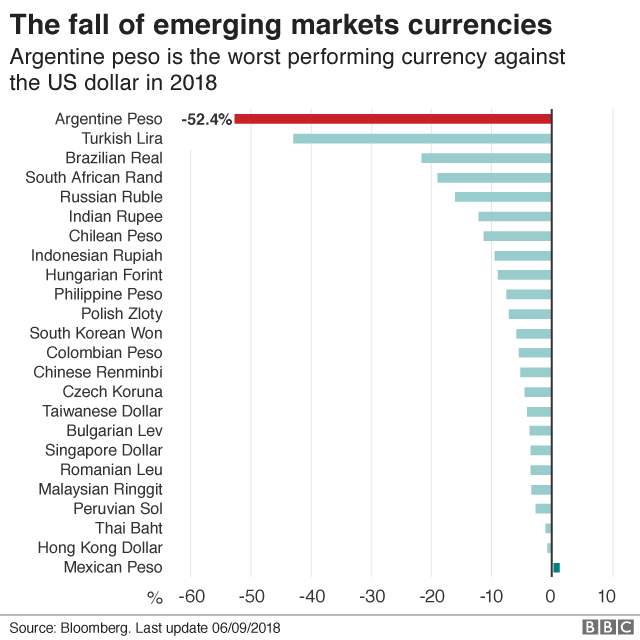
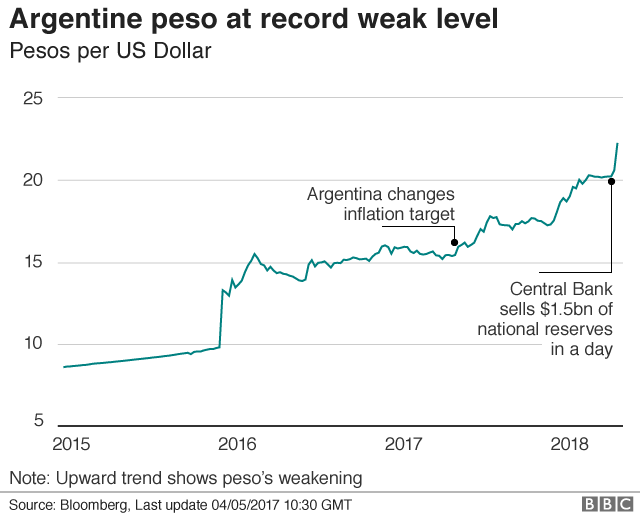
The BBC reports that Argentina imposes currency controls to support its economy, again.

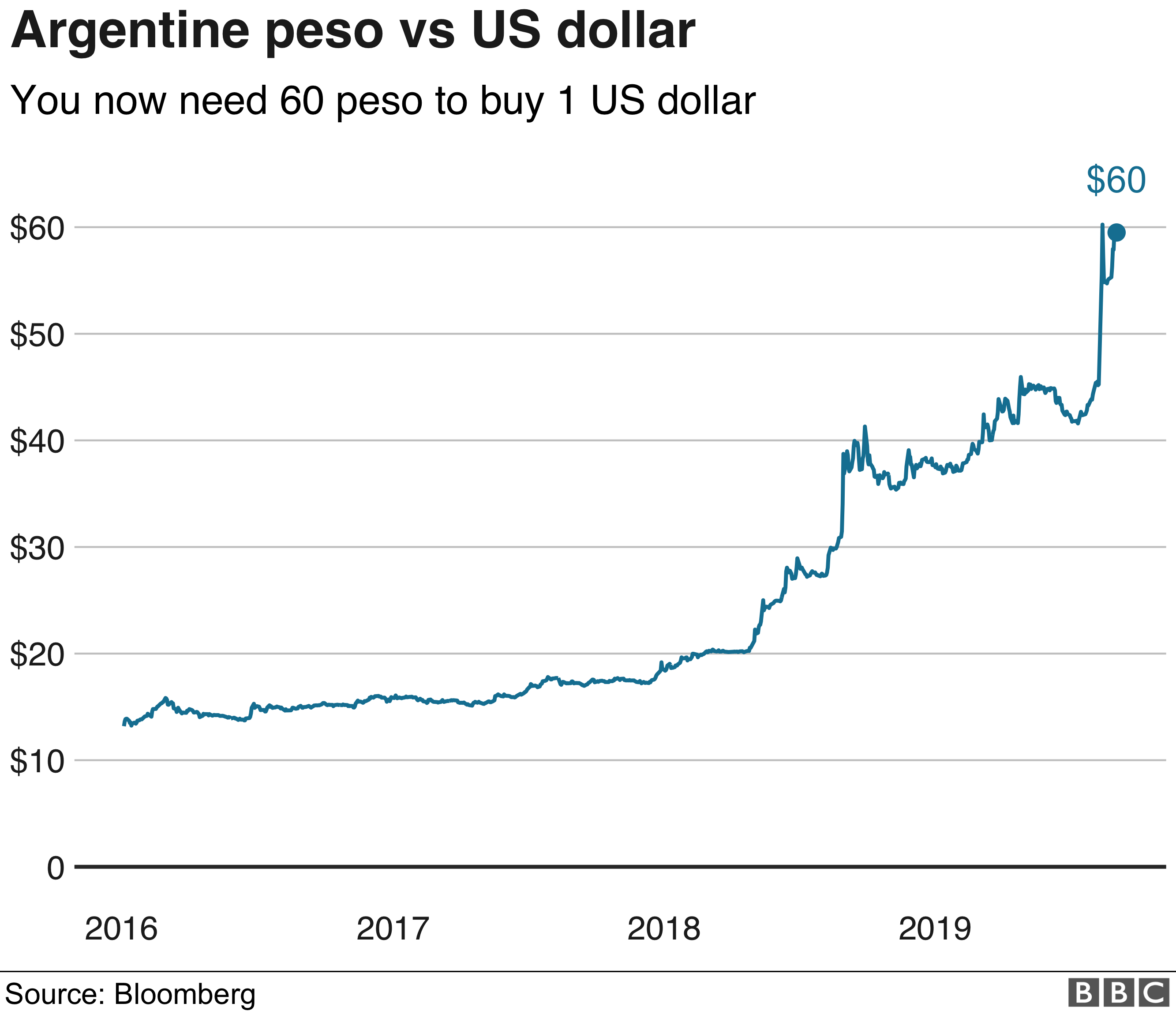
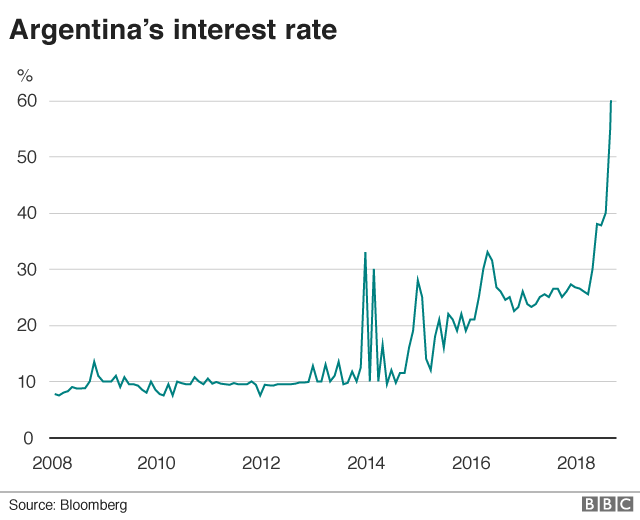
Argentina reportedly imposed currency controls to stabilise financial markets as the country faces a deepening financial crisis. The government restricted foreign currency purchases following a sharp drop in the value of the peso. Individuals can continue to buy US dollars, but they need permission to purchase more than $10,000 a month. Firms have to seek central bank permission to sell pesos to buy foreign currency and to make transfers abroad.

Argentina is also seeking to defer debt payments to the International Monetary Fund (IMF) to deal with the crisis.

IMF and Argentina lending history

What has the government said?

In an official bulletin issued on Sunday, the government said that it was necessary to adopt “a series of extraordinary measures to ensure the normal functioning of the economy, to sustain the level of activity and employment and protect the consumers”.

The central bank said the measures were intended to “maintain currency stability”

What triggered the current crisis?


The peso fell to a record low last month after the vote showed that the business-friendly government of President Mauricio Macri is likely to be ousted in elections in October.

Peso vs US Dollar

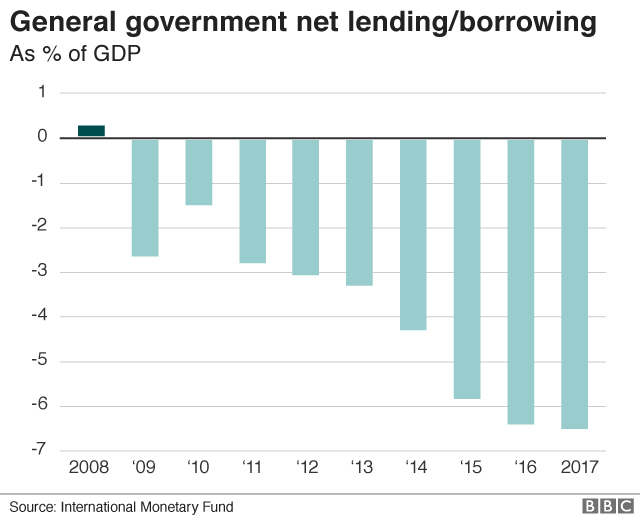
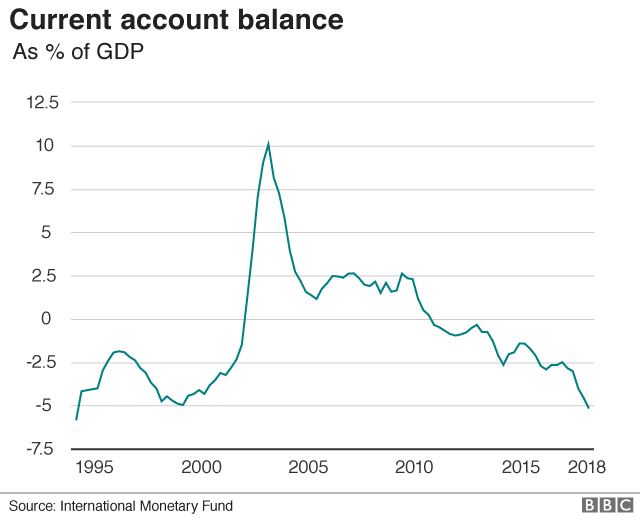
The country is in a deep recession. It has one of the world’s highest inflation rates, running at 22% during the first half of the year. Argentina’s economy contracted by 5.8% in the first quarter of 2019, after shrinking 2.5% last year. Three million people have fallen into poverty over the past year.

How is the move likely to be received?

Ordinary Argentines have traditionally had little faith in their own currency, preferring to convert their spare pesos into dollars as soon as they can. They don’t trust financial institutions much either, so they resort to what is locally known as the “colchón bank” – that is, stuffing their dollars under the mattress. Anecdotal stories abound of people keeping money buried in the garden, hidden in the walls or even stuffed in heating systems – occasionally with disastrous consequences if there is an unexpected cold snap.

People still have bad memories of the “corralito”, imposed in 2001, which stopped all withdrawals of dollars from bank accounts for a whole year. The only serious attempt to wean Argentines off their dollar dependency dates back to the 1990s under President Carlos Menem, when the peso’s value was fixed by law at parity with the dollar.

Last week, the country said it would seek to restructure its debt with the IMF by extending its maturity. This would give the country more time to pay back the money it owes to the IMF. Rating agencies, including Standard & Poor’s and Fitch, decided that amounted to a default and downgraded the country’s credit ratings. Whatever happens in Argentina, the risk of financial contagion is low, say analysts.

Why Is The Iphone Tariff 6%, Not 15%?

Mother Jones provides an explanation: “It is hard to keep track of all the China tariff action these days. Here’s a short primer. Imports from China have been broken into lists, which are just what they sound like: lists of various kinds of products.
Lists 1 and 2 account for about $50 billion worth of Chinese imports annually and were subjected to 25 percent tariffs last year. These were mostly industrial products, not consumer products.

List 3 included food and other consumer items in addition to industrial goods, clocking in at about $200 billion worth of Chinese imports. Trump imposed a 10 percent tariff on List 3 last year and upped it to 25 percent earlier this year.

List 4 is everything else and amounts to about $300 billion worth of imports. Trump imposed a 10 percent tariff on List 4 products earlier this month. On Friday, he announced that this would increase to 15 percent and the tariffs on the other lists would increase to 30 percent. However, because Trump doesn’t want to interfere with Christmas, List 4 was split into List 4a and List 4b. The tariffs on List 4b, which includes lots of popular consumer items, won’t go into effect until mid-December.

Keep in mind that tariffs are imposed on the “customs value” of products. An iPhone that retails for $1,000, for example, has a customs value of around $400. A 15 percent tariff comes to $60, or roughly 6 percent of the retail value.

All told, we import about $550 billion in goods from China annually, and when List 4 takes full effect at the end of the year all of it will be subject to Trump tariffs. Products on Lists 1-3 will be subject to tariffs of 30 percent and products on List 4 will be subject to tariffs of 15 percent. Unless Trump changes his mind between now and December”…

“I Am The Chosen One:” When All Else Fails, Appeal to Religion

On August 25, 2019, Politico reports that “Trump continued to shrug off responsibility for any economic fallout from his trade war with China on Wednesday, arguing that a face-off with Beijing was necessary due to the failures of past administrations. Trump painted himself as a reluctant warrior, shifting from his usual narrative that the trade fight is not hurting the American economy or his political prospects to asserting that it was something he had to do. The president also adopted a religious theme in describing his role in picking a trade fight with China, saying: “I am the chosen one.” “Somebody said it is Trump’s trade war,” he said. “This isn’t my trade war. This is a trade war that should have taken place a long time ago by a lot of other presidents.”

Novel Enemies: WSJ & Republican White House

The WSJ is the most conservative mainstream paper, and it decided to pick a bone with White House Trade Policy, after which The White House Trade Advisor “then compared the WSJ, which has long been a leading capitalist voice in the US, to the main media outlet of the Chinese Communist Party.”!

“The Wall Street Journal editorial board warns against a tariff-fueled ‘Navarro recession’ for the second time in one week

Gina Heeb, Aug. 15, 2019, 01:27 PM
  • The Wall Street Journal editorial board lambasted the economic policies of White House trade adviser Peter Navarro for the second time in one week on Thursday.
  • That came a day after a key recession warning led to the stock market’s worst session of the year. 
  • Investors have become increasingly unnerved by slower global growth and escalating tariff disputes.

The Wall Street Journal editorial board has lambasted the economic policies of White House trade adviser Peter Navarro for the second time in one week, a day after a key recession warning sent stocks to their worst session of the year.

The Journal first took aim at the China hawk in an op-ed last week, saying the trade war could lead to a “Navarro Recession.” Navarro then compared the Journal, which has long been a leading capitalist voice in the US, to the main media outlet of the Chinese Communist Party.

“That was novel as criticisms of these columns go, but perhaps Mr. Navarro would care to comment again after Wednesday’s recession warning from the bond and equity markets? Are they Commies too?” the Journal’s editorial board wrote Wednesday in an article titled “The Navarro Recession, II.”

 “Wednesday’s market moves are an omen of the future, not destiny,” they wrote. “The key to avoiding the worst is to restore a sense of policy calm and confidence. Stop the trade threats by tweet. Call a tariff truce with China, Europe and the rest of the world while negotiations resume.”

“We’ve been warning for two years that trade wars have economic consequences, but the wizards of protectionism told Mr. Trump not to worry,” the Journal article said. “The economy was fine and the trade worrywarts were wrong.”


The Trump administration has argued that its trade policies would ultimately protect Americans from what it has found to be unfair business practices abroad, such as intellectual property theft in China.

“Someone should tell Mr. Trump that incumbent Presidents who preside over recessions within two years of an election rarely get a second term,” the editorial board wrote.

China’s New Retaliation

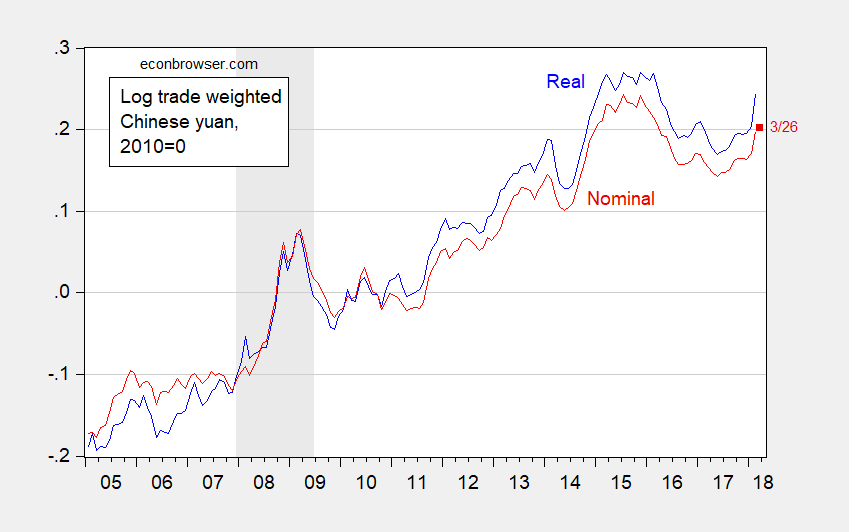
Since the US imports more from China than China from the US, Trump has been excited to level more and more tariffs on Chinese goods claiming that eventually, China would not be able to retaliate. It turns out that global trade has many dimensions. China can retaliate not only via tariffs on trade but restrictions on FDI or simply by depreciating its exchange rate: TB($) = X [$, Chinese tariffs] – M[E, US tariffs]. As tariffs increase China does not have to increase its tariffs on US goods, it can simply depreciate its currency, as it did today.


Britains Impending Golden Age

Boris Johnson, the new British Prime Minister promised the “beginning of a new golden age” in his inaugural speech. Sounds like Britain has a dose of Trump coming its way. As per the Oxford Dictionary, Golden Age is defined as “an idyllic, often imaginary past time of peace, prosperity, and happiness.” The one part that I can see happening is the “imaginary” part. Here is why

All this does not sound like the coming of a golden age, actually, it sounds like the opposite. But if BJ can say it at least three times it may come true or at least people may think it becomes true according to “Trump’s Rule” which he called “truthful hyperbole” as he laid out how he enjoys “playing with people’s fantasies.”

source

Tariffs As Revenue Source

Brown and Irwin have a wonderful piece documenting the importance of US tariffs as a source of government revenue. The two economists parse Trump’s recently tweet:

“Billions of Dollars are pouring into the coffers of the U.S.A. because of the Tariffs being charged to China, and there is a long way to go. If companies don’t want to pay Tariffs, build in the U.S.A. Otherwise, lets just make our Country richer than ever before!”

Here is what they find

1. The United States gets 98 percent of government revenue from non-tariff sources.

2. Raising revenue through tariffs is more costly than other forms of taxation.

3. Raising revenue from tariffs generates fairness concerns.


Payroll Data: When a subject is important, the thirst for data overcomes our judgement about its relevance.

The monthly release of the US Payroll data is always a key indicator of economic activity. Jeff Miller parses what we should and should not read into the payroll data. Here is the abstract:

A) Job creation and destruction exceeds 2 million per month, so the net effect is likely going to be relatively small – despite the fact that the economy created millions of jobs.

B) The reported payroll data is the change in the net, reducing the magnitude of the payroll data even further.

C) But most importantly, the payroll data ist is not the actual change in payroll jobs based on a surveyed sample of US businesses.

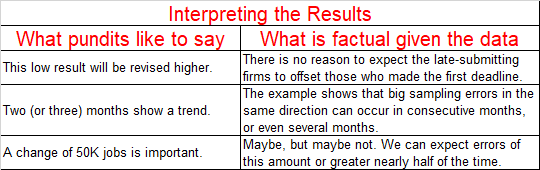
D) Given the size of the US workforce (~150 million), the sampling error implies a 90% confidence interval of 112,000 jobs!  This means that if 100 samples were taken, the mean of 90 of the 100 samples would contain the true mean, but that these 90 samples could differ up to 112,000 jobs.

This has important implications for the interpretation of payroll results:

Trump Tax Reform and US Multinationals

Below the analysis from Brad Setser, who is known for his meticulous knowledge and analysis of international data. Here is what the reform promised:

Trillions of dollars in trapped profits will return to the United States… We expect that it could be — the number started out at about $2.5 trillion; we think it’s going to be close to $5 trillion,” he [Trump] said, speaking to business leaders. “Over $4 [trillion], but close to $5 trillion, will be brought back into our country. This is money that would never, ever be seen again by the workers and the people of our country.” (Source)

But wait, there were more bombastic promises: “With a lower tax rate, U.S. firms will no longer have an incentive to offshore” said Kevin Hassett (Trump’s Chair of the Council of Economic Advisors): “There is also a literature that looks at the relationship between tax rates and transfer pricing. That literature implies that a corporate tax cut to 20 percent would dramatically reduce the trade deficit and increase GDP accordingly.”

And finally, The Trump White House: “The tax cuts will make America a more competitive location for manufacturing.” “American manufacturers are optimistic like never before, because President Trump’s tax cuts and relief make them more competitive.”

All three arguments come up short when compared to the data. It is not true, as Setser shows that “With the tax reform, there is no longer a tax incentive to maintain the whole “offshore” profit charade…  What has happened? Some money has moved back (as one would expect), but not all that much and as of the first quarter [of 2019] firms returned to “reinvesting” a portion of their offshore profit back abroad. The cumulative sum of “reinvested earnings” is rising again.”

US FDI Cumulative Reinvested Earnings

Given all the rhetoric about the cost to the United States of all these trapped profits, the reality that only a small amount, on net, has come back to the United States should be a bit sobering. It turns out that most firms weren’t all that inconvenienced by their large offshore cash balances. Those that really wanted to do a buyback could borrow against their offshore profits. Those that wanted to wait until the tax code changed before doing a buyback could do that too, as the market expected that the bulk of the cash would eventually be returned to shareholders.

Tax Reform in Action

Technically speaking, about $248 billion of formerly offshore profit was returned (That is the sum of the “negative” numbers on reinvested earnings, and sum consistent with the findings of the Wall Street Journal, which found a roughly $300 billion drop in the overall cash balance of U.S. firms in 2019)… Substantively, what really matters is whether the new tax code got rid of the incentive for firms to “offshore” a large portion of their profits. And the answer is clear. It didn’t.

global distribution of us profits (seven low tax vs six large markets)

The amount of profit that American firms report in the world’s low tax jurisdictions is the strongest single bit of evidence that the current process of globalization needs to be reformed. U.S. firms report to earn about 1.5 pp of U.S. GDP in Ireland, the Netherlands, Switzerland, Singapore, and a bunch of really small Caribbean islands. That is far more income than U.S. firms report in large market countries like Germany, France, Italy, China, Japan, India, and Mexico. Clearly something is going on (the countries in Europe are well aware of this, the non-taxation of the profits U.S. tech firms earn in Europe has long vexed them).

The data on the global distribution of U.S. FDI tells the same story—the majority of FDI by value is now claims on those same low tax jurisdictions (Don’t trust me? Look at table 1 of the BEA’s release on U.S. direct investment abroad and the IRS data on what kind of profits U.S. firms report and what kind of tax they pay in different jurisdictions). What happened after tax reform? The profit U.S. firms report in these low tax jurisdictions went up.

location of us profits abroad (bea data, t4q sums, usd billions)


The US Content of “Made In China”

A new Fed paper outlines the “local content” in US Imports, to highlight that trade is not “us against them” but that global supply chains are intertwined. It is well known that Apple designs in the US, builds components globally, and assembles its phones in China. That is one reason why US tariffs on Chinese goods hurt not only China, other countries that produce intermediate inputs, and also the US itself!

When you buy a $100 pair of Nike sneakers made in Asia, only $25 of its cost goes to the Asian factory that assembles the shoes (Kish 2014). Of the remaining $75, $3.50 is spent on shipping from Asia to the United States, and $21.50 goes to Nike to cover its design, marketing, profits, and other expenses. The remaining $50 goes to the U.S. retailer that pays for the transportation of the sneakers inside the United States, worker wages in its U.S. warehouses and retail outlets, rental cost of retail space, insurance, and so on. Thus, half the cost of a pair of sneakers made abroad pays for workers and capital expenditures in the United States, not even counting the part that goes to Nike.

When you buy a MADE IN THE US of A Jeep Patriot, manufactured in Illinois, at least 17% of the cost goes to parts made in other countries (NHTSA 2017). Thus, even for a car that is manufactured in the United States, a substantial part of its cost traces to imported intermediate parts used in its production.

These examples are useful to understand how raw statistics on imports fail to fully account for the cost of imports, and how part of the cost of American goods and services reflects imports. The Fed study accounts for the US (“local”) content of US imports and finds that for some countries (including China) over half of the expenditures for imports flows back to US companies and workers.” 

Trade Negotiations, Mixed Messages

In May 2019, President Trump declared a national emergency regarding potential threats posed by foreign technology companies and blacklisted the Chinese Company Huwwei to prevent it from conducting business with U.S. companies. The U.S. Department of Justice (DOJ) had charged Huawei in January 2018 with bank fraud and stealing trade secrets as well as crimes including conspiracy, money laundering, bank and wire fraud, flouting U.S. sanctions on Iran, and obstruction of justice.

Several dozen(!) countries intoduced bans on Huawei, followed the US lead on Huawei either because they were strong-armed or because they trusted the US threat assessment.

Six weeks later, Trump declared Huawei open for business again and all other countries that shut down Huawei for supposed national security reasons now sit with egg on their faces. Even Republican senators noted that no one will believe the US anymore if one day it declares a country/company a threat to national security and on the next day declares it open for business.

This raises they question why anyone would believe Trump in the first place (see also link and link). Here is the latest soap opera regarding his trade negotiations with China:

Trump on Monday [7/1/2-19] said talks have already begun. “They’re speaking very much on the phone and also meeting,” he told reporters at the White House. A spokesperson for [US Trade Representative] Lighthizer said there no scheduling announcements at this time. “The date is not set. The city is not set,” said one person close to the talks, when asked by Morning Trade about when U.S. Trade Representative Robert Lighthizer might sit down with Chinese Vice Premier Liu He.

We also learned some interesting new pieces if information about these negotiations. They are no longer about tariff reductions but about changes in laws. The “U.S. still wants China to change its laws to implement commitments to combat forced technology transfers and other intellectual property transgressions.” “China wants the U.S. to also amend its laws that Beijing views as hostile to Chinese companies.” You be the judge how likely any of these outcomes are…

Trade War Downsides: Collaborative Countries Have Even More Incentives To Sign Trade Deals

After the G20 summit in Japan, US President Trump went to the only country where he could claim a sealed trade agreement: South Korea (Trump signed a slight update of the comprehensive 2012 Korean-US trade agreement). In Korea he toasted the deal as evidence he’s winning.

But in Washington officials were confronting a grim new reality for U.S. economic power. When Trump dialed up the heat with tariffs and threats, the rest of the world looked elsewhere for opportunities: Bloomberg reports that the European Union is taking advantage of the void created by Trump’s lack of Free Trade leadership by signing historic trade deals with Japan, Latin America, and Vietnam benefiting EU firms in these key markets over US firms.

For two decades, Europe had been trying to nail down a pact with Brazil, Argentina and the two other members of Mercosur, a bloc traditionally known for its nationalist approach to industrial policy and protectionism. But hours before Trump and Xi met, the EU announced the deal was finally done. The message was stark. European industrial giants such as Airbus and Siemens would gain an advantage over their U.S. competitors in Latin America. Argentinian and Brazilian farmers would win an edge in Europe over U.S. competitors, adding to the decline of America as an agricultural export power… With Trump threatening the global order, officials in Brussels, Brasilia and Buenos Aires had spied an opportunity to forge the new economic alliance — just as the EU and Japan had in a deal that took effect earlier in 2019. A day after the leaders left Osaka summit, the EU signed a deal with Vietnam, a nation Trump just days earlier lambasted as ‘almost the single worst abuser of everybody.’”

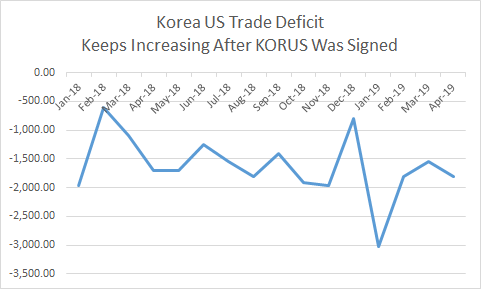
And just to clarify what Trump calls “winning” as he visits Korea: The Korean trade deal (signed September 2018) has done nothing to reverse the bilateral US trade deficit (not that bilateral trade deficits matter, but it just shows its unclear what Trump was toasting in Korea as evidence he’s “winning”).

Data source: BEA

Databases


The New Trade World Order

US President Trump met General Secretary Xi of China at the G20 meeting in Osaka, Japan. Subsequently Trump announced not to impose additional tariffs in exchange for China’s increased purchases of US agricultural goods, [mysteriously the Chinese statement of the meeting did not mention China’s increased purchases...].

Just to be clear, the brilliantly negotiated, triumphant outcome for Trump is thus simply status quo that existed along before Trump started his bilateral trade wars (e.g: no tariffs and China buying US Ag products).  Well, no, one thing is different: The US will provide China a shopping list of what it is supposed to buy from the US. Whoever came up with this unusual idea really distinguished himself/herself. Of course the Chinese will only buy what they need so they are humoring Trumps list — but what is the purpose of Trump going around threatening countries with forced shopping lists of US products? Is that how the Trump or the US wants to “win” the trade war?

source

My Son Just Bought His College Laptop…

T’was an HP that my son ordered, which was custom built and shipped straight from the factory in China to our doorstep. No notions that there may be any American manufacturing involved (like the Dells computers who first make their way to Texas to be shipped out from an American address). Fortune Magazine reports that

Dell, HP, and Microsoft said they account for about half of the notebooks and detachable tablets sold in the U.S. Prices for laptops and tablets will increase by at least 19%—about $120 for the average retail price of a laptop [and game consoles!] — if the proposed tariffs are implemented, according to a study released this week by the Consumer Technology Association. The companies said they spent a collective $35 billion on research and development in 2018 alone, and tariff costs would divert resources from innovation while providing “a windfall” to manufacturers based outside the U.S. that are less dependent on American sales.”

So the Chinese exporters that Trump is trying to hurt are actually US companies. The profit shifting from China to the US are actually reducing US companies’ profits as the tariff reduces US companies’ profits relative to competitors who ship their computers to non US consumers (from China).

Here are the results from the study: After accounting for new tariff revenue, there is a net $8.1 billion loss for the U.S. economy, from cell phone and laptop tariffs alone, with most of the burden carried by U.S. consumers.

CELL PHONES:

  • Change in Price of Chinese Imports +22.0%
  • Change in Chinese Production -4.8%
  • Change in U.S. Production 0.0%
  • Change in Prices of U.S.-Made Cell Phones 0%
  • Change in U.S. Consumer Prices (from All Sources) +14.0%
  • Impact on Consumption -28.0%
  • Reduction in Consumer Spending Power $8.1 bill.
    Net Impact on U.S. Economy -$4.5 bill.

Laptops and Tablets

  • Change in Price of Chinese Imports +21.0%
  • Change in Chinese Production -7.0%
  • Change in U.S. Production +4.8%
  • Change in Prices of U.S.-Made Laptops/Tablets +6.5%
  • Change in Prices to U.S. Consumers +19.1%
  • Impact on Consumption -35.3%
  • Reduction in Consumer Spending Power $8.2 bill.
    Net Impact on U.S. Economy -$3.6 bill.


More Problems With Bilateral Trade Balance Fixations

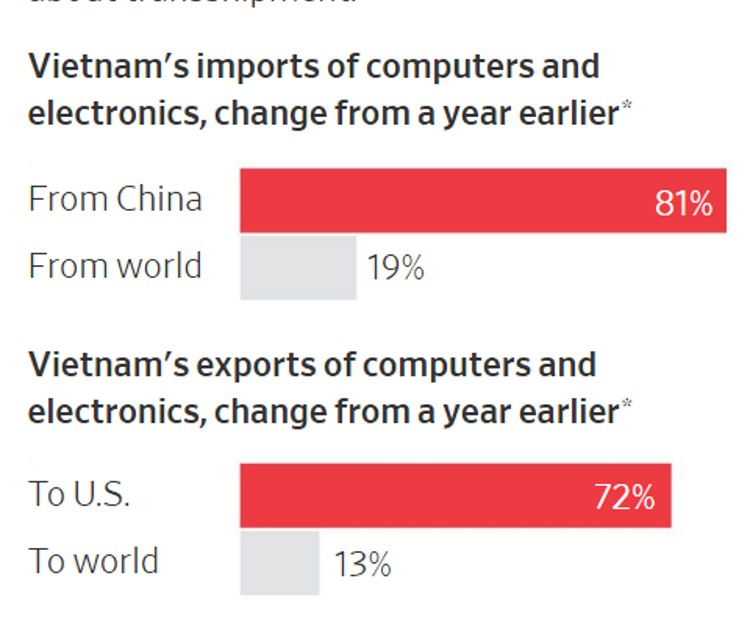
President Trump likes to fight each country individually, each with its own personalized trade war. A quick search of this blogroll highlights how quixotic it is to focus on bilateral trade balances. Aside from the fact that the aggregate trade deficit is determined by factors other than unfair trade measures in any particular country, there is also the issue of “trans-shipments.” Brad Setser documented it for “Chicken Feet” while the WSJ documents the same for computer electronics. Chinese exports to the US now simply have to traverse through a 3rd country to avoid 25% tariff. 

Tariffs and National Security

In May 2018 the US Department of Commerce started to investigate the car industry to determine whether imports created a national security risk. Usually, these investigations are initiated by either firms in the industry or by unions but curiously both opposed the investigation. The Motor and Equipment Manufacturers Association, which represents auto parts suppliers, warned that “tariffs will shrink investment in the United States at a time when the auto industry is already reeling from declining sales, Trump’s tariffs on steel and aluminum, and tariffs on auto parts from ChinaThese tariffs, if applied, could move the development and implementation of new automotive technologies offshore, leaving America behind… Not a single company in the domestic auto industry requested this investigation.”

Safeguard investigations are allowed to last up to 270 days and on February 17, 2019, two (!) hours before the 270 day deadline was up, the US Department of Commerce sent its report to the White House, triggering a 90-day review period for Trump to decide whether to impose tariffs (IF the report found national security issues). These 90 days were supposed to be up on May 17, 2019, but this has not stopped the White House from a) keeping the report secret although it has a statutory legal obligation to make it public, b) threaten car tariffs.

source

Another Trump Victory: China Is Lowering Tariffs – Just Not To The US

While Trump shows other countries nothing but his tariff stick, China has been offering carrots.  Beijing has repeatedly cut its duties on imports from America’s commercial rivals, including Canada, Japan, and Germany.”

In an amazingly researched piece, Chad Brown at the Peterson Institute of International Economics documents that while China is raising its tariffs in retaliation to the US, it is lowering its tariffs to the rest of the world. Probably to limit the negative impact from the Trump Tariff War. So the escalation in tariffs Trump is forcing is only half the bad news for US exporters, the other half is American companies and workers now are at a considerable cost disadvantage relative to both Chinese firms and firms in third countries. The result is one more eerie parallel to the conditions US exporters faced in the 1930s.Figure 1: China’s average tariff rate is climbing on US goods and falling for the rest of the worldFigure 3: China’s tariff rates on US goods vs. the rest of the world’s goods by sector as of June 1, 2019

Addressing Migration Incentives

There are two approaches to addressing migration. 1) Trumps political hostage taking, hoping paramilitary and human rights violations (due to aberrant asylum laws) will solve the issue. 2) Addressing the cause of migration: income inequality.

When the Iron Curtain fell in the early 1990s, migration pressure from Eastern to Western Europe was tremendous. In PPP USD, several former Eastern Bloc countries had per capita incomes that were less than 1/6th of Germany’s. That is similar to the current disparity between the US  and Central American countries that originate most of the migrants. Instead of building new walls, dismantling asylum laws or instituting paramilitary searches, Europe went on a determined program of structural adjustment loans to help developing Europe catch up and provide jobs and reasons from former Eastern Block citizens to stay instead of migrating.  25 years later, migration from Eastern European countries is not an issue. The Peterson Institute makes the same case for Latin America:

Tariffs on Mexican Products Will Not Curb Migration from Guatemala, Honduras, and El Salvador; Prosperity Will

Anabel González (PIIE), June 7, 2019 12:15 PM

President Donald Trump’s threat to impose across-the-board tariffs on Mexican imports is aimed at reversing alleged Mexican inaction in stopping the flow of migrants from Guatemala, Honduras, and El Salvador—known as the Northern Triangle—into the United States. This measure, which would raise the costs of $346 billion in imports, would not only violate international trade obligations, it is also the wrong tool to stop the flow of immigrants. Increasing prosperity in Northern Triangle countries would directly address one of the root causes of migration.

US IMMIGRATION PATTERNS ARE CHANGING

The increased Northern Triangle migration highlights several changes in US immigration trends. First, it takes place in the context of historically low levels of total immigration to the United States. From a 45-year low of approximately 304,000 apprehensions of migrants of all nationalities at the southwest border in 2017, the number increased to 397,000 in 2018, which was comparable to the annual average for the southwest border[1] during 2009–18. Second, the national origins of immigrants are shifting. Immigration from Mexico, which accounted for almost all migration flows to the United States at the beginning of the century, has plummeted (see figure 1). Conversely, immigration from Northern Triangle countries, which started to increase in 2012, reached 52 percent of southwest border apprehensions in 2018 (see figure 2). Third, the type of migrants apprehended has also changed. Whereas in the past, single adult males represented over 90 percent of apprehended migrants, now most of them are families and unaccompanied children, asking for protection from violence and crime.  And fourth, the number of affirmative asylum applications from nationals of Northern Triangle countries has increased from 3,523 in 2012 to 31,066 in 2017, an almost 800 percent increase. More than half of the applications were from unaccompanied minors.Figure 1 Immigration from Mexico has plummeted Figure 2 US Border Patrol apprehensions for Mexicans have dropped, while apprehensions of Northern Triangle citizens have increasedMIGRATION FALLS WHEN INCOMES RISE

Migration is a complex phenomenon. The immigration literature shows that there is an inverse relationship between economic development and migration (Clemens 2014). It is not until countries achieve a certain income per capita, around $8,000, that migration flows begin to cease. Illegal Mexican immigration into the United States fell sharply around 2005, when Mexico’s GDP per capita hit the $8,000 mark.[2]

The Northern Triangle countries still have a long way to catch up with Mexico. In 2017, GDP per capita was $3,889 in El Salvador, $4,471 in Guatemala, and $2,480 in Honduras (see figure 3). This roughly implies that for migration to slow down, El Salvador and Guatemala would need to double their respective per capita incomes, while Honduras would need to more than triple its own. Looking at potential growth trajectories for these countries, this is a tall order.Figure 3 GDP per capita for Northern Triangle countries is far below that of MexicoAccording to the International Monetary Fund (IMF), potential growth for Central American economies is projected to remain at 4 percent on average during 2015–20 (and this estimate includes other countries in the region that have posted higher growth rates in the past and have brighter prospects). So, were the Northern Triangle countries to manage sustained annual growth rates of 4 percent—which is feasible for both Guatemala and Honduras but more challenging for El Salvador—it would take El Salvador and Guatemala some 17 to 18 years to achieve the mark of $8,000 of income per capita and a few more years in the case of Honduras.

INCREASED PROSPERITY FOR NORTHERN TRIANGLE COUNTRIES IS KEY TO TACKLING MIGRATION ISSUES

To accelerate their growth rate, these countries need policy interventions and significant public and private investments in infrastructure, connectivity, and education and skills, among other factors, to increase private sector opportunities. The region furthermore needs to strengthen its ability to cope with and manage its high vulnerability to natural disasters. These interventions must promote inclusive growth in order to create good formal jobs, reduce poverty, and allow for broad-based development. Increased prosperity is only feasible if security challenges associated with illicit drug trafficking and gang violence are addressed in parallel, while strengthened governance, through improved rule of law and anti-corruption actions, takes priority. In tackling these underlying causes of migration, US assistance plays an important role, which is why President Trump’s decision earlier this year to cut off an estimated $700 million in aid to the three countries is worrisome.

A more prosperous, secure, and well-governed Northern Triangle is possible, but that transformation will take time—far more than a decade. Transition measures are thus required to accommodate migration flows as economic development takes place. And Mexico, for sure, has an important role to play. Just last December, the United States and Mexico committed to expand bilateral cooperation to foster development and increase investment in southern Mexico and Central America to create a zone of prosperity. Moreover, President Andrés Manuel López Obrador has been promoting a “Marshall Plan” that would see some $20 billion in private investments directed at the southern part of Mexico and the Northern Triangle countries, which in turn would strengthen Mexico’s capacity to absorb larger immigration flows from its Central American neighbors.

Increased tariffs on Mexican goods will not help. Instead, tariffs will increase trade costs, unravel supply chains, deter investment, and increase prices for US consumers.  Escalating duties will also erode the US negotiating position with other trading partners, as they see the United States renegade on agreed rules. It is possible tariffs may force Mexico into stepping up enforcement actions at its southern border.  But one thing these tariffs will not achieve: stopping migrants from Guatemala, Honduras, and El Salvador. That will only happen when they can find economic opportunity in their own countries.

Capital Controls in China and Vietnam & The Impossible Trinity

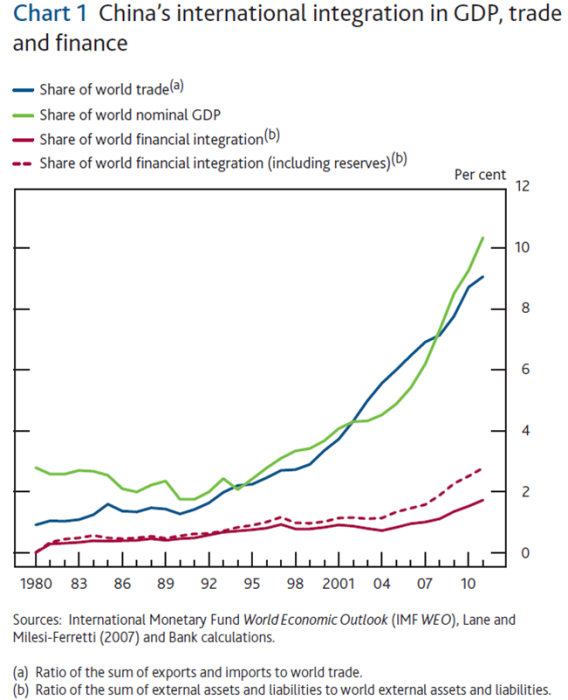
“Low ‘k’ ” or limited capital mobility seems like a preposterous concept these days — although it was the global standard from 1044-1972. Most industrial and developing countries have since liberalized their financial accounts, but China and Vietnam still maintain strict controls on the financial account. Here is a comparison courtesy of the Vietnam Investment Review:

Comparison of China’s capital controls with Vietnam’s

Economic theory defines the ‘Impossible Trinity’, also known as ‘the Triangle of Impossibility’, as a nation’s inability to simultaneously pursue three macroeconomic goals: a stable exchange rate, free capital flows, and an independent monetary policy. This theory was named the Mundell-Fleming Model, put forward by Robert Mundell and Marcus Fleming in the 1960s.

Despite similarities with Vietnam in terms of macroeconomic goals, China has greater inbound foreign investment controls.

Vietnam approaches the triangle of impossibility in much the same way as China does. They both implement capital controls in order to pursue their inflation target, while maintaining exchange rate stabilisation. In a previous article, we examined China’s controls regarding inbound foreign direct and indirect investment capital, in order to draw parallels with Vietnam. Today, we review China’s control on inbound foreign indirect investment capital by individuals.

Two currencies are used within Chinese markets: renminbi in mainland China and Hong Kong dollars in the Hong Kong special administrative zone. In accordance with the Impossible Trinity theory mentioned above, the renminbi is controlled at the expense of free capital flows, while Hong Kong dollars are based on free capital flows and an independent money supply.

There are also two types of shares traded in these markets with different rules, namely A-shares and B-shares, both of which are traded on the exchanges at Shanghai and Shenzhen. A-shares are denominated in renminbi. They can only be traded by Chinese citizens and a small number of foreign institutions with Qualified Foreign Institution Investor (QFII) status. China’s foreign exchange management on QFIIs was described in our article posted in VIR dated November 30, 2015.

B-shares are denominated in US dollars on the Shanghai exchange and Hong Kong dollars in Shenzhen. They can be traded by all foreigners and by Chinese citizens with the appropriate foreign currency accounts. The B-shares market is small, contains many poor-quality companies and generally sees little action. In the mainland China market, foreign investors are only allowed to buy B-shares, with prices quoted in US dollars and Hong Kong dollars, which are free-float currencies. In this regard, China’s authorities don’t have to manage foreign exchange on renminbi with foreign portfolio individual investors. 

While B-shares were originally intended to be the main mechanism for foreigners to invest in China, most investors have preferred to focus on shares of mainland Chinese companies listed in Hong Kong, which are available to all investors. These companies fall into three groups: ‘H shares’ are issued by mainland-registered companies in the Hong Kong market (so the same business could have A shares, B shares and H shares outstanding); ‘Red chips’ are state-controlled businesses that are technically registered in Hong Kong, but do the majority of their business in the mainland; and ‘P chips’ are registered in Hong Kong, but are controlled by non-state mainland owners.

The rules on investing in A-shares are likely to be relaxed in the long term, but it will probably take a decade or more for this to take effect. For now, foreign retail investors are confined to the other types of shares.

Recently, some foreign investors have suggested that the State Bank of Vietnam relax the documentation requirements for foreign individual investors to invest in the stock market here.  However, Vietnam’s controls are already much looser for foreign individual investors than China’s. Although foreign ownership limits are still applied in Vietnam, foreign individual investors are allowed to invest in all types of securities companies whose prices are quoted in VND, including both listed and OTC shares.

130% of Trump’s Tariff Revenues Redistributed to Farmers

“A little hyperbole never hurts. People want to believe something is the biggest and the greatest and the most spectacular. I call it truthful hyperbole. It’s an innocent form of exaggeration — and a very effective form of promotion.” (Donald Trump, “The Art of the Deal”)

In his great confusion (or “truthful hyperbole”) about tariff mechanics, President Trump proclaimed that China is paying US tariffs: he tweeted that “I am very happy with over $100 Billion a year in Tariffs filling U.S. coffers… great for the U.S. not good for China.”

Steil and Della Rocca from the Council of Foreign Relations point out that the $100 billion is without foundation and actual tariff revenues are less than $10 billion: “As we pointed out last December, Trump’s tariff claims have a bigger flaw. In 2018, the U.S. government committed to paying American farmers $9.6 billion to offset their losses from Chinese tariff retaliation. This is about $1 billion more than it took in all year from Trump’s China tariffs. Tariffs, therefore, ending up not just harming American companies and consumers, but costing the government money. More money left “U.S. coffers” to offset farm losses than came into them from U.S. importers.”

Since last year, as the graphic above shows, Trump’s “tariff deficit” has only ballooned further. The Department of Agriculture just unveiled a new $16 billion bailout for farmers hit by the trade war. After just ten months of a trade war with China, subsidies to farmers are set to drain over $25 billion from “U.S. coffers” for damage done to date. China tariffs, meanwhile, have so far brought in just over $19 billion in tax payments from U.S. importers—$6 billion less than authorized farmer payments.”

Fixed Exchange s, Open Financial Accounts and Fiscal Deficits

Seven years ago, at the height of the Greek Euro Crisis, Robert Mundell, “father” of the Mundell Fleming model and “father” of the Euro, proclaimed that the biggest threat to the euro is a potential bailout of Italy, which might just be too expensive

Italy is still (again?) teetering on the brink as it risks a $4billion penalty for violating the Euro’s fiscal discipline rules. Why? Use the MF model to explain Italy’s interest in racking up debt.

Another Tariff Shock

One way to detract from the fact that the USMCA trade agreement may not be ratified is to kill it before it has even been discussed in Congress.

On May 20, 2019, President Trump announced a 5% tariffs on Mexican goods would go into effect on June 10, unless Mexico “curbs illegal migration” at the US Mexico Border. It is unclear what the measure of “curb” is here, but perhaps that is his point. These tariffs are supposed to grow steadily up to 25% by Oct. 1, 2019.

Deutsche Bank reminds us that two-thirds of U.S.-Mexico trade is between factories owned by the same company. Source: Deutsche Bank Research


US-China Trade War Trade Diversion

The National Bank of Canada noticed that Canada, as the largest trading partner of the US would benefit from the trade diversion created by the US-Chinese tariff war. The statistical analysis seems a bit suspect (a 1% reciprocal tariff increase is supposed to result in increased Canadian exports to the US that lift Canada’s real value added by about 0.8%. But the tariff increase is going to be 10%-25%). Nevertheless, it is nice to see that someone picked up on the trade diversion concept. A windfall for the Canadians and another loss for American consumers.

Carpet-Bombing Trade: The Art/Sport? Of The Deal

Trump: The Art of the Deal

It turns out, just when President Trump wrote his epic “The Art Of The Deal” fiction novel. He was losing billions of dollars to bilk the US Government/IRS and private banks out of revenues. He called this behavior a “sport.” Although the arch-conservative Washington Inquirer newspaper notes that his “sport” cost tens of thousands of honest Americans dearly. Image result for trump tax sport tweet


He may be following a similar script in his trade negotiations with China. On less than a week’s notice, increased tariffs on $200 billion in Chinese imports to 25% tariff (I wonder what that will do the iPhone…). The WSJ reports that the first round of Trump tariffs cost US consumers $69 billion, this new round will be substantially more expensive. Now Trump threatens virtually all Chinese imports with tariffs. The Chinese will retaliate.

One interest group is being taken care of, however, Trump tweeted that US government would “buy agricultural products from our Great Farmers, in larger amounts than China ever did.” That’s in addition to the $12billion handout farmers already received in January 2019 to compensate them for earlier tariff-related trade losses.

Both Fed Nominees Withdraw

Herman Cain, Tea Party activist, former presidential hopeful, and Trump’s uniquely unqualified Fed nominee withdrew April 22, 2019, although he had adamantly stated 4 days earlier that he would “continue the fight.” That was after Senate Republicans withdrew they support for his confirmation.

Ten days later, Stephen Moore, ‘American Writer’ at the Heritage Foundation, and Trump’s other uniquely unqualified Fed nominee also withdrew only hours after his “I’m all in” pledge. Incoherent interviews showed him struggling to explain away his lunatic economics statements/forecasts, and his disqualifying misogynistic and racist statements/jokes did him in.

Let’s hope the next nominees are qualified.

China Isn’t “Cheating” On IP, It Is Just Running America’s Old Plays

writes Jeff Pross. It was no other than Alexander Hamilton, the first US Secretary of the Treasury, who instituted the first US tariffs in 1792 with the explicit intent of raising funds and paying off the first States’ debts and developing US industries. (Here is the full story).

In 1944, global institutions were established to assure free trade (IMF, World Bank, GATT, WTO), which impose tough rules that guarantee free movement of goods across borders. These rules prohibit public subsidies and “industrial policy” (tariffs to safeguard industries threatened by imports). Sure, China and many other nations flout those rules (here is a list of the nearly 600 WTO trade disputes since 1995), but neither the US nor Europe became rich by following these rules themselves! Quite the contrary, Pross suggests that China’s current trade strategies are basically plays from the 1800-1944 US/European development playbook. In fact, the US/Chinese trade tensions hold an “uncanny resemblance to the German/UK trade tensions in the nineteenth century… Both rivalries feature countries enmeshed in tariff threats, standard-fights, technology theft, financial power struggles, and infrastructure subsidies for advantage.”

“Between 1816 and the end of the Second World War, the U.S. had one of the highest average tariff rates on manufacturing imports in the world.” Over its history, the U.S. has never shied away from using subsidies and industrial policy to support everything from agriculture to transportation to health research. Right after independence and technologically behind Britain, America was absolutely shameless about snatching technology and intellectual property from other countries. By comparison, China’s “forced” technology transfer is pretty tame: It simply demands that any foreign investor who voluntarily decides to do business in China’s domestic market must engage in a joint venture with a Chinese partner.

European countries followed the same playbook of development. Britain built up wool manufacturing in the late 1500s through industrial policy.. lowering tariffs on imports of raw materials, but raising tariffs on imports of manufactured products — in order to keep the resources coming in but to protect its high value-added industries. In the mid-1800s, Britain pulled off the original “technology transfer” with China as its victimBritain sent agents through China to steal tea plants/seeds and learn agricultural practices to introduce tea plants to India and marginalize China in the global tea market. And oh, to “fix” its trade deficit with China, the British government (!) resorted to overt drug trade, flooding China with Opium; and once addicted, the British sold China opium at exorbitant prices to reverse the trade deficit into a surplus.

 There exist similar stories with different variations for other European nations such as France, Germany, Sweden. In 1885, the German economist Friedrich List noted that great powers tended to grow their own industries through protectionism until they were big enough to be basically invulnerable in the global market. Then the they “kicked away the ladder” by converting to free trade policies, and demanding others do the same.

It Is What It Is


I’d like to keep the blog academic and fact-based, and at the same time, some of the recent economic events are just so surreal and frankly (in my opinion) dangerous that I fear some of my posts start to read like partisan politics (see my posts on Turmp’s trade person, Peter Navarro here, here, here, here,  and here). But what has to be said in the name of truth, has to be said.

If you think I am harsh on the people Trump employs to lie about economics, I should note that even arch-conservative magazines like “Fortune,” (to the right of the WSJ) call the Trump’s economic policies “stupideconomics.” (here and here).

It has long been Trump’s goal to dismantle government agencies by installing critics who hate the very agencies they were supposed to lead. These critics then proceeded to dismantle with impunity key agencies such as the US Department of Agriculture, the US Department of Energy, the US Environmental Protection Agency, or the US Consumer Financial Protection Bureau (or 68 minor agencies and programs that are being eliminated directly through proposed 100% funding cuts). While it is difficult for me personally to see these agencies and programs go, I accept that the will of the people (in form of the electoral college) apparently supports Trump’s concept of “instant deregulation” through agency shut down.

But when it comes to the dismantling of the Fed we are starting to talk not just about the dismantling of an agency, but about the dismantling of the very economic foundation of our society. I have written about the two new nominees for the Fed positions before. In a recent New York Times OpEd, Paul Krugman puts it eloquently:

“The Fed’s governing board currently has two vacancies, and Donald Trump has proposed filling those vacancies with ludicrous hacks. If he succeeds, one of our few remaining havens of serious, nonpartisan policymaking will be on its way toward becoming as corrupt and dysfunctional as the rest of the Trump administration. Stephen Moore and Herman Cain are, of course, completely unqualified — I say “of course” because their lack of qualifications is, paradoxically, a key qualification… for Trump…”

As I pointed out before, both Moore and Cain were “Hard Money Men” during Obama’s presidency, meaning both demanded higher interest rates when unemployment was high (to fight inflation they predicted would appear but which never materialized). Now, strangely, both demand lower interest rates while unemployment is at an all-time low — only because it conforms with Trump’s view of the world.

Krugman characterizes Moore and Cain succinctly: Moore “is basically a classic right-wing hack who tries (incompetently) to impersonate an economic expert. Cain, on the other hand, is a spam king whose business model involves making his email list available to direct marketers… Moore has been out there predicting magical results from tax cuts, putting out fake economic numbers, and giving speeches to FreedomFest. At the same time, Cain has been offering a platform for peddlers of get-rich schemes and cures for erectile dysfunction.” This reminds me of Trump’s choice Attorney General,  whose prior job was to promote hot tubs and toilet seats for well-endowed men for a scam company that was shut down by the FTC.

Tampering with the independence and competence of the FED by nominating either a pizza exec who peddles erectile dysfunction spam or an unscrupulous economic liar is dangerously undermining the very foundation of the US.

Trump Proposed Two Uniquely Unqualified Candidates To Run The Fed

This from the conservative WSJ

President Trump said Thursday he intends to nominate former GOP presidential candidate Herman Cain to the Federal Reserve’s board of governors… The selection of Mr. Cain, following the president’s decision to nominate his former campaign adviser Stephen Moore, marks an effort to install two Fed critics and loyal Trump supporters on the central bank’s powerful seven-seat board… Messrs. Cain and Moore both staked out positions quite critical of the Fed’s easy-money policies earlier this decade —stances that would appear to be at odds with Mr. Trump’s desire for rate cuts now. Messrs. Cain and Moore have previously advocated, for example, a return to the gold standard… 

…JPMorgan Chase & Co. Chief Executive James Dimon said he hoped senators would “do their homework” on Messrs. Moore and Cain. “I don’t think they are the right people,” he said at an event in New York. “They should put professional people on.”

What does Dimon mean by “professional people?”  Probably “economists.”

Cain’s background — other than his sexual harassment allegations and settlements is in the burger and pizza business. I am not making this up, zero economics background. No wonder he is a gold bug.

Moore’s background — other than his refusal to pay debts to child support – is an MA in economics with zero peer-reviewed output and a long, scary history of flagrant lying about economic facts. Here are some direct links from Menzie Chinn that are well worth reading to understand how scary his appointment would be — and he is the “more qualified” of the two candidates…

Stunning Central Bank Balance Sheets

This picture speaks 1000 words: From 2016 to 2019, the balance sheets of central banks (in an (over)simplified way of thinking, the amount of bonds they are holding) increased from about 5 trillion to 22 trillion dollars. That is an incredible infusion of liquidity into the global financial markets, which has led to near zero (in some cases negative) interest rates – but very little inflation and certainly no roaring equipment investment. Structurally, the economies or certainly financial intermediation has changed. 


Market Power and FTA Negotiations

The UK is learning how important it is to have market power in FTA negotiations. When the entire EU (28 countries) negotiated FTAs with non-member countries, they were able to insist on basic human rights standards. No so anymore as Britain is trying to renegotiate its own agreements. The Guardian reports that “Britain has received demands to roll back its human rights standards in exchange for progress on post-Brexit trade deals…” Even countries like Japan and Korea are in no hurry to sign trade deals and demand additional economic concessions. So far, only the UK has rolled over just £16bn out of £117bn in trade deals (link).

Image result for cartoon britain negotiate new trade deals

source

Fascinating Term-Spread / Deficit Mystery

Depite strong income (GDP) growth in 2018 and increases government spending tax revenues were flat, thanks to the huge Trump tax cut (mostly for corporations).  Menzi Chinn highlights a real puzzle: Why are term spreads (10yr -3mo Treasury Bill Spreads) falling as the deficit is rising? ON TOP OF THAT, demand for treasuries in general seems to be falling (although it would be interesting to see the graph disaggregated by 10yr and 3mo terms). Figure 1: 10 year-3 month Treasury spread (blue), structural budget deficit as a share of potential GDP (red). Orange shading denotes Trump administration. Source: Federal Reserve, CBO, Budget and Economic Outlook, and Chinn’s calculations.Figure 2: Foreign and international holdings of US Treasurys (blue) and Federal Reserve holdings (red), both as a share of potential GDP. Source: BEA, CBO, and Chinn’s calculations.


Confidence Intervals

From Wiki: In statistics, a confidence interval (CI) is a type of interval estimate, computed from the statistics of the observed data, that might contain the true value of an unknown population parameter. The CI has an associated confidence level that, loosely speaking, quantifies the level of confidence that the parameter lies in the interval.

More strictly speaking, the CI represents the frequency (i.e. the proportion) of possible confidence intervals that contain the true value of the unknown population parameter. If confidence intervals are constructed for a given confidence level from an infinite number of independent sample statistics, the proportion of those intervals that contain the true value of the parameter will be equal to the confidence level.

Menzi Chinn highlights what a Confidence Intervals is not:

The specific 95 % confidence interval presented by a study has a 95 % chance of containing the true effect size. No!

A reported confidence interval is a range between two numbers. The frequency with which an observed interval (e.g., 0.72–2.88) contains the true effect is either 100 % if the true effect is within the interval or 0 % if not; the 95 % [confidence interval] refers only to how often 95 % confidence intervals computed from very many studies would contain the true size, if all the assumptions used to compute the intervals were correct. [A polite way of saying, if your statistical model is garbage, your confidence interval is garbage, too. Garbage in Garbage Out.] It is possible to compute an interval that can be interpreted as having 95 % probability of containing the true value; nonetheless, such computations require not only the assumptions used to compute the confidence interval, but also further assumptions about the size of effects in the model. These further assumptions are summarized in what is called a prior distribution, and the resulting intervals are usually called Bayesian posterior (or credible) intervals to distinguish them from confidence intervals. Source: Greenland et al. (2016).

The Economic and Environmental Impact of the WA Shellfish Industry

“Northern Economics Inc” provided an economic impact study of the Washington Shellfish Industry: Over 2500 jobs created, over $250 million in output and labor income. 

Note that these gains are largely private, that is, they accrue to private individuals such as workers or business proprietors. What the study does not mention are the costs, most of them public. Cliff Mass at the UW, summarizes the harrowing costs outlined in the must-read book “Toxic Pearl” (The Kindle version from Amazon is only $5.99))                                               Toxic Pearl: Pacific Northwest Shellfish Companies' Addiction to Pesticides? by [Perle, M.]

Here is the abstract from Mass’ blogpost: The book describes

  • Poisoning of Washington State’s shorelines by some members of the shellfish industry.
  • Spraying of herbicides and pesticides over State shorelines from Puget Sound to Willapa Bay,
  • Spread of plastic pollution,
  • Physical destruction of shorelines areas.
  • Cooperation of WA Department of Ecology and Natural Resources officials and even the Governor’s office with the shellfish industry, and even the participation of the State’s educational institutions like WSU and the UW. Apparently The WA State Departments of Ecology and Natural Resources have supported the use of pesticides to kill the native burrowing shrimp.

For decades, this industry, sprayed the pesticide Carbaryl, a powerful neurotoxin (also known as Sevin) around Willapa Bay and other local shore areas to kill a Washington State native animal, the burrowing shrimp.  Burrowing shrimp are an important food source for many native species including fish, birds, and crabs.

Some members of the shellfish industry are also spraying herbicides such as imazamox  over the coastal zone to kill eel grasse to make it easier for the industrial clam and oyster operations.  Such grasses are important source of food for wildlife and provide habitat for a wide variety of species.  More recently, some in the shellfish industry is pushing to spray ANOTHER neurotoxin (Imidacloprid) over our coastal waters.   And, chasing the high-value Chinese market for geoducks, the industry is putting in miles of cut-off plastic tubes with plastic netting over mudflats around the region, resulting in the dispersal of plastic pollution throughout our coastal environment (see picture below).
Toxic Pearl also documents sickness and illness following the spraying, and reviews the association of spraying with a large increase of miscarriages among the Shoalwater Bay Tribe.

In 2015, Danny Westneat of the Seattle Times wrote an important article outlining the herbicide/pesticide spraying by the WA shellfish industry, but some of the clam/oyster folks are still spraying herbicides and pushing to spray Imidacloprid.

The author, M. Perle, has set up a website with orders and additional information: http://www.toxicpearl.com

Economics of Voting

Source

Would increasing household income lead to increased voter participation?Econofact mentions a recent study that involved a natural experiment: unexpected and permanent increase in household incomes.  The Eastern Band of Cherokee Indians in North Carolina opened a Casino and households enjoyed a windfall increase in income that was unrelated to education, disabilities, income level, marital status or the presence of children (each adult received $4,700/year). The increase in income did not have an effect on parents’ voting behavior, however, it did increase their children’s voting behavior. Children benefiting (indirectly) from the cash transfers had higher levels of education, which suggests that the subsequent increase in voting. Another possible is that families who received the income windfall were less likely to move, which helped students education attainments or their families’ civic participation.

Tariffs Hurt Babies!

In what seems to be a curious public relations stunt, the US farmers are financing a public relations website called tariffshurt.com. It reports that the Pittsburgh based non-profit called “Cribs for Kids” had to reduce the amount of cribs it could provide to US moms in need.

Tariffhurts.com also quantifies the cost of Trump tariffs on each state’s economy (sadly no methodology was provided). Here is the impact on Washington State: 

What Happened to the Trump Corporate Tax Cut: Part II?

How much of a stimulus did the economy receive from the 100’s of billions in tax cuts corporations received? Reuters/Yahoo reports that U.S. companies used the money to go on a shopping spree for their own stocks to raise their own share prices.

These stock buybacks were a major factor behind the 2018 bull market. “Companies bought back around 2.8 percent of shares outstanding in 2018. That was a substantial support to the market and bigger than dividends,” said Jack Ablin, chief investment officer at Cresset Wealth Advisors in Chicago. 2018 will go in the books as a record for buybacks. Through the first three quarters of the year companies bought $583.4 billion of their own stock, just shy of 2007’s full-year record of $589.1 billion, according to S&P Dow Jones Indices data.

Strategists say U.S. companies spend heavily on their own shares as they have plenty of cash and tend to favor buybacks over dividends and major capital investments in times of economic and policy uncertainty. Goldman Sachs has forecast a 44 percent jump in buybacks to $770 billion for 2018, with growth slowing to a 22 percent rise to $940 billion for 2019.

After rushing home some $295 billion of foreign profits in the first quarter of 2018, the pace of repatriation by U.S. multinationals has since slowed sharply, Commerce Department data shows. In the third quarter that was down to about $93 billion. About $190 billion, or about a third, of repatriated funds were used on buybacks in the first three quarters of 2018, JPMorgan strategist Nikolaos Panigirtzoglou wrote.

FEEDING THE BULL

Buybacks have been a major support to the bull market that began in March 2009. S&P 500 companies bought roughly $4.5 trillion worth of their own shares, equal to about a third of the benchmark’s $15 trillion gain in value over that time, according to Audrey Kaplan, head of global equity strategy at Wells Fargo in New York. Datatrek Research said U.S. companies tend to spend between 40 percent and 60 percent of operating income on buybacks and only breach the low end in “the direst times.”

What Happened to the Trump Corporate Tax Cut: Part I?

President Trump signed the “Tax Cuts and Jobs Act” into law on Dec. 22., 2017, bringing sweeping changes to the tax code. The tax cut features temporary changes to the individual tax code and permanent changes to corporate taxes. Overall it is a $1.5+ trillion overhaul. Investopedia has the details. The tax cuts permanently remove the “individual mandate,” which was a key provision of the Affordable Care Act; this will raise health care insurance premiums and significantly reduce the number of people with coverage. The highest earners are expected to benefit most from the law, while the lowest earners may actually pay more in taxes once most individual tax provisions expire after 2025.

For the wealthy, banks and other corporations, the tax reform package can be considered a lopsided victory given its significant and permanent tax cuts to corporate profits, investment income, estate tax and more. Financial services companies, especially, stand to see huge gains based on the new, lower corporate rate (35% to 20%) as well as more preferable tax treatment of pass-through companies. Some banks have said that their effective tax rate will drop under 20%.

The overhaul is forecast to raise the federal deficit by hundreds of billions of dollars – and perhaps as much as $2.0 trillion – over the coming decade. Estimates vary depending on assumptions about how much economic growth the law will spur, but no independent estimates follow Treasury Secretary Steven Mnuchin, who is by law required to study the impact of the tax change on US dept predicts net reduction to the national debt as a result of the overhaul. The entire study of the trillion dollar overhaul by Mnuchin was a single paragraph.

The Peterson Foundation reports that, on October 15, 2018 the Department of the Treasury released its tally of budget totals for fiscal year 2018. In that report, they showed that corporate income tax receipts fell from $297 billion in 2017 to $205 billion in fiscal year 2018 — a 31 percent drop. Such a large year-over-year drop in corporate income tax revenue is unprecedented in times of economic growth. The 31 percent drop in corporate income tax receipts last year is the second largest since at least 1934, which is the first year for which data are available. Only the 55 percent decline from 2008 to 2009 was larger. While that decrease can be explained by the Great Recession, the drop from 2017 to 2018 can be explained by tax policy decisions.

The falloff in corporate tax collections in 2018 exacerbated the growth in the annual deficit, which rose by $113 billion relative to 2017 (from $665 billion to $779 billion). Looking ahead, deficits are expected to continue rising in the years to come, and diminished corporate tax revenues will be an important contributor to those deficits.Revenues, by Major Source(source)(source)

Getting Tired of Winning

The country might be getting tired of this kind of winning, as Menzi Chinn points out in his update of Trumps fixation of the China-US bilateral trade balance:US merchandise exports to China (blue), and seasonally adjusted using X-13 with lunar new year dummy (bold dark blue), and US merchandise imports from China (red), and seasonally adjusted (bold dark red), both in billions US$, at annual rates. NBER defined recession dates shaded gray. Trump administration shaded light orange. Source: BEA/BuCensus, NBER, and author’s calculations.

Of course, examining any bilateral trade balance is not the right metric (see here). If any trade balance matters, it is the overall, not a bilateral. Also, this is part II of the ongoing series “tired of winning the trade war”


Economists’ Statement on Carbon Dividends

27 Nobel Laureate economists, 3 other former Chairs of the Federal Reserve and 15 former Chairs of the Council of Economic Advisers and thousands of economists from around the country are signatories of the Economists’ Statement below. The statement was released today on the opinion page of the Wall Street Journal. It outlines what we believe is the most cost-effective, equitable and politically-viable national climate solution. Now more than ever, it is critical for economists to point the way forward and coalesce around a bipartisan climate policy.

ECONOMISTS’ STATEMENT ON CARBON DIVIDENDS

Global climate change is a serious problem calling for immediate national action. Guided by sound economic principles, we are united in the following policy recommendations. 

I.          A carbon tax offers the most cost-effective lever to reduce carbon emissions at the scale and speed that is necessary. By correcting a well-known market failure, a carbon tax will send a powerful price signal that harnesses the invisible hand of the marketplace to steer economic actors towards a low-carbon future. 

II.         A carbon tax should increase every year until emissions reductions goals are met and be revenue neutral to avoid debates over the size of government. A consistently rising carbon price will encourage technological innovation and large-scale infrastructure development. It will also accelerate the diffusion of carbon-efficient goods and services. 

III.        A sufficiently robust and gradually rising carbon tax will replace the need for various carbon regulations that are less efficient. Substituting a price signal for cumbersome regulations will promote economic growth and provide the regulatory certainty companies need for long- term investment in clean-energy alternatives. 

IV.        To prevent carbon leakage and to protect U.S. competitiveness, a border carbon adjustment system should be established. This system would enhance the competitiveness of American firms that are more energy-efficient than their global competitors. It would also create an incentive for other nations to adopt similar carbon pricing. 

V.         To maximize the fairness and political viability of a rising carbon tax, all the revenue should be returned directly to U.S. citizens through equal lump-sum rebates. The majority of American families, including the most vulnerable, will benefit financially by receiving more in “carbon dividends” than they pay in increased energy prices.

Another Shutdown

The BBC reports how the 2019 US government shutdown is playing out:

Nine of 15 federal departments, including State, Homeland Security, Transportation, Agriculture and Justice began partially shutting down after funding for them lapsed at midnight (05:00 GMT) last Saturday.

Hundreds of thousands of federal employees will have to work unpaid or are furloughed, a kind of temporary leave.

In practice, this means that:

  • Customs and border staff will keep working, although their pay will be delayed. Airports will continue operating.
  • About 80% of National Parks employees will be sent home, and parks could close – although some may stay open with limited staff and facilities.
  • About 90% of housing department workers will take unpaid leave, which could delay loan processing and approvals.
  • Most of the Internal Revenue Service (IRS) will be sent on unpaid leave, including those who assist taxpayers with queries.
  • The Food and Drug Administration will pause routine inspections but “continue vital activities”.

The remaining 75% of the federal government is fully funded until September 2019 – so the defence, veterans affairs, labour and education departments are not affected.

shutdown graphic

Intra Industry Trade At Its Best

The Guardian reports how parts for the Mini Cooper Car ship back and forth across Europe, several times to and from the same country!

A Mini part’s incredible journey shows how Brexit will hit the UK car industry. Multiple cross-Channel road trips highlight how carmakers and suppliers in Britain and the EU are intertwined.

If there is just one anecdote that succinctly sums up the problems that Brexit and the threat of tariffs pose to the UK car industry, it is this: the story behind the crankshaft used in the BMW Mini, which crosses the Channel three times in a 2,000-mile journey before the finished car rolls off the production line.

A cast of the raw crankshaft – the part of the car that translates the movement of the pistons into the rotational motion required to move the vehicle – is made by a supplier based in France.

From there it is shipped to BMW’s Hams Hall plant in Warwickshire, where it is drilled and milled into shape. When that job is complete, each crankshaft is then sent back across the Channel to Munich, where it inserted into the engine.

From Munich, it is back to the Mini plant in Oxford, where the engine is then “married” with the car.

If the car is to be sold on the continent then the crankshaft, inside the finished motor, will cross the Channel for a fourth time.

How Mini crankshafts cross the Channel during car manufacturing

Another well-travelled car part is the Bentley bumper. It is made in eastern Europe before being sent to Crewe for further work, then on to Germany for finishing and finally back to Crewe where it is added to the luxury vehicle. The UK automotive industry is right at the centre of concerns about what damage Brexit might inflict on the British economy – because the expansion of car plants since the financial crisis is based on remarkable levels of cooperation with suppliers on the continent. The 1.72m cars produced in the UK last year was a 17-year high and by 2020 production is currently expected to top the all-time high of 2m achieved in 1972. But on average, just 41% of the parts used in a car assembled in the UK are actually produced in the country.

Bosses in the automotive industry are not just concerned about the impact of tariffs on vehicles made in the UK that are sold abroad, but on the parts used to make them, and whether they will still be able to move parts across the Channel quickly and affordably.  The modern automotive industry supply chain means that some car parts go back and forth across the Channel far more times than a Mini crankshaft before reaching the final assembly line.

“The automotive industry has potentially exploited the single market more than any other sector,” Mike Hawes, chief executive of the Society of Motor Manufacturers and Traders, said.

“There are hundreds and thousands of movements per car. Anything that changes or puts barriers to that free flow of parts will have an effect. It is fundamental to the efficiency in this country.”

The speed at which parts are moved from factory to factory is critical. Most car plants in Britain operate with what is known as “just-in-time” (JIT) production, an idea imported from Japan. This involves components being added straight to the car when they arrive at the factory rather than being stored in a warehouse. The system dramatically improves the productivity of the plant – but any interruption to supply can bring production to an immediate halt.

Tim Lawrence, head of manufacturing at PA Consulting, said: “They schedule components on the production line and sequence it so parts arrive only hours before. You may think that sounds straightforward, but there is quite an art to this JIT supply chain. If you put a customs unit in place [because you are no longer part of a single market] things could be delayed at the border for a couple of day – it really has an impact.”

“There are two ways [for a carmaker] to approach it,” he said. “You could look to bring components into the UK to manufacture, so it could have a positive impact. But the challenge is if you are exporting 80% of the vehicles – like Nissan are or Vauxhall are from Ellesmere Port – you have to question the benefits of that if there will be tariffs on exports.

“The margins are slim for OEMs [original equipment manufacturer] – 5% to 10%. If you add a 10% tariff you could charge the customer more – which is unlikely – or you look at it very quickly and say ‘It’s going to to cost us hundreds of millions of pounds a year or the cost of a new plant is £800m to £1bn, so let’s move manufacturing’.”

The industry – led by Hawes and the SMMT – is lobbying the government heavily about issues including tariff and bureaucracy-free arrangements for the movement of car parts in any agreement with the European Union. But it has also highlighted the need for complex rules around the origin of parts to be recognised.

Existing trade deals between the EU and other countries include rules that products must have a certain proportion of parts built in their home market to avoid tariffs. For example, in the EU’s agreement with South Korea 55% of the parts in a car must be sourced from Europe to qualify for free trade.

These rules are an issue for the UK industry because less than half of parts in cars assembled in the country are sourced domestically. This means the government will need to persuade the EU and other countries with which it wants free-trade agreements that EU-sourced components should be classed as local content.

As Lawrence suggested, UK manufacturers are already attempting to build up the supply chain in Britain and encourage major suppliers to open plants in the country.

Colin Lawther, Nissan’s senior vice-president of manufacturing supply chain, told MPs earlier this week that the Japanese company was prepared to spend up to £2bn a year with British suppliers if its Sunderland factory could find parts locally.

The Nissan executive warned that the future of the Sunderland plant will be at risk if the government does not provide £100m towards building the supply chain in Britain.

Nissan’s site – the largest car plant in the UK – uses 5m parts a day on a production line that makes two cars every minute. “We’re talking two, three, four, six minutes’ downtime a day interruption is a disaster,” Lawther said.

The coalition government oversaw a programme to boost the number of component makers in the UK in collaboration with the industry. The Automotive Investment Organisation – part of UK Trade and Investment – is still working to boost investment.

However, Sir Vince Cable, the business secretary between 2010 and 2015, said the progress of the industry since the financial crisis was at risk.

“What is happening now is a shock to the system,” he said. “At the moment it is all bits and pieces [of news] but it adds up to an industry that is unhappy and unsettled.

“There are two things that will happen. Decisions over new models will switch away from the UK and I think when a company is face with tough decisions – like Vauxhall/Opel – the likelihood is it will go against the UK.”

Cable said there is likely to be “intensive lobbying” from the German government to protect jobs at Opel if PSA, the owner of Peugeot, completes a takeover of General Motors’ European business. “Its difficult to see what Britain can offer them [PSA] other than years of uncertainty,” he warned.

No-Deal-Brexit in 5 Charts

The Guardian visualizes the effect of the UK leaving the EU without a new preferential trading agreement in place.

1. Emergency planning costs balloon as the government prepares for medical shortages

The Treasury this week announced a further £2bn in “Brexit preparedness” funding, to cope with the extra costs of a no-deal exit, taking the total to more than £4bn. At the same time, the health secretary, Matt Hancock, said he had “become the world’s No 1 buyer of fridges” as part of a plan to stockpile essential medicines.

2. Truck queues at Dover may back up for miles

Simulations by Imperial College and planning by Highways England have both forecast immobile freight traffic for tens of miles along the M20 caused by delays at Dover. Kent county council said this would lead to gridlocked and rubbish-strewn streets, unburied bodies and children unable to take exams.

3. Economic growth will take a hit of nearly 10%

The government’s own forecasts say that growth over the next 15 years without a deal will be 9.3% lower than it would otherwise have been.

4. Some major industries will be hamstrung

The example of how a crankshaft for a new Mini is made shows how car parts can cross the English Channel multiple times during the manufacturing process. Tariffs on these partial exports and imports, and delays to “just-in-time” production processes would make British factories much less appealing to carmakers.

5. UK exporters face annual tariff costs of more than £6bn

Guardian analysis showed that under WTO rules, British exports to the EU would be hit by tariffs of £6bn (roughly two-thirds of Britain’s net contributions). Imports were also likely to be affected, increasing the cost of living in the UK.


Not MAGA but MRGA

Makes Russia Great Again (MRGA) Edition:

 by Benn Steil and Benjamin Della Rocca

Blog Post by Steil and Della Rocca, Council of Foreign Relations, December 18, 2018

growth in china's imports

“Tariffs will make our country much richer than it is today,” President Trump tweeted in August. So far, there’s not much evidence of that. As the left-hand graphic above shows, U.S. exports to China have plummeted since June—while U.S. imports from China have continued to rise. Meanwhile, U.S. importers (many of whom are exporters) have seen their U.S. tariff bill more than double since May, topping $5 billion in October.

Trump’s tariff war has some clear winners, however—high among them, Russia. As shown in the left-hand graphic, Chinese imports from non-U.S. firms have continued to grow at a robust 18 percent year-over-year rate while those from U.S. firms have fallen. Among the hardest-hit U.S. sectors have been soybeansautos, and oil. Whereas China had accounted for about 22 percent of U.S. oil exports in the two years to July 2018, it fell to zero thereafter. This has proven a boon to alternative suppliers like Russia, as shown in the right-hand figure. And so, in the ultimate irony, Americans are paying tariffs that boost the profits of Russian firms subject to U.S. sanctions.

Tariff Revenue and Trade War Compensation

115 Percent of Trump’s China Tariff Revenue Goes to Paying Off Angry Farmers

fiscal effects of us china trade war

“Billions of Dollars are pouring into the coffers of the U.S.A.,” tweeted President Trump last month, “because of the Tariffs being charged to China. It would be nice if it were true. But it is, in fact, doubly false.

First, tariffs are not “being charged to China.” They are being charged to American firms importing Chinese goods. As the left-hand bar in the graphic above shows, such firms will pay about $8.4 billion in tariffs on China imports by the end of 2018.

Second, this tariff revenue does not remain in U.S. government “coffers.” As shown in the right-hand bar above, all of it and more is being paid out to American farmers as partial compensation for their losses from Chinese tariff retaliation. The U.S. government has already committed to paying out $1.2 billion more to angry American farmers than it will take in this year from angry American firms.

By launching a trade war with China, therefore, the president has simultaneously raised taxes on U.S. companies and lost the government money. And with the farm constituency critical to his 2020 re-election hopes, the losses are only set to mount going forward.

Onshore / Offshore Yuan Management

The Wall Street Journal has an excellent review of China manages its currency in a fixed exchange rate with tightly controlled financial flows.

The Chinese currency: where it’s traded, how it’s controlled, what it all means

  • The Yuan Moves—in a Controlled Way and Central Bank Tools
  • The Yuan Trades in Two Markets
  • China’s “war chest” to “defend” the price of the Yuan
  • Why the Yuan is not truly global

Skip the “trilemma” video, its not helpful.


EU Ends Quantitative Easing

Eurozone inflation finally surpassed the 2% threshold in October 2018 so it was clear EU QE would come to an end sooner rather than later. The 2.5 trillion euro bond purchasing program of the European Central Bank, which was started in 2015 to stimulate economic recovery, has finally done its job. Perhaps. The ECB deposit rate on excess reserves is still negative, and the ECB lending rate is still zero. What do we expect of Eurozone interest rates and the value of the Euro in the future? (Give key determinants of the Euro’s value.) 

Trump’s “America First” Policy and “Twin Deficits”

From the national savings identity we can derive an immediate correlation between the “Trade Deficit ” and the “Fiscal Budget Deficit.” Desmond Lachman connects the dots between “America First” Policy and the “Twin Deficits”  [edited version]:


Trade Wars and Equity Drops

Goldman Sachs estimates the negative impact of the US-Chinese tariff war. They consider not only the straight effects on the Goods trade balance, but also the elasticities of the goods traded and also secondary effects such as a stock market collapse as company profitability declines. Interestingly the second order effect from a stock market decline is estimated to have the largest impact.

Visualizing Hyperinflation

The BBC has a nice feature visualizing hyper inflation. Below is a picture when a chicken cost 14,600,000 bolivars (equivalent to $2.22, or £1.74) in the Venezuelan capital, Caracas.A 2.4kg chicken next to 14,600,000 bolivarsor when a roll of toilet costs 2,600,000 bolivars.A toilet roll next to 2,600,000 bolivarsThis explains pictures circulating on the web asking people NOT to use banknotes as toilet paper… Also, imagine the volume of money needed to buy a car! 

And yes, the Venezuelan fiscal deficit is out of control, at about 20% of GDP.

This BBC article shares a history of memorable hyperinflation events.


Farmers Ask When They Can Finally Stop Winning Trump’s Trade War

There were an estimated 775 million undernourished people in 2014 and that number increased to 815 million in 2016. In 2016 23% of children in the world are “stunted,” meaning they are too short for their age as a result of chronic malnutrition (link). But in the US food is rotting by the tons as farmers cannot afford the harvest or storage prices now that Trump’s trade policy has closed key global export markets. A good application of the “large open economy” effect where the lack of exports depress domestic prices.

The gap between US and Brazil (World) soybean prices is substantial: 

Source: CNBC.

Estimated Costs of Leaving an Economic Union (Brexit)

The UK’s ruling government’s very own study suggests Brexit will cost the UK between $80-$300 billion (2.5-9.3% of GDP) per year (!).  A study commissioned by the “People’s Vote campaign” (which seeks a second Brexit referendum), was conducted by the independent National Institute of Economic and Social Research (NIESR), found that the most likely cost to the UK would be 3.9% of GDP or $125 billion. The House of Commons Treasury Committee requested that the Bank of England published an analysis of the effects of Brexit; the Bank of England Report published today suggested the impact could exceed $300 billion with -10% of GDP per year

Correlate “the different levels of integration” we learned bout in class with the “no deal” and “FTA” Brexit options in the figure below to explain the size and origins of the losses.GDP growth scenario

Source1, Source2, Source3

Former Fed Chair Comments On Trump’s Populism

In a recent BBC interview former Fed Chair Al Greenspan suggested that “The populism of Donald Trump is a “shout of pain” but it won’t improve the living standards of ordinary Americans.” Greenspan led the US Central Bank from 1987 to 2006, said Mr Trump’s trade war with China would hurt US workers. The BBC comments that “since 2017, Mr Trump has left or sought to renegotiate international trade deals and imposed steep import tariffs on goods like steel. He says he wants to stop US jobs being lost to countries with lower labour costs, like Mexico or China, while addressing decades-old trade imbalances.” 

Interestingly Greenspan compared the president’s approach to that of populist leaders in Latin America in the late 19th and early 20th centuries. “We have one major so-called leader saying ‘I feel your pain and I am here to help you’,” he told BBC Radio 4. “People like the sound of it but the facts are he is lowering the standard of living of the average American.”

How do Greenspan’s comments relate to the policies that eventually require expenditure switching and expenditure reductions?

300 Foot Plastic Bags

Who knew there was a market for these? China’s retaliatory soybean tariffs have created a market for huge plastic bags to store soybeans as farmers have run out of existing storage capacity. As soybean prices per bushel have fallen by about 20%, farmers have opted to increase storage rather than sell. Here is the catch: the beans in these bags are only good for about 4 months. Will there be a resolution of the trade war before March 2019? China probably knows about the storage life of these bags…

Who Pays For Steel Tariffs?

Chad Brown and coauthors examine how US steel imports changed from 6 months before the 25% Trump Tariffs to 6 months after: They find that “because of strong US economic growth, total US imports of steel actually increased by 2.2 percent in the first full six-month period after Trump imposed 25 percent tariffs on March 23.”

How could this be explained using the partial equilibrium tariff graph?

Interestingly, US importers did not pay the full 25% increase in prices. Exporters and importers shared the tariff burden just about equitably as prices paid by importers rose only 14%. Clearly the world price is not perfectly elastic and seems to have declined some in response to tariffs. Why? Figure 1 Percent change in US imports and foreign exports of steel over the six months prior to and following Trump’s imposition of tariffs on March 23, 2018

Trump exempted some countries from tariffs during April and May (Argentina, Brazil, Canada, Mexico, and the European Union) as other countries faced the 25% tariff. This produced nothing other than a redistribution of imports – towards exempt countries. Small and poor countries saw steel export volumes and export prices plummet, while exempt countries saw no change in exports and even an increase in prices and revenues.

“China Is Now Paying Us Billions Of Dollars In Tariffs.”

The quote is from President Trump  as recounted by Peter Coy. Then Trump added: ““It will be a lot of money coming into the coffers of the United States of America.” That’s scary stuff for any student who has taken international economics. As Menzie Chinn points out these statements highlight that  “(1) Mr. Trump has no understanding of how tariffs work, or (2) he does understand, and he’s lying.”

As a simple application of the partial equilibrium framework, who is paying for the tariffs? China or…..

As another simple application of the partial equilibrium framework, who is generating the “money coming into [the US government’s] coffers”?

The extra credit question relates to the “large country” case that Menzie Chinn refers to. It would require a substantial decline in Chinese export prices which has (to date) not been observed. EVEN IF a dramatic decline in export prices from China could be observed (because it lost the US as its export market), basic principles of international economics highlight that it is the value added not the absolute value of exports that matter. To the degree that prices would fall, Chinese producers would only be affected to the degree that they add value added. But what do we know about the US or foreign share in value added of Chinese exports?

Source


Trump Renews Charges of Chinese Currency Manipulation

Reposting an excellent blog from Jeff Frankel [edited down]:

September 23, 2018 — The US Treasury is due in October to submit its biannual report to Congress on what countries, if any, are manipulating their currencies to gain unfair trade advantage.  President Trump has recently resumed the accusation against China  that he made during the election campaign.  “I think China’s manipulating their currency, absolutely. And I think the euro is being manipulated also,” he told Reuters.  He is apparently pressuring the Treasury directly in its deliberations.

What has changed since April?

What has changed since the last Treasury foreign exchange report in April?  That document did not find China else guilty of manipulation.  Nor did its predecessors in the previous two administrations.  The last time the Treasury report pronounced China or anyone else a manipulator was in 1994.

China does not qualify for the accusation any more now than last April.  It still does not meet the three criteria that Congress specified in a 2015 modification of the legislation that requires the bi-annual Treasury reports.  First, it hasn’t been persistently intervening in the foreign exchange markets (at least not in the direction to push down its currency).   Second, it isn’t running an overall current account surplus greater than or equal to 3 per cent of GDP.  Its surplus was 1.3 % in 2017.

It does meet the third criterion specified by Congress, a bilateral trade surplus with the US in excess of $20 billion.  But Congress was wrong to use the bilateral balance as a criterion and the bilateral balance is not one of the criteria for manipulation in the internationally agreed rules under the IMF Articles of Agreement. The reason the US runs a bilateral trade balance with China is, first and foremost, because it runs a huge trade deficit worldwide:  currently about $600 billion.  (That includes trade in services, while the Trump Administration unaccountably counts only trade in goods.)  China is 15% of the world economy, so even just its proportionate share of the US deficit would be $90 billion, well over the $20 billion threshold.  True, the bilateral deficit is in fact a lot higher than that.  But that is for a variety of reasons, including that many of China’s exports to the US contain as much inputs that it imports from other countries as domestic value added.

In any case, a country has to meet all three of the congressional criteria to warrant the designation.  The April 2018 report did find five other countries — Germany, India, Japan, Korea, and Switzerland — that met two out of the three criteria and so were said to merit monitoring, along with China, but none that met all three.  That hasn’t changed.

What has changed since April is that the renminbi has depreciated 6% against the dollar.  The euro too has depreciated 6% against the dollar since April.  But most currencies have depreciated against the dollar since April.  There is a phrase for that: the dollar has appreciated.  Indeed on a broad average basis across trading partners (trade-weighted), the dollar has appreciated by 7%.  Perhaps the reasons for the exchange rate movement originate primarily in the United States instead of among all of its nefarious trading partners.

Sometimes exchange rate theory works

Why has the dollar been so strong?  Exchange rates don’t always act in ways that can be predicted by economists’ models.  But in this case the appreciation of the dollar can be readily explained by either or both of President Trump’s biggest economic policy moves, in the areas of fiscal policy and trade policy, respectively.

First, he has undertaken a big fiscal expansion — producing budget deficits virtually unprecedented outside of war-time or severe recession — in the form of the tax cut bill passed in December, the rapid increase in government spending this year, and proposals over the summer for further tax cuts.  Macroeconomic theory says that such fiscal expansion should drive up interest rates, attract a capital inflow from abroad, and appreciate the dollar.  That is what happened when the US had a similar fiscal-monetary mix under Ronald Reagan in 1981-84.  And it seems to be happening again now.

Second, Trump launched a trade war against America’s major trading partners in the spring and summer.  Most recently, he announced tariffs on another $200 billion of Chinese exports, to take effect September 24.  He thinks this will improve the US trade balance.  Economists explain, to little avail, that if we cut off foreigners’ exports to us, they won’t have the dollars to buy US goods.  This works through a number of channels.  Foreign retaliation in the form of tariffs against US agriculture   and other products is the first and most tangible channel.  Second, if foreign trading partners go into recession as a result of lost exports, they will not be able to import as much from us.  Finally, to return to the exchange rate, theory says that since the dollar floats, if we curtail foreigners’ ability to earn dollars by exporting to us the dollar scarcity will automatically cause the dollar to increase in value in the foreign exchange market.  Trump’s escalation of the trade war appears to have had the predicted effect on the dollar.

China’s Exchange Rate Policy

In 2014, for whatever reason – probably the slowdown in the Chinese economy, strong growth in the US, and a corresponding shift in relative monetary policies – capital started to flow out of China and the currency started to depreciate, reversing a ten-year pattern.  Just as the People’s Bank of China had intervened to dampen the appreciation of the RMB from 2004-2014, so it began intervening to dampen its depreciation after 2014.  This pattern of intervention is called leaning against the wind.  Indeed the PBoC spent a world-record $1 trillion trying to defend the currency against its slide.  If the authorities had followed the demands from American politicians, to let the market determine the exchange rate, the renminbi would have depreciated further and US producers would have had a harder time competing.

Eventually American politicians began to figure it out.  The last one to get the message was Donald Trump.  He campaigned for president on the issue and, even as late as April 2, 2017, called the Chinese the “world champions” of currency manipulation.

Then suddenly ten days later, on April 12, 2017, he switched positions, telling the Wall Street Journal “They’re not currency manipulators.”  (Apparently one of his business advisory councils managed the feat of explaining the issue to him, before they disbanded.)  Trump said relatively little about the subject for the rest of the year until returning to the attack recently. Ironically, the year during which he suspended the charge that China was pushing down the currency was also the year – 2017 – during which it in fact suspended its efforts to push up the currency.  Its foreign exchange reserves were roughly flat for the year.

More recently the Chinese have resumed their efforts to defend the currency, just in time for Trump to resume his accusation that they are doing the opposite.  Its central bank has signaled application of a so-called “counter-cyclical factor” (in its daily “fixing” in the foreign exchange market), to slow depreciation.

Why has Trump consistently gotten it backwards, accusing the Chinese of currency manipulation during periods when they are working hard to keep the RMB higher than it would otherwise be (2016 and now) and dropping the charge when they are not (2017)?  No, it’s not simple perversity. He makes the charge when the renminbi depreciates, which is also when the Chinese central bank intervenes to support it.  But what is fundamentally driving the depreciation?  Market forces, which in turn respond to Trump’s own fiscal and trade policies.

IMF Is Going All Out — In Argentina

Argentina has been in crisis mode for much of 2018 (see here, here, here, and here). Today the WSJ reports that Argentina received the largest IMF program loan ever. While the IMF recommended a currency board in 1989 (which failed in 2001), it now requires Argentina “to maintaining a floating exchange-rate regime without intervention” and to reduce its fiscal deficit to zero, indeed to a surplus (!) by 2021 (WSJ).

This is a nice application of the TB/Y or the Mundell Fleming Model (as the capital account opened up again recently) to figure out how a huge reduction in government spending (~6.5% of GDP) and a flexible exchange rate will affect Argentina and its reserves vs the currency board medicine which had previously been prescribed by the IMF.Image result for argentina imf cartoonSource:

Trump Tariffs: What’s The Point

By now economists are reasonably confident that Trump Tariffs were never designed to moving manufacturing jobs to the US. If that was the policy target, one would/could have gone about it in an effective fashion. Indeed there are many reasons why Trump Tariffs wont have the promised economic effect.

  1. Trump is obsessed with bilateral trade balances. Even the right wing Cato Institute tried to explain the futility of the concept and elementary trade theory clarifies the point. But that confuses Trumps intentions; his point is not the US trade balance. His point is to blame specific countries for unskilled workers plights in the US. US Commerce Secretary “We are using “trade deficit” as a shorthand way of saying job creation.”
  2. Reducing the trade deficit will not return the US to the manufacturing employment of the 1970s. US wages have increased since then and no one in the US is willing to work for Chinese or Vietnamese wages. So, even if Trump chose prohibitive tariffs (forcing the US to produce certain products in the US), firms would not use the same number of workers as in the 1970s — they would substitute ample capital to increase labor productivity to the point where they would be able to pay the going US wages. Whats next? Prohibiting artificial intelligence in the production processes?
  3. Nicholas Kristof laid out nicely decades ago that tariffs wont reduce the trade deficit. He provides some wonderful examples.
  4. The recent articles about companies moving production from China to (Chinese subsidiaries in) Vietnam show that the jobs won’t return to the US but instead move to lower wage countries. 

Tariffs on Gross Value vs Value Added Exports

The distinction between Gross Value trade balances and Value Added trade balances is crucial, not only to identify the true trade deficit between countries, but also to assess the impact of tariffs. Take the case of China/US imposing 25% tariffs on each others’ goods. While the dollar amount of traded goods covered by the tariffs is roughly the same (around $50 billion), the effects differ. Menzie Chinn points out that US exports to China are closer to 100% value added (when the entire product is produced with US goods and inputs). However, as noted in this post, roughly 50% of the value of US imports from China is foreign sourced. Taken literally, a 25% tariff the gross value of a Chinese export works out to be a 50% tariff on Chinese value added for Chinese exporters. Generally a tariff on gross value translates into a effective higher tariff for the country whose exports have the lower value added.

Who Says Trade Wars Must Be Fought In Goods Markets?

President Trump is said to have imposed the additional $200 billion in tariffs on China (beyond the initial $50 billion) “because China cannot retaliate” — China only imports $130 billion in US goods. Not so fast, the trade balance is not TB = X – M, but we measure its value (in dollar) as

TB = P[US] * X – E*{P[China]*(1+tariff)}*M, so a devaluation of the Yuan, or an appreciation of the dollar (E decreases) implies that Chinese goods appear cheaper to US consumers (even if prices in the US and China remain constant).  Sufficiently cheaper perhaps to offset a tariff…

Menzie Chinn [you can skip the tariff analysis, if you have not taken econ 471] lays out nicely what that means for Exchange Rate Management: China has a managed exchange rate; so it could unload its Treasury Bills but the capital losses would be large. (Recent estimates of impacts on Treasury yields are here [this link is fyi only, not required).

Source: Torsten Slok, April Chartbook, DeutscheBank.

However, China could do the opposite, and buy more Treasury Bills, strengthening the dollar, i.e., weakening the yuan. There is substantial scope for depreciation, as shown in Figure 2. A 25% depreciation (log terms) would restore the CNY to 2011 levels.Figure 2: Log real trade weighted Yuan (blue), nominal (red), 2010=0. March 2018 observation for March 26. Source: BIS.

So, in order to restore competitiveness after Trump tariffs, all China needs to do is to engineer a depreciation/rebuild forex reserves. Of course a managed depreciation of the yuan would be declared “currency manipulation” by the Trump administration, who would then be calling the kettle black, since the white house first initiated the “trade manipulation” but imposing tariffs.

Update; 9/7/18 President Trump just announced he is ready to slap tariffs onto another $260 billion in Chinese goods (that’s $50bil + $200bil + $260bil = $510bil) which actually exceeds the current US trade deficit with China ($505billion). Perhaps the White House will come to its senses when it reads the Menzie Chinn post?

Forced Technology Transfer & China

China is a unique case study about technology transfer. While most developing countries have had trouble attracting sophisticated foreign direct investment in the past 200 years, China’s market size is large enough that it can impose rules on firms that seek to enter the Chinese market.

Some of these rules related to the sharing of technology/ownership structure. For example, when foreign firms can enter China only when they establish a joint venture with a Chinese company. The Chinese provide capital/land, the foreigners bring technology. This can be seen as “forced technology transfer.” At this point there are no international rules that guide which conditions countries can impose on foreign investors (in fact there are many such conditions in first world countries, too).

The problem arises, however, if the joint venture leads to misappropriation of foreign technology. For example, if one year after the joint venture has been established, the foreign company finds an exact copy of its product on the market produced by a rogue Chinese firm. Note that this is an intellectual property rights issue, not a “forced technology transfer issue;” the two are is often confused. Technology sharing in a joint venture is voluntary — foreign companies can choose not to enter. Stealing technology is a crime.

Econofact has a great discussion of the issue (based on the 2018 PIIE Brief by Lee Branstetter: “China’s Forced Technology Transfer Problem — And What to Do About It.” which I summarize in edited form:

  • The problem of protection and enforcement of intellectual property rights in China is a longstanding one — and a concern for current and previous U.S. administrations. Weak intellectual property enforcement. Studies by the current and previous U.S. administrations have tried to quantify the financial losses that these practices impose on owners of U.S. intellectual property. The wide-ranging estimates have indicated that losses could be measured in the ten of billions — perhaps even hundreds of billions — of dollars (see for instance U.S. Trade Representative 2018U.S. International Trade Commission 2011, and Commission on the Theft of American Intellectual Property 2017). These estimates mostly reflect the value of intellectual property believed to be infringed by Chinese entities, due to weak enforcement of intellectual property rights (see here).
  • There are plenty of cases when multinationals based in the U.S. or Japan or Europe will voluntarily choose to transfer technology to other firms — even other firms that they do not control. For instance, if a firm has a supplier providing a critical input, it is in the firm’s interest to make sure that that input is of high quality. If it has technology that can help the supplier be more reliable, to produce a higher quality product, or a higher-performing product, it has a strong incentive to provide that technology.
  • First World countries (and their corporations) prefer to let transacting parties work out the degree of technology transfer, without (Chinese) government interference).  That would be a key tenant of economic imperialism: let the advanced country/firm decide how to enter developing markets, vs letting the developing market decide how best to manage entry for its market benefit. The issues is even more preposterous since the first world countries, especially the US, have government rules to its own benefit that prohibit the transfer of certain technologies. The “forced technology transfer” issue in reverse, so to say.

Women In Economics (Not?)

Incredibly frustrating data, shocking annecdotes. Corroborated by

Chen, Kim, and Liuy (AER Conference Paper 2016), who find that, relative to males in the same cohort, female economists are less likely (by 9.6%) to have received tenure and promotion during the first eight years since graduation.

Antecol, Bedard, Stearns (AER 2018), who find that, using data on all(!) assistant professor hires at US top-50 economics departments from 1985-2004, the adoption of gender-neutral tenure clock stopping policies substantially reduced female tenure rates while substantially increasing male tenure rates.

Of course there is also the long legal history between Columbia and Graciela Chichilnisky, that started while I was in NY. At the time the rumor at Columbia was that the University had problems establishing the absence of wage discrimination because there were no other female professors (to establish wage comparisons) at any other Ivy League econ department.

In our department, I very much hope Judy Thornton, an absolute trailblazer of (tenured) women in economics, will write her memoirs to report on the situation starting in the 1950s. She shared with me that at Harvard she had to sit outside the door of Schumpeter’s lecture hall to hear his class (as women were not admitted to sit in class) and upon arriving at the UW in the early 1960s she reports that “one of the full professors patted me on the head and said ‘we needed a cute little instructor’.”

Trump Tariffs Vs Quotas

Episode 49 asks if “Trump’s Steel Quotas [are] Worse than His Steel Tariffs?Soumaya Keynes of The Economist and PIIE‘s Chad P. Bown describe how the Trump administration’s quotas imposed on steel imports from South Korea, Brazil and Argentina are different from the simple application of tariffs. They also speak with Jennifer Hillman – former administrator of US quotas for textiles and apparel in the 1990s – and Aaron Padilla (American Petroleum Institute) to explain the structure of Trump’s quotas, the perverse economic incentives and unintended consequences they create, and the new difficulties facing American businesses.


Excess Reserves

Excess Reserves are the amount of money that banks deposit at the Central Bank for safe keeping above and beyond what is necessary under the Reserve Requirement.

I have been fascinated by excess reserves since 2008, given that they reached $2.5 trillion – that is money banks decided not to lend to investors but instead stash away for safe keeping at the FED. Apparently Banks were less interested in the return ON their investment than in the return OF their investment.

Here is a good explanation of some of the reasons for excess reserves, unclear how relevant the explanation it is still today (since excess reserves are still seemingly inexplicably large).


Expenditure Reducing In Argentina (Again)

The newest Argentinean Crisis required another trip to the IMF. The BBC details the long sorted history of Argentina and the IMF (here) and (here):IMF and Argentina lending historyThe Expenditure Reducing measures announced (exceeded the IMF requirements) include “taxes on exports of some grains and other products” and “about half of the nation’s government ministries will be abolished” and “half of ministry jobs being axed.” This after January’s cuts that froze government employees’ pay and cut “one out of every four ‘political positions’ appointed by ministers.”

The measures are designed to stabilize the value of Argentina’s currency, which has lost about half its value this year against the US dollar, despite the central bank raising interest rates to 60%(!).

While these measures go beyond the IMF’s conditionality (FMI abbreviated in Spanish), Argentinians learn one thing: call the IMF and the country goes into a real crisis. Why?

As background info, the BBC provides key statisticsEmerging currencies

Government deficit

Current account balance

Interest rate

Why do you think the BBC chose these graphs?

A Way To Prop Up Stock Valuations


The WSJ reports that U.S. companies are buying back record amounts of stock this year. S&P 500 companies are on track to repurchase as much as $800 billion in stock this year, a record that would eclipse 2007’s buyback bonanza. The Real Problem With Stock Buybacks is that they transfer wealth from investors to company executives.. Billions of dollars spent to buy back shares could have gone toward investment in new factories or technology that could lead to stronger profit and wage growth in the future.

The S&P 500 Buyback index, which tracks the share performance of the 100 biggest stock repurchasers, has gained just 1.3% this year, well under performing the S&P 500, so buying back stocks does not guarantee higher stock prices. The point of buybacks is simply to make a company’s stock seem more valuable. By mopping up shares, a company shrinks the stock pie, which boosts earnings per share. That, in turn, should push the share price higher.

The strategy is risky, if companies buy their own stock that eventually falls in price. In 2008, Exxon Mobil Corp. Microsoft Corp. MSFT 0.34% and International Business Machine Corp. paid more than $18 billion to repurchase stock at a peak, only to see their share prices slump a year later. These days Oracle has been one of the biggest buyers of its own stock in recent years and spent $11.8 billion on stock repurchases last year, when shares gained nearly 23%.

Why are corporations using their cash to buy back stocks? How do you spell “WINDFALL”? Courtesy of Goldman Sachs, we know where the Trump Tax Cut is really going. Surprise! It’s paying for stock repurchases by corporations, as Corporate America despairs of investing in much other than dividing the pie provided by near-record profitability into fewer and larger pieces. Buyback announcements were up 22% to $67 billion in just six weeks after the tax cut passed.

Even Turkey Retaliates

The gusto with which President Trump imposes tariffs on other countries makes me wonder if the notion of “retaliation” has been fully discussed in the White House. If so, one wonders why the President still raises tariffs expecting other countries to roll over. (As Einstein said, “insanity is to conduct the same experiment over and over again and expect different outcomes”)

Most recently, President Trump imposed tariffs on the shaky economy of Turkey. Not because it steals intellectual property of US firms (as was Trumps rational for Chinese tariffs), and not because it was in the interest of national security (as Trumps rational for Mexico, Canada, EU tariffs). This time it was to punish the shaky Turkish government (featuring a coup attempt two years ago) for having imprisoned a US citizen. In the past, governments used diplomacy in these cases, but President Trump seems to prefer tariffs.

So here we have a developing country, not even a EU member, not even a country with a timeline for EU accession, and President Trump imposes a tariff. Did Turkey retaliate? You bet.

(Early) Victims of Trade Wars

China just announced it would levy new tariffs on more than 5,200 US products if the US goes ahead with its latest threat to impose 25% tariffs on $200bn of Chinese goods.
Early victims (there will be more) include commodity exporters, especially soybeans. The vessel Peak Pegasus became a hit on the web, as it tried to beat the tariff date:

Peak Pegasus is a 750-foot-long bulk carrier transporting 70,000 tons of soybeans, worth about $20 million, from the U.S. to China. Offloading the soybeans in China after the 25% tariff would add $6 million to the cost to deliver these soybeans. So the vessel owners decided to pay $12,500 per day to keep the Peak Pegasus circling in the Yellow Sea off the port in Dalian, China, in hopes that they can wait-out the trade war.
The Peak Pegasus cargo ship shown on the Thomson Reuters tracking plot.

A few days later, the ship’s owners apparently decided that the tariffs are here to stay, and (given the transportation costs of moving to an alternative market) there is not a higher net price to be obtained (more, here).

The BBC has a first assessment of other early victims of Trump’s Trade War.
US China tariffs timeline

I) Cars and Motorbike Victims, with the three US major automakers recently warning that changes to trade policies are hurting performance due to higher steel and aluminium prices caused by new US tariffs.

In May, China announced that it would cut tariffs on imported cars from 25% to 15% on 1 July in a move seen as an attempt to reduce trade tensions with the US. But shortly after, on 6 July, it increased tariffs on US-made cars to 40% in retaliation to the US’s move to tax $34bn of Chinese products. “Ironically some of the hardest-hit companies are American or producing in the US, even though the tariffs imposed by the US are intended to help domestic companies.”

And of course there is Harley-Davidson, which plans to shift some production away from the US to avoid the “substantial” burden of European Union tariffs, imposed in retaliation to US duties on steel and aluminium.

II) Food and Drink Victims

Tyson Foods recently cut its profit forecast, saying retaliatory duties on US pork and beef exports had lowered US meat prices. US spirits and wine giant Brown-Forman has said it will increase the price of Jack Daniel’s and other whiskeys in some European countries, according to media reports. Coca-Cola has said it will increase prices in North America this year to compensate for higher freight rates and metal prices, according to the Wall Street Journal.

III) Other Victims – Toymakers, Commercial/Consumer Products, Furnishing, Equipment Manufacturers

Toymaker Hasbro is moving more production out of China. US commercial and consumer products conglomerate Honeywell wants to use more supply chain sources from countries outside China, and home furnishing company RH expects to cut the amount of goods sourced from China, according to Reuters. Meanwhile, US equipment maker Caterpillar recently said strong demand had allowed it to hike prices to offset $100m-$200m in higher steel and aluminium costs. The International Monetary Fund says an escalation of the tit-for-tat tariffs could shave 0.5% off global growth by 2020.

UW Teaching Task Force Findings

UW launched a new webpage to provide information on teaching international and multilingual students at UW” covering

Trump Tariffs: German BMW Cuts Jobs & Investment — In The US

Reuters reports that Donald Trump threatened to pursue German carmakers until there their cars are no longer rolling down New York’s Fifth Avenue. He thinks that imported cars pose a threat to national security.

In response, BMW declared that its South Carolina plant will see job cuts and investment cuts. The South Carolina plant is BMW’s largest globally, with 70 percent of its production going to other export markets. Chinese tariffs on U.S. passenger cars, imposed in retaliation for U.S. duties on Chinese goods, have already hiked up the cost of exporting to China, BMW said. Any U.S. tariffs would likely lead to further retaliatory measures from China and the European Union.  And… the top three US auto exports to China are German branded (BMW X5 and Mercedes GLE/GLS).

To add insult to injury: foreign branded car manufacturers are now making more cars In U.S. than U.S. car companies, and BMW is the largest US car exporter.

Higher tariffs on car components imported to the United States would make other production locations outside the country more competitive. “All of these factors would substantially increase the costs of exporting passenger cars to these markets from the United States and deteriorate the market access for BMW in these jurisdictions, potentially leading to strongly reduced export volumes and negative effects on investment and employment in the United States,” BMW said in the letter.

Two major US auto trade groups had earlier this week said that imposing up to 25 percent tariffs on imported vehicles would cost hundreds of thousands of jobs and dramatically hike prices on vehicles.
Image result for bmw plant south carolina

Tariff Jumping FDI: Harley Davidson Not Made in the USA

There is an entire strand in the trade literature called “Tariff Jumping Foreign Direct Investment.” The idea is that, instead of exporting, firms may move production locations to avoid high tariffs. This literature is equally well known as the Tariff-Retaliation literature, which outlines that tariffs are seldom imposed unilaterally, but followed by retaliation from countries that are hard hit.

Donald Trump has just provided two new case studies. His tariffs on European Steel produced retaliatory tariffs from the EU — The EU tariffs then induced Harley Davidson to move production out of the US and abroad to avoid the tariffs. As theory predicts, trade restrictions reduce national income and employment.  No one but Trump is surprised. perhaps with the exception of Peter Navarro.

In keeping with Trump’s previous attempts to micromanage multinational investment decisions, he  threatened  to tax Harley-Davidson “like never before.” His statements that “A Harley-Davidson should never be built in another country-never!” implies he is unaware that Harley Davidson is already a multinational company with factories in Brazil, India and Australia.

“IMF never again”: Argentinean Assessment Of The $50Bil IMF Deal

“IMF never again” says this graffiti in Argentina. There is widespread suspicion in Argentina about the new IMF deal, reports the BBC. Why? If, as the IMF Managing Director stated that As we have stressed before, this is a plan owned and designed by the Argentine government, one aimed at strengthening the economy for the benefit of all Argentines.” “At the core of the government’s economic plan is a rebalancing of the fiscal position,” reports the IMF. Why the cryptic language use of the fancy term “rebalancing,” and why are Argentines suspicious?

STEEL (Again): Trade and National Security

Econfact  reviews the case of US steel tariffs, after the Department of Commerce concluded that under Section 232 of the Trade Expansion Act of 1962 (19 U.S.C. 1862(b)(1)(A)) steel and aluminum imports constitute a “national security threat.”

But wait there is more, on May 23rd 2018, the administration initiated a new investigation to determine whether imports of automobiles also threaten US national security.

Prior to the two Trump cases, the Department found national security threats in only two cases in the past 56 years (both involving oil). How could this be true? Well because the Department of Commerce recently adopted a new “definition” of “national security.” Commerce Secretary Wilbur Ross stated that

“National security is broadly defined to include the economy, ….to include employment, to include a very big variety of things… 

So national security = economy = a very big variety of things.

This raises an interesting question, what is the effect of a steel tariff on the economy. Since steel is an important intermediate input, the tariff implies higher prices not only for consumers but also producers (e.g., of cars). Here is a summary of the economic effects from Econfact:

  • “Imposition of these tariffs under the guise of national defense could have large negative economic effects even in the absence of retaliation. For instance, one estimate indicates a 40,000-job loss in the automobile industry (a heavy steel user) from the steel tariffs alone. With the expiration of exemptions on the EU, Canada and Mexico, some $50 billion of steel and aluminum imports are now covered by tariffs. One can expect the employment impact to be even more substantial. Adding in retaliation (but incorporating the now defunct exemption for Canada and Mexico), the consulting firm Trade Partnership estimated a net loss to the economy of 470,000 jobs. The Peterson Institute for International Economics estimates a 25 percent tariff on imported automobiles (currently at 2.5 percent for non-Nafta members, and 25 percent for trucks) would reduce employment by 195,000 over the course of three years. With retaliation, that number would rise to 624,000.”

Under the above definition of national security, maybe we should subsidize steel?

Trade Creation / Trade Diversion

Menzie Chinn is getting exasperated, here is his post ad verbum:  Things I Never Thought I’d Have to Explain on Econbrowser: Trade Creation/Trade Diversion:

Suppose you (the UK) are in a tariff-ridden world, getting butter from your former colony and current Commonwealth partner New Zealand, the global low cost producer. Then you (the UK) decide to join a customs union that encompasses Denmark, which produces butter at a lower cost than the UK, but higher than New Zealand. In plain words, the tariffs between UK and Denmark on butter go to zero, while those between UK and NZ remain. Is the UK better or worse off?

This depends on whether the benefits of trade creation (increased amount of trade with the lowest cost producer within the customs union) outweigh the costs of trade diversion (no longer sourcing imports from the global lowest cost producer). This can be shown simply (albeit in a partial equilibrium setting):Trade creation UK butter diagram

Source: EconomicsOnline.

There is always a gross loss from trade diversion unless the global low cost producer is in the customs union. The question is the net effect. Is the home country better or worse off than before? This is an empirical question. If areas b and d sum to less greater than that of e, then benefits of trade creation exceed that of costs of trade diversion, and vice versa. (Assuming the marginal utility of a dollar to producers and consumers is equal, as is usually the case in simple welfare analysis.)

I never thought I’d have to explain this, but apparently I do, because of this comment:

…trade diversion was being presented as bad and due to the current ZTE sanction/tariff actions, but trade diversion has many other causes (taxes, sanctions, political changes, trade agreements, etc.) and is not necessarily bad. What amazes me is the the lack of understanding of the bigger picture surrounding Trump’s actions. Negotiation leverage may be manufactured and alleviated when needed.

and

Trade Diversion, a 1950s term/finding, was coined before the major implementations of the VAT. It assumes efficiency of production of products naturally means lowest price for products and subsequent purchases of them in international trade. The VAT changed that assumption. There are far more changes that impacted international trade since the 50s. It is, therefore, more difficult to determine the negative impacts of Trade Diversion on “NATIONAL” economies today than in the 50s.

The specific reference is Jacob Viner, “The Customs Union Issue” (1950).

If the US imposes sanctions on China and the rest of the world is in a global free trade area with the US (that is the idea of a WTO), and China is the low cost producer of, say, carpet sweeper parts, it may very well be the case the benefits outweigh the costs. It depends.

To my knowledge, imposition of a VAT does not change the analysis. In fact, all it does is make the relevant costs inclusive of taxes and fees. One might as well say the presence of sales taxes invalidates the trade creation/trade diversion analysis. (In point of fact, I suspect that since a VAT is typically less distortionary than other taxes, the idea of VATs invalidating the analysis makes the least sense — but I’m not an expert on this issue, so I leave to others to debate).

I could see that the development of global value chains might impact the standard analysis. However, to the extent that rules of origin along with content requirements are in force, I don’t see how. About the only thing I can think of that might affect the bottom line is macro in nature; in a world with exchange rate fluctuations, who is the lowest cost producer might vary over time (depending on the extent of the cost advantage; if it’s sufficiently large, the lowest cost producer might remain the lowest cost producer, although profit margins will then vary).

GrExit, BrExit, now ItExit

The recent political crisis in Italy has given rise to expectations that President Matarella has in effect launched a referendum on the EU/euro. This makes for a wonderful application to study interest parity. The Wall Street Journal’s Daily Shot Blog as (as usual) all the relevant graphics: Italian 2 year bond yields experienced the greatest one-day increase in years (NB: yields were negative just a few days ago!): Source: Bloomberg


And, to complete the interest parity case study, here is the 10 year Bond Spread to Germany, which has the identical currency!

And then there is contagion with immediate spillovers into Spain and Portugal, as their CDS Spreads* and Bond Spreads widen:

[*CDS or a Credit Default Swap is referred to as its “spread,” and is denominated in basis points (bp), or one-hundredths of a percentage point. For example, right now a Citigroup CDS has a spread of 255.5 bp, or 2.555%. That means that, to insure $100 of Citigroup debt, you have to pay $2.555 per year]

The Art of the Deal: All Roads Lead to NAFTA

Image result for The art of the deal

Politico reports about TRUMP’S AUTO TARIFF SURPRISE: What started Wednesday as a cryptic tweet from President Donald Trump ended in the evening with the Commerce Department launching a Section 232 [effect of imports on national security] investigation into whether to restrict imports of cars, trucks and auto parts. Trump requested the probe into whether auto imports could justify a 25 percent tariff to protect U.S. national security, a senior administration official confirmed to POLITICO.

The response from the US auto industry was unsurprisingly negative. “To our knowledge, no one is asking for this protection,” said John Bozzella, the CEO of Global Automakers.

The investigation could take several months to complete, but few think it will take that long. Indeed that same night, Commerce Secretary Wilbur Ross night laid out the facts justifying the trade probe: “There is evidence suggesting that, for decades, imports from abroad have eroded our domestic auto industry.” That sure looks like a threat to national security; looks like the Commerce Department has their facts at the ready.

All roads lead to NAFTA: The news was viewed by some observers through the lens of the NAFTA talks that have focused almost obsessively on auto issues. A final deal is hung up on the willingness of Mexico and Canada, the two largest exporters of cars to the U.S., to accept new content rules that could potentially alter existing supply chains to the benefit of U.S. production.

Trump appeared to link the two issues on Wednesday, when he told reporters that he felt the auto industry would “be very happy with what’s going to happen. You’ll be seeing very soon what I’m talking about. NAFTA is very difficult. Mexico has been very difficult to deal with. Canada has been very difficult to deal with. They have been taking advantage of the United States for a long time. I am not happy with their requests. But I will tell you, in the end, we win. We will win, and we’ll win big.”

Argentinean Expenditure Switching and Expenditure Reducing

Bloomberg reports that Argentina “will reduce the nation’s fiscal deficit at a faster pace as part of an agreement with the IMF…” At the same time the article suggests that “an eventual deal with the International Monetary Fund will restore confidence and ensure long-term economic growth, President Macri told reporters on Wednesday.” That may be difficult to achieve at while the fiscal deficit declines according to the TB/Y / NS-I model. But until growth returns, the “main objective is reducing the fiscal deficit, which is a fundamental problem. This is something that makes us vulnerable because we depend so much on lending.” “Depending too much on lending” is a great euphemism for “living above one’s means.” Below are a few background graphs that correlate well with the TB/Y models (Source: Financial Times).

Line chart showing real GDP and inflation (consumer prices) for Argentina in annual % changeStacked column chart showing Argentina's primary v overall deficit in % of GDP

Composition Effects / Pollution Havens

Trade and the Environment Theories stress three key effects of trade on the environment: Scale, Technique and Composition effects. Here is a good example of the composition effects — as an added bonus it plays out with a trade barrier!

Trade allowed for recycling waste to find its way to China, or HOW THE CHINESE COULD DISRUPT GLOBAL RECYCLING MARKETS

The recent Trump trade war has given China a great opportunity to “clean up its” composition effect as U.S. scrap exports to China just came to a screeching halt

History Doesn’t Repeat Itself But It Often Rhymes…

… said Mark Twain. Here is a good rhyme:  In 1930, 1,028 economists urged Congress to reject the protectionist Smoot-Hawley Tariff Act. And in 2018, over 1,100 economists warned Trump his trade views echo 1930s errors. So they simply  copied-and-pasted the identical text that the 1,028 economists had sent as a depression warning in the 1930s. Congress did not take economists’ advice, the law passed in 1930 and was a key factor in a trade war that deepened the worldwide economic slump. Here is the full text of the 2018 letter

May 3, 2018

Open letter to President Trump and Congress:

In 1930, 1,028 economists urged Congress to reject the protectionist Smoot-Hawley Tariff Act. Today, Americans face a host of new protectionist activity, including threats to withdraw from trade agreements, misguided calls for new tariffs in response to trade imbalances, and the imposition of tariffs on washing machines, solar components, and even steel and aluminum used by U.S. manufacturers. Congress did not take economists’ advice in 1930, and Americans across the country paid the price. The undersigned economists and teachers of economics strongly urge you not to repeat that mistake. Much has changed since 1930 — for example, trade is now significantly more important to our economy — but the fundamental economic principles as explained at the time have not: [note — the following text is taken from the 1930 letter]

We are convinced that increased protective duties would be a mistake. They would operate, in general, to increase the prices which domestic consumers would have to pay. A higher level of protection would raise the cost of living and injure the great majority of our citizens. Few people could hope to gain from such a change. Construction, transportation and public utility workers, professional people and those employed in banks, hotels, newspaper offices, in the wholesale and retail trades, and scores of other occupations would clearly lose, since they produce no products which could be protected by tariff barriers. The vast majority of farmers, also, would lose through increased duties, and in a double fashion. First, as consumers they would have to pay still higher prices for the products, made of textiles, chemicals, iron, and steel, which they buy. Second, as producers, their ability to sell their products would be further restricted by barriers placed in the way of foreigners who wished to sell goods to us. Our export trade, in general, would suffer. Countries cannot permanently buy from us unless they are permitted to sell to us, and the more we restrict the importation of goods from them by means of ever higher tariffs the more we reduce the possibility of our exporting to them. Such action would inevitably provoke other countries to pay us back in kind by levying retaliatory duties against our goods. Finally, we would urge our Government to consider the bitterness which a policy of higher tariffs would inevitably inject into our international relations. A tariff war does not furnish good soil for the growth of world peace.

Argentina: Crisis Deepens Without IMF Agreement

The WSJ Daily Shot has a great summary of recent events in Argentina: Argentina is in trouble. The peso (ARS) gave up 7% on Monday as markets await further news from the IMF.

The central bank continues its attempts to intervene, but the situation appears hopeless even with short-term rates at 40%.Argentina needs some $30bn in standby funds, perhaps more.Source: IIF

Credit investors are not taking chances, pushing Credit Default Swaps (CDS) spreads higher on Monday. (The price of a credit default swap is referred to as its “spread,” and is denominated in basis points (bp), or one-hundredths of a percentage point. For example, a Citigroup CDS might have a spread of 255.5 bp, or 2.555%. That means that, to insure $100 of Citigroup debt, you have to pay $2.555 per year).

And we have Contageon! Several other EM currencies are still struggling. Here Argentina’s neighbor’s currencies: The Brazilian real (BRL)

The Uruguayan peso (UYU):

Trade War 101: Non Tariff Barriers

The WSJ reports that US-Chinese Spoiled Relations lead to U.S. Goods Stuck at China’s Ports as Trade Tensions Heat Up. Not only nvel oranges, lemons and cherries and Washington apples, have been sitting at Chinese docks longer than normal. China’s customs agency said Monday it would start strengthening quarantine inspections on U.S. apples and timber after claiming to have found pests in some recent shipments. Before last week, U.S. cherries could pass through such quarantine inspections in a matter of hours, and oranges and lemons would typically take a couple of days to clear the reviews. Now the process is, in some cases, taking five to seven days.

Even Ford cars may now need to be disassembled for Chinese customs officials as US cars are now subjected to unusually rigorous checks at the port. Chinese customs officials want to inspect individual components inside the vehicles’ emissions system, which basically requires the car to be disassembled…

The Chinese have a playbook for Non Tariff Barriers, the WSJ reports: “Last year, amid tensions about South Korea’s deployment of a U.S.-built missile-defense system, China stopped sending tour groups to the country and sales of Hyundai Motor Co. cars in China plummeted. China at one time imposed curbs on imports of Philippine bananas over rival territorial claims in the South China Sea.

In April, Beijing increased tariffs on fruit, including lemons and limes to 26% from 11% and 25% on cherries from 10%, along with a number of other U.S. imports. It was in retaliation against the Trump administration’s penalties that have hit Chinese steel and aluminum. Now we pile on NTBs.

Argentina Calls In The IMF

Time Magazine and the Economist Magazine  report that Argentinians smell a rat. When interest rates at at 20%, if no “Austerity,” then what? Image result for argentina protests imf 2018 Things have taken a rather dramatic turn for the worst over the past two weeks. After the central bank hiked rates three times in the space of a week for a total of 1,275 basis points in an effort to arrest the slide in the peso. But that wasn’t enough as the Argentinean Peso (ARS) careened to a new all-time low ahead of another CB rate decision.ARSBloomberg noted, the bid/offer was “very wide with almost no real trades executed.” This crisis goes back to a poorly communicated December CB decision to up the inflation target along with a couple of rate cuts in January. Now the chickens have come home to roost and it’s a bloodbath, both for the currency and for the bonds, which are plunging:ARGBondsNeedless to say, it doesn’t help that U.S. interest rates are rising. Standard results from a Mundell Fleming Monetary Policy expansion…

Section 301

Section 301 of the U.S. Trade Act of 1974 authorizes the President to take all appropriate action, including retaliation, to obtain the removal of any act, policy, or practice of a foreign government that violates an international trade agreement or is unjustified, unreasonable, or discriminatory, and that burdens or restricts U.S. commerce. If the US Trade Representative initiates a Section 301 investigation, it must seek to negotiate a settlement with the foreign country in the form of compensation or elimination of the trade barrier.

For cases involving trade agreements, the USTR is required to request formal dispute proceedings as provided by the trade agreements under Section 301. The law does not require that the U.S. government wait until it receives authorization from the WTO to take enforcement actions.

In the 1990s, Section 301 ws challenged by a number of Members of the WTO as contrary to the WTO Agreement.[8] The WTO ruled that that “taking any such actions against other WTO member countries without first securing approval under the WTO Understanding on Rules and Procedures Governing the Settlement of Disputes is, itself, a violation of the WTO Agreement.”


The most recent Section 301 investigation involved Chinese intellectual property rights theft. Here is the report. It was the basis for President Trumps $60 billion tariff. Chad Brown does the analysis and characterizes the retaliation.

Winning The Trade War Part I: S. Korea

The US is finally on its way to win its trade war with the rest of the world. Forbes Magazine reports “Koreans agreed to allow U.S. automakers to export 50,000 cars per year to Korea, up from 25,000.” Finally, victory! But wait there is more: “The Koreans also agreed to limit their annual steel exports to the U.S. to [a self administered quota of] 70% of their average over the last three years.” That’s the stuff that the news cycle loves, as Trump promised, the US “is gonna win so much you may even get tired of winning.”

Then there are the pesky details:

  1. The agreement with S. Korea to “allow 50,000 US car into its market is utterly meaningless, because U.S. automakers have never exported anything close to 25,000 cars to South Korea in any year. They exported 16,400 passenger vehicles there in 2016 and that included golf carts. In 2017, they exported 7,000 cars and golf carts.”
  2. The agreement on self administered steel tariffs is going to be expensive, since World Trade Organization rules expressly forbid voluntary export restraints (VERs)…  Other countries will challenge the agreement at the WTO, which will then result in compensation that has to be paid.
  3. And all this is to reduce the bilateral US – S. Korea Trade deficit, although focusing on bilateral trade deficits is futile. 

White House Mickey Mouse Economics Part II

From hereon out I will refer to intentionally made up numbers that are used to either confuse the public (because until now we believed numbers were real) or to support wishful thinking on the part of the policy makers as “mickey mouse economics.”  Here is an example, from Time Magazine (via Menzie Chinn’s Blog)

Mr. Trump holds forth on how he interacts with other heads-of-state (from TIME):

And by the way, Canada? They negotiate tougher than Mexico. Trudeau came to see me, he’s a good man, he said we have no trade deficit with you, we have none. Donald, please. Nice guy, good looking guy. Comes in. Donald we have no trade deficit. He’s very tough. Everyone else, getting killed or whatever. But he’s tough. I said, well Justin, you do. I didn’t even know. Josh, I had no idea. I just said you’re wrong. You’re wrong. It was so stupid. [LAUGHTER]. I thought it was fine. I said, you’re wrong Justin. He said, nope we have no trade deficit. I said, well in that case I feel differently. I said but I don’t believe it. I sent one of our guys out. His guy, my guy. They said check because I can’t believe it. Well, sir you’re actually right, we have no deficit but that doesn’t include energy and timber. [LAUGHTER]. Well you don’t have timber, and when you do we’ll lost $17 billion. It’s incredible.

USTR notes that the 2016 bilateral trade balance between the US and Canada is +12.9 billion.

US-China-Tariff Part I: Opening Salvo

The WSJ reports that The White House is preparing to crack down on what it says “are improper Chinese trade practices” by making it significantly more difficult for Chinese firms to acquire advanced U.S. technology or invest in American companies. The pro business WSJ’s editorial board has has a different opinion. If there is a trade war, China will of course strike where it hurts most the first round of that conflict started after Trump imposed tariffs on washing machines (?) and solar panels.

1.  Should the U.S. government impose tariffs on imported Chinese goods in
response to perceived improper trade practices by China? If so, on which goods?
2.  Should the U.S. government use a “principle of reciprocity” in response to
perceived improper trade practices by China?
3. Beijing likely to retaliate against tariffs imposed by the U.S. on
imported Chinese goods? How would an anticipated retaliation affect the Trump
administration’s decision whether to impose tariffs?

Interesting is the assertion that the WTO dispute settlement mechanism is ineffective, given the actions of previous US presidents, and the fact that US insisted on the dispute settlement mechanism in the first place.

Steel V: Exemptions & Consulting Periods

Quick review, the top 10 Exporters of Steel to the US are

  1. Canada 16.7 percent
  2. Brazil 13.2 percent
  3. South Korea 9.7 percent
  4. Mexico 9.4 percent
  5. Russia 8.1 percent
  6. Turkey 5.6 percent
  7. Japan 4.9 percent
  8. Germany 3.7 percent
  9. Taiwan 3.2 percent
  10. China 2.9 percent

Canada and Mexico were exempt the day of the announcement, today a few more countries were also exempt: the entire European Union, Argentina, Australia, Brazil, and South Korea. Maybe the steel tariff was more about a detraction from other news than about steel?

Today Trump also announced a tariffs valued $60 billion on Chinese goods, but these will only take effect after a 60 day consultation period — to give industry lobbyists a chance to water down a proposed target list.

Steel Part IV: Why Steel?

Why Steel? Steel imports from China are not even in the top 10. The biggest steel exporter to the US: Canada, which was exempt from the tariff!??  So why did the administration pick steel as its opening tariff gambit to start a trade war?  Here are the top 10 US steel producers:Image result for to 10 steel producers usa

source

Turns out Nucor provided Trump’s Trade guru Peter Navarro $1 million in hidden payments through a shell company to make a YouTube video about his book. And the other staunch steel tariff pusher in the cabinet, commerce secretary Ross owned International Steel Group Inc., which he sold for $4.5 billion.  He remained on that company’s board until becoming commerce secretary in 2017

Who wins and who looses under tariffs?


CPTPP Signed

As the Britains voted to exist the European Unions common market (which led to a spike in Google.uk searches for “What is the EU?”) and as the US trade policy is run by wishful thinkers, Asia is taking the lead today. The BBC reports [edited]:

Asia-Pacific trade deal signed by 11 nations

Eleven Asia-Pacific countries signed the trade pact formerly known as the Trans-Pacific Partnership. Although the US pulled out last year, the deal was salvaged by the remaining members, who signed it at a ceremony in the Chilean city of Santiago.

Chilean foreign minister Heraldo Munoz said the agreement was a strong signal “against protectionist pressures, in favor of a world open to trade”. The deal covers a market of nearly 500 million people, despite the US pullout. In the absence of the US, it has been renamed the Comprehensive and Progressive Agreement for Trans-Pacific Partnership (CPTPP). Australia, Brunei, Canada, Chile, Japan, Malaysia, Mexico, New Zealand, Peru, Singapore and Vietnam signed the deal with covers

  • tariffs reductions between member countries.
  • reductions in non-tariff measures and harmonized, transparent and fair regulations
  • commitments to enforce minimum labor
  • commitments to enforce and environmental standards
  • an Investor-State Dispute Settlement mechanism, which allows companies to sue governments when they believe a change in law has affected their profits.

President Donald Trump in his efforts to work for american workers and against special interests groups labeled the agreement “a rape of our country.”

Who are the winners and losers?

The Peterson Institute for International Economics says Malaysia, Singapore, Brunei and Vietnam will each receive a bump of more than 2% to their economy by 2030. New Zealand, Japan, Canada, Mexico, Chile and Australia will all grow by an additional 1% or less. The same study says the US could be a big loser, foregoing a boost to its Gross Domestic Product of 0.5% (worth $131bn). The US will also lose an additional $2bn because firms in member countries have an incentive to trade with each other instead of with American companies.

Unions (particularly in wealthier member countries such as Australia and Canada) say the deal could be a job killer or push down wages. Some economists have also suggested that free trade agreements are rigged by special interests, which makes their economic value far more dubious.

Image result for CPTPP

Steel Part III: White House Mickey Mouse Economics

Teaching trade used to be fun. We used to talk about valid positions held on both sides of an issue and weighted pros and cons. All this has gone by the wayside. It is such a sad state of affairs when the country is run by wishful thinking with vacuous content, which leaves no room for pros and cons discussions.

March, 2, 2018. Twitter. The President:

“When a country (USA) is losing many billions of dollars on trade with virtually every country it does business with, trade wars are good, and easy to win,” Trump said on Twitter on Friday March 2, 2018. And later that day, “We must protect our country and our workers. Our steel industry is in bad shape. IF YOU DON’T HAVE STEEL, YOU DON’T HAVE A COUNTRY!”  

Steel Part II: US Protectionism Fact and Fiction

“The United States has the lowest tariffs in the world — the lowest non-tariff barriers — and what do we get for that? We get a half-a-trillion-dollar a year trade deficit, which is draining us dry, taking our jobs, putting them offshore, harming the workers of America, and driving down wages.”
— Peter Navarro, director of White House National Trade Council, interview on Fox News, March 2, 2018

Aside from the fact that anyone with remedial economics knows that the trade deficit has its origins elsewhere, it is interesting to follow up on this statement. The Washington Post does some digging. There is an interesting issue related to the measurement of “non-tariff barriers” but Credit Swiss apparently did a tally:

Here are my favorite non-trade barriers. The Japanese used to be the quite creative until they were outdone by the French:

  • Japan’s used to refuse to import American skis because Japanese snow is different. So, Japan argued, US skis cannot not meet Japanese safety standards.
  •  When Japan refused to lower its quota on American Beef imports in the 1980s, the Japanese argued that they were physically incapable of eating more beef. Mr. Hata, the Japanese agriculture minister, explained that that Japanese people have longer intestines than other people.
  • Foreign pharmaceutical manufacturers often cannot sell their drugs in japan because their exhaustive tests for new drugs are judged inadequate. These tests were conducted on other humans and not Japanese.
  • France then got back at the Japanese and required that all Japanese VCRs be inspected in the city of Poitiers before they could be sold in France. Poitiers is a tiny town in the middle of France far from ports and highway connections to ports.

It is true that average tariffs (which can actually be measured) are low in the US, but certainly not the lowest in the world according to the WTO which spends a fortune monitoring tariff data.

Steel Part I: Top Exporters to the USA

Who is Trump trying to stick it to? The US International Trade Administration reports. Would you have guessed? 

source

Trade Remedies in the Steel Sector include Antidumping duties (AD), countervailing duties (CVD), and safeguards. These are internationally agreed upon mechanisms to address the market-distorting effects of unfair trade, or serious injury or threat of serious injury caused by a surge in imports. The nice thing about safeguard tariffs is that they do not require to be motivated by “unfair” practice, it is sufficient to assert injury caused to a domestic industry. The table below provides statistics on the current number of trade remedies the United States has against imports of steel mill products from various countries.

So much for the country without the lowest trade barriers…

Check Your Ideology

I come across a lot of graphs and figures, but Piketty’s education/income graph easily takes the prize as the most impressive in a long time: 

The data is from Chetty et al and I paraphrase Piketty’s penetrating commentary: All societies need a grand narrative to justify their inequalities. In contemporary societies, the focus is on meritocratic narratives, such as: `Modern inequality exists as the outcome of free choice; all individuals have the same opportunities.’ The problem with such narratives is the yawning gap between meritocracy and reality. The graph shows that, in the United States, chances of obtaining higher education are almost entirely determined by the income of one’s parents! Barely 30% for the poorest 10% attend college, while over 90% of kids of the richest 10% attend. (What is worse, we are not even talking about the same educational quality that the richest and poorest receive in college…).

Guess what: Educational experiences of poor and rich families translate directly into inequality: 


Tit-For-Tat

It turns out that tit-for-tat is a surprisingly effective strategy in some games; trade being one of them, especially among large industrialized countries. Already in 1956, Harry Johnson pointed out that trade wars a la Trump wont yield good outcomes (for consumers and national welfare), given that partner countries are likely to retaliate.

After recent attacks by the White House to upset Canadian trade relations, Canada is playing tit-for-tat-trade with the US. Let’s not forget where most US exports go:

source

Tax Cuts, Stimulus, And Growth

It is difficult to make sense of politics at times, especially when it comes to economics. The 2017 Republican Tax Cut is supposed to cut taxes, but increase revenues. Many focus on distributional concerns, This post is about the feasibility of cutting taxes and without increasing the deficit, implying that revenues must stay at least neutral. How is it possible? Only if income goes up sharply, so that a lower tax on a larger tax base (income) does not affect revenues.

Economic Growth theory, suggests this is actually possible. Think about it this way: If there were no taxes there would be no funds to provide public goods (education, roads) crucially needed for prosperity. so we know that taxes must be positive even for low levels of income. On the other hand, the tax rate also cannot be linear (increasing with income) because prohibitive taxes (100%) would provide no incentives to work as income rises. So, the optimal tax is rising to a certain level and then declines again, inverted U curve. The question is what determines the maximum and is an economy to the left of the right or the maximum where taxes should either increase or decrease to foster growth.

In a sense this is an empirical question and is easily answered. The Kennedy/Johnson  Reduction Act cut income tax rates across the board and reduced the corporate tax rate. Revenues increased. The Reagan and Bush tax cuts had opposite effects Economic Recovery Tax Act of 1981 cut the top marginal tax rates from 70% to 50% and the bottom rate from 14% to 11% in addition to cutting capital gains, estate and corporate taxes.  Under the Tax Reform Act of 1986, the top marginal tax rates were reduced further (from 50% to 28%) and increased the bottom rates from 11% to 15% (in other words, taxes on the lowest earners were raised to 1% higher than when Reagan stepped into office.

source

Recently Kansas tried the same experiment by lowering taxes dramatically in 2012. NPR has a summary of the effects that is well worth listening to.


Self Initiated Trade Wars: Aluminum & National Security

Today the Commerce Department launched an antidumping case against Chinese aluminum imports. The reason: Aluminum is [supposed to be] crucial for national security. Well…

The New York Times clarifies: Aluminum production has been declining before Chinese Imports ever started. Why? Because electricity, a key input in the production of  aluminium, is cheapest in Iceland. Also, only 10% of US aluminum imports come from China,

(source: US ALUMINUM ASSOCIATION)

Since electricity is expensive in the US, aluminum production plants plants that still operate in the US must be heavily subsidized (such as the NY Massena plant which receives subsidies to the tune of $73 million) or they are located near hydropower (as in Pacific Northwest, which used to supply about 40% of the nations aluminum) . Of note is that at its height, the aluminum industry employed only 1000 workers (to produce 40% of US aluminum!!) in the Pacific Northwest and now that computer server farms compete for hydroelectricity so that Alcoa, the main aluminum supplier is now moving production to Iceland.

How about National Security? The commerce department cites gives as its reason for the antidumping case a “Section 232 Investigation on the Effect of Imports of Aluminum on U.S. National Security.” It turns out that there is only 1 plant in the US producing aluminum for the US military… which produces 5% of US aluminum

Well, producers will be ecstatic, while Forbes Magazine notes that producers can then raise the prices they charge to those American consumers. That being the very damage that such tariffs do to consumer interests. What we end up with is a transfer of money from consumers to domestic producers, exactly the reason why domestic producers so like such tariffs.

Some of this is just straight textbook international trade. The politics are confusing, however, given that Trump proclaimed just a couple of weeks ago that “he does not blame China for the “unfair” trade relationship between the countries, despite long railing against the economic imbalance. He gave China “credit” for working to benefit its citizens by taking advantage of the US.” (BBC)

Finally, in a twist that comes across stranger than fiction, the Commerce Department is “self initiating” the antidumping investigation. Generally US administrations respond to requests by the industry or labor to investigate trade related matters, but every now and then presidents become eager to make their points without a mention that the industry has been injured. This is historic, the last time this happened was under President Bush (Sr) 25 years ago.


Strategic Trade Policy – Not So Strategic

Donald Trump has made it clear that he wants to put “America First” according to Steve Bannon’s philosophy of “economic nationalism.” The devil turns out to be in the detail: “How”  to put America first?

One approach is to slap trade barriers on the competition. Boeing recently rejoiced when the administration imposed a 300% tariff on Canadian Bombarier’s planes. Interestingly, Bombardier was making small planes of the type that Boeing does not even produce — so the competition argument for protection was a fictitious red herring (Boeing’s single-aisle 737 plane is not a direct competitor). Also, the “America First” mantra quickly questioned by US airlines, which complained that such a tariff was preposterous since they could not by similar planes on the US market. Delta Airlines was stunned as it had just agreed to purchase a lot of Bombardier planes whose price had just tripped.

The Delta CEO thought the tariff in front of Bombariers bow would just be the opening gambit and stated that “we don’t believe that will be the end of the story.” He was right, it was not. It came even worse US economic nationalists: instead of selling only a few planes globally, as planned, Bombardier folded, sold its blueprints to Airbus, which will now be producing 1000s of Bombardiers planes globally, some in the US to sell to the US market. Was Boeing/Trump really expecting the global economy would take their affront and roll over? The law of unintended consequences struck again, as it usually does when mindless, quick solutions to thorny competitiveness problems create nothing but problems.

Image result for airbus bombardier

source

Not Draining the Sweet Swamp

Another Installment in the Sugar Saga (click here for part 1, and part 2). Jeff Frankel has an analysis of the NAFTA re-negotiation will be an opportunity for President Trump to make true on his word to drain the “Sugar Swamp.” Outline the costs and benefits of Sugar Tariffs according to Frankel’s [edited] blog abstract below:

The Sugar Swamp

June 26, 2017

As the US, Mexico and Canada get ready to begin talks on the re-negotiation of NAFTA – possibly as early as August – governments are giving a lot of attention to one particular product: sugar. The outcome will predictably be a sweet deal for the US sugar industry, quite the opposite of Trump promises to “drain the swamp” of disproportionate influence in Washington by special interests.

It’s an old story, in the US as in other industrialized countries. The politically powerful sugar producers receive protection in the form of tariffs and quotas on imports, to keep the domestic price of sugar far higher than the price in such low-cost supplier countries as Brazil, Australia, the Dominican Republic, the Philippines, and Mexico.

Sugar in NAFTA

As part of NAFTA, the US was supposed to open up the American sugar market to Mexico. Indeed sugar was one of the few products in which free trade meant the removal of high US barriers, whereas the Mexicans had high barriers on many US products that NAFTA required them to remove. But the required sugar liberalization was delayed long after NAFTA took effect in 1994.

Mexican sugar exports to the US did not rise strongly until 2013. Then when they did, American producers and refiners lost no time in seeking protection. The Commerce Department decided to give it to them: tariffs up to 80%. This threat forced Mexico to agree in 2014 to limit its sugar exports and to explicitly prop up the US price.

Mexico this month apparently agreed to extend the limits. According to Commerce Secretary Wilbur Ross, “The Mexican side agreed to nearly every request by the US industry.” (The recent agreement apparently has as much to do with protecting American refiners per se by tightening the limits on trade in raw sugar, as with any adjustment in the overall level of protection of the sugar industry a whole.)

Why is sugar protection bad? Let’s start with the benefits, because the list is short. The beneficiaries are American sugar growers – particularly a small group of wealthy cane producers concentrated in Florida plus sugar beet farmers in places like Minnesota and the Dakotas. They have a long history of generous campaign contributions to the relevant politicians. For example the famous Fanjul brothers, Alfonso and Jose (who incidentally are Palm Beach neighbors and friends of Secretary Ross), reportedly gave a half million dollars for the inauguration ceremonies of President Trump in January. Another company, US Sugar, has been donating equally generously to Florida Governor Rick Scott.

Economic Costs of Sugar Protection

The costs of measures to protect the sugar industry are numerous.

  • As with trade barriers in most industries, American consumers are hurt by the high price of US sugar, which has been double the world price on average over the last 35 years. The cost to consumers has been estimated at $3 billion a year.
  • Candy and ice cream companies of course use sugar in their production and so are also hurt by the distorted, high price. They have been shedding employment for years, as confectioners move their factories offshore where their chief input is less expensive. (Outsourcing of manufacturing jobs, anyone?) The International Trade Agency of the US Commerce Department found that “sugar costs are a major factor in relocation decisions” and estimated that “For each one sugar growing and harvesting job saved through high U.S. sugar prices, nearly three confectionery manufacturing jobs are lost.”
  • Sugar cane in Mexico is produced by hundreds of thousands of small, mostly poor, farmers. Depriving them of their livelihood is bad foreign policy. Think of the undesirable alternatives to which those farmers might turn. Or think of the larger message that is sent to the world when our actions are seen to contradict its lectures about the virtues of the market system.
  • Limiting imports is also bad for our exporters. The macroeconomic channels may not be obvious. But if Mexicans can’t earn dollars by exporting to the US, they won’t have dollars to spend on US goods; the dollar will appreciate against the peso and so render US exports uncompetitive. More tangibly, if the US were to ratchet up tariffs against Mexican sugar as we threaten (which we would do in the name of fighting dumping and subsidies), the Mexicans would immediately respond by raising tariffs against our exports (again in the name of fighting dumping and subsidies).
  • The taxpayer is on the hook as well. Besides import barriers, another way that the US government protects domestic sugar farmers is a policy of putting a floor under the price via non-recourse marketing loans (from the USDA’s Commodity Credit Corporation). When the domestic price dips down near the floor, as it did in 1999 and 2013, the government in practice subsidizes the producers at taxpayer expense (despite “no-cost” promises to the contrary).

Environmental Costs of Sugar Tariffs

  • If the US hadn’t historically blocked sugar imports from countries such as Mexico and Brazil, it could have used sugar-based ethanol in auto gas tanks, at lower cost to both the environment and the consumer.
  • The Everglades – the unique system of wetlands in southern Florida that includes a National Park – have suffered environmental degradation for a century. They have shrunk to half their original size because the incoming flow of water was diverted by federal water projects early in the last century (by the US Army Corps of Engineers). Phosphorus run-off [from sugar farms] has altered the eco-system (choking out sawgrass, feeding algae blooms). The main problem all along has been the nearby sugar cane industry, which demands the diverted water, supplies the phosphorus run-off, and lobbies politicians with some of the resulting profits. Most recently, sugar interests have posed financial and political obstacles to efforts to build a reservoir (south of Lake Okeechobee) as part of the year-2000 Everglades restoration plan.
  • In a free market, it would not be profitable to grow so much cane on valuable South Florida land, if any. But Trump’s idea of “draining the swamp” in Washington is evidently to artificially stimulate the sugar industry through import protection and subsidies, and to let everyone else bear the cost: consumers, candy manufacturers, Mexico, and the environment. That includes draining the Everglades.

SO YOU WANT TO FIX THE TRADE DEFICIT?

So You Want to Fix the Trade Deficit?

by Menzie Chinn [edited to focus on class material]
Tariffs and quotas, plus “tweaking” Nafta, are not going to do it. Take a look at the trade deficit as defined in the national income accounting sense (i.e., “net exports”), expressed as a share of GDP:

Figure 1: Net exports (blue), net exports ex.-petroleum products (red), and current account (light green), as a share of nominal GDP. NBER defined recession dates shaded gray. Source: BEA, 2017Q1 3rd release and author’s calculations.Notice that net exports have improved since the onset of the Great Recession, in part because of

a) slower growth

b) a depreciated dollar

c) an increases in petroleum product exports (as highlighted by the fact that the ex-petroleum net export series moving closer to balance than the overall).

The dollar’s value is one key factor in these movements. Below in Figure 2, the trade weighted dollar is graphed (the dollar exchange rate against a broad basket of currencies, in Chinn’s definition, a downward movement is a appreciation), lagged two years, against net exports, ex-petroleum.Figure 2: Log US dollar exchange rate against a broad basket of currencies, lagged two years (dark blue), net exports ex.-petroleum products as a share of nominal GDP (red). Exchange rate defined as downward movement is a dollar appreciation. NBER defined recession dates shaded gray. Source: BEA, 2017Q1 3rd release and author’s calculations.

So, the question is whether trade measures will have a noticeable impact on the trade balance (this is a separate question from whether it’s welfare improving to impose such barriers). The answer depends in large part whether you think the impacts of US income and the dollar’s value (the two key variables) are going swamp any changes in relative prices coming from tariffs and quotas imposed at the sectoral level.

I tend to think that level of US national saving (the sum of government budget surplus and private saving) and desired investment tend to drive the trade balance (approximately the current account, as shown in Figure 1) more than the trade balance drives the US budget balance, private saving and investment. In that framework, trade protection measures have second order effects, unless they were to drastically change these macro aggregates. Tariff revenues are too small to affect the budget balance. It is hard to see how they increase private savings; maybe they could affect investment in protected sectors — but that works in the wrong direction. (More on the national saving identity here).

So, the Trump project of reducing trade deficits through protection, while maintaining growth (protection which triggers retaliation and a global slowdown could “work” to reduce the US trade deficit) is doomed to fail.


The Unusual Mechanics of the Euro Central Bank(s)

One would think a Euro is a Euro is a Euro. The same piece of paper in Athens is issued and administered in a common fashion across the eurozone. But not so. The Wall Street Journal has a great article summarizing the European system of Central Banks, administering and issuing currency and debt” 

How Does the Eurosystem Work?

By Charles Forelle6:17 AM EST JUL 10, 2015

A Greek exit from the eurozone would be a social, political and economic cataclysm. It would also make a mess of the Eurosystem, the carefully constructed central-banking arrangement that underpins the 19-nation currency union. What would happen to it if one country fell out? We’ll step through the implications, including for Target2, the transnational payment system that has caused a huge fuss in Germany.

How are central banks set up in the eurozone?

What we think of as the European Central Bank is really the “Eurosystem”: the 19 central banks of eurozone countries plus the ECB itself. The vast bulk of ECB’s balance sheet—its assets and its liabilities—is held by the national central banks. They function as sort of branches of the broader ECB. This is a consequence of Europe’s imperfect union: All the eurozone countries retain their own central banks and their own banking systems, even though the system’s policies and rules are set centrally.

In normal times, this is a distinction without a difference. But when one country is on the cusp of leaving, it starts to matter.

How do commercial banks operate in the eurozone?

They interact and transact with the central bank of their home country.

Commercial banks have their own deposit accounts with the local central bank. When they need central-bank loans, they turn to the local central bank. That means that, say, Piraeus Bank (a Greek bank) gets funding from the Bank of Greece.

A customer’s deposit in a commercial bank is simply an amount the bank owes the customer. When a customer of Piraeus Bank transfers €1,000 ($1,117) to another Piraeus Bank customer, Piraeus notes in its ledger that it now owes €1,000 less to Customer A and €1,000 more to Customer B.

When the Piraeus customer transfers €1,000 to a customer of Alpha Bank (another Greek bank), the Bank of Greece gets involved.

Just as a customer deposit with Piraeus is an amount Piraeus owes the customer, Piraeus itself has a deposit account with the Bank of Greece that shows how much the Bank of Greece owes it.

In the transfer from a Piraeus customer to an Alpha customer, the Bank of Greece notes in its ledgers that it now owes Piraeus €1,000 less and Alpha €1,000 more. Piraeus notes that it owes its customer €1,000 less and Alpha that it owes its customer €1,000 more.

(This, incidentially, is why electronic transfers within Greece are permitted by the capital controls.)

OK, so what happens if a Piraeus customer transfers €1,000 to, say, an account in Germany with DeuTsche Bank?

Well, the customer can’t anymore because of capital controls, but let’s go back to a time when he or she could.

Piraeus deals with the Bank of Greece and Deutsche Bank with the Bundesbank, Germany’s central bank. That makes the transfer more complicated. The central banks themselves don’t have a “master” central bank with which they both have deposit accounts. Instead, the Eurosystem operates a system called Target2 to handle the payment.

The €1,000 transfer works like this: Piraeus notes that it owes the customer €1,000 less. The Bank of Greece notes that it owes Piraeus €1,000 less. The Bundesbank notes that it owes Deutsche Bank €1,000 more. Deutsche Bank notes that it owes the customer €1,000 more.

In between the Bank of Greece and the Bundesbank sits Target2. The Target2 system notes that the Eurosystem owes the Bank of Greece €1,000 less and the Bundesbank €1,000 more.

Target2 operates every business day; over time these credits and debits add up, and every central bank has either a positive or negative balance toward the Eurosystem.

How big are these balances?

In precrisis times they were pretty small. That’s because banks in the eurozone used to lend money to each other quite readily. If a Piraeus customer transferred €1,000 to a Deutsche Bank customer, that might have been offset by a loan from Deutsche Bank to Piraeus (or another German bank to another Greek bank)—which is money moving the other way. Thus the Target2 flows cancelled each other out.

How about now?

Now, not so much. Greek banks have been cut off from international markets for months; in order to get €1,000 to transfer to a German bank, a Greek bank would’ve had to borrow it from the Bank of Greece. The outgoing flows have not been offset by incoming flows, and so the Bank of Greece’s Target2 balance has ballooned. It was minus €100 billion at the end of May. By contrast, the Bundesbank’s balance was positive €526 billion at the same time.

So Germany is lending money to Greece through the central banks?

Not exactly. Let’s get philosophical. We need to understand the nature of a euro.

Where do euros come from?

Banks make them. Loans create deposits. If the bank lends you €200,000 for a mortgage, it notes in its ledgers that it you owe it €200,000 (that’s an asset to the bank) and credits your deposit account with €200,000 (that’s a liability for the bank). Voila, some new euros are born. You transfer them to the house seller, and off they go into the financial system.

Banks can’t make euros like this infinitely: Regulatory constraints bind how much risk they can take (a loan is risky), and the central bank requires that they hold an amount equal to a certain fraction of their loans as deposits with the central bank.

Since the central bank controls how much of this central-bank money exists for these deposits, the central bank controls the ability of the commercial banks to make loans and create euros.

In effect, there are 19 systems creating euros—”French euros,” “Spanish euros,” “German euros,” “Greek euros” and so on. What makes all of these euros euros is that Target2 works: a euro in one place can be sent, through the central banks, to another place, where it is still a euro.

But don’t the central banks make euros, too?

Yes, and it is this central-bank money that is “moved” between central banks via Target2. Central banks make euros the same way commercial banks do, by making loans. (They also buy bonds, as in quantitative easing.)

The central bank makes a loan to a commercial bank. It records in its ledger a loan to the bank (an asset) and a deposit to the bank’s account (a liability). In normal times, the central bank doesn’t need to do very much of this: banks can get loans from other banks if they need funds. But since the onset of the crisis, the ECB has let banks have as much funding from the central bank as they need, on generous terms, so long as they can put up some assets as collateral to secure the loan.

And in a pinch, the central bank gives emergency funding in this way—as the Bank of Greece has been doing for Greek banks—against less-secure collateral.

So have all the central banks been creating euros like this?

Some much more than others. The Bank of Greece, as of May, has created €116 billion through lending to its banks, both regular and emergency. The Bundesbank has created just €35 billion.

It is this outsized creation of euros that allows the buildup of the Target2 balance: In essence, the Greek central bank has been creating euros that its banks can send elsewhere.

Does the Bank of Greece ‘owe’ this sum to the Eurosystem?

In an accounting sense, yes. It pays interest on its Target2 balance, though it never has to be repaid. (A similar thing happens with banknotes; a central bank that issues excess banknotes pays interest to the Eurosystem. The Bundesbank is a big excess issuer of banknotes.)

So if Greece leaves the euro, does the Eurosystem have a €100 billion loss?

Not necessarily. Let’s look at the Eurosystem’s balance sheet. Its balance sheet is the sum of all the balance sheets of the 19 national central banks and the ECB itself. The Eurosystem’s assets are mostly gold, foreign reserves, loans to eurozone banks and bonds it has bought under various bond-buying programs including quantitative easing.

Its liabilities are mostly banknotes and the deposit accounts maintained by eurozone banks.

Hidden in the Eurosystem’s balance sheet are the amounts that the central banks owe each other; they sum to zero. The Bank of Greece owes €116 billion (€100 billion for Target2, €18 billion for excess banknotes, minus €2 billion for other stuff it is owed). It has a liability of €116 billion.

Because all these claims balance each other out, the rest of the Eurosystem has an asset of €116 billion: a claim on the Bank of Greece. Thus, if the Bank of Greece were simply chopped out of the Eurosystem, the new Eurosystem’s balance sheet would record that claim as an asset.

But surely that asset isn’t worth €116 billion?

Maybe not, but it possibly doesn’t matter. If the post-Grexit Bank of Greece repudiated that claim, the post-Grexit Eurosystem might have to take a writedown and book a loss. A loss would be shared among the central banks and could lead countries to recapitalize the system.

The economist Karl Whelan makes the point, in a comprehensive paper on Target2, that Greece wouldn’t necessarily have to, or want to, repudiate the claim. Being able to transact payments in euros is useful, and Greece could remain part of Target2 even if it exits the eurozone: several noneuro EU countries are part of it. “The claims can be honoured simply by making the necessary interest payments,” Prof. Whelan writes. At the current rate of 0.05%, the annual bill would be around €50 million.

What about the rest of the Eurosystem’s balance sheet?

The imperfect union of Europe actually helps in a divorce: because all the Greek banks transact with the Bank of Greece, the Greek system could be more easily hived off.

One sticky point is banknotes. Greek banks’ electronic deposits with the Bank of Greece could be switched into drachma at the press of a button. But the euro banknotes it has issued to commercial banks can’t be pulled back. The Bank of Greece has issued €45 billion in banknotes—its regular allocation of €27 billion plus an additional €18 billion.

It’s not clear what would happen. One solution is to consider a post-exit Greece’s regular allocation of banknotes to be 0 instead of €27 billion—it’s not in the eurozone, after all.

Then, that €27 billion gets added to Greece’s excess issuance, and becomes part of its liability to the new Eurosystem, taking it from €116 billion to €143 billion.

Will it ever pay that back?

Maybe, eventually. Target2 liabilities and banknote liabilities don’t have to be repaid—they exist in perpetuity, fluctuating over time. But if Greece leaves the eurozone, its Target2 and banknote liabilities won’t soar again, because it can no longer print euro banknotes and it can no longer create euros by lending them to its banks.

Quality White House Economic Analysis Goes The Way Of The Comey

Krugman classified economics into three kinds of writing in economics: Greek-letter, up-and-down, and airport.

Greek-letter writing formal, theoretical, mathematical is how professors communicate… using the specialized language of the discipline [Greek Letters] as an efficient way to express deep insights….

Up-and-down economics is what one encounters on the business pages of newspapers, or for that matter on TV. It is preoccupied with the latest news and the latest numbers, hence its name. […]

Airport economics is the language of economics bestsellers. These books are most prominently displayed at airport bookstores, where the delayed business traveler is likely to buy them. Most of these books predict disaster: a new great depression, the evisceration of our economy by Japanese multinationals, the collapse of our money. A minority have the opposite view, a boundless optimism. Whether pessimistic or optimistic, airport economics is usually fun, rarely well informed, and never serious.”

Never serious? Well, that was the 1990s… These days Airport economics is the stuff that White House economics is made of.

Here is the White House Director of the National Trade Council, Peter Navarro’s most recent book: Death by China” Image result for death by china

Navarro’s theories have not been received kindly by Greek Letter Economists: A New Yorker reporter described Navarro’s views on trade and China as so radical “that, even with his assistance, I was unable to find another economist who fully agrees with them.[34] University of Michigan economist Justin Wolfers described Navarro’s views as “far outside the mainstream,” noting that “he endorses few of the key tenets of” the economics profession.[36] According to Lee Branstetter, economics professor at Carnegie Mellon, Navarro “was never a part of the group of economists who ever studied the global free-trade system … He doesn’t publish in journals. What he’s writing and saying right now has nothing to do with what he got his Harvard Ph.D. in … he doesn’t do research that would meet the scientific standards of that community.”[37] Marcus Noland, an economist at the Peterson Institute for International Economics, described a tax and trade paper written by Navarro and Wilbur Ross for Trump as “a complete misunderstanding of international trade, on their part.”[22]

Next up, billionaire Commerce Secretary Wilbur Ross. Without economics background, his specialty is leverage buyouts (buying distressed companies, chopping them up and selling them at a premium a few years later). Wilbur Ross is unencumbered by the facts or data as top Greek Letter Trade Economist Jeff Frankel at Harvard points out. Frankel described Wilbur Ross’ Financial Times column “not economically literate or coherent.  This judgement is not based on economic theories, but rather definitions and facts.  For example, he says three or four times that American productivity has fallen. It has not; it continues to rise. Okay, what he means is the rate of productivity growth, which has indeed fallen since the turn of the century, and is indeed a problem.  But what numbers does he choose to cite to measure the productivity slowdown?  “During the 1970s growth in US unit labour costs was 6.8 per cent a year but it dropped…to 1.2 per cent so far this century.”  What a bizarre thing to say!   Growth in unit labor costs (ULC) equals the rate of wage increase minus the rate of productivity growth.  Other things equal, the productivity slowdown would show up as a higher rate of increase in ULC, not lower.  Does he know that higher ULC is usually considered a bad thing (by hurting competitiveness)?   Is he trying to say something about wages, and if so, what?  Is he agreeing with Trump’s statement about wages being too high or not?  It is impossible to tell. There are other mistakes as well.  For example, the continent of Europe does not “run massive and chronic trade deficits.”  To the contrary.  He seems to imply  manufacturing employment shares in Germany and Japan have not declined.  They have.   And so on. It appears that definitions, logic and facts are no more important to Trump’s adviser than to the candidate himself.”

The most recent nominee to the Trump “Team Econ” is Kevin Hassett as the Head of the President”s Council of Economic Advisors. His claim to fame is THE epitome of Airport Economics: a 1999 book entitled “the Dow at 36000” (at that time the Dow Jones Industrial Index index was at 10,000…)Image result for the dow at 36000

Nobel laureate Paul Krugman pointed out basic arithmetic errors in the book and statistician and blogger Nate Silver described the book as “charlatanic..”[9][10]

An then there is the president himself. He recently gave his first in depth economics interview to the Economist Magazine. Public Radio International summarizes the article

This week, The Economist published an in-depth interview with Donald Trump about his economic policy. The piece, which described Trump’s economic strategy as “unimaginative and incoherent,” picked up a lot of attention. The president’s speech was riddled with falsehoods and confusion, drawing critics and social media commentators out of the woodwork. The Economist’s own analysis was even more scalding…

“Contrary to the Trump team’s assertions, there is little evidence that either the global trading system or individual trade deals have been systematically biased against America (see article). Instead, America’s trade deficit—Mr Trump’s main gauge of the unfairness of trade deals—is better understood as the gap between how much Americans save and how much they invest (see article)… A deeper problem is that Trumponomics draws on a blinkered view of America’s economy. Mr Trump and his advisers are obsessed with the effect of trade on manufacturing jobs, even though manufacturing employs only 8.5% of America’s workers and accounts for only 12% of GDP. Service industries barely seem to register. This blinds Trumponomics to today’s biggest economic worry: the turbulence being created by new technologies. Yet technology, not trade, is ravaging American retailing, an industry that employs more people than manufacturing (see article). And economic nationalism will speed automation: firms unable to outsource jobs to Mexico will stay competitive by investing in machines at home. Productivity and profits may rise, but this may not help the less-skilled factory workers who Mr Trump claims are his priority.”

And finally the Economist Magazine clarifies how the capriciousness with which policy is being made at the White House:

We asked him about the whole saga of how he was on the very point of withdrawing from NAFTA. He told us the back story, that he’d been ready to do it, but then he’d had a nice phone call from the prime minister of Canada and the president of Mexico. And they asked him “could you think again? Maybe we should renegotiate instead of withdraw completely?” And so out of respect for them, he agreed to do that. 

Now that’s actually slightly different from the story that we heard from people in the inner circle who said it was a lot more chaotic as a process. We heard some fairly startling stories that the reason the Canadians and the Mexicans called the president was that people in the inner circle of team Trump were very anxious about what was about to go down. They called [Canada and Mexico] and said, “You need to call [the president]. Right now.” People inside the White House also called the new Agriculture Secretary Sonny Perdue. Perdue who had only been confirmed a day or two earlier. And they called him in, [saying], “You need to come over here now! You need to! He’s about to withdraw from NAFTA.” So Sonny Perdue literally asked his staff to draw up a map of the bits of America that had voted for Donald Trump and the bits of America that do well from exporting grain and corn through NAFTA. [The map] showed how these two areas often overlap. So he went in, said to Donald Trump, “Actually, Trump America, your voters, they do pretty well out of NAFTA.” And the president said, “Oh. Then maybe I won’t withdraw from NAFTA.”

Inconvenient Truths about the U.S. Trade Deficit

Trump Tweet: “The U.S. recorded its slowest economic growth in five years (2016). GDP up only 1.6%. Trade deficits hurt the economy very badly,” [April 26, 2017]

Martin Feldstein [Head of Ronald Reagan’s Council of Economic Advisers]:

The real reason for the trade deficit? Our spending habits  Published: Apr 26, 2017 1:14 p.m. ET CAMBRIDGE (Project Syndicate)

The United States has a trade deficit of about $450 billion, or 2.5% of gross domestic product. That means that Americans import $450 billion of goods and services more than they export to the rest of the world. What explains the enormous U.S. deficit year after year, and what would happen to Americans’ standard of living if it were to decline?

It is easy to blame the large trade deficit on foreign governments that block the sale of U.S. products in their markets, which hurts American businesses and lowers their employees’ standard of living. It’s also easy to blame foreign governments that subsidize their exports to the U.S., which hurts the businesses and employees that lose sales to foreign suppliers (though U.S. households as a whole benefit when foreign governments subsidize what American consumers buy).

But foreign import barriers and exports subsidies aren’t the reason for the U.S. trade deficit. The real reason is that Americans are spending more than they produce. The overall trade deficit is the result of the saving and investment decisions of U.S. households and businesses. The policies of foreign governments affect only how that deficit is divided among America’s trading partners.

The reason why Americans’ saving and investment decisions drive the overall trade deficit is straightforward: If a country saves more of total output than it invests in business equipment and structures, it has extra output to sell to the rest of the world. In other words, saving minus investment equals exports minus imports — a fundamental accounting identity that is true for every country in every year.

So reducing the U.S. trade deficit requires Americans to save more or invest less. On their own, policies that open other countries’ markets to U.S. products, or close U.S. markets to foreign products, won’t change the overall trade balance.

The U.S. has been able to sustain a trade deficit every year for more than three decades because foreigners are willing to lend it the money to finance its net purchases, by purchasing U.S. bonds and stocks or investing in U.S. real estate and other businesses. There is no guarantee that this will continue in the decades ahead; but there is also no reason why it should come to an end. While foreign entities that lend to U.S. borrowers will want to be repaid some day, others can take their place as the next generation of lenders.

But if foreigners as a whole reduced their demand for U.S. financial assets, the prices of those assets would decline, and the resulting interest rates would rise. Higher U.S. interest rates would discourage domestic investment and increase domestic saving, causing the trade deficit to shrink.

Comparative Advantage 101

Bloomberg summarizes how Germany be the worlds third largest exporter (largest per capita exporter), running a huge trade surplus, if its manufacturing sector has been shrinking just liked Trump laments in the US? Summarize the arguments of the Bloomberg article and be able to criticize them. Krugman, on the other hand argues that the decline in manufacturing could not have been caused by the trade deficit, which would have to be much larger to the culprit. Which means of course, that reducing the trade deficit is also not going to cause a huge reversal in manufacturing employment.


Why Trade Assistance?

When company X in Ballard or Seattle goes out of business because company Y in Fremont or Portland, or Alabama has found a cheaper way to produce the same (or better) product, we take it as evidence that the good ole capitalist system is working just fine. We revel in all signs of “successful entrepreneurism” that is what capitalism is all about! No complaints, quite the contrary.

But now this:

If company X in Ballard or Seattle goes out of business because company Y in Toronto or China has found a cheaper way to produce the same (or better) product, we almost invariably observe incensed reactions. There are often feelings of grave injustices – the basic, underlying driver of “fear of international trade.”

Curiously, while intra-national gains from trade are the very foundation of “The American Dream,” inter-national trade is are considered to be undermining the American dream – requiring “protection,” “assistance,” and “compensation.”

How about some examples:

  1. The real long-term threat to American jobs…
  2. Amazon and the changing the nature of retail

http://si.wsj.net/public/resources/images/BN-SP677_Dshot_NS_20170323002543.jpg

http://si.wsj.net/public/resources/images/BN-SP674_Dshot_NS_20170323002541.jpg

http://si.wsj.net/public/resources/images/BN-SP676_Dshot_NS_20170323002543.jpg

First Estimates of WTO Sanctioned Retaliation to Trumps Border Tax

The Peterson Institute – widely acknowledged to be the highest quality international economics policy think tank in the US, estimates that WTO sanctioned global retaliation to the border tax could add up to $385 billion “almost immediately upon implementing the tax, through the imposition of countervailing duties by trading partners.

Oliver Blanchard, former chief economist at the IMF and top econ professor at MIT, analyzed the long run impact of the tax. His assessment in a paper with Jason Furman: THE CATCH: BORDER ADJUSTMENT ACTUALLY RAISES NO REVENUE IN THE LONG RUN. IT ONLY BORROWS FROM THE FUTURE.” In other words, the great border tax revenues that the US will surely trump around early on ($1.2 trillion over 10 years) the price Americans have to pay in the future. This reveals the sad truth about the border adjustment tax: “Who Pays for Border Adjustment? Sooner or Later, Americans Do

Here is the Blanchard’s intuition:

Net revenues from border adjustment taxes and subsidies will be positive so long as the United States runs a trade deficit. But if foreign debt is not to explode, trade deficits must eventually be offset by trade surpluses in the future. Net revenues that are positive today will eventually have to turn negative. Indeed, any positive net revenues today must be offset by an equal discounted value of negative net revenues in the future. As trade deficits eventually turn into trade surpluses, and thus border adjustment net revenues turn from positive to negative. Sooner or later, taxes will have to increase to make up for the lost border tax revenue.

Econ students should be fundamentally familiar with this line of reasoning. It is akin to a decrease in taxes today financed by new debt issues today (perhaps to win an election). When the government issues debt, taxpayers get a break now, but they will have to repay the cost of the debt eventually in the future.

While the border tax may be “intertemporally zero sum”, that is it wont generate more revnues in the long run, Robert Reich highlights the distributional issues with the border adjustment tax. Ok, Reich was labor secretary under Clinton, so he has a slant. If that makes his analysis suspect to you, simply check out what happened to the stock price index for major US retailers since the border tax was first mentioned in December:

Source


Fixed E Dynamics In Real Life

Markets are preparing for the Czech National Bank (CNB) to remove the cap on the Czech currency, the koruna. Here is the koruna (CZK) vs. the euro (EUR).Maintaining a fixed exchange rates implies a cap on the price of foreign currency which has forced the central bank to keep buying euros (and selling koruna) to make sure the koruna doesn’t appreciate above the target level. This policy has resulted in the CNB holding huge amounts of euros.Source: Goldman Sachs, @joshdigga

Foreigners who bought the koruna (and sold euros to the Czech central bank) have invested in Czech bonds. They are hoping to see a pop [aka a spike in return] when the CNB abandons its currency cap driven by the increase in the value of the investment as the koruna appreciates (although much of this cap removal is already priced into these bonds).


Effects of QE

Staggering portions of the investment community choose to PAY to park their money, rather than generate a return on their investment. That is after all what negative interest rates imply. Shockingly, even in 2017 over 10 trillion(!!) dollars are investment in assets that guarantee the “return of the investment, but not a return on the investment.”Source: @fastFT

Navarro-Navarro Land

Looks like the sequel to Navarro’s “Death by China” is “Death by Germany” (spoiler alert, there are many more sequels to come to line Navarro’s pocket book with his creative writings). President Trump’s trade adviser suggested on Monday March 7 2017 that the US should “negotiate with Germany on a bilateral(!) basis.” Neither magic tricks nor bilateral trade negotiations will “fix” the US-German trade deficit. Surely once Trump hires a real economist, s/he can explain to Navarro what “EU” means. Forbes Magazine, even more conservative than the WSJ, calls this “stupideconomics.” (here and here).

Trump’s (Anti-)Trade Strategy

He’d like to make trade great again. So, on March 3, 2017, President Trump rolled out his trade strategy. No one summarizes it better than Menzie Chinn, and I am reproducing the analysis in his blog (spoiler alert: the Trump trade strategy may likely end up being contractionary):

The Administration rolled out a new trade strategy yesterday (The President’s 2017 Trade Policy Agenda, part of this document)… If the Administration pursues a trade agenda that invites trade retaliation, while implementation of stimulative macro policies (e.g., infrastructure investment, tax cuts) are delayed, then we may very well get an economic slowdown before a boom. From the document“It is time for a more aggressive approach. The Trump Administration will use all possible leverage to encourage other countries to give U.S. producers fair, reciprocal access to their markets…”

From WaPoThe new trade approach, which was sent to Congress Wednesday, could affect businesses and consumers worldwide, with the White House suggesting the United States could unilaterally impose tariffs against countries it thinks have unfair trade practices — paving the way for a more adversarial relationship with China and other trading partners — and punish companies that relocate overseas and then attempt to sell products on the U.S. market… Trump’s threatened tariffs and other trade barriers could violate WTO rules and bring blowback from other countries in the trade organization. But the agenda signals the Trump administration could simply ignore those complaints… Chad Bown, a senior fellow at the Peterson Institute for International Economics, said he fears the administration’s criticism of WTO rules could end up creating a more lawless global system. “The difficulty is, once we step away from that and say the WTO rules imply a lot more flexibility in what we’re allowed to do, we can be 100 percent certain other countries will start to do the same. That’s what will ultimately undermine the U.S. system, and there will be big repercussions for U.S. exporters.”

So retaliation is a distinct possibility. The amount of the potentially authorized retaliation against the U.S. is not trivial. From Mericle and Phillips, “US Daily: Trade Disputes: What Happens When You Break the Rules?” Goldman Sachs, February 17, 2017 (not online): 

Exhibit 3 A WTO Case against Recent US Trade Policy Proposals Would Likely Be Unprecedented in Size. Source:Mericle and Phillips, “US Daily: Trade Disputes: What Happens When You Break the Rules?” Goldman Sachs, February 17, 2017 (not online), based on data from World Trade Organization, Goldman Sachs Global Investment Research.

Frankly, I didn’t even contemplate the fact that the amounts could be so large… From the GS Note: How such a scenario would play out is extremely uncertain. But in light of the magnitude of the potential violation, the likelihood that a WTO case would be lengthy, the fact that authorized penalties would not be retroactive, and the domestic political pressures that would quickly mount, press reports suggesting that the EU, Mexico, and China would likely respond quickly are unsurprising. It is difficult to know how President Trump might react to an adverse ruling from the WTO, an organization he has called a “disaster,” or to foreign retaliation. But reversing a large tariff, let alone a fundamental corporate tax reform, would be difficult politically, raising a risk of escalation that could undermine current multilateral trade agreements.

By the way, I have not discussed the macroeconomic impact of a full-fledged trade war (see here). Here’s a depiction of the impact on employment, state-by-state.

Predicted Job Losses Due To Trade War, state-by-state.piie_drumpfwar_map

Source: Marcus Noland, Gary Clyde Hufbauer, Sherman Robinson, and Tyler Moran, “Assessing Trade Agendas in the US Presidential Campaign,” PIIE Briefing 16-6 (September 2016).

And, for all those people who bemoaned policy uncertainty as slowing down economic growth, over the past eight years, something to consider — again from WaPoStan Veuger, a resident scholar at the American Enterprise Institute, said the administration’s plan to continually reevaluate existing trade relationships could end up disrupting American business. “All those things together create a system where the U.S. government may intervene in arbitrary and unpredictable ways in trade relationships, and I don’t think that kind of framework is very helpful for the creation of lasting, worthwhile relationships between firms in the U.S. and firms abroad,” he said. “It just makes the business environment more uncertain.”

Here is the Baker, Bloom and Davis measure of global economic policy uncertainty through January 2017.

Figure 1: Global Economic Policy Uncertainty Index, Market GDP weights (blue). Orange denotes post-election period.

Source: Policyuncertainty.com, accessed 3/2/2017.

Trumps Orders Creation Of Fake Trade Statistics To Scare Americans

Trump and his Trade person, Peter Navarro, (I just cannot get myself to write ‘economist”) want to redefine the US trade balance to scare Americans. Neither the OECD, UN, World Bank or IMF trade statistics use Trump’s definition — this should give us pause and raise suspicions that Trump/Navarro are in the process of creating “alternative economics.” The Wall Street Journal calls it a “fuzzy math” “trade trick.” Here is the issue in a nutshell, the trade balance is defined as

TB = X – M

Trump/Navarro want to define the trade balance as

TB = X – M – Re-Exports

to “exaggerate the overall U.S. trade deficits with countries such as Mexico, and create the illusion of deficits where none exist” (WSJ). Re-Exports are goods that are exported in the same state that they were previously imported. Re-exports equal the difference between total exports and domestic exports. At first it may seem reasonable to focus on domestic exports only.

Issue #1. If we are deflating our trade balance by Re-Exports, why wouldn’t we also deflate imports by Re-Imports? Reliable statistics for this do not exist. Caroline Freund provides a detailed explanation.

Issue #2. The focus on bilateral trade balances is a scare tactic, but reveals little about the US economy or economics. As Nicholas Kristof outlined so eloquently, it is the overall US trade deficit that matters, which is given by National Savings – Investment.

Issue #3) The issue had originally invented by trade alarmist Senator Bernie Sanders. It was misguided then then and it wrong now.

Trump’s Trade Economist

Economists usually like data and studies. Navarro’s approach is new: Thoughtful commentary usually does not commence with “these garbage studies.” The corollary to fake news is, I guess, fake econ. How do you like them apples?

P.S. The origin of “how do you like them apples“: In World War I, some of the mortars resembled apples with a stick in them. In the 1959 movie Rio Bravo a guy tosses a hand grenade and says “How do ya like them apples?”

Econ472 Jobs To Be Had In DC

True Story:

WASHINGTON – President Donald Trump was confused about the dollar: Was it a strong one that’s good for the economy? Or a weak one?

So he made a call ― except not to any of the business leaders Trump brought into his administration or even to an old friend from his days in real estate. Instead, he called his national security adviser, retired Lt. Gen. Mike Flynn, according to two sources familiar with Flynn’s accounts of the incident.

Flynn has a long record in counterintelligence but not in macroeconomics. And he told Trump he didn’t know, that it wasn’t his area of expertise, that, perhaps, Trump should ask an economist instead.

Trump was not thrilled with that response ― but that may have been a function of the time of day. Trump had placed the call at 3 a.m., according to one of Flynn’s retellings ― although neither the White House nor Flynn’s office responded to requests for confirmation about that detail.

Traders Talk Trumponomics & Trade

The WSJ cites a trader who asserts that

“A shift towards a ‘weak dollar policy’ is at odds with the imposition of tariffs (which tend to lead to exchange-rate appreciation—ignoring for the moment the possibility of retaliation),” said Vasileios Gkionakis, London-based global head of FX strategy at UniCredit Bank, in a note. ”And needless to say, a stronger [U.S. dollar] is difficult to reconcile with the creation and protection of manufacturing jobs domestically. So the market smells political inconsistency…and this is happening at a difficult point for the dollar.”

Use the Mundell Fleming Model to see if you can replicate the trader’s reasoningImage result for trump trade cartoon

Bush Legs and Trump Feet

Trade Policy gone awry is now being expressed in chicken parts – America’s great exports to the world.

First Bush Legs, now Trump Feet.  When the US imposed countervailing duties on Chinese tires, the Chinese “counter-sanctioned” the US with their own tariff on, you guessed, chicken feet.

Of course, the tire tariff reduces only Chinese tire imports but not total US tire imports, as Brad Setser documents. And while Chinese imports of US chicken feet have declined dramatically, the US saw a mysterious, huge, increase of chicken feet to Hong Kong… How surprising, the Chinese+Hong Kong chicken feet exports are essentially constant.

In the most recent installment of this short course in trade policy, the original trucks-for-chicken-tax is coming home to roost. This time around, American manufacturers are hurt by the tariff, as they want to produce in Mexico and import their Rams to the US.


[pls read all associated articles in the links].

Who Is Paying For “The Wall”

President Trump promised Mexico would. Since the proposed border tax is not location dependent, actually all foreign imports are subject to higher prices. In fact, Bloomberg estimates that Mexico is not even on the top 10 list. 

Here the rhetoric is important. Pay here means that these countries may see a decline in their exports to the US because US import prices rise. This implies of course that the people who really pay for the wall via this tax are Americans who consume imports that have risen in price to reflect the border tax. Most of these imports are not from Mexico. On top of that, Forbes outlines why the border tax wont affect the trade balance.

Image result for trump protectionism cartoon

Border Tax & Other Veiled Tariff Mechanics

Tariffs and Export Subsidies are blatant violations of WTO rules. The new new thing in protectionism is the “Border Adjustment Tax.” Congress and President Trump are preparing their own versions, but here is a nice description of this veiled tariff:

Essentially, companies would be able to deduct from their U.S. Federal tax filings the cost of goods and wages produced in the U.S. and exclude any revenue from exports. To illustrate Company A is a retailer who buys its products from China (think Walmart). Lets say it has $1 billion in revenue and spends $100 million on its stores and employees and $800 million on imported goods. The resulting profit of $100 million would be taxed at 35%, producing a $65 million after tax net profit. Under a border adjustment tax it still produces a $100 million profit before taxes but now it’s tax profit is considered to be $900 million ($100 million real profit plus $800 million in non deductible imports). The FIT would now be $315 million (35% of $900 million) producing a net loss of $215 million. To keep producing a 10% after tax profit Company A now has to increase its prices about 25%.

Now Company B is an export driven company (think Boeing). It produces $1 billion in revenue like Company A but 80% of it’s sales are exported with its costs in the U.S. being $900 million producing a $100 million dollar profit before tax and $65 million after tax. For tax purposes they only have to declare $200 million in U.S. sales (the $800 million in exports is not considered revenue for tax purposes). Under the new approach Company B would declare $200 million in revenue and $900 million in expenses for a tax loss of $700 million with a tax refund of about $250 million bringing their after tax income to $350 million ( $100 million normal profit plus a tax refund of $250 million).”

Note that, while companies would no longer be able to deduct the cost of their imported goods, and the sales of their exports would no longer be subject to U.S. taxes. That means American companies could reduce the prices for products they sell abroad, a simply veiled export subsidy.

Oh Boy, so much for Republicans simplifying the tax system. This is rife for transfer pricing games. The tax is supposed to raise about $100 billion/year, to offset the $500 billion hole created by the proposed reduction in the corporate income tax from 35% to 10%. More wonkish info available here

Will “Buy American” Make America Great?

President Trumps executive orders reveal one pillar of his “Make America Great Again” campaign promise. “Trump signed a third [executive] order mandating that the pipes used for the [Keystone Pipeline] project be manufactured in the United States — “like we used to in the old days.” Trump has been meeting with a lot of business executives during his first days in office — JMC Industries probably was not included to provide an alternative reality.

keystone-pipeline

TPP RIP

President Trump pulled the plug the ratification of the Trans Pacific Partnership (TPP). The TPP is an odd animal whose framework agreement was signed February 2016 in New Zealand by Australia, Brunei, Canada, Chile, Japan, Malaysia, Mexico, New Zealand, Peru, Singapore, the United States and Vietnam, but these signatures only started the process of each country’s TPP ratification. The ratification process allowed for further changes to the TPP, so it was widely expected that countries such as the US would determine the final standards ranging from workers’ rights to intellectual property protection.

Trump’s act was only symbolic; Congress and the Obama administration had already signaled in November that there would be no path to TPP ratification in the US.  The 12-Nation Pacific Trade Agreement is about a lot more than trade, future posts will outline the embattled pros and cons of TPP.

“Buy American,” Flint Michigan & US Steel

Congress is discussing a new Bill that stipulates ‘Buy America’ Provisions.” Speaker Paul Ryan and other Republican lawmakers raise objections over requiring U.S. iron and steel in water infrastructure projects. Mr. Ryan and other Republicans have begun raising objections, saying “the requirement would pick winners and losers among U.S. companies and shouldn’t be included in the final legislation.” Are there other reasons to scrap “buy American” provisions, generally?

source

MERCOSUR Telenovela

MERCOUR is the Latin American “NAFTA” or EU. Except its not really functioning… Here is the latest installment: While BREXIT is expected to take years, one MERCOSUR member was just summarily ejected… The article claims its because of democracy and human rights violations, but it turns out the reason is actually economic “Three years after joining Mercosur, Venezuela still has not met most of its obligations and accession commitments. The apparent reluctance to adapt to common standards strengthens the view that Caracas has always bet more on the South American bloc as a political platform than as an area of free movement of goods, services and people. Venezuela’s Treaty of Accession…,

BOP: The Trouble with Numbers

Brad Setser highlights the difficulties statistical agencies encounter in their efforts to track all international transactions When The Trade Data Does Not Add Up: The bulk of the UK’s surplus in services come from trade with non-EU countries (services exports to the EU are large, but so are imports—Tuscan and French vacations?). See this chart (h/t Toby Nangle).

A big part of the non-EU surplus in services comes from the United States. In 2015, the UK reported a 27 billion GBP (just over $40 billion) surplus in services trade with the U.S. and an overall surplus in goods and services with the United States. The funny thing? The U.S. also thinks it runs a surplus in services trade with the UK. A $14 billion surplus in 2015, for exampleIt is pretty hard to square those two data points. UK data is from the Office of National Statistics’ Pink Book, U.S. data is from the Bureau of Economic Analysis (BEA), table 1.3 of the “International Transactions” data set. It turns out that the U.S. thinks it sells more services to the UK than the UK thinks it buys:And the UK thinks it sells more services to the U.S. than the U.S. thinks it buys.My guess is that such discrepancies are actually common in the services trade numbers. Goods trade is calculated by customs bureaus. Lots of the numbers on services trade come from surveys, estimates, and the like.

BOP MindBender

The Economist Magazine reports that since 1989 foreigners have owned more assets in America than Americans have owned overseas; in the jargon, the net international investment position (NIIP) has been negative.

One would expect that a negative NIIP would result in a negative sub component of the  Current account, namely the Net Interest Account. If foreigners have been investing more in the US than US companies invested in the rest of the word, one would expect that the US is paying more in interest payments to the rest of the world to generate a negative NIA. But no, the NIA has been constant at about 1% in the past decade… How could that be possible?

Oups, What Now?

 NPR reports that after the Brexit Vote, Britain Asks Google: ‘What Is The EU?’

By a 52-48 percent margin, the popular vote in the United Kingdom moved to detach the country from the European Union. It’s been a momentous event, building up for months with anticipation and anxiety domestically and abroad, marked by bitter campaigningsharp regional disagreements and the murder of an anti-“Brexit” member of Parliament, Jo Cox. But if you judge a country’s interests only by prevalent Google searches, it was after the polls closed when British voters started to think seriously about the implications of their choice.

According to data from Google Trends, the searches for “what is the eu” and “what is brexit” started climbing across Britain late into the night. The polls closed at 10 p.m. local time. Searches for “what is the eu” and “what is brexit” spiked in the U.K. after polls closed. Though of course searches for these questions were dwarfed by the general interest in “Brexit results,” the question “what is the EU” spiked in popularity across all parts of the U.K., in this order: Northern Ireland, Wales, England, Scotland. Google Trends, on Twitter, has highlighted a few local spikes, too, with “what is Brexit” a top search related to the referendum in both Northern Ireland and Scotland. Both of them voted in favor of remaining in the EU. Londoners specifically did a lot of googling for “move to Gibraltar.” (Gibraltar is a British territory in southern Europe.)


The Ass End of the Donkey

Ed Lazowska’s assessment of education in Washington State.

“Unfortunately for the state, the University of Washington Seattle is one of the few bright spots amidst an otherwise struggling education system with regard to producing tech talent. While Washington ranks fourth in the nation for tech-related companies, the state comes in a disappointing 46th for participation in science and engineering graduate programs.”

But this goes way beyond science and engineering: “Washington has “pipeline issues” from secondary to postsecondary education. One-third of the kids in Washington who are eligible forHead Start or other Pre-K programs are denied access because the state doesn’t provide adequate funding. Among tech states, Washington has the highest dropout rate from 9th-grade to college. And depending on what you count, Lazowska said, the state ranks somewhere between 35th and 49th in the country in bachelors education participation rate per capita.” Here is a visualWashington has pipeline issues from secondary to postsecondary education. I wrote about this back in 2005, but Governor Gregoir at the time had no interest in addressing the issue.

Economic Effects of Brexit Part I

Brexit is a political decision with economic consequences. The BBC outlines the immediate effects. Somewhat stunning in a world where data usually reports economic effects with significant lags, there seem to be strong indications of a sharp drop in the UK economy. Vox provides a forecast from some economists:

Here’s John Van Reenen, director of the Centre for Economic Performance at the London School of Economics: There will be an immediate slowdown of growth. At the moment, there’s still a ton of confusion as Britain’s government decides whether and how to actually exit the European Union. And that uncertainty alone could lead to economic turmoil. You get a rabbit-in-the-headlights phenomenon where businesses don’t want to make new decisions, or new investments, because they are uncertain about the future. The immediate effect will be a lowering of investment activity, a lowering of hiring. There will an immediate slowdown of growth.

Prior to the referendum, the Centre for Economic Performance at the London School of Economics put out a research brief explaining why the British economy would suffer if it actually did leave the EU. Among other things, 48 percent of all UK exports go to the rest of Europe, and the country has long benefited from the lower tariffs and favorable market access that comes with EU membership. If Britain left, those trade flows could shrivel considerably — though there would be a two-year window in which the country will maintain unfettered market access as it negotiated an exit. The report notes that UK incomes could fall between 1.1 percent and 3.1 percent as a result. In the longer term, the slowdown in productivity growth and new restrictions on immigration could hurt Britain’s growth prospects even further, though that’s harder to quantify.

Paul Krugman of the New York Times argues that leaving the EU would hurt Britain’s economy… Yes, Brexit will make Britain poorer. It’s hard to put a number on the trade effects of leaving the EU, but it will be substantial. True, normal WTO tariffs (the tariffs members of the World Trade Organization, like Britain, the US, and the EU levy on each others’ exports) are low and other traditional restraints on trade relatively mild. But everything we’ve seen in both Europe and North America suggests that the assurance of market access has a big effect in encouraging long-term investments aimed at selling across borders; revoking that assurance will, over time, erode trade even if there isn’t any kind of trade war. And Britain will become less productive as a result.

But he’s also skeptical that Brexit would lead to a broader financial crisis the way, say, the implosion of Lehman Brothers in 2008 did: But right now all the talk is about financial repercussions – plunging markets, recession in Britain and maybe around the world, and so on. I still don’t see it. It’s true that the pound has fallen by a lot compared with normal daily fluctuations. But for those of us who cut our teeth on emerging-market crises, the fall isn’t that big – in fact, it’s not that big compared with British historical episodes. The pound fell by a third during the 70s crisis; it fell by a quarter during Britain’s exit from the Exchange Rate Mechanism in 1992; it’s down about 8 percent as I write this. …. Furthermore, Britain is a nation that borrows in its own currency, not subject to a classic balance-sheet crisis due to currency devaluation – that is, it’s not like Argentina, where the fall in the peso wreaked havoc with firms and consumers who had borrowed in dollars.

If you were worried that fears about Brexit would cause capital flight and drive up interest rates, well, no sign of that – if anything the opposite. Before the vote, analysts at the Dutch bank ING tried to run numbers on the consequences of Britain leaving. One thing that makes this so maddeningly difficult is that there’s no real historical precedent: Quantifying the impact from a possible Brexit is anything but easy. As so often in these unprecedented big bang events, headline estimates of a quantified economic impact on the Eurozone and individual countries should be taken with a pinch of salt. … Nevertheless, such estimates give at least some idea of the possible magnitude. To give an example, a study by the German Bertelsmann Foundation, relying on Ifo estimates, shows that a Brexit could lower Eurozone GDP growth by between 0.01 and 0.03 percentage points each year.

ING also dug into some of the details, noting that European financial firms with offices in London could leave and relocate to the continent. (The financial sector is about 8 percent of Britain’s GDP, so that could make a considerable dent.)

Larry Summers, former director of the US National Economic Council, argues that it may take awhile to understand the full economic impacts; the biggest question is what happens if other countries in the European Union also decide to leave: For Britain, the economic effects are two sided. On the one hand, a major jolt has been delivered to confidence, to future unity and down the road to trade. On the other, the currency has become more competitive, and liquidity will be in very ample supply. I would expect that a significant deterioration in growth and a recession beginning in the next 12 months has to be a substantial risk though short of an odds on bet.


China’s Trilemma

Here is a great article that tries to nail Chinese “off-shore” capital in the presence of Chinese capital controls:

Achieving the goal of autonomous monetary policy (in order to sustain growth) can be accomplished by either further currency depreciation, or tightening capital controls. The extent to which a combination of these policies will have to be pursued depends in part on how much capital outflow persist, with some observers holding apocalyptic views (e.g., “people are panicked”). On this count, McCauley and Shu provide a more nuanced view of the source of outflows.

Persistent private capital outflows from China since June 2014 have led to two different narratives. One tells a story of investors selling mainland assets en masse; the other of Chinese firms paying down their dollar debt. Our analysis favours the second view, but also points to what both narratives miss – the shrinkage of offshore renminbi deposits. grap2-A

Trumponomics and Sandersnomics: Trade Wars. Nuclear & Near-Nuclear Options

Substantial attention has been devoted to the disasterous effects of implementing a Trump and Sanders Trade agenda of imposing 45% tariffs on imports of goods from China. To gain some perspective, consider the implications for prices of goods imported from China if such a tariff were imposed (and a large country assumption used, so that only half of the tariff increase manifested in increased prices). Menzi Chinn has the scoop (be sure to read the cited WA PO and WSJ articles, too!):

 pimp_ch_trump

Dumping The Gains From (Solar) Trade

The idea was that the US would "Inflict Pain on Chinese Solar Manufacturers" (who gains who looses?)

Turns out things aren't all that easy in the world of trade and retaliation: a few month later not only the Chinese but also WA manufacturers felt the pain as WA Solar Plants have to shut down because of the trade war with China over solar panels. Even the WA governor is intervening, WA is providing massive subsidies to the Solar energy, just like the Chinese. 

But wait there is more. New fronts on the trade war have been opened with India as Europe also enters the fray (Europe's case has since been resolved "amicably"). Here is the background that outlines the case 

REC Silicon is shutting down its production plant in Moses Lake. 

Moses Lake Silicon Plant 

China Sterilization Part III (What A Difference A Year Makes)

From the WSJ MarketWatch:

China cuts banks' reserve ratio

Published: Apr 19, 2015 9:45 a.m. ET By
LINGLING WEI, 
Mark Magnier contributed to this article.

BEIJING–China's
central bank reduced the amount of reserves commercial banks are required to
hold, freeing up about $200 billion for lending in the latest easing measure to
shore up the world's second-largest economy.

The People's Bank
of China's one percentage point cut in the reserve requirement, announced
Sunday, is a larger-than-usual reduction. It is the second cut in banks'
reserve requirement in less than three months and comes after the economy
decelerated to 7% year-over-year growth in the first quarter, the slowest pace
in six years.

China has been struggling with economic ills, ranging from a
slumping property market and persistent industrial overcapacity to high debt
levels among companies and local governments. Many Chinese officials and
economists say the central bank will have to step on the easing pedal harder
for Beijing to
reach its 7% annual growth target for this year–already the lowest level in 24
years.

The government has
been trying to guide the economy to a soft landing. But the latest step
highlights concerns growth continues to flag and that two interest-rate cuts
since November and other easing measures helped heavily indebted industries and
fueled a run-up in the stock markets, but failed to lift areas that nurture
demand and consumption, such as small businesses. Borrowing costs for business
remain high, made worse by weak prices that border on disinflation.

Still, China's central
bank officials remain wary of too much easing, for fear that relaxing credit
too aggressively would add to the country's debt problems and put the economy
at greater risk. In a statement at the International Monetary Fund's meetings
in Washington this weekend, the People's Bank
governor, Zhou Xiaochuan, said that while China's economic growth is slowing,
it's still within a "reasonable range" and employment growth remains
stable. Mr. Zhou reiterated that China will maintain a
"prudent" monetary policy stance.

Sunday's announced
cut, which lowers the reserve-requirement ratio, or RRR, to 18.5%, takes effect
Monday. The move frees up about 1.2 trillion Chinese yuan (US$194 billion) in
additional funds that banks can now lend. The central bank also announced additional
reserve reductions aimed at banks catering to agriculture and small businesses,
which some analysts say will free up an additional 300 billion yuan in funds.

A question now is
whether Chinese banks and companies will take advantage of these new efforts or
hold fast amid further signs of slowing growth.

Despite prodding
from policy makers, Chinese banks have become increasingly cautious about
making loans, especially to small and private businesses, which are generally
seen as higher credit risks than big state-owned companies–the state banking
sector's mainstay customers. On Friday, China's Premier Li Keqiang urged banks
to step up their support to the economy, saying that the government would give
commercial banks "preferential policies" if they lend to small
borrowers.

The latest
reserve-requirement cut was unusually large in scale. The central bank last cut
the required reserves in early Feb.–the first such move since May 2012–by the
typical half a percentage point.

In the past, the
central bank used the reserve requirement to counteract cross-border capital
inflows, hiking the ratio banks were required to hold to sop up money investors
were pouring into China
to capitalize on the red-hot economy. Now, with the Chinese economy cooling,
there are increased signs of money leaving China's shores. Yuan positions on
the central bank's balance sheet, a gauge of capital flows, declined a record
251.1 billion yuan in the first quarter. With the outflows come higher
expectations for more reserve cuts.

"China should cut the RRR 20 times in the next
five years as the pattern of capital flows has changed significantly,"
said China
economist Larry Hu at Macquarie Group Ltd

Chinese Sterilization Part II

Fan Gang, professor of economics at Beijing University, explains the need for Chinese sterilization. Here is the abstract: 


While the Fed is pumping more money into the US economy, the
People’s Bank of China (PBC) is trying to reduce the amount of money in
circulation. Money used by commercial banks to satisfy the required reserve
requirement (RRR), which is held in accounts at the PBC, can no longer be
extended as loans. As a result, more money than ever is now frozen or inactive
in China. 

It is understandable that the Fed wants to boost demand as long as the US economy
remains depressed. But why has the PBC tightened monetary policy so much? Inflation
is a concern – having risen to 4.4% year on year in October, from 3.6% in
September. But really, the PBC’s policy is preemptive: sterilize over-liquidity
and get the money supply under control in order to prevent inflation or
over-heating.

At the beginning of the year, the RRR increases could be regarded
as part of efforts to correct the over-supply of money that arose from the
anti-crisis stimulus package. But the most recent RRR increases serve mainly to
sterilize the increase in the money supply caused by the increase in
foreign-exchange reserves.

Indeed, in September 2014 alone, China’s foreign-currency reserves
increased by almost $100 billion compared to August. With the global economy
recovering, China’s
trade surplus began to grow. The rapid growth in foreign-exchange reserves, means
an increase in the domestic money supply, because the PBC issues RMB6.64 (down
3% since June) for every dollar it receives. That means that money supply
increase by nearly RMB700 billion in September. The two 50-basis-point RRR
increases just locked up the same amount of liquidity. The PBC now holds more
than $2.6 trillion in foreign reserves.

The RRR is only one example of a textbook sterilization
instrument. Another is to sell off government bonds held by the central bank in
order to take money out of circulation – again, just the opposite of what the
Fed is now doing. But the PBC sold out its holdings of Chinese government bonds
in 2005. So it had to create something else to sell. It created so-called
“Central Bank Bills,” which commercial banks are supposed to buy voluntarily.
When they do, the money they pay is also locked up in the PBC’s accounts. To
date, up to 5-6% of total liquidity has been returned to the central bank in
this way.

Roughly one-quarter of China’s total monetary base is
illiquid [tied up in RRR]. Thus, although
China’s total money supply seems
excessive, with the M2-to-GDP ratio now at about 190%, the real monetary base
is actually much smaller than it appears. As a result,
China’s
inflation, as well as asset prices, remain under control. With the Fed’s QE2 on
the table, conditions may worsen before they improve. The PBC may have to
continue its sterilization for some time in the foreseeable future.


S&P Sentenced to $1.4bn For Ratings Subprime Mortgages AAA

The BBC reports that ratings giant Standard & Poor's (S&P) agreed to pay a $1.38bn to settle with US regulators for knowingly inflating ratings of risky mortgage bonds from 2004-2007.

S&P is only the first credit agency to be fined over financial crisis-era violations. The falsely rated bonds that sub-prime mortgages, have been blamed for the collapse of the US property market and subsequent global financial crisis. By certifying bonds as AAA, the bonds were not as safe as the rating suggested. 

The US government said that S&P's ratings encouraged financial institutions around the world to buy and sell what proved to be "toxic" financial products in their trillions.

It also accused S&P of failing to warn investors that the housing market was collapsing in 2006 because doing so would have hurt its business.

S&P admits under this settlement, that company executives complained that the company declined to downgrade underperforming assets, because it was worried that doing so would hurt the company's business. While this strategy may have helped S&P avoid disappointing its clients, it did major harm to the larger economy, contributing to the worst financial crisis since the Great Depression.

Draghi’s ‘QE battleship’ sinks the Euro

Metaphors, Metaphors, Metaphors… The number of metaphors in econ articles is usually inversely related to the value of its content. This one is entertaining:

Draghi’s ‘QE battleship’ sinks the Euro

January
22 2015

Investors will welcome with caution the
ECB’s “shock and awe” announcement and will look to buy eurozone equities –
particularly exporters – and to a lesser degree the Danish Krona and gold.

Tom Elliott, International Investment Strategist at deVere Group, observes:
“The ECB has added its newest €60 billion a month battleship to the currency
wars, which only the U.S.
and Swiss stay aloof from. It is a larger-than-expected quantitative easing
(QE) program, designed to inflict shock and awe on markets.

“Its goal is to severely weaken the euro and so spur exports and
boost imported inflation. Let’s not pretend it will boost eurozone lending,
while the bank sector remains so weak.

“But while this will boost eurozone stocks, by weakening the euro,
investors should regard QE with mixed feelings.  Capital markets are in a
curious and unstable mode thanks to QE from other central banks that has pushed
up all asset prices in recent years with little discrimination over quality.”

Mr Elliott adds: “Many investors will pile into eurozone
export-based stocks. But a broader stock market recovery may happen if, and
when, stronger exports feed through into a broad-based recovery, which is the
intention.

“In addition, investors may look to buy the Danish Krona on the
chance that the Danes break their peg with the Euro, preferring a revalued DKR
and a recession to the risks caused by ultra-loose ECB monetary policy. The
current peg has resulted in a large and destabilising current account surplus.
This would echo the Swiss franc move last week, though in the case of Denmark the
significance would be greater given the duration of the peg with the
deutschmark and then the euro.

“If the idea of the Danish National Bank breaking the euro peg is
a step too far for investors, a small position in gold to hedge against the
whole global QE experiment ending in inflationary tears must be a reasonable
step for a long-term investor. If not, we can throw all monetary economics text
books away.”

The End of Another “Currency Manipulator”

Switzerland, like China, used to peg its currency to its major trading partner to avoid an appreciation. Today a Swiss stunner sends euro to 11-year low against buck. Of course it also (primarily) caused a crash of the euro. The end of the Swiss Central Bank Policy to peg the currency to the Euro, has consequences for the value of the euro against the dollar (the "Buck"). Why? 

 More Background material can be found here and here and the videos here and here The Swiss National Bank introduced the currency floor in September 2011 to head off deflation.

Negative Interest Rates Are Not Enough – QE, Maybe, at ECB?

In June the European Central Bank decided to induce negative interest rates as version I of quantitative easing in Euroland. 


By October 2014, the central bank began buying "covered bonds" which are bonds secured by a pool of loans, such as mortgages. November 2014 it started purchasing "asset-backed securities" injecting a total of about 7 billion Euro into the market (ECB Balance Sheet link). 

Why not buy government bonds outright to create a full fledged QE? It turns out that the treaties that founded the modern EU prohibit the ECB from financing governments (aka buying their bonds)! Germany’s Bundesbank, which is always paranoid about inflation (given the sore memories of German Hyperinflation a century ago) is outspoken against expanding the supply of money through government bond purchases. The Bundesbank argument is that aside from risking inflation, the moves reduce the incentives for governments to stop overspending and make their economies more competitive. But ECB president Draghi (who is Italian) suggested that the ECB could add as much as 1 trillion euros ($1.3 trillion) to its balance sheet!  A great review can be found here.

Major Challenges Ahead For Draghi's QE Notion 

source 

Debunking Economic Fallacies: A Country Is Not a Company

Probably one of the most deep seated erronious  views is that if "I have to balance my checkbook, so does the country." Paul Krugman highlights that a country is not a company

The first few sentences are ominous:

College students who plan to go into business often major in economics, but few believe that they will end up using what they hear in the lecture hall. Those students understand a fundamental truth: What they learn in economics courses won’t help them run a business. The converse is also true: What people learn from running a business won’t help them formulate economic policy. A country is not a big corporation. The habits of mind that make a great business leader are not, in general, those that make a great economic analyst; an executive who has made $1 billion is rarely the right person to turn to for advice about a $6 trillion economy. 

Then there is a 2014 addendum that you can read in (here) 


Russia’s Next Stop: IMF?

Not so says Tim Duy

Meanwhile, the international fallout from the oil price drop continues. Russia is a classic emerging market crisis story. The decline in energy prices reveals a currency mismatch between assets and liabilities. The decline in oil dries up the dollars needed to support those liabilities, so the value of the ruble is bid down as market participants scramble for dollars. One suspects that capital flight from Russia only aggravates the problem; those oligarchs are seeing their fortunes whither. Currency plummets, aggravating the cycle. The sanctions were the beginning of this crisis, the oil price shock the culmination.

The Central Bank of Russia is forced into defending its currency via either depleting reserves or hiking interest rates. Both are losing games in a full blown crisis. The Central Bank of Russia has tried both, upping the ante by jacking up rates to 17% this afternoon, a hike of 650bp. That, however, is no guarantee of stability. Tight policy will crush the financial sector and the economy with it, triggering further net capital outflows that my guess will swamp the net inflows the rate hike was intended to create. Everything heads into free-fall until a new, lower equilibrium is established.

It is all appears really quite textbook. At this point, an IMF program would be on the horizon. But that's where the textbook changes. Hard to see the IMF just handing out a lifeline to an economy probably viewed by most as currently invading its neighbor (that's the point of the sanctions after all). And I am guessing that Russian Premier Vladimir Putin is not going to easily acquiesce to an IMF program in any event. At the moment, looks like Russia is toast. (Update: Arguably I am being a little pessimistic here. Joseph Cotterill points out that the rate hike falls well short of 1998.)

Venezuela is heading down the tubes as well, but that was always a given. Just a matter of time on that one. 


Russian Central Bank Hikes Interest Rate 65%!

After spending $70 billion this year to stabilize the rouble, the Russian central bank reverts to more desperate tactics…

As of Monday afternoon, it takes more than 60 roubles to buy a single dollar. The 60 mark is considered a "psychological barrier" for Russia's national currency, says the BBC's Moscow correspondent, Steve Rosenberg. The "psychology" might have been influenced by this

\

Rouble Trouble

Here goes another currency. Let's examine the anatomy of the crisis: 


        Brent Crude Oil $/Barrel 

With oil being 40% of exports and oil prices down 30%, one would expect Russian export revenues to decline substantially.
In July Europe and the US imposed sanctions on Russia, in response to the political crisis in Ukraine. Russian state banks can
no longer borrow in Europe, and there is a ban on oil equipment exports to Russia. 
 
 
http://www.dailyfx.com has a great analysis of cause and consequence. 
 
Russia Has Scrapped its Managed FX Regime, Allowing Ruble to Float Freely
  • Policy Change Aimed at Scaring Away RUB Sellers with Threat of Intervention
  • Capital Controls Loom Ahead, Warning of Aggressive Volatility on the Horizon


The Central Bank of Russia (CBR) abandoned the exchange-rate “corridor” containing the Ruble’s value against the Euro and the US Dollar, allowing the unit to float freely. The move marks the latest in policymakers’ attempts to deal with a precipitous drop in the currency that has thus far produced losses of as much as 47.8 percent this year against the greenback.


Why are there risks of more stringent capital controls and potentially significant trading losses on the horizon?


Markets Send Russian Ruble Sharply Lower on Political Turmoil


The Ruble started what would evolve into a near-parabolic plunge in mid-July following the downing of Malaysia Airlines flight MH17 over the Ukraine. The incident marked an escalation of tensions between Moscow and Western powers that began as the toppling of Ukraine’s government amid mass protests early in the year led to the secession of Crimea and its subsequent Russian annexation. The US and the EU unveiled a new round of anti-Russian sanctions by the end of the month.


Geopolitical Risks Spark Capital Flight out of Russia

Russian Ruble Plummets and Forces Policy Change - Capital Controls Next?

Source: Bloomberg

Investors spooked by swelling geopolitical risk began pulling money out of Russia, sending the capital account to lows unseen since 2009 and helping to push the Ruble to record lows against the Euro as well as the US Dollar. Selling pressure was compounded by a sharp reversal in crude oil prices. Energy sales account for close to two-thirds of Russian exports and a deteriorating outlook on that front helped encourage liquidation across the spectrum of assets sensitive to the country’s economic fortunes.


Noteworthy Declines in Crude Oil Prices Worsen Pressure on Russian Ruble

Russian Ruble Plummets and Forces Policy Change - Capital Controls Next?

Source: Bloomberg


The dual headwinds of sanctions and a dimming exports outlook coupled with the sinking currency made for a toxic mix. A survey of analysts polled by Bloomberg reveals increasingly acute “stagflation” expectations as median forecasts for 2015 economic growth and inflation race in opposite directions. This has put the central bank squarely between the proverbial “rock and a hard place”. On one hand, soaring price growth demands tightening; on the other, fading output expansion begs for easing.


Russian Central Bank Put in Difficult Position as Raising Interest Rates Difficult, Ineffective

Russian Ruble Plummets and Forces Policy Change - Capital Controls Next?


Faced with this dilemma, policy officials set about attempting to stem the currency’s slide in an apparent bid to calm the waters before tackling larger issues. Trying to discourage sellers with aggressive interest rate hikes as well as directly fighting the drop by selling FX reserves in exchange for the local unit have proven futile. This has left the central bank with a hard choice: allow the Ruble selloff to run its course or introduce a far more draconian regime of restrictions to squash capital flight.


Bank of Russia Floats Exchange Rate to Stem Ruble’s Decline – Effectiveness Unclear


The Bank of Russia unexpectedly floated its exchange rate in an attempt to control the currency’s freefall, and thus far it looks like a risky move. Allowing the Ruble to run its course and raise the risks of outright intervention in FX markets, and the threat of unpredictable RUB selling makes it far less attractive to sell into the currency’s declines. The Russian Ruble rallied sharply on the CBR’s actions, but the early victory is hardly encouraging.


As history amply demonstrates, the threat of big-splash intervention and even its repeated realization has failed to sustainably deflect investors’ assault on a given currency. One need only look at Japan and New Zealand’s recent attempts at bullying the markets to see how quickly their impact evaporates as traders shake off losses and return to the offensive.


Major Risk to Investors as Continued Ruble Losses Invite More Drastic Action


The punchline is clear: further Ruble declines and broader financial market volatility would force the Bank of Russia into even more drastic measures and threaten real monetary harm to investors. What was arguably unthinkable three months ago is now a distinct possibility: the CBR could halt all speculation and cross-currency investments with the Ruble and force substantial losses on investors and savers.


Sophisticated investors are likely among the first to abandon a given market on the first sign of danger. But the risk is clear – what if this sparks a broader run on the Russian banking system?


Volatility Prices and Realized Volatility on US Dollar/Russian Ruble at Highest since Financial Crisis

Russian Ruble Plummets and Forces Policy Change - Capital Controls Next?

Russian Financial Crisis of 1998 Offers Clear Warnings


The Russian Financial Crisis of 1998 underlines the potentially substantial effects of further turmoil and risks to the investor. Given a toxic mix of risks to the economy, the Russian government devalued the Ruble, defaulted on domestic debt, and in effect defaulted on payments to foreign creditors. The results were dramatic: the exchange rate plummeted and domestic inflation hit 84 percent as a veritable run on the Russian financial system sent domestic savers and investors scrambling for “hard” currencies. The ensuing political fallout brought now-Russian President Vladimir Putin into power.


Vladimir Putin knows the risks of political regime change are significant, and we would argue he could take even more significant measures to prevent this much.


Capital Controls – Why should Investors Worry?


Putin’s government could in effect subject financial markets to far more stringent controls than in 1998 and for most intents isolate Russia from world financial markets. If a trader is holding a position in theUSD/RUB or any other RUB-based pair, this could mean that trades would be closed at a significantly unfavorable rate—likely causing losses for those on either side of the trade.


Much of this is clearly speculation, and it is impossible to know exactly what the outcome will be. Yet the real takeaway is also sobering: further turmoil makes what was once seen as an insignificant possibility to a real probability. Putin’s actions to date increasingly hint at a policy of outright isolation from the West and even global capital markets.


Even non-Ruble traders should take note; Russia is far from an economic backwater. Its financial links around the world have clearly shrunken in recent months due to sanctions and the flight of capital, but a true rupture of these connections may trigger violent gyrations across the asset spectrum as investors scramble to adjust portfolios.


The Euroglut

Euroglut: a new phase of global imbalances
 
Introducing "The Euroglut"
The dust is settling on the Global Financial Crisis, and markets are now focusing on the future.
 
One prominent line of thinking is that the new normal is "secular stagnation" – weak trend growth and very low neutral rates.
 
Another view is that "normalization" is around the corner – growth will soon return, and policy will inevitably normalize faster, particularly in the US.
 
IEurope's huge savings glut – what we call euroglut – will drive global trends for the foreseeable future.
 
While euroglut seems similar to "secular stagnation", the asset price conclusions are very different and far more powerful. What is Euroglut? Euroglut is a global imbalances problem. It refers to the lack of European domestic demand caused by the Eurozone crisis. The clearest evidence of Euroglut is Europe's high unemployment rate combined with a record current account surplus. Both are a reflection of the same problem: an excess of savings over investment opportunities. Euroglut is special for one and only reason: it is very, very big. At around 400bn USD each year, Europe's current account surplus is bigger than China's in the 2000s. If sustained, it would be the largest surplus ever generated in the history of global financial markets.
 
Read about the Policy Implications here and here
 

QE RIP — Meanwhile in Japan…

From  

The Nikkei closed up 4.83%, hitting a seven-year high after the Bank of Japan (BoJ) unexpectedly announced it was expanding its monetary easing policy Friday morning.

In a tight vote, the BoJ backed an 80 trillion yen ($720 billion) target for expanding the monetary base (a measure of the amount of money held by the central bank and in the economy). That's up from a previous target of 60 trillion to 70 trillion yen.

Analysts were basically not expecting anything Friday: this one was a genuine surprise. Just as the Fed this week announced the final tapering of QE3 (in which the monthly bond purchases the Fed had been making were stopped), the Bank of Japan is hitting the gas. 

japan kurodaREUTERS/Toru HanaiBank of Japan Governor Haruhiko Kuroda caught the markets by surprise Friday.

China As The World’s Biggest Economy – Qualified

The Economist Magazine documents that China is now the worlds largest economy. Their chart is intriguing but deceptive (click on the link to enjoy the presentation)

Drama sells magazine subscrptions, but drama is also likely to involve hyperbole The presentation actually tells us NOTHING about how rich people in these economies are. A week later the Economist Magazine relented and produced the relevant chart:

China has a long way to go… 

Solar Panel Wars Part II: WTO Rules Against US

As previously covered in the blog (link), the WTO issued a ruling in the Solar Panel War. The verdict is that the US improperly imposed tariffs on Chinese steel and solar panels (link). The US had argued it had to impose tariffs to combat artificially low prices on products from India and China's state-subsidised industries. Dont hold your breath. The Solar Panel War is not over since the US can still appeal.

Who benefits in the US, in China/India and what does that mean for pollution and global welfare? Use all relevant trade theories to support your answer.  

Workers in China holding solar panels

Interest Arbitrage

Interest Differentials between Chinese yuan denominated assets and the rest of the world have been sustained because capital mobility is severely restricted via capital controls (discussed previously in this link). This generates of course amazing profit opportunities, as outlined by this Bloomberg article. 


Exit Strategy: QE3 To End In October

WASHINGTON (MarketWatch) — Federal Reserve revealed in the
minutes of its June meeting released Wednesday that it has decided to end its
asset-purchase program in October if the economy stays on track. 
Market Watch, July 9, 2014, 3:37 p.m. EDT. By Greg Robb

According to
the new plan, the Fed will make a $15 billion final reduction at its October
meeting, after trimming it by $10 billion at each meeting up to that point. Fed
officials said that members of the public had asked them if the Fed would end
the program in October or with a final $5 billion reduction in December. Most
Fed officials said that the exact end of the tapering issue will have no
bearing on the timing of the first rate hike. The Fed has said that rates would
remain near zero for a “considerable time” after the Fed halts its program of
bond purchases. An end of the asset purchases will “set the clock on eventual
tightening — which we think could start as soon as March 2015,” said Jim
O’Sullivan, chief
U.S.
economist at High Frequency Economics. Stocks
 dipped
immediately after the Fed minutes were released but quickly moved higher. Bond
yields 
also had a brief move higher after the report.

The minutes
also reveal that Fed officials had a lengthy discussion of its
exit strategy
The central
bankers generally agreed to keep reinvesting the proceeds of securities that
mature on its balance sheet until after it had hiked interest rates. Fed
officials also agreed that the rate of interest on excess reserves would play a
“central role” in moving rates higher when the time comes. It will have an
overnight reverse-repo facility with an interest rate set below the IOER rate [
the interest rate the FED pays on commercial banks' excess reserves is often called the IOER rate]. The spread would be “near or above the current level of 20 basis points and
give the Fed adequate control over interest rates.” A reverse repo is when the
Fed accepts cash from counterparties such as banks and money-market funds on an
overnight basis in return for a security. Responding to some criticism that the
Fed’s overnight repo facility might become too large and drown out private
market participants, the central bankers discussed some design features that
might limit its size. Several Fed officials said that they don’t think the
facility will become a permanent policy tool. Fed officials “signal a good deal
of comfort in managing policy with a high balance sheet,” said Eric Green, head
of
U.S.
rates and economic research at TD Securities. There is “no appetite whatsoever
to sell assets,” he noted. The Fed holds a record $4.38 trillion of securities.

Don’t Cry For Me (Again) Argentina

The sequel continues (link). The Wall Street Journal (link) discusses Argentina's impending default. As a side show, two international hedge funds are now at each others throats in a game of "collection agency" (link).

This is a great application to use the Mundell Fleming model to show how the increase in default risk affects the exchange rate. Think carefully what you assume about the Argentinean exchange rate regime. Hint: 


Euro-QE: Why Did The European Central Bank Introduced Negative Interest Rate?

The US is winding down its third round of quantitative easing (QE3), having been joined by QEs in the UK and Japan (Abenomics) in recent years.  The purpose of these programs is always to provide effective monetary policy when interest rates hit the zero lower bound. At zero the central bank cannot simply lower discount rates further. Existing versions of QE all rely on central bank purchases of (mostly) treasury bills which increase the demand for these assets, raise their price and thus lower their interest rate. By depressing interest rates on secure assets the central bank hopes to entice investors to loan out their money to riskier but higher yielding investments – such as business investment. 

The European version of QE started June 5, 2014 but it took a different form than outright goverment bond purchases. In the EU its a bit tricky to purchase goverment bonds, since there are so many goverments with different levels of debt! So the Europeans started with a new version of QE: paying negative interest rates on the deposits that banks have at the central bank. Just like citizens deposit funds at commercial banks, commercial banks at times deposit extra funds with the central bank. Now the European Central Bank will be charging commercial banks to do so. In effect the hope is that commercial banks move their money from the ECB and provide it to business men and women to stimulate the economy. We will see how effective this measure will be. 

Clearly the US, UK, and Japan could have gone similar routes. Instead especially in the US the central bank decided to pay interest on commercial bank deposits (albeit only 0.25%). Some suggest that the FED's reluctance to charge negative interest rates is related to the worry how it would affect commercial banks' balance sheets.

McKinsey Quantifies the Benefits of Currency Wars


When and how will the Fed and other central banks wind down
their mammoth asset purchases, also known as quantitative easing (QE)? 
Since the
start of the financial crisis, the Fed, the European Central Bank, the Bank of
England, and the Bank of Japan have used QE to inject more than $4 trillion of
additional liquidity into their economies. When these programs end, governments,
some emerging markets, and some corporations could be vulnerable. They need to
prepare.


  • Research by the McKinsey Global Institute suggests that
    lower interest rates saved the US
    and European governments nearly $1.6 trillion from 2007 to 2012
    . This windfall
    allowed higher government spending and less austerity. If interest rates were
    to return to 2007 levels, interest payments on government debt could rise by 20%,
    other things being equal. 
    Governments in the US and the eurozone are
    particularly vulnerable as interest rates
    rise, governments will need to determine whether higher tax revenue or stricter
    austerity measures will be required to offset the increase in debt-service
    costs.
  • Likewise, QE saved firms $710
    billion from lower debt-service payments,
    thus ultra-low interest rates boosted profits by about 5% in the US
    and the UK,
    and by 3% in the eurozone. This source of profit growth will disappear as
    interest rates rise, and some firms will need to reconsider business models –
    for example, private equity – that rely on cheap capital.
  • Emerging economies have also benefited from access to cheap
    capital.
    Foreign investors’ purchases of emerging-market sovereign and
    corporate bonds almost tripled from 2009 to 2012, reaching $264 billion. As QE programs end, emerging-market countries could see an outflow
    of capital.
  • By contrast, households in the US
    and Europe lost $630 billion in net interest
    income as a result of QE.
    This hurt older households that have significant
    interest-bearing assets, while benefiting younger households that are net
    borrowers. 
  • QE may have also generated NEW asset-price bubbles in
    some sectors,
    especially real estate. The International
    Monetary Fund noted in 2013 that there were already “signs of overheating in
    real-estate markets” in Europe, Canada,
    and some emerging-market economies. 


Of course, QE and ultra-low interest rates served a purpose.
If central banks had not acted decisively to inject liquidity into their
economies, the world could have faced a much worse outcome. Economic activity
and business profits would have been lower, and government deficits would have
been higher. When monetary support is finally withdrawn, this will be an
indicator of the economic recovery’s ability to withstand higher interest rates.

Nevertheless, all players need to understand how the end of QE
will affect them. After more than five years, QE has arguably entrenched
expectations for continued low or even negative real interest rates – acting
more like addictive painkillers than powerful antibiotics, as one commentator
has put it. Governments, companies, investors, and individuals all need to
shake off complacency and take a more disciplined approach to borrowing and
lending to prepare for the end – or continuation – of QE.

Chinese Capital Controls

The recent years have been a frustration for anyone trying to make sense of China’s capital control policies. Capital controls have been an important part the Chinese economic policies since the communist revolution in 1949. At present, the dominant view both among Chinese policy makers and analysts is that at some point the restrictions have to go. They are incompatible with the pursuit of a
free market economy especially for a country with a leadership role in international commerce.

However, as with many other reforms, the chosen model of capital account liberalization has been baby steps. So far, capital account liberalization measures have opened up only new channel for Chinese firms to transfer funds abroad or new channels for foreigners to invest in China. Hong Kong has emerged as a renminbi (RMB) hub, where off-shore Euro-RMB can be deposited and freely traded. After all these developments, are the controls still effective?

Yin-Wong Cheung and Risto Heralla study the covered interest differential (CID) between onshore and offshore RMB (interest rates on RMB assets in China and outside China). The CID is a much used measure of the effectiveness of capital account restrictions because it vanishes by arbitrage under free capital mobility. So, if the CID is still large (in absolute value), we can be confident that capital account restrictions are still important (“binding”), and the arbitrageurs have not yet been able to arbitrage away the interest differential. Cheung and Heralla find that Chinese Capital Controls are still binding (see graph below) in fact the CID seems to be getting larger over time..

Apparently, China still considers capital control policy to be an indispensable tool to manage and stabilize the economy. However, the use of capital controls to restrict capital inflows and thereby undervalue the RMB comes at high cost: it is at variance with the goal to develop the domestic economy, since it depresses credit
availability within China. 

Covered interest differential (CID) between RMB and Euro-RMB 

Image result for Covered interest differential (CID) between RMB and Euro-RMB

Source:

China Enters Currency War And Carry Trade

In  the Past 7 Days Yuan Devalues Most In 20 Years
By Tyler Durden 2/25/2014 [edited]
 
The last 7 days have seen the end of the unstoppable 'sure-thing', the one-way bet-of-the-decade, – yes Durden is referring to the end of the appreciation of the Chinese Yuan. ince the currency has gained nearly 1%, the largest gain since 1994, suggests the Chinese Central Bank is intervening. 

As for the causes, there is clear evidence of intervention from the People's Bank of China. We think that the recent yuan move is intended to discourage arbitrage inflows. If short-term capital inflows abate, the depreciation will probably halt. 

The yuan appreciated by nearly 3% against the greenback and 7% against in nominal effective exchange rate terms in 2013. Over the same period, China's FX reserves added another $500bn, despite the repeated talk from officials that China has had enough reserves. These seemingly contradictory messages and signs, in our view, suggest that the PBoC never really wants too much yuan appreciation, especially if it is driven by short-term speculative capital inflows.

The recent divergence of Chinese RMB interest rates and off-shore RMB interest rates raise suspicion that the Chinese Central Bank is behind the move. As the Chinese Central Bank buys more USD, it creates natural liquidity in the CNY, leading to much lower interest rates. For the Chinese authorities, this intentional weakening seems to be aimed at trade – specifically exports (and maintained export growth).

The yuan possesses the very two qualities of a carry trade currency: high onshore interest rates and a gradual but steady appreciation trend. The first quality is partly caused by the Fed's easing policy and partly by the Chinese Central Bank's reluctance to ease domestic liquidity conditions out of concerns over debt risk. 

But this certainly will not please the Japanese (trying to devalue and manufacture their own recovery) or any other beggar thy neighbor nation. Welcome to the Currency Wars China… Potential asset deflation is a risk, as the carry trades diminish/unwind.  

The Tanks Are Rolling In Post-Devaluation Kazakhstan

The recent evaluation in Kazakhstan brought citizens to the banks and tanks to the streets (link
 
1) How is contagion related to the Kazak crisis? (short read link)
 
2) Is the reason for the devaluation "to stymie speculators" or are the reasons related to economic fundamentals" (short read link) 
 
3) Why do devaluations lead to bankruns? (short read link
 
4) How may the end of QE3 be related to the Kazak crisis. Use the Large Open Economy MF model. (short read link, and link


The Law of One Price – Stir Fried In The US

Here are entirely unexpected obstacles to the Law of one Price:


US targets buyers of China-bound luxury cars


Wed Feb 12, 2014 6:58AM GMT

US federal prosecutors say the businessmen who re-export luxury cars from the United States to buyers in China are violating customs laws and deceiving auto manufacturers Mercedes-Benz and BMW, which try to keep tight control over sales to domestic dealers and to foreign countries.

In the past three years, the Chinese growing demand for Mercedes, BMW and Range Rover has created a lucrative business in a dozen of US states, where many businessmen sell the luxury cars to the companies which ship them to China, eventually.
According to a report by The New York Times, the cars, which typically retail for $55,000 to $75,000 in the United States, can be sold for as much as three times those prices.

“We’re taking advantage of a legitimate arbitrage situation,” Michael A. Downs, a businessman in Fort Lauderdale, Fla., was quoted by the Times as saying.

But federal prosecutors and agents with the Secret Service and the Department of Homeland Security has begun a broad crackdown on the export business since last yar.

Nearly 35,000 new luxury cars are re-exported to China from the United States each year.

Federal prosecutors in New Hampshire, New Jersey, Ohio, New York, Texas and South Carolina have filed criminal or civil actions seeking to put a halt to the resale of luxury cars to China, the Times said.

According to the newspaper, prosecutors have frozen bank accounts containing the proceeds from auto sales and seized hundreds of cars, some waiting to be shipped from cargo ports in Newark, Staten Island and Long Beach, Calif.

The US authorities have even ordered vehicles already on ships headed to China to be returned to port, the paper said,
The aggressive crackdown has raised concerns among many in the US, who believe the issue should be resolved through private litigation.

Questions: 

Why are FEDERAL prosecutors involved in the crackdown? 

Which laws are being broken and to what is the interest of the US to enforce these laws? 

Don’t Cry For Me Argentina. History Repeats Itself.

In Argentina, it repeats itself just about every decade with currency crises in 1972, 1982, 1990, 2001 and now 2014. Please answer the questions related to the newest crisis installment: 

1) Did the currency fix fail because the Central Bank did not "want" to use its reserves? (short read link)

2) Use the MF diagram to explain why did the Argentinea Central Bank increase the interest rate so dramatically after the devaluation? (short read link)

3) Fixed exchange rates require fiscal discipline. How could this event be related to the crisis? (short read link

4) Use the MF diagram to show the effect of goverment expenditures on the exchange rate. (read link 

Here is what happens when the public looses confidence in the domestic currency (source: FT). The pink line is the offical exchange rate (which few Argentineans were allowed to use recently) and the yellow line is the "blue peso" which is the nickname of the black market peso.


 Here is a long discussion of the causes of the current crisis (voluntary reading link

Mechanics of China’s Sterilization

The BBC tracks the Sterilization of Chinese Foreign Currency Interventions: 

 China removes $8bn from money markets to control lending

 Yuan notes being counted

China's central bank has removed nearly $8bn (£4.7bn) from the money markets in a bid to control the amount of credit in the country's financial system.

According to reports, the People's Bank of China (PBOC) did so by issuing 14-day forward bond repurchase agreements, also known as forward repos.

It is the first time since June the PBOC has used forward repos, and comes after China released unusually strong economic data earlier this year.

Chinese stocks fell in Shanghai.

A trader at a Chinese commercial bank in Shanghai told the Reuters news agency that the move "sent a strong signal to the markets that the central bank is not letting liquidity ease".

"If money market conditions remain sloppy, the central bank could even step up efforts to mop up excess," he said.

China has been looking to suck excess cash from its open-market operations to reduce the risks of shadow banking, or informal lending to businesses.

Shadow banking has been identified as a major risk to China's future growth, because of the possibility of large debts turning sour.

Chinese banks traditionally see a spurt in lending at the beginning of the year, as businesses and consumers borrow money to fund spending in the new year.

In January, new local currency loans nearly tripled from the month before to $218bn.

By reducing the amount of money available, the government makes it harder for banks to borrow and move the money into risky investments.

However, in its attempt to rein in credit, China's money conditions have been volatile over the past six months.

China's seven-day bond repurchase rate – a measure of short-term liquidity – surged to double digit territory last year on concerns there was not enough money in the system.

This caused a sell-off in global markets last year, spurring China's central bank to make a series of short-term capital injections to soothe investors.

In a monetary policy report released in February, the PBOC said volatility in money-market rates is set to persist.

"When the valve of liquidity starts to tame and curb excessive credit expansion, money-market rates, or the cost of liquidity, will reflect that," it said.

"The market needs to tolerate reasonable rate changes so that rates can be effective in allocating resources and modifying the behaviour of market players." 


Spanish Contagion Update: Green Shoots


This is an update to my depressing Spanish recession blog entry from 4 years ago: The WSJ finally announced the

"End of Recession in Spain Fuels Hopes for the  for Euro Zone"

The article neglects to mention that Spanish unemployment is still exceeding 26%. Yes, this is no typo. Youth unemployment (16-24 year olds) has dropped below 55%. But these are good numbers compared to the Spanish economic situation in the past (see the Guardian's analysis)

 Spain unemployment

Why Logs?

James Hamilton has a great post on why economists use logarithms: S– it’s usually a much more meaningful and robust way to display and examine dataS&P 500 stock price index, 1871:M1 - 2014:M2.  Data source: Robert Shiller.

S&P 500 stock price index, 1871:M1 – 2014:M2. Data source: Robert Shiller.


On the other hand, if you plot these same data on a log scale, a vertical move of 0.01 corresponds to a 1% change at any point in the figure. Plotted this way, it’s clear that, in percentage terms, the recent volatility of stock prices is actually modest relative to what happened in the Great Depression in the 1930′s.

Natural log of U.S. stock prices.

Natural log of U.S. stock prices.


other helpful sites are 

http://people.virginia.edu/~rwm3n/pdf/Notes%20on%20logarithms.pdf 

The Egyptian Pound Gets Pounded.

Bloomberg has a great application to practice how the external balance line behaves in times of risk and crisis. 


1. Describe the major thesis,
the central idea, or set of ideas
 in
the reading. 


2. Citing specific lines in the article, quote verbatim a statement
or brief passage that is interesting to you or elicits in you some type of
emotional response.  Then identify your emotional response or why you
found it interesting, describe the meaning(s) that the statement or
passage has for you, and provide actual or possible reasons for your
response.


3. Show how the External Balance line behaves after the first riots, and explain why.   

Sterilization in Europe


International Economics usually covers the concept of sterilization in the context of central banks' intention. That is,  Central Banks "sterilize the effects of foreign currency interventions" when Central Banks buy or sell foreign currency, so minimize the effect on the domestic money supply. 

In Europe the GIPS countries have encountered serious economic crises, that resulted in huge goverment deficits and massive public debt. To allow these countries to remain in the EU, the European Central Bank (ECB) decided to buy their debt and thus keep the interest on the debt managable. Of course every time the ECB purchases government debt, it increases the money supply – much the chegrin of other EU countries who fear inflation. In response the ECB is "sterliziing" these bond purchases. Here is the article: 


Questions:


1. Why does the WSJ say the the ECB sterilizing its money supply?


2. If Eurozone countries start to struggle with a trade deficit that continues for a long period of time, what will eventually happen to their foreign reserves? Draw a graph to illustrate your point.


3. What are some policy options countries can take if they want to correct their trade deficits or their fiscal deficits? 
  

Japanese J-Curve

Fabliha Ibnat suggested a great Bloomberg article on the Japanese J-curve:  

Japan Trade Deficit Hits Record as Yen Inflates Imports: Economy

Japan’s trade deficit swelled to a record 1.63 trillion yen ($17.4 billion) on energy imports and a weaker yen, highlighting one cost of Prime Minister Shinzo Abe’s policies that are driving down the currency.

Exports climbed 6.4 percent in January from a year earlier, the first rise in eight months, exceeding the median 5.6 percent estimate in a Bloomberg News survey of 24 economists. Imports increased 7.3 percent, the Finance Ministry said in Tokyo today.

Weakness in the yen that aids exporters such as Sharp Corp. and Sony Corp. also means the country pays more to import fossil fuels needed as nuclear reactors stand idle after the Fukushima crisis in 2011. That burden may encourage the government to limit the currency’s slide, with Deputy Economy Minister Yasutoshi Nishimura signaling in a Jan. 24 interview that the government may prefer a yen stronger than 110 per dollar.

“The trade deficit means the yen can’t just keep weakening,” said Takeshi Minami, chief economist at Norinchukin Research Institute Co. in Tokyo. “Abe will probably restart some nuclear plants after the upper house elections in July as, without them, the costs to the economy are too great.”

Nearly 80 percent of Japan’s imports were denominated in foreign currencies in the second half of last year, compared with about 60 percent of exports, according to the Finance Ministry.

[Some] Export Increase

Exports to China rose 3 percent from a year earlier, the first increase since May, while those to the U.S. gained 10.9 percent, today’s data showed. Shipments to the European Union fell 4.5 percent.

“A rebound in global demand, especially the U.S., is helping Japanese exports,” Azusa Kato, an economist at BNP Paribas SA in Tokyo, said before the data.

China Trade

Japan’s government predicts that trade with China, the nation’s biggest export destination, will recover this year after falling in 2012 for the first time in three years because of a territorial dispute between the nations and a slowdown in the Chinese economy.

Japan’s car exports declined 8 percent from a year earlier, while iron and steel shipments increased 24.4 percent. Imports of liquefied natural gas rose 1 percent from a year earlier to the highest since at least May 1999. The average price paid by Japan for a metric ton of natural gas has risen almost 17 percent in yen terms since November, according to Bloomberg calculations based on Ministry of Finance data.

The yen has fallen more than 13 percent against the dollar in the past three months as Prime Minister Shinzo Abe calls for aggressive monetary easing to end deflation.

 Questions: 

1.      Why did Japan experience an increase in exports, but not a decrease in
imports after the yen was devalued? What does this mean for the trade balance?


2.      What imported good is driving this trend, and what does this mean about
Japan’s elasticity towards this good?


3.       Do you think the deteriorating trade deficit a long term trend? Draw a graph to
illustrate what you think might/should happen to the trade balance in the long run. Be very careful to explain the reasons for your preditions regarding the the shape of the trade balance in the future. 

4. Describe the major
thesis, the central idea, or set of ideas in the reading.

5. Identify a concept presented in the article, define or describe it,
and compare or contrast it to an idea that you have read about in any other
article. Discuss how they are similar or different, and how they are related to
each other.

6. Citing specific lines in the article, quote verbatim a statement
or brief passage that is interesting to you or elicits in you some type of
emotional response.  Then identify your emotional response or why you
found it interesting, describe the meaning(s) that the statement or
passage has for you, and provide actual or possible reasons for your
response.


Byproducts of Currency Wars: Housing Bubbles

Back to Housing Bubbles

An uncomfortable topic. Nouriel Roubini sees housing bubbles in Switzerland, Sweden, Norway, Finland, France, Germany, Canada, Australia, New Zealand, and, back for an encore, the UK (well, London). In emerging markets, bubbles are appearing in Hong Kong, Singapore, China, and Israel, and in major urban centers in Turkey, India, Indonesia, and Brazil. Given global interest rates, the analysis is not surprising…

“Let The Sunshine In” – Just not into the US and Europe. Solar Panel Update

The NYT has an update on the US – Chinese solar panel dispute. 

While green technologies are key to reducing the energy consumption in the US, sadly the focus is only on rules of origin: who produces the green technology, not how much it can help us reduce carbon emissions.  The US would like to keep cheap Chinese solar cells out. After a first victory that imposed huge subsidies for US producers and huge tariffs (24%-36%) on Chinese solar imports, the Chinese turned around and started to source key components from Taiwan. Since only Chinese solar cells had been subject to the US tariff, the new cheap "Taiwanese" cells soon flooded the US market. Much to the chegrin on US solar cell producers who wanted to maintain higher prices in the domestic market. This "loophole" is now to be closed by having high tariffs imposed on any solar modules that contain Chineses parts. The winners: "Solar World Industries of Amercia" (which is actually a subsidiary of a German company!) , the loosers (as usual): consumers and sadly also now the environment.

In Europe the threat of a 67% tariff resulted in a negotiated price floor that Chinese companies agreed to and voluntary export restraints to end the "oversupply" of solar cells. 

Debt Ceiling History

The Washington Post has a great article on the history of the debt ceiling (thanks Jun Ong for pointing me to it!)

Here is the upshot: Since Congress had to approve all debt issues, it thought it might be easier not to micromanage the Treasury during WWI, but simply provide a debt ceiling. The ceiling was not used as a bargaining chip until the mid 1950s, and the current president admits to having voted against the debt ceiling (during his time as a senator) for political reasons – which he now regrets 🙂 


Source 

Crisis 3.0: Debt Lies and Videotapes.

In a sequel to my last Crisis & Bailout postCharles Wyplosz is taking another stab at the looking glass. 

The Guardian has a good timeline of Greek Events, starting with the infamous our goverment budget is a "black hole news conference" and chronicling the $240 billion already spent by the "Troika" (EU, ECB, IMF).

While the Greek Prime Minister is "confident" that Greece will return to positive growth in just a couple of months, Wyplosz is not so optimistic: "The situation in Greece is so disastrous that some form of debt relief is likely." Whether to believe the politician or the economist is always an issue, but the data always tells the smoking gun: The Greek programmes haven’t worked

  • GDP has plummeted, and continues to contract to a total of 30% over the last six years of deepening depression (see the figure below).
  • The European Commission forecasted Greek growth of -4.1% for 2013, but it has been -5.5% so far this year according to the IMF.
  • The unemployment rate stands at 27%; youth unemployment is 57% (yes, that’s fifty-seven, not 5.7).

The financial situation is almost as bad:

  • At the end of 2009, on the eve on the crisis, Greek gross public debt stood at 130% of GDP, now it is 175%.
  • Bank deposits have fallen by 30%, partly fleeing abroad, partly the result of strong dissaving by the population.
  • Nonperforming loans to households and corporations have reached the amazing levels of 25% and 31%, respectively.

My personal favorite is the Troika's Debt Restructuring program: Greece could no longer pay the interest on its bonds, so lenders had to accept a "haircut" – which is a reduction in the value of the debt. So if you held a $100 goverment bond, over night your bond was declared to be worth only $47. The haircut lowered the debt-to-GDP ratio by 55 percentage points, but since Greek banks held almost 1/3 of the debt, the banks' capital was wiped out and the Troika need to pay for a bank recapitalisation – added back an additional 25 percentage points to the debt-to-GDP ratio. Lots of smoke screens here. 

With the Greek crisis eventually came contageon, leading to sovereign debt crisie, banking crises and growth/competitiveness crises in several countries all reflected wonderfully in the interest- risk differentials

File:Long-term interest rates (eurozone).png 


DUMPING 101: DON’T DUMP MY SOLAR PANEL

Jeff Frankel
wrote an interesting blog about
trade policy: Solar Panel Dumping.  So called "Infant industry arguments" have been justifying anti-dumping tariffs dating back to 
Alexander Hamilton's Report on Manufactures", which he
drafted in 1790 to stimulate the US
economic independence from Great
Britain

At the core of the infant industry argument is the belief that nascent
industries may n
ot have achieved the
necessary scale, yet, to compete with
established industries abroad, or, that sufficient production volume is required
to generate learning-by-doing to sufficiently lower production costs.

Below is
an edited version from Frankel's blog – it focuses on Chinese subsidies, but neglects to discuss in detail the huge subsidies that the US provides to
its own solar industry. The US federal government spent Over 
$100 billion dollars (more than is entire spending on education!) on solar and wind subsidies, to generate a list of subsidy recipients that is a mile long. On top of that, US states have their
own subsidies.

The huge difference is that China
subsidizes production
(and hence the low cost of solar panels) while the US largely subsidizes consumption (rebating the cost of expensive panel installations to households, and
guaranteeing huge solar electricity subsidies
of up to 54 cent per KWH
). 


Protectionist Clouds Darken Sunny Forecast for Solar Power

On
July 27 negotiators reached a compromise settlement in the world’s largest
anti-dumping dispute, regarding Chinese exports of solar panels to the European
Union.   China
agreed to constrain its exports to a minimum price and a maximum
quantity.   The solution is restrictive relative to the six-year
trend of rapidly Chinese market share (which had reached 80% in Europe), and plummeting prices.  But it is less
severe than what had been the imminent alternative:
 EU tariffs on Chinese solar panels had been set to rise sharply on August
6, to 47.6%, as the result of a “finding” by the EU Trade Commissioner that China had been
“dumping.”   The threat of likely retaliation by China helped
persuade the Europeans to back off from their determination to impose such high
protective walls around their own solar panel industry. 

The
China-EU dispute parallels a similar one running between China and the United States.  Last fall,
tariffs went into effect against US imports of Chinese solar panels, at
24%-36%, after the Commerce Department “found dumping” into the American
market.  China has
already retaliated in a targeted way: imposing tariffs, which could reach
prohibitive levels in excess of 50%, on imports from the US of
polysilicon.  (It had not yet done the same on imports from the EU.) 
China
cited its own finding of US dumping of polysilicon into its market.  The
material is a key input into the production of solar panels, which gives poetic
justice to its choice as target of retaliation.

Trade could be the savior of solar power

The
solar power industry is a perfect example of how trade can have beneficial
effects on air quality.  Most Europeans, and many Americans, would in
principle like to be able to get more of their energy from renewable sources
like solar power — but not so much if the cost is exorbitant.  Skeptics of
solar power have long argued that its share in electricity generation cannot
rise above a few percentage points without massive subsidies, because it is too
costly unaided to compete with alternatives such as coal.  Proponents, for
their part, have long made sunnier forecasts, arguing that if moderate
subsidies were used temporarily to expand the solar industry, economies of
scale and learning-by-doing would then bring down costs sharply. 

But
proponents have focused too much on subsidies by their own governments and paid
insufficient attention to the contribution of international trade.  Trade
has been a very positive development in the industry of solar power generation
in recent years, as the bonanza of cheap solar panels from China had
helped keep down costs.  Conversely, the new protectionism in solar panels
is a negative development.  Remarkably, European imports of products that
facilitate renewable energy are apparently now the target of almost ¾ of the
Trade Defense Instruments currently in force in the EU (by import value; Kasteng, 2013).

High
subsidies had also helped drive the European industry until recently.  But
the subsidies were unsustainably expensive and have now been cut back for
budget reasons.  With the loss of subsidies and the loss of cheap solar
panels from China, the share of solar power in Europe will far short of environmentalists’
goals.  (Of course the loss of subsidies also helps explain why hard-hit
European solar panel makers lobbied for protection against imports from China.)

Solar-loving
Westerners should send Chinese producers of panels a note of thanks for their
contribution to keeping solar power viable, rather than letting the US and EU governments impose barriers or
blackmail China
to restrain the exports “voluntarily.”   Apparently western producers
of polysilicon, for their parts, are more efficient than Chinese producers, and
so they too should be sent a note of thanks by anyone favoring solar power,
rather than being penalized in anti-dumping battles.   Efficient
production in our globalized world economy means different countries
specializing in different stages of the process (Deutch and
Steinfield, 2013
).


What
is “dumping”?

But
surely “findings of dumping” warrant some response, even if the ensuing damage
goes beyond the cause of international trade and growth and falls on a
specially valued activity like solar power?  Actually, no. 

“Dumping”
into a foreign market in such cases is defined as selling at a price below
cost. (It used to be defined only as selling in the foreign market at a price
below the home market price.  But the United States wasn’t finding enough
cases of dumping under the old definition and so changed it.) 

Why
would any producing country sell below cost, a recipe for losing
money?   How does one measure cost, anyway?  And why do I keep
putting those quotation marks around “finding,” “dumping,” and “cost”? 
The answers to these questions are closely related.

First,
the motive for “selling below cost.”  Even those who are generally
sympathetic to trade and markets are often given the impression that
anti-dumping laws are laws against “predatory pricing:”  a large producer
is selling below cost in order to drive its competitors into bankruptcy, under
a plan subsequently to exploit the absence of competition to raise the price and
reap monopoly profits.  But in fact, that is not even the way anti-dumping
laws are usually written, let alone applied.  To put it simply,
anti-dumping proceedings, such as the US and EU tariffs against Chinese
solar panels, are a means of reducing competition, not of
fostering it.  

If
predatory pricing is not the producers’ motive for selling below cost in these
cases, then what is?   This leads us to the second question, the
definition of cost.  The world solar panel industry has a glut of
productive capacity on all three continents: in China,
in Europe, and in the US. 
As a consequence, the competitive market intersection of supply and demand
occurs at a global price that is below long run average cost per unit, which is
defined to include a share of the cost that has already been incurred in
building the factories.  But that global market price is not below the
short run cost of keeping the factories running once they are built.  In
other words, it is at what economists call Marginal Cost, though
below Average Cost.   Producers sell at prices where they lose money
because, having already built the factories they will lose even more money
if they charge above the competitive market price or if they shut down
production altogether.   That low price is the appropriate
competitive outcome.  When the US or EU government finds that China is
“dumping” solar panels below cost, or when China finds that the US is “dumping”
polysilicon below cost, they are using the irrelevantly high measure of average
cost instead of marginal cost.   By this criterion, dumping occurs
every time a store has a clearance sale.

A
precedent

Some
have compared the accusations of dumping in the solar panel case, and the
subsequent avoidance of anti-dumping tariffs by means of negotiated agreements
to limit exports, to past “Voluntary Export Restraints” (VERs) or “Orderly
Marketing Arrangements” (OMAs) in the steel and consumer electronic industries,
especially those that Japan agreed to apply to its exports to the United States
in the 1980s.  But an even more illuminating precedent is Japan’s VERs on
exports of autos around that same time.  American automakers had found it
harder and harder to compete against imports of Japanese autos that were not
only better value for the money, but were also smaller and more
fuel-efficient.  Antidumping cases and VERs under the Reagan
Administration gave temporary protection.  When free trade was eventually
restored, the increasing imports of fuel-efficient Japanese autos benefited
both American pocketbooks and air quality.  The healthy competition even
forced a slimmed down American auto industry to become more efficient.

Trade
was good for the environment in the case of automobiles thirty years
ago.   The same is true of trade in solar equipment today.  Westerners
should celebrate the contribution of trade to reducing the cost of solar power,
not block it with protectionist anti-dumping measures.


The Impossible Trinity

A central result in open economy macroeconomics, first clarified by Mundell and Fleming, is that a country cannot simultaneously opt for 

1) open financial markets (Free Capital Mobility)

2) fixed exchange rates (Peg)

3) effective monetary policy (Monetary Autonomy)


Rather, the country is constrained to choosing two of these three.  The Impossible Trinity is also sometimes called the "Trilemma" since it is a choice among three favourable options, only two of which are possible at the same time.   

In the real world policy this simply means "a country must pick two out of three. It can fix its exchange rate without emasculating its central bank, but only by maintaining controls on capital flows (like China today); it can leave capital movement free but retain monetary autonomy, but only by letting the exchange rate fluctuate (like Britain or Canada); or it can choose to leave capital free and stabilize the currency, but only by abandoning any ability to adjust interest rates to fight inflation or recession (like [the currency board regimes in Hong Kong today or Argentina in the 1990s]). Source 

Policy and Economics of Optimum Currency Areas

At the 10th anniversary of the British refusal to join the Euro, we have access to first hand accounts and the background research that drove the UK's decision. It is interesting to see how detailed the economic background information was that drove the discussion. Simon Wren-Lewis comments on the academic perspective and David Ramsden discusses the UK treasury view (careful Ramsden's video is looong and wonkish).


(graphic source

History CAN Repeat

From The European Crisis in the Context of the History of Previous Financial Crises (by Bordo, and James, NBER 19112)

There are some striking similarities between the pre 1914 gold standard and EMU today. Both arrangements are based on fixed exchange rates, monetary and fiscal orthodoxy. Each regime gave easy access by financially underdeveloped peripheral countries to capital from the core countries. But the gold standard was a contingent rule—in the case of an emergency like a major war or a serious financial crisis –a country could temporarily devalue its currency. The EMU has no such safety valve. Capital flows in both regimes fueled asset price booms via the banking system ending in major crises in the peripheral countries. But not having the escape clause has meant that present day Greece and other peripheral European countries have suffered much greater economic harm than did Argentina in the Baring Crisis of 1890. 

How to Combat Currency Wars

The World Bank suggests 3 policy options during currency wars: a country could 

1) Use its own monetary policy. But then the WB observes "appropriate monetary policy in many developing economies at present would likely be to tighten, which will however attract even more capital inflows and further appreciate exchange rates."  

2) Fixed exchange rates, which would require the country to "ceding control of monetary policy as an independent policy instrument." This would imply "importing loose U.S. monetary policy to stimulate excessive domestic money growth, inflation in the goods market, and speculative bubbles in asset markets. In this case, adjustment will occur through high inflation (with its attendant efficiency and equity costs) and appreciation of the real exchange rate." 

3) "combine an independent monetary policy with a fixed exchange rate by closing the capital account through capital controls." This will lead in inefficient allocation of capital and a destortion in the longer maturities.  Argentina seems to have used the latter path – but life without captial flows is not all that easy (see link). As the Argentiniean "government’s economic model is based on aggressive monetary expansion to support swelling budget deficits, currency and capital controls" the MF model tells us that the duration of these policies is limited by Argentina's foreign currency reserves. 


Lead or Leave

Soros and Sinn weigh in on European Policy Options.

It all seems so black and white: Germany shoulders a greater share of the adjustment, and/or a price adjustment in crisis countries is inevitable. Note that the adjustment will either be an internal devaluation (reduction of prices/wages without a change in the exchange rate) or through an external devaluation (countries exiting the Euro, effectively leaving a fixed exchange rate regime, and depreciate their (new domestic) currencies).

There is also an interesting historical parallel. In The Economic Consequences of the Peace (1919), Keynes argued that Germany's war debt should be largely forgiven. He thought the absence of a German recovery would stifle the economic (and political) recovery of all of Europe. As an advisor to the British Government at the Verailles Conference he argued that German reparations should be limited to £2,000 million. This was less than what Britain owed the US in war loans! Nevertheless he had the audacity to suggest that a general forgiveness of war debts would benefit Britain. Certainly the German transgressions had been more objectionable than the Greek, Cypriot, Irish, Portuguise goverments in the early 2000s.

This illustration is by Chris Van Es and comes from <a mce_thref="http://www.newsart.com">NewsArt.com</a>, and is the property of the NewsArt organization and of its artist. Reproducing this image is a violation of copyright law. 

The 365-day forward rate (wonkish)

Econbrowser has a great post on interest-forward rates, and monetary tightening

The Federal Reserve has been trying hard to communicate that it intends to keep short-term interest rates low for quite some time. The market seems to have embraced the message.

One way to summarize the yields on securities with different maturities is with the forward curve. Suppose that today I sold $1000 worth of a bond that I’ll have to pay back with interest 365 days from now and simultaneously bought $1000 worth of a bond that will pay me back with interest 366 days from now. That would leave me on net owing nothing and receiving nothing for the next year, paying out some money 365 days from now, and getting my money back with interest 366 days from now. In effect, I’ve used today’s interest rates to lock in the return on a one-day security I plan to purchase 365 days from today. The return I could get from that transaction is known as today’s 365-day forward rate.

You can’t usually buy a 366-day bond, but you can fit a smooth function to the yields on whatever bonds you can buy to get an estimate of the 365-day and 366-day interest rate, from which you can calculate the 365-day forward rate, and indeed could calculate the n-day forward rate for any value of n you might be interested in. A paper by Gurkaynak, Sack, and Wright developed a simple way to do that. You can download their summary of the yield curve for any historical date going back to 1961.

I’ve used their data (along with equation (21) in their paper) to calculate what forward rates looked like as of November 18. Their approximation is designed for the longer end of the yield curve, and the very near forward rates you’d calculate from their formula have trouble coping with the zero lower bound. For this reason, I start the graph below with the 6-month forward rate. The date in the future at which I would earn my one-day yield is plotted on the horizontal axis, and the yield at an annual rate is on the vertical axis. The forward curve implies overnight rates that remain below 25 basis points through the end of 2014, and only rise very slowly after that, with the rate still below 2.5% until the end of 2017.


Current instantaneous forward rates as function of horizon as calculated from Gurkaynak, Sack and Wright data and formulas.
forward1_nov13.png

It’s interesting to compare that gradual slope with the actual historical path of short-term interest rates, as summarized by the graph below of the fed funds target.


Fed funds target rate. Source: FRED
fed_target_nov13.png

The table below summarizes what happened during the previous 4 episodes of Fed tightening. These lasted for one or two years and resulted in an increase of the overnight rate of between 175 and 425 basis points. During an average tightening episode, the short-term rate went up by 22 basis points per month. That compares with an average increase of 6 basis points per month implied by the forward curve for a monetary tightening beginning in 2015.


Historical fed tightening cycles
START END CHANGE IN TARGET CHANGE PER MONTH


Mar 29, 1988 Feb 24, 1989 3.25 0.30


Feb 3, 1994 Feb 1, 1995 3.0 0.25


Jun 29, 1999 May 16, 2000 1.75 0.17


Jun 29, 2004 Jun 29, 2006 4.25 0.18

I was curious to go back and see what the forward curve was signaling prior to each of these four episodes. The blue line in the graph below plots the 3-month Tbill rate, while the orange segments show the forward curve looking ahead up to 2 years from the date before the episode began. The forward curve was much more steeply sloped as those episodes began than it is today, and anticipated the Fed tightening fairly well.


3-month T-bill rates (blue) and forward curves as of the date of start of 4 historical Fed tightening episodes (orange).
forward2_nov13.png

A good deal of economic research has established that there is a risk premium built into these forward rates, particularly as you use them to describe a transaction farther into the future. There are a number of different models people have developed to try to estimate this risk premium. However, the direction of this risk premium suggests that a rational forecast of the short rate would be even lower than the path implied by the forward curve in the first figure above. This for example is the implication of the calculation of the risk premium that comes out of a model of interest rates developed by Wu and Xia (2013) that I described a couple of weeks ago. The Wu-Xia forecast of the shadow rate– a theoretical construct on the basis of which all other interest rates get determined– doesn’t begin to turn positive until September of 2016.


Blue: historical values for the shadow rate. Orange: forecast formed as of November 2013 of value the shadow rate will take on at indicated future date. Calculated using the procedure described in 
Wu and Xia (2013)
.
forward4_nov13.png

Based on current interest rates, the market thus appears quite convinced that the Fed is indeed not going to begin raising short rates for some time, and that, when it does finally begin to raise rates, it will do so much more slowly than was the case in any of the 4 previous tightenings. Partly this might be judged a success of the Fed’s forward guidance communication efforts, and partly a conclusion that conditions just aren’t going to be strong enough to lead the Fed to want to raise short-term rates for some time. The table below summarizes what the data for unemployment and inflation (as measured by the year-over-year change in the PCE deflator) were like at the start of each of the four historical tightening episodes.


Historical fed tightening cycles
EPISODE BEGINNING UNEMPLOYMENT BEGINNING INFLATION


1988-89 5.7 3.7


1994-95 6.6 2.1


1999-2000 4.3 1.6


2004-2006 5.6 2.5


AVERAGE 5.6 2.5


Nov 2013 values 7.3 0.9

The lowest inflation rate at which the Fed began any of these cycles was 1.6% while the highest unemployment rate was 6.6%. For comparison, the inflation rate currently stands at 0.9% and the unemployment rate at 7.3%. In its most recent policy statement, the FOMC said that it “currently anticipates that this exceptionally low range for the federal funds rate will be appropriate at least as long as the unemployment rate remains above 6-1/2 percent, inflation between one and two years ahead is projected to be no more than a half percentage point above the Committee’s 2 percent longer-run goal, and longer-term inflation expectations continue to be well anchored.” The Survey of Professional Forecasters is anticipating that the unemployment rate won’t be down to 6.6% until 2015, at which time PCE inflation will still only be 2.0%.

It is possible that the Fed will announce a slowdown in the rate of large-scale asset purchases sometime soon, which could affect the long end of the yield curve. But the market is pricing in little risk of a significant move in short rates any time soon. Some might count this as a success of the Fed’s communication strategies. But it could also be interpreted as a market consensus that robust growth for the U.S. economy is not coming any time soon.

Gold Standard and Competitive Devaluations

The term "competitive devaluations" or "beggar-thy-neighbor" policies refer to monetary policy designed to lower the exchange rate to increase exports and growth (see IE CH 19). More recently these policies have also been referred to as "currency wars" and even financial "weapons of mass destruction." A recent working paper by the World Bank now equates failures of the gold standard in the 1930s to competitive devaluations. Instead of unilateral devaluations, the World Bank document suggests 

The optimal policy response to the Great Depression, in this view, should have been a coordinated, unsterilized devaluation against gold by all countries suffering deflation. In effect, this would have been a coordinated global monetary easing, but without the beggar-thy-neighbor effects on trade.

– How would "coordinated devaluations" across countries have avoided the beggar-thy-neighbor effects

– Can you see any problems with the World Bank's policy prescription?  


This Time Is Different

Its impossible to argue with the numbers; and few can slice and dice numbers like Ed Leamer, who provides his is take on the sources of the 2008- recession. He focusses on an important factoid: The most recent recession is not different: because its similar to the two previous recessions (1990 &2001). And these last three recessions collectively behaved very different from the previous 9 recession.

Is it robots / microprocessors / trade? Some would add a possible liquity trap as the source of the 2008 crisis (but we all agree 1990 & 2001 were no Liquidity Trap efflictions). Personally, for me no story of the 2008- crisis is complete without an explanation of the encredible Excess Reserves: the money banks are depositing with the Federal Reserve for meager interest rate of 0.25% rather than lend it out to business investments for substantially higher rates.   

The New New Thing: Fiscal Devaluation

An Extenal Devaluation is simply lowering the value of a currency. An Internal Devaluation is trickier, it implies that domestic prices fall (and hence exports become more competitive abroad). Hailed as the the new form of expenditure switching and reducing, we now also have Fiscal Devaluations if internal devaluations are not feasible. 

source 


1. Describe the major
thesis, the central idea, or set of ideas in the reading.

2. Use the TB/Y diagram to outline how a fiscal devaluation would work (assume lower prices shift the x-m curve only).  


Currency Wars: The Only Thing We Have To Fear Is Fear Itself

Barry Eichengreen and Paul Krugman take down the Currency War Mirage

 Use the Large Open Economy Mundell Fleming Model to show how Currency Wars

a) may have no effect on either country in terms of competitiveness

b) show how two countries – (and hence the world) might benefit from a currency war and give the conditions under which this must be true.  

Having the Last Laugh

Phelps on Rational Expectations 

Ed Phelps (Nobel 2006) does not like rational expectations:

Expecting the Unexpected: An Interview With Edmund Phelps, by Caroline Baum, Commentary, Bloomberg: …I talked with [Edmund Phelps] … about his views on rational expectations…

Q: So how did adaptive expectations morph into rational expectations?

A: The "scientists" from Chicago and MIT came along to say, we have a well-established theory of how prices and wages work. Before, we used a rule of thumb to explain or predict expectations: Such a rule is picked out of the air. They said, let's be scientific. In their mind, the scientific way is to suppose price and wage setters form their expectations with every bit as much understanding of markets as the expert economist seeking to model, or predict, their behavior. …

Q: And what's the consequence of this putsch?

A: Craziness for one thing. You’re not supposed to ask what to do if one economist has one model of the market and another economist a different model. The people in the market cannot follow both economists at the same time. One, if not both, of the economists must be wrong. … Roman Frydman has made his career uncovering the impossibility of rational expectations in several contexts. …

When I was getting into economics in the 1950s, we understood there could be times when a craze would drive stock prices very high. Or the reverse… But now that way of thinking is regarded by the rational expectations advocates as unscientific.

By the early 2000s, Chicago and MIT were saying we've licked inflation and put an end to unhealthy fluctuations –- only the healthy “vibrations” in rational expectations models remained. Prices are scientifically determined, they said. Expectations are right and therefore can't cause any mischief.

At a celebration in Boston for Paul Samuelson in 2004 or so, I had to listen to Ben Bernanke and Oliver Blanchard … crowing that they had conquered the business cycle of old by introducing predictability in monetary policy making, which made it possible for the public to stop generating baseless swings in their expectations and adopt rational expectations…

Q: And how has that worked out?

A: Not well! …

[There's more in the full interview.]

Greek Debt: Haircut to Firesale


 Its unclear how much hair is actually left in Greece, but its debt has gone from "Haircut" (here and here) to firesale. The first haircut was 50% in October 2011, but by early 2012 more haircuts were on the docket. This is not all that surprising since few economists thought a credible plan for Greek debt management has been presented. So the term "haircut" is actually quite fitting in the context, since regular trips to the barber are the status quo (unless you are bald).


Back to the news, today Greece managed a more permanent solution to its debt troubles: it bought back its own debt (for pennies on the dollar, or better $0.32 – $0,40 cents per dollar of debt) using other peoples' money (the European Financial Stability Facility (EFSF)). Interesting transactions: Europeans paying Greece to buy back Greek debt that is (mostly) held by Europeans. Why?


Haircut or firesale, Greek debt is still forecast rise to a whopping 188% of Greek GDP. Definitely default range. 


New Perspective on the Large Open Economy Model

The East Grows only because the West Consumes. Bitch Please.

Danny Quah – 23rd October 2012

The East grows only because the West consumes.

An abiding belief held by many about the global economy is that the East is one gigantic Foxconn-shaped, steroid-boosted manufacturing facility, pumping out iPhones, shoes, clothing, refrigerators, air-conditioners, and defective toys that its own people could never afford. In this narrative, the only reason that measured Eastern GDP shows any kind of life is because the Western consumer steps into the breach to buy up these manufactures.

The confirming natural experiment would then be what was sure to occur post-2008, when Western imports collapsed. Here is what actually happened:

China became the single largest contributor to world economic growth, adding to the global economy 3 times what the US did. Since this chart shows GDP at market exchange rates, those who have long argued China’s RMB is undervalued must be standing up now to say that China’s real contribution is likely even larger. Sure, China undertook a massive fiscal expansion beginning November 2008. But, hey, everyone fiscal-expanded.

In number two position among the contributors to global growth is Japan. Yes, “Lost Decades” Japan helped stabilize the global economy more than did the US. Among the other top 10 contributors are the other BRIC economies, and Indonesia.

How is East Asian or emerging economy growth merely derivative when they had nothing among Western economies from which to derive?

Here’s the other interesting fact:

(German exports to the rest of the world. Source: IMF Direction of Trade Statistics, 2011)

This chart addresses the question: How has Germany remained a successful export-oriented growing economy when its domestic demand is weak, the Eurozone is buying hardly anything these days, and German exports to the US have collapsed in the wake of the 2008 Global Financial Crisis? The chart shows that today Germany exports 30% more to Developing Asia than it does to the US. And this is not just a China effect: German exports to China account for just two-thirds of exports to Developing Asia overall. Also notice how as late as 2005, German exports to the US were still double those to Developing Asia.

The East grows only because the West consumes. Bitch please.

1. Describe the
major thesis, the central idea, or set of ideas in
the reading.

2. Identify a
concept presented in the article, define or describe it, and compare or
contrast it to an idea that you have read about in any other article. Discuss
how they are similar or different, and how they are related to each other.

3. Write a one
paragraph critical perspective on some aspect of
 the
article, citing evidence that prompts you to agree or disagree with
 the
author’s perspective.


China Currency Manipulation Update

Menzie Chinn is reviewing recent developments. Here are the pertinent aspects (October 25, 2012)

(1) the Chinese currency has
appreciated considerably since 2005 to arguably near equilibrium levels, and

(2) Chinese reserve accumulation has
tailed off; in particular accumulation of USD has stabilized. 

First, to the point of Chinese
currency appreciation. Figure 1 shows the nominal bilateral USD/CNY exchange
rate, with Deutsche Bank forecasts, and the trade weighted real CNY exchange
rate.

romneystrikes1.gif 

Figure 1: Log trade weighted real (CPI deflated, broad basket, 2010=0) CNY index (blue, left scale), nominal USD/CNY exchange rate (dark red), as of 10/24 (dark red triangle), and forecasts from Deutsche Bank (Oct. 3) (red +). Sources: BIS, St. Louis Fed FRED, and Deutsche Bank, Exchange Rate Perspectives(October 3, 2012).
Figure 4. Source: “Capital Inflows Become Outflows in China, WSJ Analysis Shows,” WSJ Real Time Economics (October 16, 2012).


In general, the trade weighted real exchange rate (blue line) is the most relevant one for assessing China’s role in the world economy; it has appreciated substantially since the end of the Great Recession. The BIS (and IMF) trade weighted exchange rates are CPI-deflated. One might reasonably argue that this measure of competitiveness (see Chinn (2006)for definitions) is not the most appropriate. It turns out that using unit labor costs does not change the conclusion considerably. Figure 2 shows that the IMF CPI deflated measure and the unit labor cost deflated to do not differ substantially (and in fact has exhibited greater appreciation since 2009Q2). 

 romneystrikes2.gif 

Figure 2: Excerpt from Figure 4 of IMF, Staff Report for Article IV Consultation: People’s Report of China (July 2012).


[Some argue] China is keeping the exchange rate weak in order to gain competitive advantage, presumably by intervening in foreign exchange markets. However, the evidence for massive intervention is quite limited, insofar as we can infer from the data. 

 romneystrikes3.gif 

Figure 16 from Deutsche Bank, Exchange Rate Perspectives (October 3, 2012).


Total reserves are barely rising, while the share of reserves held in US dollar assets is estimated by DB to be declining over time. Moreover, it is not quite right to equate reserve accumulation with the trade surplus, as shown in the below figure from the Wall Street Journal Real Time Economics: 


romneystrikes4.png 

Would it be better for the U.S. and world economy if the Chinese allowed the currency to appreciate more rapidly? Most likely; as I’ve argued, this would help re-allocate aggregate demand away from China and to the rest-of-the-world. 

Eurogeddon?

There are a number of ways to think about Europe's troubles

a) An irresponsible buying spree by the GIPS countries, induced by lower interest rates, due to the Euro was financed by Germany (Sinn)

b) Germany's excess savings sloshed into GIPS countries who were now flush and of course started buying 

c) It's the balance of payments, stupid! (also known as doctrine of immaculate transfer, see Davis)  

Paul Krugman provides the Davis quote and the data. 

It is normal to discuss the sovereign debt problem by focusing on the sustainability of public debt in the peripheral economies. But it can be more informative to view it as a balance of payments problem. Taken together, the four most troubled nations (Italy, Spain, Portugal and Greece) have a combined current account deficit of $183 billion. Most of this deficit is accounted for by the public sector deficits of these countries, since their private sectors are now roughly in financial balance. Offsetting these deficits, Germany has a current account surplus of $182 billion, or about 5 per cent of its GDP.

It’s also worth noting that we’re not talking about imbalances that have been going on forever.The internal imbalances of Europe are a recent development, coinciding with and almost surely caused in large part by the creation of the euro itself (GIPS is Greece, Italy, Portugal, Spain):

And what Davies’s post drives home is that implicitly at least European leaders went in for the doctrine of immaculate transfer — in effect, they wanted to believe that the huge payments imbalances could be ended without major changes in relative prices.

Desperate Measures

110 Billion to rescue Greece in 2010 seemed like a lot. Politicians underestimated the power of capital flows. To counterbalance international capital markets, which can trade $2.6 trillion on a quiet day, the size of the fund has progressively grown.  


The fund is still miniscule compared to the approximately $2 trillion China has in reserves to stablilize its currency. Curious also that Italy and Spain are in it for about a quarter when both countries may soon be in dire need of the funds assests. In the next month economists will learn how the inevitable (the end of the Euro as we know it) can play out politically.  

The Case For The Liquidity Trap

From Paul Krugman's "All Banked Up With Nowhere to Go"

First, I really, really don’t understand people who deny that we’re in a liquidity trap. As I’ve tried to explain in various ways,
the hallmark of such a trap is that at the margin people hold money not
for its moneyness but simply as a store of value, and that therefore
conventional monetary policy — which involves swapping money for
non-money assets like Treasury bills — has no effect, because it’s just
replacing one zero-interest asset with another.

As confirmation, consider this LA Times report on surging bank deposits;
basically, people are holding monetary assets simply as a safe place to
park their wealth, and the banks have no desire to put those funds to
work.

You can also see this in the data. Look at the velocity of
M2 — the ratio of nominal GDP to Milton Friedman’s preferred measure of
the money supply. Monetarism rested on the assumption that there was a
reasonably stable relationship between M2 and GDP; what’s happening now
is that deposits are piling up but going nowhere, so velocity (which
rose in the 90s thanks to the rise of shadow banking) has plunged:

What
about inflation? First of all, the inflation question is to some extent
separate from the liquidity trap issue: you can be in a liquidity trap,
with conventional monetary policy ineffective, while still having some
inflation due to cost pressures.

That said, is inflation running
higher than I expected? Yes. Am I worried that this might be the
beginning of a runaway inflation process? No. Do I sound like Donald
Rumsfeld? Yes.

The IMF study of PLOGs
— prolonged large output gaps — pretty much summarizes my own views.
You expect a persistently depressed economy to have falling inflation,
although it tends to level out at a small positive number. There can be
episodes of rising inflation along the way, however, but these normally
reflect special and temporary factors, usually oil prices and/or
currency devaluation.

US experience mostly fits this pattern,
although I now believe that there’s an additional special factor that
isn’t typical: the prolonged slump in home construction has now created a
bit of a shortage, so rents are rising — and since implicit owners’
rent is a major part of core inflation, that’s causing a pickup over and
above the effects of oil prices.

But there remains no sign of a wage-price spiral — wages remain very weak:

I expect inflation to subside; so do investors.

However, fear of inflation remains a powerful factor among people with a strong influence on policy — as witness Paul Volcker’s op-ed today, which is a clear demonstration of just how hard it is to break out of this trap.

In
principle, monetary policy can still be effective even in a liquidity
trap — hey, I sort of wrote the book on that back in 1998. But that
effectiveness depends on expectations, on credibly promising higher
inflation over the medium term, so that sitting on cash becomes less
attractive. And that credibility is hard to achieve when even good guys —
and they don’t come much better than Volcker — insist on partying like
it’s 1979; not to mention the likes of Rick Perry threatening the Fed
with mob justice.

The belief that it would be hard to gain the kind of credibility we need for monetary effectiveness is why I and others, notably Mike Woodford, believed that a strong fiscal stimulus was the option most likely to work in clawing our way out of a liquidity trap.

Of
course, that didn’t happen either. So now people are once again hoping
that the Fed will save the day — even as it’s more likely, as Tim Duy says, that we’ll get some deck-chair rearrangement.

What Does ‘Economic Growth’ Mean for Americans?

A fascinating paper by Anthony Atkinson, Thomas Piketty and Emmanuel Saez in the Journal of Economic Literature, condensed and interpreted by Uwe E. Reinhardt @ the NYT Economix:


its a good exercise to figure out why median and mean income diverged so dramatically while per capital GDP kept growing. The answer is on Reinhardt's blog, and its depressing.

Grade Inflation

From Stuart Rojstaczer and Christopher Healy, grade inflation chroniclers extraordinaire (via Economix):

Here is   historical data on letter grades awarded by more
than 200 four-year colleges and universities, confirming that the share of A grades awarded has skyrocketed over the
years: 

DESCRIPTION
Stuart Rojstaczer and Christopher Healy Note:
1940 and 1950 (nonconnected data points in figure) represent averages
from 1935 to 1944 and 1945 to 1954, respectively. Data from 1960 onward
represent annual averages in their database, smoothed with a three-year
centered moving average.

Most recently, about 43 percent
of all letter grades given were A’s, an increase of 28 percentage points
since 1960 and 12 percentage points since 1988. The distribution of B’s
has stayed relatively constant; the growing share of A’s instead comes
at the expense of a shrinking share of C’s, D’s and F’s. In fact, only
about 10 percent of grades awarded are D’s and F’s.

Private colleges and universities are by far the biggest offenders on
grade inflation, even when you compare private schools to equally
selective public schools. Here’s another chart showing the grading
curves for public versus private schools in the years 1960, 1980 and
2007:

DESCRIPTION
Stuart Rojstaczer and Christopher Healy Note: 1960 and 1980 data represent averages from 1959–1961 and 1979–1981, respectively.

As
you can see, public and private school grading curves started out as
relatively similar, and gradually pulled further apart. Both types of
institutions made their curves easier over time, but private schools
made their grades much easier.

What accounts for the higher G.P.A.’s over the last few decades?

The authors don’t attribute steep grade inflation to higher-quality or harder-working students. In fact, one recent study found that students spend significantly less time studying today than they did in the past. In the last couple of
decades to a more “consumer-based approach” to education may be to blame, which they say
“has created both external and internal incentives for the faculty to
grade more generously.” More generous grading can produce better
instructor reviews, for example, and can help students be more
competitive candidates for graduate schools and the job market.

More disturbing, they argue, are the potential effects on educational outcomes. “When
college students perceive that the average grade in a class will be an
A, they do not try to excel,” they write. “It is likely that the decline
in student study hours, student engagement, and literacy are partly the
result of diminished academic expectations.”

All this jives with Cliff Mass's report that the University of Washington simply watered down its math assessment for Freshmen to reverse the trend of falling math scores in the 1990s.  


Contagion, Theory and Practice

Here is a nice summary of the contagion factors in Europe. 

Contagion: Looking Ahead to Spain and Italy

The past week has been a busy one for people worried that the Greek debt
crisis will soon spread to other countries. Ireland and Portugal have
long been seen as susceptible to going the same way as Greece, but
recently Italy has joined the group of countries seen to be potentially
vulnerable.

So like many, I’ve been thinking a lot about
contagion this week. But even though it seems to be common knowledge in
the business press that if and when Greece defaults the crisis will
immediately deepen for other countries, cogent explanations for why that
might happen have been scarce. So I think it’s helpful to try to get
more specific about why we think the crisis might or might not spread
further to Spain or Italy. That will help us better understand whether
those fears are real or overblown.

Most of the economic
literature about contagion has focused on its applicability to currency
crises, such as the EMU crisis of 1992-3 or the “Asian Flu” of 1998.
However, the logic is similar when applied to sovereign debt crises. As
a reminder, here’s a list of some of the explanations that have been
put forward to explain previous episodes where financial crises spread
from country X to nearby and similar country Y:

  • a common external shock: whatever factor originally tipped country X into crisis has the same effect on country Y, so it will also push Y into crisis.
  • the “wake up call”: when
    country X enters a crisis investors suddenly reevaluate their
    portfolios for risk, and sell off assets related to any country similar
    to X, thereby precipitating a crisis for country Y.
  • liquidity concerns among common creditors: crisis
    in country X causes creditors (e.g. banks) to suffer losses that force
    them to sell off assets in country Y, precipitating a crisis in Y.
  • cross-market hedging among common creditors: crisis
    in country X means that the portfolio of creditors (e.g. banks) has
    suddenly become more risky on average, so they respond by reducing their
    risk exposure elsewhere in their portfolio, in part by selling off the
    assets of any similar country also seen as risky, such as Y.
  • political contagion: the
    actions taken to deal with the crisis in country X (e.g. dropping a
    fixed exchange rate, or in this case, default) make it less costly for
    country Y to do the same thing, and investors realize this, sell off the
    assets of country Y, and thus precipitate a crisis for country Y as
    well.

The thing that these mechanisms have in common is that
they all create a process of self-fulfilling expectations, where a loss
of investor demand or confidence causes a sell-off of assets, which
causes a crisis, which validates the original loss of confidence.

But
in the case of Greece, I don’t think that most of these sources of
contagion are of real concern, simply because the crisis has been drawn
out over such a long period of time now that investors and creditors
have all had plenty of time to expect and plan for a Greek default. So I
think that the only one of these possible sources of contagion that
might apply in this case is the last one, which for convenience I’ve
labeled “political contagion”.

If Greece is seen to default (and
it seems likely that however the EU chooses to package and label the
terms of the new Greek bailout, it will involve some sort of "soft
default"), then investors will have been provided a demonstration of how
a limited default could work for other euro countries. This poses an
enormous problem for European policymakers. Whatever new bailout and
debt restructuring they agree to for Greece — especially if it
substantially reduces the Greek debt burden going forward — could
prompt Ireland and Portugal to ask for the same terms. On the other
hand, if the terms of the Greek deal do not sufficiently reduce Greece’s
debt burden then the deal will have done nothing to resolve the
fundamental issue of insolvency, and policymakers will be right back
where they started at some point down the road.

But developments
in the financial markets over the past week have reminded everyone that
policymakers may need to worry less about Ireland and Portugal, and
instead be more far-sighted and consider first and foremost the impact
on Spain and Italy. Because when it comes to those two countries, it is
clear to everyone that if the debt crisis takes serious hold on them
then a financial crisis will become a financial catastrophe.

Paradoxically,
one way to help cut off the speculation in the financial markets that
Spain and Italy could at some point be candidates for bailouts and/or
debt restructuring would be for the EU and ECB to be relatively generous
with Greece. If the transfers to Greece from the core euro countries
are large – so large that they are difficult for France and Germany to
agree to – then investors will have to draw the conclusion that such a
deal could never, ever be applicable to Spain and Italy. Spain and
Italy are just too big, and the aid packages that worked for Greece
would never be feasible for them. While that wouldn’t necessarily stop
speculation that Spain and/or Italy might someday be unable to service
their debts, it would definitely stop speculation that they would ever
be candidates for a Greek-style managed default. And that might be
enough to help. 

While We Have Our Eyes On The European Disaster…

… Mike Shedlock redirects our attention to the fact that only US income but not employment is rising. Not only is the change in income quite diverse and concentrated across the US population but it is also geographically diverse. Some areas gain while others loose (you guessed it largely the geographic gains/losses are correlated with the changes in inequality in the population as a whole)… Here is the sad case of Detroit – unlike Greece it does not have the option to exit a currency union and devalue…:

Please take a look at this link of a 360 degree photo tour of several spots in or around Detroit, including the abandoned Michigan Central Train station. Then there are the images of the Michigan Central Train depot courtesy of the Wall Street Journal article Less Than a Full-Service City

Shedlock has written about Detroit on several occasions:

Staggering Fairy Tales

How much longer will politicians pretend there is a way around restructuring? Mish has the round up:

80
Percent of Greeks Oppose More Austerity; Tens of Thousands Defy Spain's
Protest Ban; Greece, ECB Deny the Obvious; IMF in Denial Regarding
Portugal

The words for today are the same as the words for last week and last month: defy and denial. Let's consider a few examples.

Campers in Spain Defy Protest Ban

The New York Times reports Tens of Thousands in Spain Defy Protest Ban

Tens
of thousands of demonstrators across Spain continued sit-ins and other
protests against the established political parties on Saturday. They did
so in defiance of a ban against such protests and ahead of regional and
municipal elections on Sunday.

About
28,000 people, most of them young, spent Friday night in Puerta del
Sol, a main square in downtown Madrid, the police said. They stayed even
as the protest ban went into effect at midnight under rules that bring
an official end to campaigning before the election in 13 of Spain’s 17
regions and in more than 8,000 municipalities.

Fueling the
demonstrators’ anger is the perceived failure by politicians to
alleviate the hardships imposed on a struggling population. The
unemployment rate in Spain is 21 percent.

Beyond economic
complaints, the protesters’ demands include improving the judiciary,
ending political corruption and overhauling Spain’s electoral structure,
notably by ending the system in which candidates are selected
internally by the parties before an election rather than chosen directly
by voters.

As the campaign ban came into force at midnight, many
of the Madrid protesters stuck tape across their mouths to signal that
they would continue the demonstration, even if ordered to be silent.
“The voice of the people can never be illegal,” read some of the
banners, while others argued, “We are not against the system but the
system is against us.”

Papandreou and ECB Deny Restructuring Under Discussion

No
matter how many times the ECB or the Greek prime minister "reject"
restructuring, the market insists otherwise. Once again, and for the
umpteenth time Greek PM, ECB officials reject debt restructuring with the bond market making fools of both of them every step of the way.

"Debt restructuring is not under discussion," Papandreou said in an interview in Sunday newspaper Ethnos.

Greece
has no other option but to follow through its fiscal plan, ECB
governing council member Ewald Nowotny told Greek newspaper To Vima
Saturday. "For the ECB, the line is one and clear: you have to implement
the commitments you have made."

Greece is considering deeper
cuts in public sector wages and further tax increases on a range of
products and professions to qualify for more aid, Greek newspapers said
Saturday.

The plan may include scrapping bonuses to civil
servants and employees in state-run companies, newspapers Ta Nea and
Isotimia reported, without citing any sources.

The government may
also lower or scrap tax-free thresholds on property holdings and the
self-employed, raise consumption taxes on soft drinks and certain fuel
types or shift a range of products to a higher VAT-bracket, other
newspapers said.

Papandreou vowed Saturday to take any measure
necessary to secure more funding for his country. "Greece must convince
everyone of its determination," he said.

Eighty percent of
respondents told pollster MRB they refused to make any further
sacrifices to get more EU/IMF aid, an MRB poll for paper Realnews
showed.

The same poll shows Papandreou's ruling Socialist PASOK
neck-and-neck with the opposition conservatives, with both parties
scoring 21.5 percent each. In the previous MRB poll in April, PASOK had
an 1.8 point-lead.

But Papandreou warned that any failure to push
through the plan might lead the country straight to default. "At the
moment, it does not seem as if Greece can cover its 2012 borrowing
needs… from the market," he said in the interview.

80 Percent of Greeks Oppose More Austerity

The
party that wins the next Greek election just may be the party that
rejects more austerity measures. Regardless, it is not mathematically
possible for Greece to grow its way out of this problem soon if ever, by
more austerity measures.

Greece is in recession now, Italy is
headed there, and as much as Greece needs serious reforms in it public
service sector, the short-term effect of taking those measures would be
rising unemployment and more capital flight.

Moreover, Greece has
a huge productivity disadvantage with Germany and France and to fix
that disadvantage would require lower wages. To top it off, Papandreou
wants to raise property taxes, consumption taxes, and self-employment
taxes.

Papandreou's 7-Point Proposal

  1. Higher property taxes
  2. Higher value-added (consumption) taxes
  3. Higher taxes on self-employed
  4. Still lower government spending
  5. Still lower wages
  6. Still lower benefits
  7. Selling Greek assets

Bear
in mind Greece is already in recession. Yet somehow that proposal is
supposed to get Greece out of trouble and growing again in 2 years.
Quite frankly it is preposterous to suggest such nonsense and the bond
market knows it.

Greece 10-Year Government Bonds

Greek 10-year government bond yield hit a new high on Friday, 16.57%.


Exit – again?

The significant event would not be a Greek exit. The significance of a Greek exit is that Germany's bailout stance would thus have changed and Chancellor Merkel closed the Tap probably not only for Greece, but also for Ireland (whose deficit is trice that of Greece), Spain and all other PIIGS

The logo of the European currency Euro stands in front of the European Central Bank in Frankfurt

Euro falls on rumours Greece is to quit the eurozone
Greece has vigorously denied rumours that it is has raised the idea of quitting the euro. The
euro has fallen by more than 1% against the dollar, following a report
that Greece had raised the possibility of leaving the single currency. German magazine Der Spiegel said eurozone finance ministers were holding a crisis meeting in Luxembourg. The report has been denied vigorously by eurozone countries, including Greece and Germany. However, the BBC has learned that ministers from four eurozone countries are indeed meeting in Luxembourg. The countries – France, Germany, Finland and Netherlands –
are said to be discussing EU issues, including the financial situation
of Portugal, Ireland and Greece. "The report about Greece leaving the eurozone is untrue," the Greek deputy finance minister Filippos Sachinidis told Reuters. "Such reports undermine Greece and the euro and serve market speculation games. "For (Greece) to leave the euro is
very complicated. It's not like they can just wake up tomorrow and say
we're not in the euro anymore”Ron Leven
Currency strategist

said

Denials

A source told Reuters that some EU ministers were meeting in
Luxembourg on Friday to review issues such as Portugal, Greece and
European Central Bank leadership, "but nothing more".German Finance Minister Wolfgang Schaeuble and his deputy Joerg Asmussen were at the meeting, according to Reuters.But the head of the Eurogroup, Luxembourg Prime Minister
Jean-Claude Juncker, has denied that crisis eurozone talks were being
staged that could see Greece exit the euro, his spokesman told AFP. "This information is totally false," his spokesman Guy Schueller told AFP. "There is no Eurogroup meeting taking place or planned this weekend," Mr Schueller underlined.Despite dismissals from officials, the story "does seem to be
having a market effect," said Ron Leven, a currency strategist at
Morgan Stanley in New York. But he played down the significance of the report. "For
(Greece) to leave the euro is very complicated. It's not like they can
just wake up tomorrow and say we're not in the euro anymore."

Police secure a street in Athens, 15 December, 2010
Protesters demonstrated in Athens in December 2010 against government austerity measures. 
 

Bailout

Greece became the twelfth country to join the single currency, when it ditched its own currency, the drachma, in 2002. Over the past decade the Greek government borrowed heavily –
public spending soared and money flowed out of the government's coffers. However, the revenues the government generated through tax
were not enough to counterbalance this, mainly as a result of widespread
income tax evasion. The result was a bulging budget deficit, more than four times the limit under eurozone rules. In the end, almost twelve months to the day, Greece was
forced to accept a multi-billion euro bailout, by the EU and the IMF, to
finance its huge deficit. The 110bn-euro ($136bn; £94bn) loan was designed to prevent Greece from defaulting on its massive debt. But despite a programme of government spending cuts and other reforms, its economy has struggled to keep its head above water. In recent weeks, there has been increased speculation that Athens could default and will need to restructure its debts. Yields on Greek government 10-year bonds have leapt to over
15 percent, a sign that investors are becoming increasingly sceptical
that they will be repaid.

Greek Tragedy: Act 2

The Greek rescue package that the EU provided last year required massive cuts, which led many economists to doubt whether the package would actually cure the patient or induce a coma. Coma it is. This years budget shows the effects of the large austerity measures (afterall G is part of Y!), so the fall in Greek national income depressed goverment revenues to jack up the deficit. The ill designed package from a year ago, now leaves Europe where exactly in the same spot it was in last year: negotiating either a Greek exit, or more cash infusions to keep the patient alive. The BBC has the story


Greece budget deficit worse than thought

Greek anti-austerity protestor
Greece's austerity measures have sparked anger in the country. 
 
Greece's budget deficit for 2010 has been revised up to 10.5% of its annual economic output. The figure is even worse than a previous estimate of 9.6%,
and far above the 8% target agreed by Athens as part of the country's
financial rescue. The data comes as Eurostat unveils official debt statistics for the EU. In Greece, debt levels jumped to 142.8% of the country's gross domestic product from 127.1% previously.
 

Select counties' debt statistics


Country

Deficit

Debt

Rep of Ireland

32.4%

96%

Greece

10.5%

143%

UK

10.4%

80%

Spain

9.2%

60%

Portugal

9.1%

93%

France

7.0%

82%

Italy

4.6%

119%

Germany

3.3%

83%

Estonia

surplus: 0.1%

7%

Eurozone

6.0%

85%

EU

6.4%

80%

Data for 2010. Source: Eurostat

The Greek government has brought
in a string of draconian spending cuts and tax rises demanded by
European peers and the International Monetary Fund as part of its
bail-out last year. The measures succeeded in bringing the government's deficit
down from 15.4% of GDP in 2009, but still fell well short of what was
hoped. Greece's two-year cost of borrowing rose further in bond markets to more than 23% per annum following the data release. The level indicates that markets believe the country's debts
are unmanageable and Athens is very likely to impose losses on
bondholders when its existing bail-out loans expire in 2013. The Greek government blamed the excess borrowing on the country's recession, which has proved deeper than expected. "The Greek government remains committed to achieving its deficit targets," said the finance ministry in a statement. "All necessary measures in that direction are accounted for
in the context of the medium-term fiscal strategy which will be
submitted to parliament by 15 May." Many economists point to the vicious circle Greece is caught
in, whereby government austerity is worsening the recession, which in
turn is increasing the government deficit.

Meanwhile, Eurostat data also painted a bleak picture at the
Irish Republic, whose 2010 deficit was confirmed at an unprecedented
32.4% of GDP. The level of new borrowing – double what was recorded the year before – was largely due losses at the nationalised Irish banks. Like Greece, Portugal – which is set to become the third
eurozone member to receive a bail-out – also overshot its 7.3% target,
with a 2010 deficit of 9.1%. Also like Greece, both Portugal and the Irish Republic saw
their borrowing costs increase after deficit data was announced, each
seeing yields on five-year bonds increase to about 11.5%. However, there was good news for Spain, which many see as next in line to become stuck in the eurozone debt quagmire. Madrid succeeded in cutting its deficit to 9.2% of GDP, beating the 9.3% target it had set itself.


Migration Alternatives

The migration discussion in industrialized countries (aka, the discuss of how to keep immigrants out to protect domestic wages) often forgets to notice that capital is mobile. The WSJ reports how US firms respond to employment cost differentials at home and abroad. Examining capital and labor flows in isolation is not helpful as the two are intimately linked.

Use the Heckscher Ohlin model, making use of the Rybczynski Theorem to analyze the effect of such captial flows on domestic and foreign wages.


Capital Flows

As the IMF finally comes around to realize that unfettered capital flows may not be optimal policy for all countries at all times, not all countries agree that the new IMF stance is appropriate. 

At the same time, China is moving in to the opposite direction – well somewhat. The Chinese capital account has been one of the most tightly regulated, which is about to change – slightly, as the WSJ reports. This is a good exercise to see how policy effectiveness in China are going to change in the Mundell Fleming model with fixed exchange rates! 

Straight From the Oracle: Italy Is The Threat

Ok, Portugal is a done deal, now people start hand wringing whether Spain is next. Bob Mundell, "Father of the Euro" or better known as the creater of the "Mundell Fleming Model" has been warning for a while that Greece, Ireland, Portugal, and Spain are trivial compared to a potential crisis in Italy. Let's start watching the risk premium on Italian goverment debt. It sounded far out in 2010, today it is an uncomfortable reality.

The Portuguese Package

As expected (but long virgerously denied by the Portuguese government), Portugal needs a bailout from the EU to maintain its fixed exchange ratet.  As usual, the past estimates were low: currently the current package has risen to $113 billion… The WSJ reports a few hours later that its closer to $126 billion…Things are starting to get interesting. Some has noticed that Spain will be next – recall that most of Portuguese debt is held by Spain…)

Portugal’s $99 Billion

From Bloomberg: Portugal Said to Need as Much as $99 Billion in Bailout

A bailout for Portugal may total as much as 70 billion euros
($99 billion), said two European officials with direct knowledge of the
matter. A financial lifeline would be between 50 billion euros and 70 billion euros … Portugal has not yet asked for a bailout.

It appears a bailout is inevitable and imminent. Here are the 2 year (6.7%), 5 year (8.2%) and 10 year (7.7%) yields on Portuguese government debt – all at new highs.

Watch Ireland too – the Irish ten year yield is near 10%.

To Cut Or Not To Cut – The 1932 Version

Same discussion, same situation, issues, just 80 years ago

The Pain Caucus of 1932

Tyler Cowen sends us to Friedrich August von Hayek, T.E. Gregory, Arnold Plant, and Lionel Robbins on October 18, 1932.

I'm trying to get Ryan Avent to let Hayek represent the Pain Caucus on the Economist's
"By Invitation" feature: he's more articulate than most members of
today's pain caucus, and also more upfront in what he wants to see.

Hayek et al.:

Sound familiar?:
We are of the opinion that many of the troubles of the world at the
present are due to imprudent borrowing and spending on the part of the
public authorities. We do not desire to see a renewal of such practices.
At best they mortgage the Budgets of the future, and they tend to drive
up the rate of interest–a process which is surely particularly
undesirable at this juncture, when the revival of the supply of capital
to private industry is an admittedly urgent necessity. The depression
has abundantly shown that the existence of public debt on a large scale
imposes frictions and obstacles to readjustment very much greater than
the frictions an dobstacles imposed by the existence of private debt.

Hence we cannot agree with the signatories of the letter that this
is a time for new municipal swimming baths, etc., merely because "people
feel they want" such amenities.

If the Government wish to help revival, the right way for them to
proceed is, not to revert to their old habits of lavish expenditure, but
to abolish those restrictions on trade and the free movement of capital
(including restrictions on new issues) which are at present impeding
even the beginning of recovery.

And a little fact-checking. Barrie Wigmore points out:

The low point in government bonds was in January 1932, when the
U.S. Treasury 4 1/4 percent bonds due in 1952 hit $99… thereafter
prices rose… reduced U.S. government bond yields from an average of
3.92% in March 1932 to 3.76% in June…

U.S. debt-to-GDP was to more than quadruple from its 1932 value in
the New Deal and World War II, with no signs at all that such borrowing
was in any way "imprudent."

To Cut Or Not To Cut


Here is a good discussion about the proposal to cut the massive US government deficit. In a nutshell, its about inequity aversion: spend now to reduce unemployment, or start saving now to reduce the largest fiscal deficit in US history. The below is all from Mark Thoma, who provides the readers digest version (read the links if you want the full load)

Former CEA Chairs and the Unsustainable Budget Deficit


Unsustainable budget threatens U.S., by 10 ex-chairs of the president's Council of Economic Advisers, Politico:
… As former chairmen and chairwomen of the Council of Economic
Advisers, who have served in Republican and Democratic administrations,
we urge that the Bowles-Simpson report, “The Moment of Truth,” be the
starting point of an active legislative process that involves intense
negotiations between both parties.

There are many issues on which we don’t agree. Yet we find
ourselves in remarkable unanimity about the long-run federal budget
deficit: It is a severe threat that calls for serious and prompt
attention. …


It is tempting to act as if the long-run budget imbalance
could be fixed by just cutting wasteful government spending or raising
taxes on the wealthy. But the facts belie such easy answers. …


To be sure, we don’t all support every proposal here. Each
one of us could probably come up with a deficit reduction plan we like
better. Some of us already have. Many of us might prefer one of the
comprehensive alternative proposals offered in recent months.


Yet we all strongly support prompt consideration of the
commission’s proposals. The unsustainable long-run budget outlook is a
growing threat to our well-being. Further stalemate and inaction would
be irresponsible.


We know the measures to deal with the long-run deficit are
politically difficult. The only way to accomplish them is for members
of both parties to accept the political risks together. That is what
the Republicans and Democrats on the commission who voted for the
bipartisan proposal did.


We urge Congress and the president to do the same. Martin N. Baily, Martin S. Feldstein, R. Glenn Hubbard, Edward P. Lazear, N. Gregory Mankiw, Christina D. Romer, Harvey S. Rosen, Charles L. Schultze, Laura D. Tyson, Murray L. Weidenbaum, 


Reading the names on the list, and noting the staunch opposition to tax increases by some, this came to mind:
Back in 2000, the U.S. government's long-term  budget was out
of balance–although not by all that much. The government had, you
see, made promises–very popular promises–for Medicare, Medicaid, and
Social Security without proposing sufficient funding streams to pay for
those promises. So back in 2000, looking forward, we had a choice:
raise taxes, or "bend the curve" by cutting the growth of spending. Instead of doing either of these, we elected George W. Bush.
Two wars. A big (and ill-advised) defense buildup that is very
unsuited to protecting us from Al Qaeda and company. A huge unfunded
expansion of Medicare. Plans for the unfunded expansion of Social
Security that came to nothing. However, instead of raising taxes George
W. Bush reduced them. Taxes are going up over the next decade–barring cuts of 1/3
to Medicare, etc. They can either go up smartly or we can pretend they
don't have to go up, in which case they go up stupidly. The argument
for small government was lost long ago, and was lost again and anew in
the past decade with Medicare Part D and the wars of George W. Bush. The time to stand up to the budget busting was when it happened, and
when members of the list had the power to affect policy, not many years
later in an article at Politico. Many on the list were either part of
the decision making team in the 2000s that opened the hole in the
budget, or supported what the team did. I suppose it's possible to argue
things were different in 2000 — there was a wide expectation that
budget surpluses would be the "problem" at that time. But if the
forecasts by members of the list were so bad then — and they were —
why should we listen now? The long-run budget problem does need to be addressed, but the
standing of some on the list to make this claim can certainly be called
into question.


So much for  Thoma's analysis, Each CEA  Chair is an intellectual power house in his/her own right. In the other corner are two nobel laureates (Stiglitz and Krugman) to create alively debate:

Why I didn't sign deficit letter, by Joseph E. Stiglitz: I was asked to sign the letter
from a bipartisan group of former chairmen and chairwomen of the
Council of Economic Advisers that stresses the importance of deficit
reduction and urges the use of the Bowles Simpson Deficit Commission’s
recommendations as the basis for compromise. … I did not sign.
I believe the Bowles Simpson recommendations represent, to
too large an extent, a set of unprincipled political compromises that
would lead to a weaker America — with slower growth and a more divided
society.
Deficit reduction is important. But it is a means to
an end — not an end in itself. We need to think about what kind of
economy, and what kind of society, we want to create; and how tax and
expenditure programs can help achieve those goals.Bowles-Simpson confuses means with ends, and would take us off in
directions which would likely be counterproductive. Fortunately, there
are alternatives that could do more for deficit reduction, more for
putting America back to work now and more for creating the kind of
economy and society we should be striving for in the future.
There's quite a bit more in the link.

Yep, It’s Regressive, says Paul Krugman: 

Jon Chait takes another look at Bowles-Simpson, this time with numbers from the Tax Policy Center, and is disillusioned. As I surmised,
it redistributes income upward: the bottom 80 percent of families
would pay higher taxes than they did in the Clinton years, while the
top 20 percent — and especially the top 5 percent — would pay less; not
what you’d call shared sacrifice.
The only twist here is that the ultra-rich, the top 0.1
percent, who get a lot of their income from dividends and capital
gains, would be hit by having these gains taxed as ordinary income.
Even so, they would face a smaller tax increase than the bottom 60
percent.
This wasn’t the plan we’ve been looking for; on taxes, what on earth were they thinking? One third of of the deficit reduction under Bowles-Simpson is from
revenue increases, and two thirds is from spending cuts. The above is
about tax cuts, but the spending cuts will, in the end, likely hit lower income households harder and end up being regressive as well.
Here is Krugma's summary of the Pain Caucuses shortcomings:


Everything You Ever Wanted To know About Trade Stats

Trade Map

Market Access Map

Investment Map

Trade Competitiveness Map

Standards Map

Market analysis tools

Product Map

Trade Statistics

▪ Sector Competitiveness
▪ Market news service
▪ Creative industries
▪ Coffee
▪ Ethical fashion
▪ Fruits and Vegetables
▪ Leather
▪ Organic products
▪ Spices and herbs
▪ Textiles and clothing
▪ Cotton
▪ Trade in Services


Political and Economic Objectives Clash Again: End of Austerity

As expected, the BBC reports that Portugal is next, its just a matter of time – or should I say: its just a matter of election time…

Portugal bail-out looms as government nears collapse

Portuguese demonstratorsPortugal's austerity measures have sparked widespread opposition

Portugal's opposition parties have withdrawn their support for austerity policies that may lead to the Lisbon government's collapse on Wednesday.

The government's expected defeat in a parliamentary vote is likely to trigger an international financial rescue.

The vote comes on the eve of a European Union summit where leaders hope to finalise a eurozone debt crisis plan.

Kevin Dunning, analyst at the Economist Intelligence Unit, told the BBC that this is "crunch time" for Portugal.

"This could be the week when they have to activate the bail-out fund," he said.

Last year Greece and the Republic of Ireland had to accept massive rescue packages after markets lost faith in their governments' efforts to deal with their debt burdens.

Portugal's financial collapse would likely spark another round of nervousness in financial markets and may revive concerns about the larger Spanish economy.

Opposition parties say the austerity plan – cuts in welfare, tax rises, and increases in public transport costs – go too far.

Prime Minister Jose Socrates has said he will no longer be able to run the country if the package is rejected.

Major international lenders have been wary of Portugal's attempts to avoid tapping eurozone bail-out funds by raising money in the debt markets.

The yield on Portugal's 10-year bond was at 7.4% Tuesday, close to recent records, an indication of investors' concerns about the country's ability to pay back its debts.

On Thursday eurozone leaders begin a two-day summit at which they hope to finalise details of a "grand bargain" to deal with the 17-nation group's debt burden. 

The China Syndrom

China is learning about the basic principles of open economy macro: Sterilize the balance of payments surplus or experience increases in output that eventually lead to inflation. Use the TB/Y diagram or the Fixed Exchange Rate MF model to show how the undervaluation of a currency leads to massive reserve accumulations that must, eventually, be sterilized. It will be an interesting case study to count the ways in which China will try to maintain control of its money supply, and how follow effective each measure is going to be.   

The Whole Enchilada

The New York Times reports that Mexican exports are hurting, because the peso is appreciating. With industrialized countries in crises, and the US in a liquidity trap, Mexico has become a high yielding currency – ripe for carry trade…. But then again, in the big picture, the peso may simply be returning to its pre-crisis value.


By ELISABETH MALKIN, NYT, February 8, 2011

MEXICO CITY— Six years ago, Benjamín Hernández turned his family’s small metal-stampingcompany into an exporter. Although the firm barely survived the global economiccrisis, it bounced back last year. But now he has a new worry. Mexico’s peso is rapidly rising against the United States dollar, which means that the costof producing in Mexicofor the American market is climbing in dollar terms. But because Mr. Hernandezfaces global competition for his plant’s fire extinguisher brackets,“increasing our price isn’t an option,” he said. So Mr. Hernández keepsreinvesting in the company, called Bicar, and praying for the United States economic recovery tocontinue, to stimulate his sales. “We just have to make a better effort to bemore efficient,” he said.

That seems to be the business attitude of Mexico rightnow, as the rising peso puts pressure on its exports even as Mexican policymakers are reluctant to intervene. “We decided many years ago to bet on a free-floating peso,”the Mexican finance minister, Ernesto Cordero, said in a radio interview lastweek. “It has given us good results, and we are convinced of this.”

As the exchange rate has dipped below 12 pesos to thedollar, the local press is full of speculation over what it calls “thesuperpeso.” The reasons behind the increase are the same as those pushing upcurrencies in other emerging markets. Facing low yields in developed countries,investors have bought securities in Latin America and Asiawhere returns are higher. “To any foreign investor in securities, thisgovernment is signaling that it is going to hang on to a very strong currency,”said Rogelio Ramírez de la O, an economist, who argues that the governmentprefers a strong peso because it brings stability. “It is a no-brainer to buythe peso.”

But the risk, he said, is that “you are inviting speculatorsto give you a capital outflow whenever something changes in the United States, particularly if U.S. interestrates rise.” Export figures suggest that the strong peso has not caused anyharm yet. Although the currency is now at its strongest level since October2008, Mexicoregistered blistering growth in exports, which drove an economic expansionabove 5 percent last year. Mexican exports rose almost 30 percent in 2010. Thestandout was the auto industry, where exports grew 52 percent to a record. Inpart the export boom is a rebound from a disastrous 2009, when the economyshrank by 6 percent as the recession caused demand in the United Statesfor Mexican products to dry up.

Nicolas M. Guillet, the president of Salzgitter MannesmannPrecisión, the Mexican subsidiary of a German supplier, said the steel tubeshis plants produced for the auto industry were priced in dollars. But thestronger peso means that his costs for labor, gas and electricity are allrising in dollar terms. Since he cannot pass the increases on to his customers,the impact is on the bottom line. “It has eaten a significant chunk of mymargin,” he said. The company, which set up production in 2007 outside Guadalajara, has beenstudying how to hedge against the stronger peso. “This creates an extra layerof complexity,” Mr. Guillet said. “Our strength and skills are in producinggood parts at a competitive cost, not in managing currencies.” Still, even withthe pressure from the rising peso, he expects sales to increase 60 percent thisyear, on top of a 100 percent increase in 2010.


The Barber of Athens

Ready for a Haircut?  EU STARTED WORK ON BRADY PLAN FOR GREECE


The Financial Times thinks this story from To Vimain Greece is true. It contains a lot detail about discussions currently under way for a future Greek debt restructuring. The paper says that the EU, IMF and the ECB have reached basic agreement that a debt restructuring for Greece is inevitable, with the following concrete options being discussed. 1. A haircut of 35%. Technically, this will be an exchange of existing bonds with bonds of 65% of their value. 2. A bond swap to 30-year bonds with low interest rates. 3. A new loan package of 25% of the previous volume. The paper recalls the Brady plan, under which the US organised a similar debt swap for Latin American debt, with the help of a Fed guarantee. The paper also quotes Greek sources as confirming that they no longer expect the rebound of growth to happen immediately.


EU ready to stretch Greek and Irish loans to 30 years

Paul Taylor of Reuters has the story that EU officials are considering an extension of the emergency loans from 3 years in the case of Greece and 7 years of Ireland to 30 years, hoping to draw a line under the debt crisis. He quotes sources saying that Axel Weber had made such a suggestion, and it was part of a discussion among EU finance ministers. (So there is plenty of action. Officials are finally doing all those things that they swore they would never do not too long ago. )


First Sovereign Default of 2011

Ivory Coast Defaults on Eurobonds, Pledges to Pay

From Bloomberg:


Ivory Coast reneged on $2.3 billion of Eurobonds, becoming the first nation to default in a year. PresidentLaurent Gbagbo’s government pledged to pay creditors, without specifying a date. “We will be making the payment,” Alcide Djedje, foreign affairs minister in Gbagbo’s administration, said in an interview in Addis Ababa, where he’s attending an African Union meeting. “We do have the money of course. We have been paying civil servants. I don’t have a date yet but we will definitely pay.”

The $29 million of interest that was due by midnight in New York after a 30-day grace period hasn’t been received, constituting an “event of default,” Thierry Desjardins, the Paris-based chairman of the London Club group of commercial bank creditors and vice president of sovereign debt restructuring at BNP Paribas SA, said in an e-mail today. The trustee is responsible for the official confirmation of default, he said.

Brady Bonds

Ivory Coast reneged in 2000 on $3.5 billion of Brady bonds, securities created as part of a debt restructuring plan for developing countries and named after former U.S. Treasury Secretary Nicholas Brady. “They’re going to have to build up their credibility” after the political crisis is over, Yvonne Mhango, a Johannesburg-based economist at Renaissance Capital, said in a Jan. 28 phone interview. The country “keeps taking a step backwards. In terms of both of foreign direct investment and portfolio inflows that’s a concern going forward,” Mhango said.

Debt Restructuring

Ivory Coast issued Eurobonds last April as part of its debt restructuring at a yield of 10.181 percent, according to the London Club’s Desjardins, and data compiled by Bloomberg. Duncan Smith, a London-based spokesman for Citigroup Inc., the paying agent on the bonds, declined to comment and referred questions to the issuer, in an e-mail today. Ivory Coast produces a third of the global supply of cocoa and depends on the chocolate ingredient for more than 25 percent of its export earnings. The economy has expanded 1.7 percent a year on average since the civil war ended in 2002, according to the Africa Economic Outlook report. In October, the IMF forecast that gross domestic product would increase 4 percent this year. Cocoa production is expected to expand to 1.3 million metric tons percent this year, from 1.2 million tons last year according to a Dec. 6 Macquarie Group Ltd. report.

Cocoa Prices

Cocoa prices have hit one-year highs on concern the political crisis is disrupting exports after the European Cocoa Association and Federation of Cocoa Commerce Ltd. said there is a “significant slowdown” in flows from the country.

The last country to default was Jamaica on its domestic bonds in January 2010, after the island nation was hurt by a drop in tourism and remittances because of the worst global recession since World War II, according to Moody’s Investors Service.


Denial Tracker II (Very Funny)

The Wall Street Journal is very funny:

Portugal Bailout Denial: Sure Sign One Is Coming Soon?

Portugal’s prime minister said Tuesday that the country won’t need a
bailout. If history does in fact repeat itself, this means Portugal’s
probably going to be asking for help in a matter of days.

During the debt crisis that’s plagued Europe for nearly a year,
government leaders have made a habit of publicly declaring that their
countries can fight their own battles shortly before asking for help.

A look at what happened when Ireland and Greece officials made
similar statements last year shows that when those two European
sovereigns declared they were fine on their own, it took less than a
week for them to start sounding a different tune. Within a month of
their statements, both had done full about-faces and sought financial
aid from the European Union and International Monetary Fund.

Ireland’s minister for European affairs, Dick Roche,
said Nov. 15 that “there is no need for us to trigger any [financial
support] mechanism; we haven’t triggered any mechanism; there’s been no
political discussions about triggering a mechanism.”

It was exactly six days later that Irish Prime Minister Brian Cowen formally applied for aid from the EU and IMF bailout fund.

Greece set the trend eight months earlier, when Greek Prime Minister George Papandreou
said March 18 that “we want to do it ourselves and, for that reason, we
are not seeking financial help.” Five days later, Finance Minister George Papkonstantinou
said, “There must be some sort of mechanism to ensure stability,” a
statement that some saw as an about-face. By mid-April, Greece had
formally requested the European Union-IMF bailout.

So, don’t be surprised if Portugal is asking for help next week, even as Portuguese Prime Minister Jose Socrates
said Tuesday that the country “won’t ask for any financial help because
it’s not necessary.” Indeed, spreads on Portuguese sovereign debt swaps
reached record-wide levels Tuesday — an indication that fears about the
country’s fiscal health were running high — before bond-buying by the European Central Bank helped calm down the market.

Just don’t assume that these sudden stance shifts are unique to
Europe. Remember how many U.S. financial institutions proudly said they
didn’t need help from the U.S. government in 2008? We all know how that
ended.

Denial Tracker I

The yield on the Portugal 10-year bond is at 7.1%…

From Marcus Walker at the WSJ: Portugal's Test of Debt Market Looms This Week

Portugal hopes to raise new funds in a bond auction on
Wednesday … European Union governments including Germany and France
have for weeks been urging Portugal to apply for rescue loans from the
joint EU-International Monetary Fund bailout facility …

the EU's deliberations over Portugal haven't reached the intensity seen
ahead of the Greek and Irish rescues … That could change quickly,
however, should Portugal's borrowing costs continue to rise. Euro-zone
finance ministers are set to meet Jan. 17, by which time the market's
appetite for Portuguese debt should be clear.

And here is the FT round up:

Portugal and the EFSF: déjà vu all over again

Reuters reports this morning that discussions have
started for Portugal to seek fund under the EFSF/IMF scheme, as
pressure on Portuguese and other eurozone peripheral bonds increased on
Friday. According to the Reuters report, preliminary discussions have
taken place since July about a scheme totalling between €50bn and
€100bn, according to an unnamed source. Merkel’s spokesman officially
denies that any pressure has been brought on Portugal (which is
obviously not true). The article also said the EU was expecting a
“battle of Spain”, which would be the real test of the system.

The official Portuguese reaction continues to be one
of denial. Portuguese Prime Minister José Socrates reiterated that the
government is doing its homework and that his government will meet its
2010 budget target. Jornal de Negocios
quotes Socrates saying: “We have better results in terms of receipts,
better results in terms of expenses and this provides the strongest
signal of confidence to the international markets that we can provide”.
 We heard the same messages before Greece and Ireland were bailed out.
Pedro Passos Coelho, the leader of the opposition, is quoted by Reuters
as saying with that, with an EU bailout, the government would not be in a
position to continue ruling as its policies would have failed. In
Portugal, the opposition is obviously using the threat of a bailout for
political point scoring.

In its attempt to alleviate the pressure of the
markets, the Portuguese government is looking into alternatives to debt
auctions. Diario Publico (hat tip El Pais) reported that the Finance Ministry will proceed with a direct sales operation, possibly towards with China.

Spanish newspapers reported that Portugal would
inevitably have to seek international financial help. (To contain
contagion, Spain wants Portugal to tap the funds sooner rather than
later.)

Spain is nervously awaiting its first bond issue of 5 year bonds, El Pais reports. Italy will also launch a bond that same day.

Bloomberg
cites an article in today’s Handelsblatt saying that Germany might be
ready to discuss expanding the €750bn rescue facility at the next EU
summit. Der Spiegel
reported that this could coincide with an agreement on aid for
Portgual. “No decision has been taken about widening the rescue fund,”
Steffen Seibert, Merkel’s chief spokesman told.

Out Of The Box: All Out Sovereign Default

Willem Buiter is provocative, but he may be correct. Any country other than the US or Japan would have seen capital flight in response to their economic crises. But in a world of risk, both countries experienced capital inflows because they were seen as the sovereign of last resort, or, the least risky of all risky assets. If Buiter is right, what will be the new save asset?

Sovereign Debt Unsafe, Default Concern Spreads to U.S., Japan, Buiter Says

Bloomberg, By Simon
Kennedy
Jan 7, 2011

Fears of a sovereign default are “manifest” in Europe and will soon spread
to Japan and the U.S.
as governments struggle to control deficits, according to Citigroup Inc.
economists led by former Bank of England policy maker Willem Buiter.

“Despite the recent drama, we believe we have only seen the opening and
second act, with the rest of the plot still evolving,” London-based Buiter and
colleagues wrote in a research note published today. “There is absolutely no
safe” sovereign.

The warning comes after the threat of default forced Greece and Ireland to
seek bailouts and as borrowing costs for Portugal this week surged at a
six-month bill sale as investors speculate it will be next to seek aid.
Elsewhere, U.S. lawmakers
last month extended tax cuts and are now wrangling over whether to raise the
nation’s debt limit, while Japan’s
public debt is set to exceed twice the size of the economy this year.

“The U.S. and Japan likely cannot continue to ignore the
issues of fiscal sustainability,” said the Citigroup economists, who added that
it’s “only a matter of time” before the U.S. government can only fund
itself through debt issuance at “significantly higher interest rates.”

Concern of default will spread especially if the definition is extended
beyond violating legal contracts to include the infliction of losses on
bondholders by deliberately engineering inflation or currency depreciation, the
economists said.

Several debt restructurings will occur in the euro area in the next few
years and the current system of providing liquidity won’t be enough to prevent
them, the economists said. Greece’s
government is “manifestly insolvent,” they said.

European Debts

Western European government bonds are now riskier than emerging-market debt
for the first time as investors brace for $1.1 trillion of borrowing from
euro-region nations this year.

For a lasting solution, the sovereign-debt crisis must be addressed at the
same time as weaknesses in the region’s banking system, the report said. In Ireland, for
example, the recent aid package will “buy time,” yet fails to address fault
lines in the country’s banking system and highlights the need for a
continent-wide regime to deal with them, it said.

Portugal is likely to be
the next country to access the regional rescue fund soon, yet the almost $1
trillion system of support “looks insufficient” to prevent a speculative attack
on Spain
or to fund it completely for three years, the economists said.

Spain
Contingency

In a separate report also published today, JPMorgan Chase & Co.
economist David Mackie said there is concern that if Spain
seeks help “the current arrangements will not be able to contain the crisis”
and that doubts about whether debt sustainability can be achieved without
restructuring would linger and contagion could spread to Italy and Belgium.

“If that were to happen, euro-area policy makers would need to enlarge the
current facilities,” said Mackie, noting that could involve moving to a system
of debt guarantees and reducing the borrowing costs on the emergency cash.

The chance of the 17-nation euro area breaking up is nevertheless “extremely
unlikely and would be an economic disaster,” said Buiter’s team, adding that
exiting the region would be “irrational” for fiscally weak countries such as Greece.

Denial Ain’t Just A River In Egypt II


We've had part I of the saga, and now – like night follows day – we have the Portuguise version (via Reuters):

Germany and France
want Portugal
to accept aid


Reuters, (by Brian Rohan; Editing by Alison Birrane)


Fri, Jan 7 2011


BERLIN
(Reuters) – Germany and France want Portugal to accept an international
bailout as soon as possible in order to prevent its debt crisis spreading to
other countries, German magazine Der Spiegel reported on Saturday.


Without citing its sources, the magazine said
government experts from both European heavyweights were concerned Lisbon will soon not be
able to finance its debt at reasonable rates, after its borrowing costs rose at
the end of last year.

Berlin and Paris also want euro zone
countries to publicly commit to do whatever it takes to protect the bloc's
single currency, including topping up a 750 billion euro ($968 billion) rescue
fund if necessary.

Portugal
is viewed by many economists as the peripheral euro zone country that is most
likely to follow Ireland and
Greece
to seek an international bailout as it grapples to cut its debts and borrowing
costs. It holds its first bond auction of the year next week.

 
Unlikely the Chinese will be able to help. Although I am sure they are interested of averting a euro disaster (aka depreciation) and have plenty of cash to buy the euro to keep the yuan cheap. There are only two questions: how long will it take until Portuguise debt is being "restructured" in a European aid program, and how many times do we need to hear the Portuguise finance minister deny that such a program is needed. 


European Myths

A scary reminder how little the 2008 US banking crisis taught Europe:

This is not, in fact, an Irish bailout. It's a bailout of the European (including British) banks that lent a lot of money to the Irish government and Irish banks. If European governments want to bail out their banks, let them do so directly and openly—not via the subterfuge of country bailouts. Then they should face the music: How is it that two years after the great financial crisis, European banks make so-called systemically dangerous sovereign bets, earn nice yields, and then get bailed out again and again? Source


Fear of Free Trade

Japanese farmers enjoy a 777.7% tariff on imported rice. Some say its a matter of national security. The new Trans Pacific Partnership would unhinge these tariffs in exchange for unfettered Japanese car and television exports… They should talk to the Indonesian farmersKorean farmers, or even those European farmers whose livelihoods are protected by subsidies…

IWAMIZAWA, Japan — Atsushi Kono considers it the gravest threat to his family’s farm in a century of rice-growing: a free-trade initiative that could dismantle Japan’s sky-high protective farming tariffs, finally opening up the country to cheap, foreign produce.  In a move pitting Japanese farmers against the nation’s export industries, Prime Minister Naoto Kan is pushing to join negotiations for an American-backed free-trade zone called the Trans-Pacific Partnership that would span the Pacific Rim.

The new zone would give Japanese exporters of cars, televisions and other manufactured goods greater access to the United States and other markets. But a trade agreement could dismantle the generous protections that have sustained Japanese farms for years — most notably, Japan’s 777.7 percent tariff on imported rice.


Win Some Loose Some

WTO Rules U.S.Tariffs on Chinese Tire Imports Legal (Businessweek)

Dec. 13 (Bloomberg) — World Trade Organization judgesrejected China’s complaintthat U.S.tariffs on Chinese car and light-truck tires violate global trade rules, sayingthe Obama administration “did not fail to comply with its obligations.”

President Barack Obama announced the three-year dutieson $1.8 billion of tires from Chinain September 2009, acting on a complaint by the United Steelworkers union,which represents 15,000 employees at 13 tire plants in the U.S. The unionsaid Chinese tire exports to the U.S. tripled from 2001 to 2004 to41 million and called for a cap on annual imports of 21 million.

The case was the largest so-called safeguard petitionfiled to protect U.S.producers from growing imports from China. Union leaders and Democraticlawmakers said at the time the decision was proof of Obama’s commitment tosafeguarding domestic workers and jobs.

The Chinese government said the tariffs broke WTOrules and were a “serious case of trade protectionism, which Chinaresolutely opposes.” It lodged a complaint at the Geneva-based WTO against theduties just three days after Obama announced them.

‘Major Victory’

“This is a major victory for the United States and particularly for Americanworkers and businesses,” U.S. Trade Representative Ron Kirk said in a statementfrom Washingtontoday. “This outcome demonstrates that the Obama administration is stronglycommitted to using and defending our trade remedy laws to address harm to ourworkers and industries.”

Trade complaints against China have surged since Obamabecame president — as have retaliatory steps by the Chinese government. China calls U.S.complaints against its exporters signs of protectionism while the U.S. says it’senforcing trade rules.

The two countries, the world’s largest andsecond-largest economies with $366 billion in annual two-way goods trade in2009, have clashed over access to each others’ markets for products includingsteel pipes, auto parts, poultry, movies and music. Chinaran up a $201 billion trade surplus with the U.S.in the first nine months of this year, more than the U.S. deficit with the nextseven-largest trading partners combined, according to Commerce Department data.

That gap, together with the drop in Americanmanufacturing employment and the U.S.contention that the yuan — which has gained 2.4 percent since a two-year pegto the dollar ended on June 19 — is undervalued, has made China a targetfor Congress and voter anger.

Opposition

The Tire Industry Association opposed the tariffs,saying they would create shortages and hardships for tire retailers withouthelping domestic manufacturers. Findlay, Ohio-based Cooper Tire & RubberCo., the second-biggest U.S.tiremaker, and the U.S. unitof Osaka, Japan-based Toyo Tire & Rubber Co., which has a plant in Atlanta, were alsoagainst the tariffs.

One year after the duties kicked in, they have“reversed a massive decline in domestic production and provided much-neededrelief to workers, their employers and communities from a flood of Chinesetires,” according to Leo Gerard, president of the Pittsburgh-based UnitedSteelworkers.

The tariffs are calculated as a percentage of tires’value. Obama imposed a levy of 35 percent in the first year, 30 percent in thesecond year and 25 percent in the third year, on top of the 4 percent dutyapplied to all passenger-vehicle and light-truck tires imported into the U.S. market.

 Samuelson provides a dissenting opinion. 

Euro Crisis: Is It Half Time Yet?


First it was panic, then hype, and now it is conventional wisdom: Portugal & Spain will have to restructure and its just a question when. How these packages turn out politically and economically will likely determine if the Euro will go into "over time" – a package for Italy… 

Here is Ken Rogoff:

Now that the European Union and the International Monetary Fund have committed €67.5 billion to rescue Ireland’s troubled banks, is the eurozone’s debt crisis finally nearing a conclusion?

Unfortunately, no. In fact, we are probably only at the mid-point of the crisis. To be sure, a huge, sustained burst of growth could still cure all of Europe’s debt problems – as it would anyone’s. But that halcyon scenario looks increasingly improbable. The endgame is far more likely to entail a wave of debt write-downs, similar to the one that finally wound up the Latin American debt crisis of the 1980’s.

For starters, there are more bailouts to come, with Portugal at the top of the list. With an average growth rate of less than 1% over the past decade, and arguably the most sclerotic labor market in Europe, it is hard to see how Portugal can grow out of its massive debt burden…

Paul Krugman provides the pertinent data…

DESCRIPTION

Italian 10 Year bond rates 

Here is the story in an interactive chart and video from the WSJ 


Ireland Is Punting

The EU/IMF program stole Ireland's Christmas. Just like in Greece, the people are on the streets to protest. Paul Krugman outlines nicely how the Irish Crisis is – just like the Greek Crisis – a botched goverment action that citizens now have to finance with dramatic spending cuts (and tax increases). 

Just like in Greece, the simple solution would be to give up on the Euro, devalue dramatically and bring back the old Irish currency, the Punt. The costs keeping the Euro a clear – they are outlined in the new EU/IMF package. What are the costs of bringing back the Punt? 


Lost In The Shuffle

While gains from trade usually generate increases in national incomes, they do produce winners and loosers. Most countries have government programs that are supposed to address this redistribution of income. In the US President Kennedy introduced the Trade Adjustment Assistance Program administered by the US department of labor. The DOL’s national statistics highlight that 57,000 (280,000) workers were covered in 2015 (2010) by the TAA at a cost of $$235 mil (575 mil). That is about $4000 ($2000) per worker – probably not enough to pay for retraining or any meaningful compensation for job losses. The state data is even more fascinating.

Another Shot Gun Wedding

The Irish Times reports that the EU and IMF have approved the Irish rescue package. Irish Prime Minister Cowen confirmed the European Union has agreed to Irish Government's request for financial aid package from the European Union and the International Monetary Fund. While the package is approved, its size is still undetermined (although the Financial Times thinks its around $100-$120 bn). Even Prime Minister Cowan does not seem to know how large the program will be – but he does know it will be smaller than the Greek bailout package

As predicted the arrival of the IMF team and the resulting austerity measures are no marriage made in heaven (see here)  

A woman walks past graffiti at Donnybrook bus station in Dublin today. Photograph: Eric Luke/The Irish Times 

·        The EU/IMF program calls for

                 – corporation tax rate to remain unchanged at 12.5%

·                                 – 10bn euros (£8.5bn) of spending cuts between 2011-2014, and 5bneuros in tax rises

·                                 – minimum wage to be cut by one euro to 7.65 euros per hour

·                                 – 3bn euros of cuts in public investment by 2014

·                                 – 2.8bn euros of welfare cuts by 2014, returning spending to 2007levels

·                                 – reduction of public sector pay bill by 1.2bn euros by 2014

·                                 – the reform of public sector pensions for new entrants with paycut by 10%

·                                 – 24,750 public sector jobs to be cut, back to 2005 level

·                                 – VAT up from 21% to 22% in 2013, then 23% in 2014

·                                 – raise an extra 1.9bn euros from income tax

·                                 – abolition of some tax reliefs worth 755m euros

·                                 – real GDP to grow by an average of 2.75% from 2011 to 2014

            –  unemployment to fall from 13.5% to below 10% in 2014 

Denial Ain’t Just A River In Egypt

Bank Run In Ireland

The Irish government is still playing hard to get. Until yesterday, it  refused to concede that a bail out was needed – and that's remarkable given that the EU/ECB/IMF delegations were already on their way to Dublin. 

This morning the FT reports that that corporate customers have been pulling out their deposits from Irish banks, amid signs of fading confidence in the banking system. Irish Life & Permanent said corporate customers had withdrawn €600m, more than 11% of total deposits, during August and September. The FT report says there is evidence that another deposit crunch is happening right now, as confidence faded that the Irish banking sector is able to fund itself if, and when the ECB scales backs its emergency funding.  But even the  ECB funding had not been sufficient as Irish central bank had to provide €20bn in exceptional liquidity assistance outside the ECB programme. And, wait for it, Brian Lenihan, the Irish finance ministers, tells the world that the Irish banks had no funding difficulties.

Who or Hu Is In Charge?

Floyd Norris of the New York Times outlines (in two parts) the US/Chinese Dilemma:

November 12, 2010, 12:00 PM

Who Sets China’s Monetary Policy?

My column this morning mentions how upset the Chinese are with the Federal Reserve, but it does not discuss one very good reason they have to be upset:Ben Bernanke’s monetary policy is not what China needs these days. It needs to tighten, as is shown by rising inflation there.

So what? China can adopt its own monetary policy, can’t it?

Actually, that is not so easy. Having decided to tie its currency to the dollar, China has effectively allowed the Fed to set monetary policy there as well. But the Fed’s mandate does not extend to protecting the Chinese economy.

The impact of that is muted to some extent by the fact China’s economy is far from open. You and I cannot invest there as easily as we can in, say, Germany. If we could, there would be a surge of capital into China, driving up the value of the Chinese currency. But there is not an impenetrable wall between China and the West, and money does get in. China’s money supply has been rising rapidly. And that is likely to continue as long as it insists on ridiculous undervaluation of the currency.

In the long run, China may have to choose. Its currency can become more reasonably valued by rising against the dollar (and the euro, and the yen, andthe pound, and the won and so on and on) or it can become more reasonably valued through inflation and rising costs that reduce China’s competitiveness. 

and 


Who's in Charge of Determining U.S. Interest Rates? It May Be Beijing

May 19, 2005 | May 13, 2005

IN Washington these days, complaining about China has become standard operating procedure. The Bush administration calls on China to allow its currency to rise and Congress talks of punishment if China does not do so.

Be careful what you wish for.

As speeches of low-level Chinese bureaucrats are read with care for hints as to just when China will allow its currency to rise, perhaps it would be better for Americans to ponder the impact of China's current policies. Some might wonder just why the American politicians are upset. The way things work now, China sells to the world most everything the world wants and then buys United States Treasury securities. That helps hold down interest rates and stimulates consumer spending.

You can understand why China might not like to keep doing that forever. Those Treasury securities do not pay much interest, and they are sure to decline in value, measured in Chinese yuan, when that currency rises. But the largest vendor financing program ever has stimulated both the Chinese and American economies. In Washington, the theory is that China's keeping the yuan low increases America's trade deficit. But the benefits to United States exporters from a modest rise in the Chinese currency would most likely be small, while the effect of higher interest rates could be larger if China cut back on its purchases, particularly if other Asian central banks decided that they, too, wanted to sell dollars.

If that were to happen, the impact could be acute in the housing market. Investors in housing stocks have been nervous for some time, happy to see ever-higher profits but worried that the good times must end someday and fearful that they could be left holding the bag when that happens. One stock where those conflicting emotions have played out is Pulte Homes, a home builder active in 27 states. Last fall, its share price fell when it reported problems in Las Vegas, which was perhaps the most overheated market in America. But price cuts there got homes selling again, and the stock has resumed its ascent. Pulte filed its quarterly report with the Securities and Exchange Commission last week, disclosing that its inventory of land continues to grow. Some of that land is owned, while the rest is controlled via purchase options that give Pulte the right to walk away – forfeiting what it paid for the option – if home sales soften.

Kathleen Shanley, a bond analyst at Gimme Credit, points out that Pulte's inventory of land is concentrated in areas where home prices have been rising rapidly and that the company's cash flow is negative, even as profits soar, because of all the land it is buying. Pulte has been borrowing money even as it buys back stock at high prices. When things were at their worst in Las Vegas, Pulte was seeing cancellations of home purchases that amounted to 75 percent of new sales. "The risk of similar, and perhaps more prolonged, regional downturns should not be ignored," Ms. Shanley wrote in a note to clients. Rising interest rates could be a cause of such downturns. Homeowners with fixed-rate mortgages would be relatively immune, although they could find it harder to sell if they needed to, and the flow of cash from mortgage refinancings would dry up.

But many buyers, particularly in some of the hottest markets, have resorted to floating-rate mortgages, some of them paying only interest. Alan Greenspan, the Federal Reserve chairman, has less power over interest rates than he once did. Perhaps the real decision maker will be Hu Jintao, the Chinese president, as he weighs the pressures to free his currency and stop accumulating Treasury securities. In the words of Robert J. Barbera, the chief economist of ITG/Hoenig, "Hu's in charge here."


China’s Rate Hike In The Mundell Fleming Model

Analysis provided by Menzie Chinn on the occasion of China's last rate hike, March 18, 2007.

Attaining Internal and External Equilibrium in China

China raises rates again. What will higher rates do?

From Bloomberg:

China Cools Investment, Fails to Tame Trade Surplus (Update1)

By Nipa Piboontanasawat

March 19 (Bloomberg) — China, which raised interest rates for a third time in 11 months this weekend, is discovering that solving one of its two main economic problems makes the other one worse.

The interest rate increases and other measures are cooling investment in factories, real estate and other fixed assets, allowing Premier Wen Jiabao to claim partial victory in a fight against wasteful spending. At the same time, the trade surplus — which has pumped cash into the economy, fueling inflation and asset bubbles — is ballooning.

The People's Bank of China raised interest rates to the highest in almost eight years on March 17. By curbing investment, Wen has reduced demand for imported steel and cement for factories, exacerbating the trade imbalance and straining ties with the U.S.

"It's difficult to reduce both investment and the trade surplus," said Huang Yiping, chief Asia economist at Citigroup Inc. in Hong Kong. "You can do one but you'll see a rebound in the other."

Wen is concerned that building too many factories will leave the world's fastest-growing major economy vulnerable in a slowdown. The central bank has increased the amount of money lenders must set aside as reserves five times in eight months, sold bills to soak up cash, and restricted property investment.

See also coverage here: FTWSJ, and Macroblog.

Interestingly, the increase in the nominal interest rate is only offsetting, to a certain degree, accelerating inflation. This point is made in Figure 1.

chinamf1.gif 
Figure 1: Nominal (blue) and real one year lending rates (green). Real rates calculated by subtracting off lagged one year CPI inflation rates (quarterly averages of monthly year-on-year inflation rates). Source: IMF, International Financial Statistics, and author's calculations.

I find it interesting to think about this issue in the context of the Mundell-Fleming model with low capital mobility. "Low capital mobility" is modeled as a small value for the parameter linking capital flows to interest differentials vis a vis developed market economies. I'll depict this characterization as a "BP=0 schedule" steeper than the LM curve.

winning1.gif

chinamf2.jpg 
Figure 2: Tightening of monetary policy.

Just to review, this is an demand side model, with prices assumed fixed (or sticky) for the period of analysis. The IS curve summarizes the relationship between interest rates and income for which income equals aggregate demand, for a given level of autonomous spending and real exchange rate. The LM curves summarizes the combinations of interest rates and incomes for which a given money supply equals money demand. The BP=0 curve includes all combinations of interest rates and income for which the current account and private capital account sum to zero, for a given real exchange rate. YFE is full employment output. As drawn, under quasi-pegged exchange rates, the country experiences a substantial balance of payments surplus; the LM is held in place by sterilization of reserve accumulation through the sales of monetary stabilization bonds.

The increase in the domestic interest rate (and the imposition of restrictive administrative measures) could be interpreted as a shift inward of the LM schedule. This leads to a reduced GDP at Y1 (or in dynamic terms, a slower growth rate), as desired by the authorities. But at the same time, the combination of reduced output and higher interest rates (now at i1) leads to an exacerbation of the external disequilibrium (a bigger balance of payments surplus, through an increase in the trade balance, and higher capital inflows), thereby illustrating Huang Yiping's assertion.

As many observers have noted, a more rapid appreciation of Chinese yuan — as shown in Figure 3 — could accomplish both aims of slower growth and less external imbalance more efficaciously.

chinamf3.jpg 
Figure 3: Accelerated real exchange rate appreciation.

A stronger yuan shifts up the BP=0 schedule and shifts in the IS schedule due to expenditure switching toward foreign goods (although the strength of this effect is subject to great uncertainty — see Marquez and SchindlerThorbecke and Chinn). Output is reduced down to full employment levels, while equilibrium interest rates fall to i2.

This then poses an interesting question: Why is it the Chinese authorities choose this route? The exchange rate route leads to a larger investment expenditure share, and smaller export sector, while the monetary tightening route leads to a smaller investment share and larger export base. It therefore appears that they value the export sector more than domestic investment. To the extent that Chinese authorities are wary about the quality Chinese capital investment, this might make sense. However, to justify the current (costly) approach, Chinese investment must be very low productivity indeed (which may be true — see Dollar and Wei). Or alternatively a yuan's worth of foreign demand might be perceived as inducing more employment than a yuan's worth of domestic investment.

On the other hand, maybe Chinese authorities are coming around to the need for more drastic appreciation. From Daily News and Analysis:

HONG KONG: Economic policy circles in China and Hong Kong are abuzz with speculation that Chinese authorities are preparing for a one-off 10% appreciation of the renminbi later this year as a "shock treatment" procedure to rein in the country’s soaring trade surplus and beat back currency speculators.

"The intriguing possibility that the authorities might be preparing for a second renminbi revaluation in the 10% range is gaining traction in policy circles," notes UBS chief Asia economist Jonathan Anderson.

How realistic, though?

"In the current environment, it's a small but rising possibility," notes Anderson. However, he acknowledges, this is an "unlikely scenario" – not only because there isn't sufficient political support for such a large discrete move but also because it's not clear that carrying out another revaluation would solve China's trade problem or end the currency speculation. …

So perhaps we may still have to wait a while more for "rebalancing".


China Is Putting On The Breaks

TUESDAY, OCT 19, 2010 13:48 ET BY ANDREW LEONARD


The Price Of Default

"We [Ireland[ are no longer a sovereign nation in any meaningful sense of that term" says Morgan Kelly, professor of economics at University College Dublin "From here on, for better or worse, we can only rely on the kindness of strangers." Kelly is known as Ireland's "Doctor Doom." He's got a long (depressing) piece on Irelands (mis)fortune entitled If you thought the bank bailout was bad, wait until the mortgage defaults hit home


Ireland’s Misery In A Nutshell

Ireland is poised to be the first country to tap into the European Financial Stability  Facility (EFSF)Self Evident has a good abstract of Ireland's demise:


Wake up and smell the Irish coffee

Why would Irish taxpayers cough up tens of billions of Euros to foreign banks? As this wonderful article from the Irish Times says:

Given the risk of national bankruptcy it entailed, what led the Government into this abject and unconditional surrender to the bank bondholders? I have been told that the Government’s reasoning runs as follows: “Europe will bail us out, just like they bailed out the Greeks. And does anyone expect the Greeks to repay?” 

Hilarious. But that is only half of the story; it gets better.

Since May, the largest purchaser of Irish government bonds has been the ECB. In fact, they are now the single largest holder of Irish debt. But in mid-October, the ECB suddenly stopped buying.

The Economist:

At a European Union summit last month Germany won agreement to rewrite EU treaties to allow for a permanent scheme to deal with stricken euro-zone borrowers—including, it hopes, a mechanism for an orderly sovereign default. At that summit Jean-Claude Trichet, the head of the European Central Bank, warned EU leaders that talk of debt restructuring was likely to unsettle bond markets and drive up the borrowing costs of troubled euro-zone countries. So it proved.

In other words, the (French) head of the ECB warns Germany that their plan will “unsettle bond markets” and “drive up borrowing costs”. Immediately thereafter, the ECB halts all purchases of Irish bonds, causing Irish bond yields to skyrocket. Holy cow, Trichet is a seer! “So it proved.” Ha, ha.

Basically, the country of Ireland is just a toy for Eurozone technocrat games.

Although things seem to be spinning out of control. Irish bond yields are hitting new records daily, and starting this week, the carnage has been across the curve. Not only is the 10-year near 9%, but even the2-year is approaching 7%.

Oh, and Portugal is in trouble, too.

EU Crisis Over Red Hering

 Wolfgang Munchau of the Financial Times has the best analysis of the recent policy dispute in Euroland. 

Why the stability pact is irrelevant

That was in 1998. Not much has changed. The French and the Germans have once again been discussing whether sanctions should be automatic or not. And central bankers are just as furious. For Jean-Claude Trichet to issue an official note of disagreement – after European Union finance ministers last week drafted a watered-down sanctions package – is extraordinary on several levels. The president of the European Central Bank had demanded a great leap forward. But the French and the Germans are not leaping. They go round in circles. Since the start of the euro, the world has suffered its worst financial crisis ever and the worst recession in 70 years – and the eurozone’s political leaders are still obsessed with the minutiae of the stability pact, which is supposed to police government debt and budget deficit levels.

The real irony is that the pact, in whatever form, is not even relevant to the eurozone’s future. This may be a shocking statement. But look at the evidence. Contrary to popular narrative, fiscal profligacy played only a minor role in the eurozone’s sovereign debt crisis. Successive Greek governments cheated, but on my information, this occurred with at least partial knowledge of the senior European officials involved in the process. They chose not to apply the pact for political reasons. When the full extent of the Greek deficit became public in the autumn of 2009, EU leaders did not want to impose sanctions on a newly elected government. Everybody wanted to give George Papandreou, the Greek prime minister, a last chance. That turned out to be a good decision.

As for Spain and Ireland, they did not breach the rules ever, and would thus never have been subject to sanctions, automatic or otherwise. Even Ireland’s shockingly large projected deficit of 32 per cent of gross domestic product this year will not be a breach. Ireland’s bank bail-out is considered an exceptional circumstance, and not subject to the pact’s sanctions procedure.

Portugal exhibited persistent bouts of fiscal profligacy, but the real problem, again, was the banks. In all three countries, the crisis was caused by private sector imbalances, which far outweigh the relatively small discrepancies between national budgets. Germany may appear a paragon of virtue, but its debt-to-GDP ratio is close to that of France. It is larger than Spain’s and only a little lower than Portugal’s. But Germany’s pre-crisis 8 per cent current account surplus and Spain’s 10 per cent current account deficit were large and real. They have improved, but on the projections I have seen, are deteriorating again.

So if you really want to fix the eurozone’s problem, the pact is not the place to start. Obsession with it does not come out of concern for the eurozone’s future, but from an inter-institutional battle in Brussels.

What about the various proposals on macroeconomic surveillance, including that of the task force chaired by Herman van Rompuy, president of the European Council? He is proposing an early warning system, in addition to the already agreed European Systemic Risk Board. At the very least, one would expect all those new rules and institutions to pass the hindsight test. Had they been there 10 years ago, would they have prevented the Spanish or the Irish housing bubble? I cannot see how. Would José Luis Rodríguez Zapatero, Spain’s prime minister, have really imposed bubble-bursting real-estate taxes, after receiving a high-level delegation from Brussels or Frankfurt? Of course not. There can be only two explanations for Mr van Rompuy’s hubris about his macroeconomic surveillance proposals. Either he is naive, or he has a different agenda.

What about the proposed crisis resolution mechanism? When Angela Merkel, the German chancellor, gave ground last week on automatic sanctions, she gained the concession from Nicolas Sarkozy, the French president, that he would support Germany on crisis resolution.So the €440bn European Financial Stability Facility, set up in May to support eurozone countries with funding difficulties, will not be renewed. In 2013, it will be replaced by a tough crisis resolution mechanism to address the logical inconsistency of a system that rules out exit, default, and bail-out. The Germans continue to support the no bail-out principle; and have accepted that you cannot force a state to exit against its will. This leaves default. Having been very pessimistic on the default-probability of eurozone states, global investors may now be too optimistic again. If Ms Merkel gets her way – and I think she will – this means the eurozone’s future crisis resolution mechanism will be based on default.

The eurozone thus ends up with tough rules, poor implementation, no effective framework to deal with private sector imbalances, and an officially instituted mechanism that encourages default. The crisis was obviously not big enough to bring about genuine policy change. If, or rather when, that next crisis comes, it will probably be too late.


The $4 Trillion Day

The Bank of International Settlements reports that the DAILY foreign exchange volume has just about cracked the $4 trillion mark. Up from $3.3 trillion in 2007. To get an idea of the unbelievable scale of these flows, the DAILY turnover is thus larger than the total ANNUAL income of any European economy (for example, FX turnover is twice the size of the UK's ANNUAL income) and DAILY FX flows are about 1/3 of the ANNUAL income in the US. Or, to ballpark it, ANNUAL FX flows are about 70 times larger than ANNUAL US GDP…

Interestingly, the dollar maintains its status as the worlds reserve currency, despite the subprime crisis, despite quantitative easing (rounds I and II), despite record fiscal deficits, and despite the zero interest rates policy of the Fed.   


Trade Deficit As A Popularity Contest

WSJ/NBC poll shows that most Americans now think free trade agreements hurt the US.


Forbes thinks it is simply the media bias. But USA Today makes a good point, From 2000 to 2009, America’s trade deficit with China surged nearly 300%. During that same time, 5.4 million American jobs in manufacturing were eliminated. It’s tough for U.S. manufacturers to compete against China’s lower wages, looser regulations and cheaper currency.

In a way the public sentiment is understandable. Nobel laureate Paul Samuelson (1969) was once challenged by the mathematician Stanislaw Ulam to "name me one proposition in all of the social sciences which is both true and non-trivial." It was several years later than he thought of the correct response: comparative advantage. "That it is logically true need not be argued before a mathematician; that is is not trivial is attested by the thousands of important and intelligent men who have never been able to grasp the doctrine for themselves or to believe it after it was explained to them." 


The Price of Austerity

Austerity protests are growing violent in Europe, and we are not just talking about Greece. Here is a summary of Austerity measures that European countries have instituted to avoid debt crises (spiraling public deficits that increase country risk). Its the cost of maintaining membership in the Eurozone. Other countries "simply" devalue – not that devaluation is without costs, they are just not that obvious. Here is a good exercise: lists the costs and benefits of staying in the Eurozone, and the costs and benefits of a devaluation. 

Currency Wars

The world at war; the weapon: depreciation. Brazilian Finance Minister Guido Mantega has warned in remarks reported from Sao Paulo. "We're in the midst of an international currency war, a general weakening of currency," he said in remarks reported by the Financial Times newspaper. "This threatens us because it takes away our competitiveness." Japan, South Korea and Taiwan have intervened recently to pull down the value of their currencies, the newspaper noted, and the dollar has fallen by about 25 percent so far this year against the Brazilian real. Such a decline increases the price of Brazilian exports on the US market. 

Barry Eichengreen provides a summary of the economic implications of currency wars. Here are a few study questions


  • Why is China keeping its exchange rate artifically low?
  • Why are the US and Europe contemplating weaker currencies?
  • How are these policies related to beggar-thy-neighbor effects?
  • What are the alternatives to beggar-thy-neighbor policies?
  • Is it the currency war itself the source of the tensions between the US, Japan, and Europe,
    or is it the execution of the currency war the real problem? Explain
    . 
  • Who is the winner in this war? 


15 Months

That's how long it took for a the NBER Eggheads to locate the bottom of the recent economic downturn – which is also associated with the end of the recession. As we know by now, the patient is recovering but much slower than we have seen after previous recessions. That's because this is the only recession that involved (or indeed was started by) a banking crisis — other than the great depression. In "Diminished expectations, double dips, and external shocks: The decade after the fall," Reinhart and Reinhart outline why the 2008 collapse of the US banking sector makes this recovery special.

Credit Suisse tells us in a few pictures why the the past year since the end of the recession is still not feeling like a "Recovery."  

The Actual Value Of The Yuan

There is a lot of hype that the Chinese are manipulating their exchange rate. Unfortunately the discussion usually involves the nominal exchange rate – which does not indicate the real value of the currency. Nor does it indicate the actual competitive edge that the Chinese exchange rate policy is actually creating. Menzie Chinn has the whole story, here are his is his post:

The debate over the yuan's value is heating up again. [Free Exchange/RA] [WSJ RTE/Talley] [WSJ RTE]Here is a plot of two relevant time series.


cny0.gif 

Figure 1: Real trade-weighted value of CNY from BIS (blue, left axis), and nominal CNY/USD exchange rate (monthly average of daily rates). + denotes 9/15/2010 observation. Dashed line at de-pegging in July 2005. Source: BIS, and St. Louis Fed FREDII.

Two quick observations. First, the Chinese trade weighted real exchange rate is the relevant one for the world economy; the USD/CNY nominal exchange rate has some importance for the US-China trade balance, but less so for the US overall trade balance — which is the relevant aggregate.

Second, the trade weighted CNY was appreciating before the crisis, and the CNY has largely reverted to that trend over the past few months, after a detour associated with the dollar appreciation during the financial crisis and flight to safety. This observation, however, does not speak to whether the level of the rate is appropriate for moving the Chinese current account to a sustainable level. Additional (relevant) graphs in this post. 

The Great Divide

The divide between political rhetoric and economic reality in Europe is growing. Former IMF chief economist Simon Johnson along with Peter Boone have the summary:


As usual, Nouriel Roubini tells us how deep Europe could side in all different dimensions. (Remember, Roubini earned only hearty laughs when he predicted the 2008 financial crisis in 12 easy steps too scary for anyone to take seriously – then it all came true, just worse than even he had predicted…

Here is the update on Euro Bond Spreads. Looks like markets are getting quite confident about default – then why is the Euro so strong? – Because US interest rates are zero… Try Interest Parity…

European Bond Spreads, Sept 15, 2010 


Beggar Thy Neighbor

The newswires are abuzz with the news of the Japanese Central Bank intervention.  Some commentators realize that the ancient term for "dollar mercantilism", "neo-mercantilism", or "competitive depreciation" is simply "beggar thy neighbor" (see Chapters 19). The Economist Magazine has an interesting take on the issue. IF the Japanese intervention floods the market with dollars and IF this would lead to inflation in Japan – the effect might actually be positive for all!

Extra Credit: How would you use the large open economy Mundell Fleming Model (Chapter 19) to explain how the massive sale of yen by the Japanese Central Bank could benefit not only Japan but also the US (and other countries).  Hint: Think Liquidity Trap, and The Paradox of Thrift

Solution: Combine 12, for an alternative view (see 3, which is the "great vacation" view of the great recession. I contrasted these views before…).

Chinese Dollar Mercantilism

Time for a short list of links to Chinese Mercantilism, which is blamed for an annual loss of 1.4 million jobs in the US.

The mechanics of "Dollar Mercantilism" – why China is buying $ 

Effects of Dollar Mercantilism on the US  

Krugman's back of the envelope US job-loss calculation  

Krugman's "Taking On China", calling for a 25% tariff against Chinese goods

Ralph Gomeroy "Jobs, Trade, Mercantilism" Part 1 & Part 2 

Peter Morici's Currency Conversion Tax to End Mercantilism 

Fred Bergsten's "Correcting the Chinese Exchange Rate: An Action Plan"  

Levy, Philip “U.S. Policy Options in Response to Chinese Currency Practices”  


Love (Hate) Triangle

Today the Japanese Central Bank intervened (for the first time in 6 years in international currency markets). BBC has the story:

Japan moves to combat rising yen 

The Japanese central bank stepped in to sell yen and buy dollars, a day after the yen hit a 15-year high against the dollar.

It is the first time in six years that the Bank of Japan has intervened, and further action has not been ruled out. A strong yen makes Japanese exports more expensive, and reduces profits when earnings are repatriated.

In early trading on Wednesday, the dollar rose to 85 yen, after hitting 83.09 yen on Tuesday. Investors welcomed the intervention, sending Japan's Nikkei share index up by 2.9% at first, with the index eventually closing 2.34%higher at 9,516.56.

Economic harm

But in a brief news conference, Finance Minister Yoshihiko Noda said: "We have conducted an intervention in order to suppress excessive fluctuations in the currency market. "We will closely monitor currency developments, and take firm action including intervention… The yen's rapid appreciation "harms the stability of the economy and finances. We cannot tolerate it."

Japanese exporters praised the intervention. "From the standpoint of aiding the competitiveness of Japan's manufacturing industry, we applaud the move by the government and the Bank of Japan to correct the yen's strength," carmaker Honda said in a statement. Honda's shares closed up4%, while Sony, another big exporter, ended 4.2% higher…  A recent government survey suggested many companies were considering moving production overseas if the yen stayed high.

The record low for the dollar is 79.75 yen, reached in April 1995. Mr Noda did not reveal the size of the intervention, although the Dow Jones news agency reported that Japan's Ministry of Finance had initially sold between 200bn and 300bn yen ($2.4bn-$3.6bn).

But who is buying the Yen? The Japanese economy has been anemic since the early 1990s (the Japanese stock index has fallen by roughly 66% in the last 20 years).


Source 

Ok, so the Chinese government has been buying Japanese bonds, but their $20 billion purchases this year, cannot be the whole story.  Reuter's makes an attempt to explain the recent movements using interest parity (yield spreads) and sterilization – none of it convincing.  The one interesting piece is that the REER has actually not moved much less than the nominal exchange rate because of Japanese deflation.


Here is a final thought: when will we hear about Japanese "Mercantilism?" 

The Wall Street Journal spells out the Love (Hate) triangle all its juicy details:

China has been diversifying its $2.5 trillion reserves away from the dollar, causing some to worry that less Chinese buying of Treasurys would cause U.S. interest rates to and make it more difficult for the government to borrow.

But Japan’s dollar buying in currency markets Wednesday shows Chinese reserve diversification might actually lead to even more demand for Treasurys.

Here’s how. As China diversifies out of U.S. dollar-denominated assets such as Treasurys, it is buying debt denominated in the currencies of some of its biggest trading partners. Not wanting to lose competitiveness themselves, those trading partners in turn buy dollars to keep their currencies cheap.

As part of the diversification push, China has been a major buyer of yen, snapping up $27 billion in yen so far this year according to Japanese Ministry of Finance. Analysts say China’s buying has helped an already strong yen get stronger.

Now, Japan, feeling under pressure to weaken its currency, turned around and bought dollars, most likely in the form of Treasurys. It isn’t clear exactly how much dollar buying Japan will have to do to protect the yen from getting stronger, but it’s likely to more than offset China’s diversification into the yen. If the past is a guide, Japan spent $320 billion in its last intervention from 2003 to 2004. And this time the currency markets are 73% far larger, with $568 billion dollar-yen trading a day,  according to the Bank for International Settlements.

Japan is not alone in this phenomenon. China has also bought South Korea’s currency, the won. And South Korea routinely intervenes in currency markets, buying dollars to keep its currency from rising too quickly, again offsetting China’s move out of the dollar. 

Mercantilism in a Large Open Economy

Dani Rodrik expounds the virtues and pitfalls of the Chinese exchange rate manipulation. For a change, he does not focus on US-Chinese economics, but on the impact of the undervalued Yuan on poor countries. 

a) use the large open economy diagram to show how the absence of FX intervention no the part of the Chinese Central Bank, and the associated one-time depreciation of the Chinese yuan, would affect China and poor countries

b) explain why the artificially weak Yuan is equivalent to Mercantilism or Neo-Mercantilism

c) If China implements high tariffs on imported goods, do you think that its propensity to import is big or small?

d) What would such a tariff mean for output in poor countries that reply on China as a trading partner?and How does this relate to Rodrik's point abou the poor countries' core problem? 


It turns out the US has its own history of trade manipulation. Cartoonist E.W. Clay published the below cartoon in 1831 to lampoon the "American System" of Protection as a "Monkey System" where "Every one for himself at the expense of his neighbor!" 

File:Henry Clay - Project Gutenberg eText 16960.png 

(Source)


 The “American System,” was the first US government-sponsored attempt to invigorate
the national economy through trade manipulation.  It implemented Alexander Hamilton’s ideas, as outlined in his 1792 “Report on Manufacturers.” At the time he  proposed a protective tariff of 20-25 percent on imported goods – such as woolens, cottons, leather, fur,
hats, paper, sugar and candy, to protect the nation’s fledgling
industries from foreign competition.  Congress finally passed the  tariff in 1816. 

V-Shaped Dreams

Dr. Doom is back. His claim to fame is that he was one of the very few economists who accurately predicted the 2008 crash. (When I say "accurately predicted" I mean accurately not just in terms of timing, since there are x yahoos out there at any given time who predict the next month's next financial armageddon. But accurately in terms of the predicted mechanics of the collapse). Today, Roubini dissects the economy and summarizes what I fear is by now the economists' consensus: The recovery is at best U shaped, with a long flat line before we see take off again. Here is Ken Rogoff, making the same argument, and Christina Romer (Ex Chair of the U.S. Council of Economic Advisers). 
 
There is also a lot of hoopla about the rapid recovery in Germany. German output roared ahead at a 9% pace during the second three months of the year. And as a result, we learn today, the euro zone economy grew by 1% in the quarter (not an annual rate), which was a better performance than either America or Japan turned in. piece in the new edition of The Economist puts the burst of growth in the proper perspective:

If Not Now Then When

This graph from Paul Swartz at the Council of Foreign Relations shows the time structure of Greek default probabilities for three different dates: The market oracles thus that default will occur sometime around 24 months from now… 

 Greece: Default Probabilities

These probabilities are based on risk spreads between German (aka "risk free") and Greek bonds. The IMF, does not seem to have a subscription to the same data. Greek debt default is unlikely according to IMF… Debt default by an advanced economy such as Greece is “unnecessary, undesirable and unlikely”, according to an IMF paper released yesterday.

This runs against market sentiment according to which  Greece will eventually restructure its debts, writes the FT. I guess the story is that "once Greece has cut its deficit to zero, it will not need any new borrowing to finance its budget. Examples in the past 20 years, like Belgium in 1984 or Italy in 1991,showed that when these advanced economies cut their deficit none of went on to default."  Time will tell…

Euro Bond Yield Divergence

 A comparison of real time yields for European Country Debt is now available from Bloomberg. Calculated Risk has the instructions:

Click here for the graph for the Greece 10 year bond yields. Then you can add other bonds for comparison. Where it says "Add a comparison" you can enter the symbols for Germany (GDBR10:IND) and then Ireland (GIGB10YR:IND) to create this graph. Here are the symbols for Portugal (GSPT10YR:IND) and Spain (GSPG10YR:IND)

Did DC Cause The Housing Bubble?

One line of reasoning holds that Fannie Mae and Freddie Mac – the two quasi governmental agencies that are now in receivership and fully owned by the tax payer – caused the housing bubble. It took until now to inform this discussion with actual data. The NYT has the abstract and the entire report can be found here.

Interestingly, the Federal Housing Finance Agency suggests Fannie and Freddie did not cause the housing bubble, since one can think of the money that poured into the housing market as cash that was piled on on top of Fannie and Freddie's regular annual mortgage financing (in blue below). This reduced Fannie and Freddie's share of the US housing finance by about 50% in 4 years. 

DESCRIPTION

Source: Inside Mortgage Finance

Right now it seems pointless to assign blame, the housing market is getting downright scary. New mortgage delinquencies are still increasing in the US and the decline in overall delinquency (still near all time highs) came only because of some loan modifications that targeted 90+ day delinquent loans.

ZZZ 

See Calculated Risk Post: MBA Q2 2010: 14.42% of Mortgage Loans Delinquent or in Foreclosure

These delinquencies are partly explained by the high unemployment, but also by the negative equity that so many Americans now hold:

 CoreLogic Negative Equity Q2 2010

My plumber in Seattle (making $90/hour) proudly told he stopped paying his mortgage, since he is 20% under water. Scarily, the above chart suggests this level of negative equity is about average for the state.  

Japan as Number 3

In 1979, Professor Vogel shocked the world with the bold title of his book: 

It was a shock, because Japan was exporting cars like this at the time: 


A few years later, the Japanese car makers brought US car makers to their knees – to the degree that Chrysler received its first government bailout in the early 1980s. When the US car industry was threatened by the popularity of cheaper more fuel efficient Japanese cars, the US government threatened car tariffs in 1981. As Japanese manufacturing productivity exploded across all manufacturing sectors, so did its exports, and soon Ezra Vogel's book became the book to read in the 1980s. 

Alas, Japan never became number 1 – and just a few days ago it lost its number 2 status, as China advanced to become the second largest global economy. The Economist points out, however, that the Chinese rise is less about China than about the Japanese decline: 

WHEN China's economy was announced as the world's second-largest earlier this week, the news was spun as a China story, or occasionally as a story about the Chinese challenge to America. But the data that triggered the announcement were Japanese, and China's rapid catch-up to the Japan says as much about the latter economy as the former. 

Five years ago China’s economy was half as big as Japan’s. This year it will probably be bigger (see chart 1). Quarterly figures announced this week showed that China had overtaken its ancient rival. It had previously done so only in the quarter before Christmas, when Chinese GDP is always seasonally high. Since China’s population is ten times greater than Japan’s, this moment always seemed destined to arrive. But it is surprising how quickly it came. For Japan, which only two decades ago aspired to be number one, the slip to third place is a gloomy milestone. Yet worse may follow. Many of the features of Japanese capitalism that contributed to its long malaise still persist: the country is lucky if its economy grows by 1% a year. Although Japan has made substantial reforms in corporate governance, financial openness and deregulation, they are far from enough. Unless dramatic changes take place, Japan may suffer a third lost decade.

Read the entire piece. It's largely about the structural problems in the Japanese economy, and especially in Japan's corporate sector. But one shouldn't overlook the chilling effect of years of deflation.

Pictures Of The Great Recession

Pictures of the Great Recession brought to you by the Center for Budget and Policy Prioritiesnter on Budget and Policy Priorities

Part I: Recovery Began in Mid-2009

The Economy Has Been Growing

Change In Real GDP

The Private Sector Has Begun to Add Jobs

Monthly Change in Non-farm Unemployment

Part II: The Recession Put the Economy in a Deep Hole

GDP Fell Far Below What the Economy Was Capable of Producing

Gross Domestic Product

Job Losses Were Unprecedented

Percent Change in Nonfarm Employment Since Start of Recession

The Unemployment Rate Rose to Near Its Postwar High …

Unemployment Rate

… And Could Stay High for Some Time

Unemployment Rates During Recessions and Recoveries

The Share of the Population with a Job Fell to Levels Not Seen Since the Mid-1980s

Employment Population Ratio

Long-term Unemployment Rose to Historic Highs

Long-term Unemployment

Labor Market Slack Reached a Record High

Total unemployed plus all marginally attached workers

The Number of People Looking for Work Swelled Compared with the Number of Job Openings

Unemployed workers per job opening

Part III: The Great Recession Would Have Been Even Worse without Financial Stabilization and Fiscal Stimulus Policies

GDP Would Have Been Lower Without the Recovery Act …

Gross Domestic Product

… And Unemployment Would Have Been Higher

Unemployment Rate

The Gap Between Actual and Full-Employment GDP Would Have Been Much Larger Without TARP and the Recovery Act

Percent of Potential (Full Employment) GDP


    Wishful Thinking

    January 2010 President Obama announced prominently in his State of the Union address that he wanted to 'double US exports in the coming 5 years." I don't know of many economists who held their breath. There are many nails littering the road to doubling exports, here is now reported by the New York Times (Seattle Times). The Large Open Economy issue is very much in play for the US (see Chapter 14)…

    Final Exit

    In 1998, the financial times reported that the Argentinian finance minister compared the country's peg to the dollar with a marriage to a pretty Hollywood actress:  Foreign investors often ask Argentine officials if they have an exit route from convertibility, the currency board system that links the peso at par to the dollar. "When you are married to Sharon Stone, you do not require an exit route."

    "Plan B" does turn out to be important, in the world of Hollywood divorces as well as in currency markets.  These are important lessons for European nations that are currently contemplating to drop the euro to depreciate (and probably also) deflate their way out of the massive country debt. Bleyer and Levy Yeyati have the story.

    The Fed’s Balance Sheet

    A fantastic, dynamic graph of the Fed's Balance Sheet, by credit facility

    Joe Stiglitz says it all in a nutshellThe Federal Reserve Board is no longer the lender of last resort, but the lender of first resort. Credit risk in the mortgage market is being assumed by the government, and market risk by the Fed. No one should be surprised at what has now happened: the private market has essentially disappeared.  

    HOW to Stimulate

    The only way you can get behind the massive government stimulus is if you believe that a one-time defibrillation is needed to resuscitate the economy from its liquidity trap. If you do not believe that we are in a liquidity trap, there is no need for stimulus and all the money spent is simply wasted without effect (other than increasing the public debt). 

    There is now ample evidence that the stimulus was large enough to stop the economy from going over the cliff – economic growth has recovered. However, at the same time, the stimulus was not large enough to result in large scale hiring or investment. That's a major problem. The defibrillation returned a heart beat, but the patient is still in a coma. 

    Many had argued that the stimulus was too small at the time. I didn't do the math at the time whether the size was right, but was astonished how unproductive much of the spending actually was. Unproductive in actually putting people to work. Of course,  in his General Theory, Keynes wrote, “To dig holes in the ground, paid for out of savings, will increase, not only employment, but the real national dividend of useful goods and services.” So the take-away was "it does not really matter what the stimulus is being spent on, as long as its spent. But it turns out that out insufficient size or productivity in terms of the # of people put to work matter for a stimulus. Here is how the unusually creative and brilliant Robert Schiller puts it in the NYT (via Mark Thoma). 


    What Would Roosevelt Do?, by Robert J. Shiller, Commentary, NY Times: Across the United States, thousands of federally financed stimulus projects are under way, aimed at bolstering the economy and putting people to work. The results so far have not been spectacular.

    Why not? There’s nothing wrong with the idea of fiscal stimulus itself. We need more stimulus, not less — but we need to focus much more on actually putting people to work.

    Two friends of mine, both economists, came upon a stimulus project … highway … sign that read “Putting America to Work: Project Funded by the American Recovery and Reinvestment Act” and prominently featured a picture of a worker digging with a shovel. Out on the road, there was plenty of equipment, including a gigantic asphalt paver, dump trucks, rollers and service vehicles. But there wasn’t a single laborer with a shovel. That project employed capital, certainly, but not many human beings.

    Like many such stimulus projects, it could be justified if you accept the idea that gross domestic product, not jobs, is central — a misconception…

    So here’s a proposal: Why not use government policy to directly create jobs — labor-intensive service jobs in fields like education, public health and safety, urban infrastructure maintenance, youth programs, elder care, conservation, arts and letters, and scientific research?

    Would this be an effective use of resources? From the standpoint of economic theory, government expenditures in such areas often provide benefits that are not being produced by the market economy. …

    President Franklin D. Roosevelt's New Deal, though no more than partly successful, was much more focused on job creation than our current economic stimulus has been. It seems that the New Deal was also more successful at inspiring the American public.

    Consider one of the most applauded of Roosevelt’s programs, the Civilian Conservation Corps, from 1933 to 1942. … The C.C.C. emphasized labor-intensive projects… Congress has recently set plans for tripling the size of AmeriCorps, the modern counterpart of the C.C.C…. At its peak, the C.C.C. employed 500,000 young men. Under current plans, AmeriCorps would top out at 250,000 people in 2017, even though the nation now is two and a half times larger. We ought to be bolder.

    Big new programs to create jobs need not be expensive. Suppose the cost of hiring a single employee were as high as $30,000 a year, several times typical AmeriCorps living allowances. Hiring a million people would cost $30 billion a year. That’s only 4 percent of the entire federal stimulus program… Why don’t we just do it? 


    This would take care of the necessary income effect to exit the liquidity trap. Appropriately targeted tax cuts could stimulate investment. But a basic result in economic theory is that temporary tax cuts have very limited effects, and the debate about the semi-permanent Bush tax cuts is still raging (see here and here and here)…

    IMF breaks off talks with Hungary

    Deficits, Elections & The IMF 

    Why have Hungary and the IMF been chatting in the first place? A previous post highlights Hungary's fiscal deficit problem, which led to increased country risk and foreign reluctance to finance the Hungarian external deficit.   As Chapter 15 and this post by Simon Johnson outline, this is a classic case for the IMF — especially if elections are coming up. Here is the story from the Financial Times:

    IMF breaks off talks with Hungary

    This is a story we used to see a lot more ten or twenty years ago. Hungary and IMF have  broken off talks, as the new Hungarian government refuses to accept further austerity measures. The FT reports that the message is not entirely clear, as the economy minister later accepted that Hungary would cut its budget deficit to 3% of GDP by 2011. It looks as though the government is mindful of the local elections, which could see the rise of a far-right party that opposes foreign capital. The election are held in October. The EU also criticised the Hungarian policies, as well as attempt to undermine the independence of the central bank. Hungary currently does not need to draw on the €20bn standby facility, but the article says the country’s financial position remains precarious. The forint fell by over 3% against the euro after the news of the breakdown of talks came out. 

    Update 7/23/2010: When It Rains, It Pours

    From Bloomberg: Hungary Credit Rating May Be Cut to Junk After IMF Talks Fail

    Standard & Poor’s said it is reviewing Hungary’s credit rating for possible downgrade after the collapse of negotiations with the International Monetary Fund and European Union. A cut would give Hungary’s debt a junk rating.

    From Reuters: Ratings agencies threaten Hungary with downgrade

    Moody's placed Hungary's Baa1 local and foreign currency government bond ratings on review, citing increased fiscal risks after the International Monetary Fund and the European Union suspended talks over their 20 billion euro ($25 billion) financing deal at the weekend.

    International Finance Trilemma

    According to the Mundell-Fleming model, a small, open economy cannot achieve all three of these policy goals at the same time:

    1. A fixed exchange rate

    2. An open capital market (no capital controls)

    3. An independent monetary policy 

    in pursuing any two of these goals, a nation must forgo the third. Every course on international finance should conclude with an exercise to prove the International Finance Trilemma. GregMankiw provides the popular review of the "impossible trinity." BradDeLong provides the following concrete examples

    Countries on the gold standard (like the U.S. from 1873-1914) chose to have a fixed exchange rate and open capital markets. They did not have independent monetary policy. (The U.S. did not even have a central bank, although the Treasury performed some of a central bank's functions.)

    The U.S. today chooses to have an open capital market and an independent monetary policy. Thus it does not have a fixed exchange rate: you cannot take your dollars to the San Francisco Fed and exchange them for gold or foreign currency at a set price.

    Countries in the Euro area, like countries on the Gold Standard, have chosen to have open capital markets and fixed exchange rates and thus they do not have independent monetary policies. The European Central Bank (the ECB) sets monetary policy for all countries in the Euro-zone.

    China has (roughly) chosen to have a fixed exchange rate and an independent monetary policy. This means that they must have capital controls, which they indeed do. For example, Article 9 of The People's Bank of China Decree [2006], No. 3 states 1: An individual's foreign exchange sales and domestic individual's foreign exchange purchases shall be imposed an annual limit. Within the annual limit, an individual can conduct a sale or purchase business with a bank by presenting valid identity documents; beyond the annual limit, an individual can conduct a current account business with a commercial bank by presenting valid.

    The Burda and Wyplosz textbook also provides a nice illustration. What happens if a nation tries to pursue all three goals at once? To start with they posit a nation with a fixed exchange rate at equilibrium with respect to capital flows as its monetary policy is aligned with the international market. However the nation then adopts an expansionary monetary policy to try to stimulate its domestic economy. This involves an increase of the monetary supply, and a fall of the domestically available interest rate. Because the internationally available interest rate adjusted for forex differences has not changed, market participants are able to make a profit by borrowing in the countries currency and then lending abroad – a form of Carry trade. With no capital control market players will do this en masse. The trade will involve selling the borrowed currency on the forex market in order to acquire foreign currency to lend abroad – this tends to cause the price of the nation's currency to drop due to the sudden extra supply. Because the nation has a fixed exchange rate, it must defend its currency and will sell its reserves to buy its currency back. But unless the monetary policy is changed back, the international markets will invariably continue until the governments foreign exchange reserves are exhausted, causing the currency to devalue, thus breaking one of the three goals and also enriching market players at the expense of the government that tried to break the impossible trinity.


    Martyrs By Mistake

    New evidence that economists had the entire stimulus vs. no stimulus debate 80 years ago. Damning evidence against economics as a science. What is the definition of progress/consensus if 80 years of theories and data do not produce insights into such fundamental events as great depressions/recessions. This tête-à-tête between Keynes et al. and Hayek et al. can actually be judged with the beautiful hindsight of history. On one side in the ring areJohn Cochrane and Luigi Zingales. On the other side are Paul Krugman and Brad DeLong. Here is Chochrane:

    Nobody is Keynesian now, really… Now, we all understand that growth, fuelled by higher productivity, is the key to prosperity… We now understand the links between money and inflation, and the natural rate of unemployment below which inflation will rise… We all now understand the inescapable need for markets and price signals, and the sclerosis induced by high marginal tax rates, especially on investment…

    Most of all, modern economics gives very little reason to believe that fiscal stimulus will do much to raise output or lower unemployment. How can borrowing money from A and giving it to B do anything? Every dollar that B spends is a dollar that A does not spend. The basic Keynesian analysis of this question is simply wrong. Professional economists abandoned it 30 years ago…

    There is little empirical evidence to suggest that stimulus will work either. Empirical work without a plausible mechanism is always suspect, and work here suffers desperately from the correlation problem… We do know three things. First, countries that borrow a lot and spend a lot do not grow quickly. Second, we have had credit crunches periodically for centuries, and most have passed quickly without stimulus. Whether the long duration of the great depression was caused or helped by stimulus is still hotly debated. Third, many crises have been precipitated by too much government borrowing. 

    Neither fiscal stimulus nor conventional monetary policy (exchanging government debt for more cash) diagnoses or addresses the central problem: frozen credit markets. Policy needs first of all to focus on the credit crunch. Rebuilding credit markets does not lend itself to quick fixes that sound sexy in a short op-ed or a speech, but that is the problem, so that is what we should focus on fixing. 

    The government can also help by not causing more harm. The credit markets are partly paralysed by the fear of what great plan will come next. Why buy bank stock knowing that the next rescue plan will surely wipe you out, and all the legal rights that defend the value of your investment could easily be trampled on? And the government needs to keep its fiscal powder dry. When the crisis passes, our governments will have to try to soak up vast quantities of debt without causing inflation. The more debt there is, the harder that will be. 


    And in the other side of the ring is Paul Krugman, who can hardly contain himself after reading the Keynes/Hayek debate from 1932:  


    First, Hayek was as bad on the Depression as I thought. The claim that “many of the troubles of the world at the present time are due to imprudent borrowing and spending on the part of the public authorities” — in 1932! — is bizarre. The claim that barriers to trade and capital movement were what was preventing recovery is as crazy as … as .. claiming that we’re in a slump because workers decided to take a break in the face of prospective Obama tax hikes.

    Second, Keynes pretty much had the policy implications of the General Theory down long before he actually worked out the detailed analysis. I’m especially struck by the way he grasped, right from the start, the point that if higher private spending expands employment in a slump, so does higher public spending.

    Third, it’s deeply tragic that we’re having to have this debate all over again, as the world economy slides into deflation and stagnation. 


    To TARP or Not To TARP

    It may be time to buy Gold. While the precious metal is at all time highs, some highly intelligent commentators see us staring at the abyss:

    Willem Buiter, a highly distinguished economists (now chief economist at Citi) believes Europe need not Euro 1 trillion, but Euro 2 trillion in tarp money. Here is his line of reasoning.  I thought it was fitting when I heard the Euro 1 trillion package referred to as "Wundertuete" or "Grab Bag" since no one has any idea if/when/how or how much a country in need could procure from that fund. Paul Krugman thinks Obama's TARP 1 was too small a similar line of reasoning has been proposed byBrad DeLong. If all that money is indeed needed at some point to pull the economy out of the ditch, government debt is going to skyrocket. If these commentators are correct, we're between a rock and a hard place: debt or depression.

    On the lighter side, the alternative is to listen to Ed Prescott (also a very intelligent economist, in fact, a Nobel Laureate). He proposes the view (called Real Business Cycles) that business cycles and indeed great recessions or depressions can be modeled as technological retrogression (people forget technology). Sounds strange, I know, but that's just the beginning (via Stephen Williamson):

    "Ed Prescott did pathbreaking work in the economics profession, and his Nobel prize is well-deserved. However, I doubt that there were any people in the room yesterday who took Ed seriously. Ed's key points were: 1. Monetary policy does not matter. 2. Financial factors are the symptoms, not the causes, of the recent downturn. 3. The recession was due to an Obama shock, i.e. labor supply fell because US workers anticipate higher future taxes."

    Tough Love IMF Style

    Chapter 15 outlines Expenditure Switching and Expenditure Reducing Policies. None one could have described the heart ache better than former IMF chief economist Simon Johnson. After using either the IS/LM or the TB/Y model to indicate how a country can end up with a balance of payments crisis, it may be interesting to read Johnson's account of the IMF's image problem. He highlights that no matter how different countries are the sources of the problems are almost always similar (as the models in Chapter 15 confirm…). His descriptive also highlights why the political powerless almost are always the losers when  in the harsh austerity measures kick in, and that this hardly makes the IMF radar :


    "ONE THING YOU learn rather quickly when working at the International Monetary Fund is that no one is ever very happy to see you. Typically, your “clients” come in only after private capital has abandoned them, after regional trading-bloc partners have been unable to throw a strong enough lifeline, after last-ditch attempts to borrow from powerful friends like China or the European Union have fallen through. You’re never at the top of anyone’s dance card.

    The reason, of course, is that the IMF specializes in telling its clients what they don’t want to hear. I should know; I pressed painful changes on many foreign officials during my time there as chief economist in 2007 and 2008. And I felt the effects of IMF pressure, at least indirectly, when I worked with governments in Eastern Europe as they struggled after 1989, and with the private sector in Asia and Latin America during the crises of the late 1990s and early 2000s. Over that time, from every vantage point, I saw firsthand the steady flow of officials—from Ukraine, Russia, Thailand, Indonesia, South Korea, and elsewhere—trudging to the fund when circumstances were dire and all else had failed.

    Every crisis is different, of course. Ukraine faced hyperinflation in 1994; Russia desperately needed help when its short-term-debt rollover scheme exploded in the summer of 1998; the Indonesian rupiah plunged in 1997, nearly leveling the corporate economy; that same year, South Korea’s 30-year economic miracle ground to a halt when foreign banks suddenly refused to extend new credit.

    But I must tell you, to IMF officials, all of these crises looked depressingly similar. Each country, of course, needed a loan, but more than that, each needed to make big changes so that the loan could really work. Almost always, countries in crisis need to learn to live within their means after a period of excess—exports must be increased, and imports cut—and the goal is to do this without the most horrible of recessions. Naturally, the fund’s economists spend time figuring out the policies—budget, money supply, and the like—that make sense in this context. Yet the economic solution is seldom very hard to work out.

    No, the real concern of the fund’s senior staff, and the biggest obstacle to recovery, is almost invariably the politics of countries in crisis.

    Typically, these countries are in a desperate economic situation for one simple reason—the powerful elites within them overreached in good times and took too many risks. Emerging-market governments and their private-sector allies commonly form a tight-knit—and, most of the time, genteel—oligarchy, running the country rather like a profit-seeking company in which they are the controlling shareholders. When a country like Indonesia or South Korea or Russia grows, so do the ambitions of its captains of industry. As masters of their mini-universe, these people make some investments that clearly benefit the broader economy, but they also start making bigger and riskier bets. They reckon—correctly, in most cases—that their political connections will allow them to push onto the government any substantial problems that arise…"


    Historical Data

    historical treasure trove (mostly US/UK data, some Chinese/Japanese data


    The Pain in Spain

    Here is the notion of Optimal Currency Areas in two pictures 

    The eurozone pain is mainly in Spain, by Stephen Gordon:

    …I charted the employment losses for the G7 countries and noted that while the US was still bouncing along the trough of of a deep recession, the other countries were less badly-hit. But there was an important country missing from that graph – and it wouldn't have been included in a chart for the G20, either.

    It turns out that even though only 14% of the people who use the euro live in Spain, the fall in Spanish employment accounts for 41.5% of the total eurozone losses since the peak in 2008Q3:

    Gordon1
    click to enlarge

    Here's a similar graph for the United States. I couldn't be bothered to do it for all 50 states, so I divided it up according to the 12 Federal Reserve districts. The data are not seasonally adjusted, so the employment losses are those between November 2007 and November 2009.

    Gordon2
    click to enlarge

    I must say that I was surprised by how close these data points were to the 45o degree line. Most of the districts saw employment losses that were roughly proportional to their population. The most notable exceptions are the Dallas FRD (which did relatively well) and the Chicago and Atlanta FRDs, which were hardest hit by the collapse of manufacturing and the housing market, respectively.

    Much of the difference between these two graphs must be attributed to the fact that the United States has a federal government that can transfer tax revenues generated in Texas to finance spending in California. If the euro had been designed properly, German tax revenues would now be propping up Spanish aggregate demand. Instead, Germany is embarking on a program of austerity.

    Spanish policy makers must be really, really sorry they adopted the euro.

    Optimal Currency Areas

    The Theory on "Optimal Currency Areas" is at least 50 years old. But somehow the principle insight of this theory did not make it into the collective thinking of key economists and policy makers in Europe. They believe that a currency union like the Eurozone can exist without fiscal transfer mechanisms or sufficient labor mobility.

    An optimum currency area is a geographical region in which it would maximize economic efficiency to have the entire region share a single currency. It describes the optimal characteristics for the merger of currencies or the creation of a common currency. The creation of the euro is often cited as the most recent largest-scale case study of the engineering of an optimum currency area. In theory. The theory of the optimal currency area was pioneered by economist Robert Mundell ("A Theory of Optimum Currency Areas", American Economic Review 51 (1961): 657-665). Credit often goes to Mundell as the originator of the idea, but others point to earlier work done in the area by Abba Lerner. 

    The four often cited criteria for a successful currency union are[5]:

    • Labor mobility across the region. The condition is important so that if one region is hit by an unexpected shock (say a hurricane or a government lying about its budget deficit) the regional contraction is mitigated by the movement of labor from low to higher wage regions. In the case of the Eurozone, while capital is quite mobile, labour mobility is relatively low, especially when compared to the U.S. 
    • Openness with capital mobility and price and wage flexibility across the region. This is so that the market forces of supply and demand automatically distribute money and goods to where they are needed.
    • A risk sharing system such as an automatic fiscal transfer mechanism to redistribute money to regions or sectors that have been adversely affected by the first two characteristics. This usually takes the form of taxation redistribution to less developed areas of a country/region. This policy, though theoretically accepted, is politically difficult to implement as the better-off regions rarely give up their revenue easily. Theoretically, Europe has no bail-out clause in the Stability and Growth Pact, meaning that fiscal transfers are not allowed.
    • Participant countries have similar business cycles. When one country experiences a boom or recession, other countries in the union are likely to follow. This allows the shared central bank to promote growth in downturns and to contain inflation in booms. 2010 is a great example that highights the downside of this condition. Germany has a booming economy, so the country seeks higher interest rates from the European Central Bank, but the PIIGS are in deep recessions and hope for lower rates. Higher rates would satisfy Germany at the expense of the PIIGS, lower rates would aid the PIIGS but overheat Germany's economy.

    Yuan On The Rise?

    The picture from the WSJ below looks dramatic. That's when people say lies, damn lies and statistics

    What looks like a massive appreciation is really only a 0.4% move against the dollar. 

    [yuan0621]

    From the WSJ Journal in Education:

    SUMMARY: China's central bank allowed the yuan to appreciate to its highest level ever versus the dollar, possibly signaling a new era of exchange rate liberalization in global markets.

    CLASSROOM APPLICATION: Student learn how central banks impact a country's currency in a fixed exchange rate regime. They also learn how market forces may affect the value of a country's currency. Finally, they discover how changes in a currency's value affects exports and economic growth.

    QUESTIONS:

    1. What are two factors that caused the value of the yuan to appreciate to 6.798 yuan per dollar on Monday? Check today's dollar/yuan exchange rate and comment on the size of the appreciation to date

    2. What will the effect of the central bank letting the yuan appreciate versus the dollar be on China's exports? On American imports? Why? Use information in the article, and recall the Marshall Lerner condition and the J curve.

    3. How does the People's Bank of China (China's central bank) intervene in foreign exchange markets to keep the yuan from fluctuating? 

    4. Does the U.S. government want the yuan to appreciate versus the dollar? Why or why not? Do American consumers want the yuan to appreciate versus the dollar? 

    Reviewed By: Marc Tomljanovich, Drew University

    ECB Sterilization Attempt Flops

    Chapter 15 outlines why and when a Central Bank might want to Sterilize the effects of Balance of Payments imbalances.

    The case seldom considered is that such sterilization might actually fail, because the public is simply not willing to lend to the central bank at the prevailing interest rates. This just happened in Europe at a grand scale. Perhaps that is not surprising, the markets are clearly predicting an imminent Greek default (aka "restructuring" or "haircut").

    CRISIS IS BACK WITH A VENGEANCE AS ECB’S STERILISATION AUCTION FLOPS

    After a brief lull, during which the crisis seemed almost forgotten, the financial market reverted to crisis…

    One of the reasons for the panic was concern about the state of the European banking system, and the surprising news was that the ECB’s €55bn fixed-term deposit flopped spectacularly, as it managed to managed to raise only €31.866bn at an average interest rate of 0.54%. This means that financial institutions continue to hog liquidity.

    The  FT reports on new turbulences in financial markets, as the ECB’s decision not to renew one-year loans to financial institutions spooked investors and prompted concerns about the ability of some eurozone banks to access interbank borrowing markets for funding.  Financial shares dropped 4.5%, European interbank borrowing rates jumped to the highest level for nine months and the euro reached lowest exchange rate level against the yen for the last eight years.

    The cost of insuring Greek government debt is now second only to that of Venezuela,Bloomberg reports. Credit swaps signal there’s a more than 67 percent chance Greece won’t meet its commitments within the next five years. Greek government bonds have now overtaken Argentina. Greek debt was 115% of GDP last year, compared to 60% for Argentina when it defaulted. 

    Europe widens stress tests

    The Wall Street Journal’s Brussels blog reports that some more details on the stress tests for European banks have now been settled. The scope of the tests will be widened from 26 banks to 60-120 banks, including Landesbanken and Cajas. The tests will incorporate banks in all countries. The results will be released on a bank-by-bank basis. The banks will be tested for sovereign default. All tests to be completed by mid-July. Last year’s forecast mistakes will be taken into account.

    Fiscal Crises of the States

    Output is turning around, employment has high rock bottom, some think the economy is on an inevitable path to recovery.

    The anatomy of the fiscal crises in the US (as told by the SF Fed) predicts a different future. Two pictures peak a 1000 words…

    As GDP fell, revenue plummeted 

    As GDP fell, revenue plummeted

     Spending adjustments failed to match revenue losses

    Spending adjustments failed to match revenue losses 

    The result?  "Aid to states in the federal economic program is winding down next year and the situation is likely to get worse before it gets better…"

    World Bank Data

    Data Sets and visualization tools (check out the data visualizer and interactive maps)


    Debt Sustainability Model Plus 


    WorldDevelopment Indicators

    GlobalDevelopment Finance

    AfricanDevelopment Indicators

    MillenniumDevelopment Indicators

    GlobalEconomic Monitor (GEM)

    ActionableGovernance Indicators

    BulletinBoard on Statistical Capacity (BBSC)

    DoingBusiness Database

    EducationStatistics

    Enterprise Surveys

    GenderStatistics

    HealthNutrition and Population Statistics

    InternationalComparison Program

    JointExternal Debt Hub (JEDH)

    LogisticsPerformance Index (LPI)

    PrivateParticipation in Infrastructure (PPI) database 

    QuarterlyExternal Debt Statistics (QEDS/SDDS)

    QuarterlyExternal Debt Statistics (QEDS/GDDS)

    WorldwideGovernance Indicators (WGI)

    Climate Data 

    Environment Data

    Rural and Urban Development Datasets

    Country Environmental Factsheets

    Little Green Data Book

    World Development Indicators

    Indicator 

    Yuan On The Move – Or Not

    Yesterday China announced it would move to a more flexible exchange rate regime. The move was hailed by those who didn't notice that the statement lacked any details. Sure enough, Monday morning the yuan was unchanged in value. Below are estimates of how much the yuan is undervalued, and Mark Thoma provides a roundup of the responses:

     Is China's announcement that it intends to increase the RMB exchange rate flexibility "more smoke than fire"?:

    China Moves. Or Not., by Tim Duy: Futures markets are abuzz with excitement over the Chinese currency proclamation issued this weekend. The announcement was quickly hailed by observers worldwide as a major policy shift, yet I am inclined to side with the analysis provided by Yves Smith – the statement leaves plenty of wiggle room, and never really promises to do much of anything. At the moment, the Chinese announcement feels like more smoke than fire.

    The Wall Street Journal's initial reporting was just want the Bejing and Washington wanted you to believe:

    China's decision to abandon its currency peg is a victory of pragmatism over divisive politics, the result of careful diplomacy by leaders in Beijing and in Washington, each side vulnerable to powerful domestic lobbies.

    In the end, both sides agreed that a more flexible exchange rate was good for China, good for the U.S. and good for the global economy. Yet timing was everything.

    The implication is that hard-working policymakers on both sides of the Pacific have risked all to foster the greater good. But what exactly has changed? From the Chinese statement:

    It is desirable to proceed further with reform of the RMB exchange rate regime and increase the RMB exchange rate flexibility.

    In further proceeding with reform of the RMB exchange rate regime, continued emphasis would be placed to reflecting market supply and demand with reference to a basket of currencies. The exchange rate floating bands will remain the same as previously announced in the inter-bank foreign exchange market

    What exactly will be the basket of currencies? On what timetable? Is this really a change? And why not widen the floating bands? I see no commitments here, vague or otherwise. Of course, there are not meant to be. From the Wall Street Journal:

    Yet, by returning the yuan to a managed float against a basket of currencies, Beijing won't have to cede too much in the near term when it comes to the bilateral dollar/yuan rate. The euro's weakness-the yuan is up 14% against the euro this year-should mitigate the speed of any yuan appreciation against the dollar.

    Looks like China is picking a policy direction that requires little deviation from current policy. Nor do they even admit there is a need for significant change. The Chinese announcement appears to preclude the possibility of meaningful adjustments.

    China´s external trade is steadily becoming more balanced. The ratio of current account surplus to GDP, after a notable reduction in 2009, has been declining since the beginning of 2010. With the BOP account moving closer to equilibrium, the basis for large-scale appreciation of the RMB exchange rate does not exist.

    Is "large-scale" 5%? 10%? 20%? The tone of subsequent reporting changed as journalists not sourced directly by Washington and Bejing began to realize the thinness of the Chinese announcement. From the Wall Street Journal:

    China's announcement that it will let its currency appreciate puts it in a strong position going into a summit of the Group of 20 on Saturday, but does little to ease pressure from the U.S. Congress.

    …But China's announcement was short on details about how much it would let the yuan appreciate. In Brazil, the central bank governor, Henrique Meirelles, said he welcomed the Chinese announcement, but wanted to see results. "It is necessary to await further developments," he said in a statement.

    Is the Chinese announcement anything more than an effort to buy time ahead of next weekend's G-20 meeting? The yuan was likely to be a primary topic, but the announcement now provides cover for Chinese officials, pushing the attention on fiscal policy in Germany and Japan. A clever diplomatic trick, but will China follow through with anything more than a token rate change? They need to, as Congress will not be held at bay much longer:

    In the U.S., New York Democratic Sen. Charles Schumer, who has spent a decade ramping up pressure on China over currency issues, remains skeptical that Beijing's announcement will make an appreciable difference. On Sunday, reacting to Chinese suggestions that change would be gradual, Mr. Schumer said he would move forward on legislation to penalize China for undervaluing its currency.

    "Just a day after there was much hoopla about the Chinese finally changing their policy, they are already backing off," he said in a statement.

    Schumer's skepticism is justified. Where is the yuan going, and how quickly will it get there? Estimates are all over the map. From Bloomberg:

    The yuan’s appreciation may be limited to 1.9 percent against the dollar this year, a survey of economists showed. The currency will climb to 6.7 per dollar by Dec. 31, according to the median estimate of 14 analysts.

    Later in the same article:

    “We can’t exclude the possibility of yuan depreciation,” said Shen Jianguang, Mizuho Securities Asia Ltd.’s chief economist for Greater China, who said a 2.5 percent drop is possible this year if the dollar-euro rate is unchanged.

    From the Wall Street Journal:

    U.S. government officials expect a slow, steady increase, similar to the way China boosted the value of the yuan between 2005 and 2008.

    Another opinion from the same article:

    Eswar Prasad, a Cornell University economist who was formerly the IMF's top China expert, said the size of the increase during the coming month will give a hint at the "trajectory" Beijing is anticipating.

    He says that in periods of economic calm, China "is comfortable with" an increase in the value of the yuan of about 10% to 15% a year.

    Congress will be closely watching for any signs of foot dragging on the part of China. I am not confident they will tolerate anything less than a 15% move this year. Note too that China is not the only one buying time with this announcement. US Treasury Secretary Timothy Geithner can now release the delayed report on currency practices, which will surely not label China a manipulator. That hot potato can go back into the oven for another six months. Geithner is clearly betting the Chinese will have shown enough results between now and then to placate Congress. If not, Congress will start sharpening the knives; the tolerance for Chinese resistance will be almost negligible of this announcement is revealed to be nothing more than smoke and mirrors.

    Bottom Line: On the surface, the Chinese announcement looks like just what the doctor ordered – a step toward a meaningful effort at rebalancing global activity. But the details are thin, very, very thin. Thin enough that one can reasonably look straight through the statement and conclude it is little more than an effort to keep China off the hot seat at the next G20 meeting. Time will tell if China actually intends a substantial change in currency policy. I hope this is in fact their intention, as the probability of a disastrous trade war will skyrocket if Congress believes they have been the victim of a classic bait and switch.

    Update: Reality sets in quickly. From the Wall Street Journal:

    China kept the yuan's exchange rate unchanged against the dollar Monday, surprising markets after announcing over the weekend it was unhitching its de facto peg.

    Underscoring its vow to move gradually in liberalizing its rigid foreign-exchange regime, the central bank set the yuan's central parity rate, an official reference level for daily trading, at 6.8275 yuan to the dollar, exactly the same as Friday's central parity rate. The fixing put the yuan slightly weaker than Friday's close in over-the-counter trading of 6.8262 yuan to the dollar.


    The Great Contraction

    International Feedback Mechanisms are detailed in Chapter 15. Except here, the locomotive effect is going the wrong direction… 

    Extra EU 27 Trade Falls by 20 % In 2009 – and that is before the upcoming EU austerity measures

    Source: WSJ


    To round out the balance of payment information, here is the news on EU financial flows:

    EU Foreign Direct Investment (FDI) flows have been severely affected by the global economic and financial crisis. They …dropped sharply in 2008, for both inward and outward FDI flows (34 % for outflows, 52 % for inflows). 


    Monetizing Debt

    That has been the fancy catch phrase which describes central banks printing money and using it to purchase government bonds. Just about every text book states that Monetizing Debt will lead to inflationary disaster. 

    As the global financial crisis caught the US in a liquidity trap, Ben Bernanke decided to fight it by monetizing debt in astonishingly creative fashion. He instructed the US Central Bank not only to monetize the government's debt (to the tune of $1.2 trillion, but also to purchase another $1.25 trillion of toxic mortgage backed securities that where sloshing in the bond market without any buyers in sight. 

    Those unfamiliar with liquidity traps saw the writing on the wall: After deciding to Monetize Debt at a gigantic scale, the US was in for hyperinflation: an "Inflation Bomb". It turns out that these predictions were not true. Prices are still falling in the US.

    Now the same discussion is taking place, since the European Central Bank was forced to buy up toxic Greek Government Debt. The WSJ captures the discussion (from the Journal In Education):


    QUESTIONS:

    1. What is the main reason that the European Central Bank (ECB) is choosing to purchase Greek bonds in the secondary bond markets?

    2. Why are critics opposing the ECB's purchase of Greek bonds in secondary bond markets?

    3. By buying Greek bonds, how is the ECB influencing the yields on Greek bonds? How in turn does this affect other countries' bond yields (e.g. Spain's)?

    4. Explain how the ECB's decision to keep purchasing bonds of distressed European countries can or cannot lead to a) inflation, and b) perpetual fiscal deficits in the long run. 

    5. What is the effect of these purchases on the Euro? 

    Adam Posen, an external member of the Monetary Policy Committee of the Bank of England,  has a blunt and impatient piece that counters those worrying about "inflation bombs." He does not mince words… Actually, mincing words would be an understatement. This speech must rank high up among the shrillest speeches anyone associated with a central bank has ever given:

    When the instrument nominal interest rate is already at de facto zero bound, and the financial transmission mechanism is damaged, buying bonds is the only means central banks have of trying to deliver price stability against deflationary pressures – some form of quantitative or credit easing is the right thing to do. Getting unduly caught up in protecting the appearance of central bank independence is doubly mistaken: first, it will not do any good because it is not that appearance which delivers desirable results; second, it will prevent pursuing the right policy option.

    As I indicated at the start, much of the hue and cry about central bank independence in response to the various sorts of bond purchases is awfully shallow. It is adolescent or worse to be so preoccupied with how someone looks, and her supposed reputation among the self-appointed conformists, than with the substance of her actions and values. This holds true whether that someone is a high school student or a monetary policy committee. That has not stopped such preoccupations and nasty name calling from spreading of late regarding central banks. In imagery typical of the preening machismo of financial markets participants and those who report on them, a number of people of late have spoken about the ECB losing its ‘political virginity’ or purity last month.

    One is tempted to ignore or dismiss such idle chatter, but let us take it at its vulgar face value to show just how empty these characterizations are. Cultures which make a public fixation of virginal purity, of a stylized maiden’s reputation, tend to be backward superstitious cultures that impede people exercising autonomy and making responsible choices. For society, and arguably for the young persons themselves, what matters is not a young person’s ‘virtue,’ let alone any  reputation for such. What matters for society and for the young person is whether they are promiscuous, engaging in unsafe behavior, or getting pregnant casually, that is whether they behave responsibly.  


    Reckoning: The Spanish End Game

    It is just uncanny how financial crises always evolve much like soap operas. At each stage you think "who's lying" and "you cannot make this one up." Here is today's news…


    Spain angrily denies rumors of a bailout

    The Spanish government was yesterday trying to deny German media reports according to which the EU was getting ready to finalize another bailout plan. [Prime Minister] Zapatero was yesterday busying trying to establish the facts behind the story in Berlin and Brussels, but nobody seems to have claimed responsibility. El Pais quoted the spokesman for economic affairs, Amadeu Altafaj, not only as denying that the Commission was negotiating a bailout, but also blaming Germany for inciting the rumors.


    and the… in the same edition of the same Spain's national news paper, on the same day, we find:


    Spain cut off from international financial markets

    The crisis has now reached a new dramatic momentum, as Spain is now effectively cut off from international capital markets. El Pais has some interesting statistics showing the reliance of the Spanish banking system on the ECB. While Spain’s share in the ECB is 9%, Spanish banks now accounts for 16.5% of direct ECB borrowing. The amounts borrowed represent a 26.5% increase over May. The paper quotes the chairman of BBVA Bank as saying that for the majority of companies and financial firms, the international capital market was closed. He said that the country urgently needed to tackle three issues simultaneously: sustainability of public finances, growth, and financial sector reform.

    Who is Bailing Whom?

    Some German economists think that bailing out foreign countries is not good policy. I wish they'd check the Bank of International Settlements' report on foreign exposures to the contagion countries. Below is the graph. Germany and France have two options: bail out another sovereign country, or bail out their own banks. It is either or -all else is empty rhetoric.


    BIS: Exposures to PIGS by Nationality of Banks 

    Source BIS and Calculated Risk 

    If It Leaks, Get Ready To Bail

    The previous post  suggested a leak in the EU containment system. That is, the announcement of a $ trillion bailout fund did not stop interest rates from rising in possible contagion countries. 

    Today German papers report that Spain's bail out is imminent.  Here is the scoop via Euro Intelligence 

    Frankfurter Allgemeine reports this morning that EU officials will start talks about a bail out for Spain, citing unnamed sourced in Berlin. The paper said the situation had deteriorated so much that they did not want wait until the EU summit on Thursday. It also said neither the European Commission nor the ECB excluded an aid package. The paper quoted Spanish officials as denying that they are about to ask for EU aid, and immediatedly pointed out that Greek officials made the same claims before. The trigger is the freeze in the inter-banking market last week as the markets have lost confidence in the Spanish banking sector.


    In a separate news report, Frankfurter Allgemeine writes that Barroso and Trichet were worried about the state of Spanish banks, and pleaded for aid. The paper also cites the latest statistics from the BIS, according to which German banks had given credits to Spain of $202bn, more than half of which to Spanish banks. The exposure of French banks is $248bn – mostly to companies and households. The Spanish central bank estimates the extent of the bad loans to be €166bn, of which only a quarter has been written off so far.  The Spanish bank bailout fund is €99bn. One of the problems now is that Spain has immediate finance needs at a time when market interest rates are rising sharply.


    The paper also reports that France is getting nervous about the effect of the crisis on its own liquidity. In a short comment, the paper makes the point that the €750bn rescue umbrella is just another bank bailout package.


    There is no whiff of any of this in the Spanish press this morning. El Pais reports on the latest BIS statistics, citing that the total exposure of European banks to Spain is €600bn (enough to bring the house down). Spain has been the beneficiary of intra-EU credit flows to a much larger extent than Greece, Portugal, and Ireland. Last week, the inter-banking market froze again in parts. The articles quotes that BIS as saying that while the single currency brought a greater diversification of risk, it warned of a contagion if any of the countries were facing solvency problems.


    Containment Leak

    This post is not about the Gulf of Mexico. Calculated Risk alerts us the the Euro crisis is far from over. Something seems to be brewing in the financial markets… Quote of the day via Bloomberg (ht Bob_in_MA):

    We do believe the recovery is strong,” Dominique Strauss-Kahn said in an interview with Bloomberg HT television in Istanbul. While rising debt levels are a risk to growth, mainly in Europe, authorities in the region “are now really committed to solve it” and “the problem has been contained,” he said.

    And this reminds us of Fed Chairman Bernanke's testimony on March 28, 2007:

    "[T]he impact on the broader economy and financial markets of the problems in the subprime market seems likely to be contained."


    Uh oh, not another problem "contained"! This just in from the Atlanta Fed:

    Following a decline after the initial reports of the EU/IMF €750 billion package and ECB bond purchases, peripheral euro area bond spreads (over German bonds) have widened. In particular, the bond spreads for Italy and Spain have widened the most relative to their levels before the rescue package was unveiled.

    After initially declining four weeks ago, sovereign debt spreads have begun widening for peripheral euro area countries. As of June 9, the 10-year bond spread stands at 554 basis points (bps) for Greece, 258 bps for Ireland, 265 bps for Portugal, and 211 bps for Spain. 

    The spread to Italian bonds has increased 76 bps since May 11, from 1% to 1.75%, while Portuguese bond spreads are 112 bps higher during the same period. U.K. bond spreads are essentially unchanged.

     Euro Bond Spreads June 9, 2010


    Real Effective Exchange Rate Data

    The Bank for International Settlements maintains a rich time series on real effective exchange rates. Interestingly, Econbrowser uses the data to show that the appreciation of the dollar against the euro is much less pronounced when we look at the broadest exchange rate measure. The answer is of course China holding its exchange rate with the US fixed.

    The euro and the dollar. First, here is a graph of the dollar/euro exchange rate expressed in units of USD per EUR.er1.gif

    Figure 1: USD/EUR exchange rate, monthly averages (blue line); synthetic euro before 1999M01. USD/EUR exchange rate on 6/4/2010 (blue square), Deutsche Bank forecasts as of 6/4/2010 (red squares) and forward rates (green triangles). Source: Fed via FREDII, Deutsche Bank, Exchange Rate Perspectives, June 8, 2010 [not online].

    The euro has declined precipitously since late last year. As of June 4, the USD/EUR rate was 1.2. Forward rates (which have little predictive power, and usually point in the wrong direction [2] ) imply no change. The Deutsche Bank forecast is for strengthening against the dollar, rising to 1.35 USD/EUR in a year’s time.

    That’s just one forecast, and given the uncertainties regarding the resolution of the euro area’s fiscal problems, there is little reason to put too much credence on this particular forecast. But this brings me to the second point. Despite the euro’s depreciation, the dollar has exhibited much less movement on a real, trade-weighted, basis.er2.gif

    Figure 2: Log broad trade weighted real USD (blue bold), CNY (red) and EUR (green). Source: BIS and author’s calculations.

    The data on this graph only extend up to 2010M04. The USD in nominal terms, on a broad basis, has appreciated by 2.8% (log terms, not annualized) in May. Still, that puts into perspective the fact that the USD is roughly where it was on the eve of the Lehman collapse.

    Global Transmission of European Austerity

    Here is a nice application of the large-open-economy Mundell Fleming model. The model is a work horse; there are many more sophisticated theories out there but some basic tenants remain helpful for policy analysis. This example is from Paul Krugman (those who read Chapter 19 can draw the diagram…)

    Some thoughts on the fiscal austerity mania now sweeping Europe: is anyone thinking seriously about how this affects the rest of the world, the US included?

    We do have a framework for thinking about this issue: the Mundell-Fleming model. And according to that model (does anyone still learn this stuff?), fiscal contraction in one country under floating exchange rates is in fact contractionary for the world as a hole. The reason is that fiscal contraction leads to lower interest rates, which leads to currency depreciation, which improves the trade balance of the contracting country — partly offsetting the fiscal contraction, but also imposing a contraction on the rest of the world. (Rudi Dornbusch’s 1976 Brookings Paper went through all this.)

    Now, the situation is complicated by the fact that monetary policy is up against the zero lower bound. Nonetheless, something much like this transmission mechanism seems to be happening right now, with the weakness of the euro turning eurozone fiscal contraction into a global problem.

    Folks, this is getting ugly. And the US needs to be thinking about how to insulate itself from European masochism.

    Euro Craters. Hungary Also Cooked The Books

    Bloomberg breaks the sad news: Hungary also deceived the capital markets: 

    Sovereign Credit-Default Swaps Surge on Hungarian Debt Crisis


    June 4 (Bloomberg) — Credit-default swaps on sovereign bonds surged to a record on speculation Europe’s debt crisis is worsening after Hungary said it’s in a “very grave situation” because a previous government lied about the economy.

    The cost of insuring against losses on Hungarian sovereign debt rose 63 basis points to 371, according to CMA DataVision at 3:30 p.m. in London, after earlier reaching 416 basis points. Swaps on France, Austria, Belgium and Germany also rose, sending the Markit iTraxx SovX Western Europe Index of contracts on 15 governments as high as a record 174.4 basis points.

    Hungary’s bonds fell after a spokesman for Prime Minister Viktor Orban said talk of a default is “not an exaggeration” because a previous administration “manipulated” figures. The country was bailed out with a 20 billion-euro ($24 billion) aid package from the European Union and International Monetary Fund in 2008.

    The euro dropped below $1.21 for the first time since April 2006, stocks tumbled and the cost of insuring against corporate default rose on speculation Hungary will weaken the EU’s willingness to rescue the region’s indebted nations.

    Swaps on Spanish government debt were up 22 basis points at 278, after earlier reaching a record 295.5, according to CMA. Contracts on Portugal were 26 basis points wider at 364.8, while Ireland was up 32 basis points at 292, and Italy climbed 30 basis points to an all-time high of 264, before retreating to 253. Contracts on Greece were 57 basis points higher at 783, down from 798 earlier.

    “Are we on the brink of something more serious?” Deutsche Bank AG strategist Jim Reid wrote in a note to clients today. “We’ve little doubt that the authorities have no appetite for imminent peripheral defaults but we do see the situation getting worse before it gets better. This leaves markets vulnerable until there is more certainty surrounding the structure of the peripheral funding bail-out.”

    Credit-default swaps pay the buyer face value in exchange for the underlying securities or the cash equivalent should a borrower fail to adhere to its debt agreements. A basis point on a contract protecting $10 million of debt from default for five years is equivalent to $1,000 a year.


    Conspiracy Theory Of International Macroeconomics

    Ominous signs of weakening Eurozone foundations via Eurointelligence:

    The report alleges that French banks, the largest holders of Greek debt, have been dumping their Greek bonds at the ECB, while the German banks have agreed with the finance ministry to hang on to their bonds until 2013.  The article, whose sources are anonymous central bankers in Germany, says the Bundesbank wonders why the ECB was still buying Greek paper at a time when the financial shield is already in place.

    The answer is that they [the German Bankers] suspect a French conspiracy, according to the article, a presumption that French banks are using the ECB purchase programme to clean their balance sheet. The article then takes to the thought to its logical conclusion, and calls the ECB a “bad bank” [a term used for a financial institution whose purpose it is to buy toxic assets]. The article goes on to ask, whether and how the ECB can get out of this, because stopping the purchase programme would lead to a collapse in prices – as the ESCB is the only buyer. And if Greece were to restructure (which is what everybody who has looked into the numbers in some detail) knows, then the ECB itself would need to be bailed by the German taxpayer.

    We assume that this article is unlikely to win a Franco-German friendship prize. French newspapers have picked up on it, including Le Monde, which said yesterday that “a perfume of divorce floats between the Germans and the ECB” (i.e. Trichet). Please also note that the source of Der Spiegel’s information do not hail from France. They are German central bankers, who voice their suspicions. So do not treat it as fact that French banks are selling, and German banks are not selling. But the article raises an interesting question: how to prevent moral hazard arising in this situation? And if the ECB were to reveal what it bought in its open market operation, we would know a lot more. At present, the only information ordinary Germans have is the Spiegel report.


    Brilliant Titbit: Small EU Country 4 Sale

    Can I interest you in a small Mediterranean country?

    The government will sell 49 percent of the state railroad, list ports and airports on the stock market and privatize the country's casinos, the Finance Ministry said after a cabinet meeting in Athens. The government will also sell stakes in water utilities serving Athens and Thessaloniki, sell 39 percent of the post office, and combine its vast real estate assets into a holding company to be listed on the stock market… The state will maintain its stakes in Hellenic Telecom and the electrical utility Public Power.

    This has to be one of the saddest paragraphs I've read in a while:

    NATO figures show that Greece spent 2.8 percent of G.D.P. on its armed forces in 2008, or about €6.9 billion. That makes it the most expensive military budget in Europe in per capita terms, and second only to the United States in the alliance. Athens has justified such spending as necessary to keep up with its regional rival, Turkey, also a NATO member.

    The military budget would seem to be a bit of low-hanging budget fruit, if only silly regional rivalries could be set aside.

    Titbit: Blue/Red States And Public Sector Size

    At times I read economic material that is off topic (in terms of the actual International Economics textbook), but I cannot help but share. So I am starting a new category, titbits, referencing the dictionary definition of the term: a tasty small piece of food for thought…

    Who'd have thought it (from the New York Times):

    Conservative states tend to employ larger shares of state and local government workers in the US

    DESCRIPTION

    Source: Report on public sector wages, Center for Economic and Policy Research, using Labor Department data; U.S. National Archives and Records Administration

    The more dominated a state is by public-sector workers, the less likely that state was to vote for the Democratic presidential candidate. Any theories? Catherine Campell suggests two potential explanation:

    1) Liberal states tend to be more urban, and big cities have a lot of private industry that can dwarf the size of state and local governments.

    2) Maybe this is not “big government” versus “small government,” but federal vs local government – since these data refer to a very specific segment of the government: non-federal workers. Maybe, Jeffersonian-style, it’s not such a big contradiction for states to be hostile to candidates perceived to be expanding the size of the federal government, and to still employ lots of workers at the state and local levels.


    Failure of Burgernomics

    The Economist Magazine has create a whole industry devoted to sizzling the Big Mac Index. Its unhealthy, as the concept has very little to do with the law of one price or purchasing power parity (see chapter 20). Bloomberg's Billy Bookshelf Index is more informative, but it also lacks a crucial arbitrage component, since the item is not freely traded, but only available from one supplier, who might still price discriminate in different markets. A good visualization of the failure of the law of one price is given by a recent Wall Street Journal article that  highlights how the change in the value of the Loonie (the Canadian dollar) is simply not reflected in US/Canadian prices of goods such as DVD players or fridges, causing major headaches for multinational retailers. 

    File:MEGA MAC Set-1.jpg

    MegaMac. Source 

    Euro Collapse, What’s it to the US?

    Applications of Expenditure Switching and the Real Effective Exchange Rate changes, via Menzie Chinn

    The euro has been depreciating against the dollar over the past few weeks. The implications of this development for the US depend critically on (1) the extent of the depreciation, (2) the duration, and (3) the source of the depreciation. (See Jim's post for other links.)

    eurodepn1.gif 
    Figure 1: EUR/USD exchange rate, monthly averages (blue line), and value as of 5/14; and trade weighted value of USD against broad basket of currencies (red line), and value as of 5/14. NBER defined recessions shaded gray. Source: Federal Reserve Board via FRED II, NBER.

    The euro has depreciated since the 2009M11 average, by about 10.5% in log terms, and about 16.1% versus 2008M07, just before the Lehman bankruptcy. What the graph makes clear is that the first flight-to-safety induced dollar appreciation faded after about a year. This second dollar appreciation might be construed as another flight-to-safety. How lasting will this appreciation be? Much depends upon how and whether the euro area governments resolve the current crisis. It also depends upon the desirability of US dollar denominated assets, including Federal government debt.

    Since I am less pessimistic than some others regarding the short to medium term deficit outlook for the US [0], I think that the upward appreciation of the dollar against the euro might be fairly persistent. That being said, Figure 1 also highlights the fact that euro movements do not translate one-for-one into dollar value movements. At the monthly to annual frequency, the elasticity is about 0.4 to 0.45 (calculated as log-changes on log-changes).

    It's difficult to evaluate the impact of exchange rate depreciation on GDP, and other variables, without taking a stand on what causes the exchange rate movements. The OECD has recently released documentation on their new macroeconometric model. One of the experiments implemented involves a 10% euro depreciation against a basket of currencies. From Karine Hervé, Nigel Pain, Pete Richardson, Franck Sédillot and Pierre-Olivier Beffy, The OECD's New Global Model, Economics Department Working Papers No. 768 (May 2010) (h/t Torsten Slok):

    eurodepn2.gif

    The simulations are conducted in the following fashion:

    The exchange rate simulations assume sustained 10% nominal effective depreciations, individually for US dollar, yen and euro rates, against all other currencies, assuming that monetary policy follows a standard Taylor rule and that fiscal policy is set by endogenous rule. Following depreciation in the first quarter, the exchange rate is assumed to remain at the new level throughout the simulation period with the sustained shift assumed to be exogenous, coming from unexplained movements in markets expectations, rather than being policy induced or reflecting an identifiable change in economic fundamentals. The possible endogenous influence of simulated changes in interest rates on exchange rates, which might tend to offset the original shock, is therefore not taken into account. For this reason, these shocks are not particularly realistic, but serve rather to illustrate the role and transmission channels of exchange rates in the model.

    The key channel is expenditure switching; a depreciation induces more spending on euro area goods, and less on those of the RoW. However, the table indicates the effect of a 10% euro depreciation would only have a modest impact on US GDP — a 0.2 percentage point deviation relative to baseline two years out, if sustained. The historical correlation between the euro/dollar rate and the BIS trade weighted value of the euro is about 0.5 (that is, the elasticity is about 0.5), so the euro depreciation since the April average is only about 5%, and hence the negative impact about half that indicated in the table.

    There are other channels incorporated in the model, including valuation effects from exchange rate changes (see this post for discussion).

    Part of the reason that the effect on the US is modest is that changes in the euro/dollar exchange rate are not the same as changes in the USD value. This is illustrated in Figure 1. The short run elasticity of (broad) trade weighted exchange rate with respect to the euro/dollar exchange rate is about 0.4-0.45 (at the one month to one year horizon).

    The model is fairly conventional in terms of macroeconomics — in the short run output is largely demand determined, while in the long run it is supply determined (in other words, pretty much like in most standard macro textbooks). The key distinction is econometric; the key macro relationships are estimated using error correction models.

    One channel that is not included (and would not be included in a open economy RBC [1] or a standardDSGE) is the effect coming from cross-border propagation of equity price declines. For that, one might need to appeal to financial stress indicators, as discussed in this post.

    Interesting side point: the government spending multipliers are substantially greater than unity.

    eurodepn3.gif

    The multiplier, defined as the five year cumulative deviation from baseline for a one percentage point of GDP increase in government spending is 2.0; this multiplier assumes a Taylor rule for monetary policy. Presumably, with interest rates set at zero, the multiplier would be bigger. 

    Bear Trap

    Is there a problem?

    Economist May 20th 2010

    Watch it snap… 


    IT HASN'T been the best couple of weeks for the global economy. China is officially in a bear equity market. Europe appears to be headed toward financial crisis or years of sluggish growth, or possibly both. America's housing market stalled out right through the first quarter, despite substantial government support (most of which has now been withdrawn). Leading economic indicators in America unexpectedly faltered in April. American stock markets have dropped over 10% in the space of just a few weeks. (On Thursday alone, the Dow fell nearly 4%.) Commodity prices are flashing a growth warning; oil prices have fallen nearly 20% over the last month. And America's labour market stubbornly refuses to right itself. Initial jobless claims rose by 25,000 last week, leaving the picture of filings looking like this:

    Meanwhile, we get statements like this from European Central Bank president Jean-Claude Trichet:

    The European Central Bank’s present monetary policy stance remains “appropriate” after the ECB’s decision to purchase debt issued by governments in the euro zone, ECB President Jean-Claude Trichet said Thursday.

    “Our decisions on May 9 have confirmed it: We are not engaging in any form of quantitative easing,” Trichet said at an event in honor of ECB Vice President Lucas Papademos, who will leave the central bank at the end of May.

    This despite the fact that annual core euro zone inflation (excluding energy) was just 0.7% in April, down from 0.8% in March and 1.7% the previous April. And despite the fact that the euro zone is forecast to see growth of just 1% in 2010, and just 1.5% in 2011. And despite the looming catastrophe in southern Europe. One doesn't want to get gloomier than the facts warrant. But the outlook for the economy looks materially worse today than it did just a few weeks ago. Markets seem quite convinced that events in Europe are likely to have a negative effect on global economic activity. It's debatable whether policy positions in Europe and America were appropriate back in April, given persistent signs of weakness. But if they were appropriate then, they're certainly too tight now. Europe has no fiscal room to boost the economy. America has some, but no appetite for new stimulus. The burden of action falls to central bankers. Unfortunately, central bankers seem to be too busy guarding their independence to handle their missions. 

    To Bail Or Not To Bail

    That is the question. Here are two views from the opposite ends of the spectrum. Avinash Persaud thinks its good policy to bail out banks and bond holders. In the other corner of the ring is John Cochrane, free market gladiator extraordinaire, who tells us of the virtues of inflicting severe pain upon those who speculated. The interesting detail here is that Greece lied about its deficit, so one cannot really talk about fair play, or rational expectations on the part of investors… So punishing those who believed the Greek government seems to be counterproductive to me. 


    Another Bottom Line

    My trusted colleague Haideh Salehi Esfahani pointed out that instead of dropping wages, Greece could simply increase its productivity. If workers produce more goods per hours worked, prices can also fall, and Greek competitiveness could increase. 
     
    It looks like Greece has a long way to go when it comes to productivity levels. 
    Productivity Relative To The US


    The Bottom Line

    Here is the bottom line on the Eurozone crisis. Is it massive government deficits, debt,  political economy of austerity, default risk, or the absence of the promised $ trillion rescue package?

    The answer is neither. The scariest prospect of all is that even if none of these issues existed, the crisis countries would have to work their way out of their crisis of competitiveness. Essentially they spent more than they produced, and to align their spending with their income, not only spending has to drop, but income has to rise. This can only happen if goods in crisis countries become more competitive. Here "competitive is simply an euphemism for "lower prices and lower wages." Krugman calls it the Elephant in the Euro and puts concrete numbers to it: wages in crisis countries need to fall 20 to 30 percent relative to Germany.

    What does that really mean? Well, no none can really conjure up images of such a wage decline. But we do know that the country with the most draconian austerity adjustments, Latvia, saw its unemployment rise from 6 to 22 percent, causing a decline a meager decline in labor costs of 5.4 percent. One can only hope that European labor markets are more flexible and prices and wages adjust faster than in Latvia – but this is obviously wishful thinking.  


    Source:  

    China Is Back

    China is said to have started again started purchased US treasuries, the first time for the emerging country since September 2009.  The Asian giant is once again the largest holder in US debt, passing Japan who took the title during China’s previous six-month sell off.  Concerns about certain European debt situations in countries like Greece, Spain, and Portugal have caused a net return to purchasing the relative safety and security of good-old-fashion American debt, according to the Wall Street Journal.  In a television interview with Bloomberg TV, the chief Asian strategist for Citigroup said, “The concern [with European debt]… is moving from how much it’s going to cost to the effect on growth.” He continued saying, “In Asia, there are clearly some headwinds.” Concerns of this debt have led the Euro to continue it’s dizzying fall today; The currency is now at a four-year low in comparison to the US dollar.  Despite the amazingly large bailout from the Eurozone (nearly $1 trillion dollars), this decline has gone unimpeded for most of the last month. 

    Doomsday Machine Can Now Predict Crises

    Every crisis has its heroes: the economists who "correctly" forecast the crash.

    Since there are a few economists who forecasts financial armageddon at any given time, the simple test whether the heroes of the last crash were lucky or omniscient is to see if they can repeat. 

    Dr. Doom, the hero of the last crash is trying to step into the spotlight again (here).  Not to remind us that he predicted the current crisis, but to announce his book. Crisis Economics, "which covers not only the recent crisis, but also dozens of others throughout history and across both advanced economies and emerging markets – I show that financial crises are, instead, predictable “white swan” events." 

    Aside from tall claims of prescience, the articles is a tour de force. It as an excellent working definition to identify a financial crisis:

    "An event that forces policy officials to spend a long weekend trying desperately to announce a new bailout package in order to avoid national and global panic before the markets open on Monday. In the past years, such weekend all-nighters dealt with the needed bailouts of private firms – Bear Stearns, Fannie Mae and Freddie Mac, Lehman Brothers, AIG, bank rescues, etc."

    and it reminds us of the scale of the "new normal" 

    The scale of these bailouts is mushrooming. During the Asian financial crisis of 1997-1998, South Korea – a relatively large emerging-market economy – received what was then considered a very large IMF rescue package – $10 billion. But, after the rescues of Bear Sterns ($40 billion), Fannie Mae and Freddie Mac ($200 billion), AIG (up to $250 billion), the Troubled Asset Relief Program for banks ($700 billion), we now have the mother of all bailouts: the $1 trillion European Union-International Monetary Fund rescue of troubled eurozone members. A billion dollars used to be a lot of money; now one trillion is the “new normal”… Governments that bailed out private firms now are in need of bailouts themselves. But what happens when the political willingness of Germany and other disciplined creditors – many now in emerging markets – to fund such bailouts fizzles? Who will then bail out governments that bailed out private banks and financial institutions? Our global debt mechanics are looking increasingly like a Ponzi scheme.

    Absent is, however, a simple, lucid analysis of what we can expect in the future as the Eurozone crisis unfolds. Paul Krugman and Milton Friedman provide that insight succinctly.   

    Political Trilemma

    Dani Rodrik's fascinating hypothesis:  “the political trilemma of the world economy”: economic globalization, political democracy, and the nation-state are mutually irreconcilable. We can have at most two at one time. Democracy is compatible with national sovereignty only if we restrict globalization. If we push for globalization while retaining the nation-state, we must jettison democracy. And if we want democracy along with globalization, we must shove the nation-state aside and strive for greater international governance. 

    The EU Picture That’s Worth A $Trillion

    I am amazed how optimistic markets have been as to the success of the EU rescue package. And sure enough the first reports are coming in that "Euphoria ends as investors suspect another shameless EU confidence trick."

    This time around the creative accounting is that Less than 10% of the funds actually existed and the rest were plans to establish facilities to raise the rest of the money. Those are a lot of hoops and ifs… Here is the rescue rackage (in euros) in a snapshot (via Econbrowser): 

    11assessgfc.jpg 

    Graphic from Thomas and Ewing, NYT, May 11, 2010; link here. 


    Note: Jean Claude Trichet clarified yesterday how the bond purchasing programme is likely to work. To sterilise the bond purchase, the ECB is considering term deposit, compulsory deposits banks would have to hold at the ECB, which has the effect of withdrawing liquidity from the system. 

    Global Arbitrage

    The WSJ reports that while bond yields soar across Western Europe, other countries once considered "much riskier" than an industrialized nation in the Eurozone are issuing debt at among their lowest interest rates ever.  Take Russia, for instance. It recently returned to the market for the first time since defaulting on its debt in 1998, to sell 10-year bonds with a yield of 5%. Investors charged Egypt 5.75% on its 10-year bonds. In contrast, Portuguese bonds are yielding 6% and Ireland's are yielding 5.8%.


    “All In”: Say Hello To Euro Bonds

    European leaders learned their poker lessons. For weeks we have been listening to policy maker agonizing about the size and conditions of a bailout package. This weekend the tide turns. No more hand wringing about the size of the package, as the Eurozone moved from squeezing out 30 billion for Greece in protracted negotiations to providing a whopping $ trillion to countries in need (no details who qualifies and how). The money is to be raised by a "special purpose vehicle to be set up in the coming week." Sounds a bit like a European IMF, and much like the creation of a Eurobond to provides for the missing link in this monetary union: a centralized means to bail out member countries in need. Here are the details (via Calculated Risk):

    1) The EU created a €60 billion fund based on article 122 (special circumstances). The IMF will add €30 billion. Press conference archive here (40 minutes)

    2) The EU will create a Special Purpose Vehicle (SPV) for 3 years based on inter government agreements. These are potential loan guarantees backed by all Euro Zone countries. This is in addition to €60 billion and will be up to €440 billion – plus a contribution from the IMF up to half of European Union contribution (up to €220 billion). The total of the two is €750 billion.

    3) There are apparently agreements from Portugal and Spain to take steps to reduce their deficits.

    4) The European Central Bank (ECB) announced "interventions in the euro area public and private debt securities markets (Securities Markets Programme) to ensure depth and liquidity in those market segments which are dysfunctional."

    5) The Federal Reserve reopened swap lines to provide dollar liquidity.

    Story Links: rom the NY Times: E.U. Details $957 Billion Rescue Package, the WSJ: World Races to Avert Crisis in Europe, Bloomberg: EU Crafts $962 Billion Show of Force to Halt Euro Crisis

    Some where awed by the big number, but the real news is that the European Central Bank will start buying government debt and private bonds to avert the crisis. This is the very policy the head of the ECB denied even ever discussing only 2 business days ago. The bank announced that it would sterilise the interventions in order to prevent them from producing broader credit growth, so this is not an expansionary policy. But that sentence is just lip service. By all appearances, the 180 degree policy reversal will most certainly lead to assertions that the ECB's independence has been compromised.  Here is Paul Krugman's customary cocky take "It now seems that [ECB president] Trichet has been dragged kicking and screaming into becoming at least a semi-Bernanke, engaging in much more expansionary policies than before. (Yes, the ECB says that they’re only liquidity operations, and will be sterilized, yada yada — we can only hope that they don’t really mean it.)"  


    Euro Endgame

    Economists aren't political scientists, but they aren't stupid. They learn quickly from their mistakes. 

    The $150 billion program was economically sufficient, but politically untenable.  Now that this is understood, there is talk is of "restructuring" Greek debt, which is nothing other than to say that the Eurozone will allow Greece to default on part of its debt (to reduce the pain of the austerity measures over the next 10 years). The question is, what comes first: the German elections (next week) or the Greek implosion. It's tough for German Chancellor Merkel to "restructure" Greek debt since Germans aren't inclined to pay for Greek transgressions. 

    And that is exactly the problem with the Euro, no fiscal mechanism to buffer ideosyncratic shocks, as Joe Stiglitz forcefully explains.

    In this instance I have always been with Joe Stiglitz (aka, the Euro was ill designed to work only in good times), and I am with Paul Krugman who highlights that there is really no way around Greece exiting the Euro. What I cannot figure out right now (since I am not a political scientist) is how important it is for EU politicians (especially those in France and Germany) to maintain the Eurozone status quo and how disasterous it will be for Greece to exit the EU in terms of contagion for Portugal and Spain. 

    Political Economy of Austerity

    Sad news from Greece (via the economist):

    Three people died on Wednesday in a blaze triggered by a fire-bomb tossed into an Athens bank during a march by tens of thousands of striking Greek workers, police said.

    Earlier, police fired teargas and stun grenades at demonstrators who tried to force their way into parliament on Wednesday ahead of an emergency debate on a harsh three-year austerity package agreed with the European Union and International Monetary Fund.

    Angry protesters outside the parliament building raised clenched fists and shouted “thieves, thieves” – a traditional Greek expression for corrupt politicians. 

    And Eurointelligence confirms the expected:

    Some really bad news from Greece – Opposition decides to vote against the deal

    The EU/IMF deal will find a majority in the Greek parliament, but last night’s decision by Antonis Samaras, leader of the opposition New Democracy, to vote against the IMF/EU package destroys any hopes of a lasting consensus for reform. It signals a return to the politics as usual at a rather early stage in the adjustment process, and destroys any hope of a national consensus, which is so critical when it comes to the implementation of long-term adjustment programmes. (Remember the IMF said the whole adjustment would take 10 years!) The decision makes it very likely that Greece will not be able to maintain the commitments it made in its negotiations, except in the very short term. 

    Seems like the markets decided the program is not implementable, Greece must default, and the question is only the size of contagion. The Euro is in free fall at 1.28… 

    Political Economy of Bailouts

    While the economics of the Greek bailout may be sound, political economy realities seem to have been entirely forgotten in the design of the package. Jean-Paul Fitoussi (via the New York times) reminds us of the obvious: Greece is a democracy and the economic policies to not square with political realities. More to the point, Fitoussi said “unfortunately for economists, there is democracy,” Mr. Fitoussi said. “If you impose too strict a program, the population will refuse.”

    Our book introduces a parallel example, when England tried to return to the gold standard in the mid 1920s. It is instructive to work out the similarities in the situations that Greece and the UK (then) faced. Maybe the Greek economy survives the austerity measures in the Eurozone, but its government likely won't. 


    €110/$146 Billion

    Greece agreed on a rescue package, and it is now clear why the IMF needed to be involved. The previous, 25 billion ($40 billion) line of credit just wasn't near enough. What's worse, already the day after, it is becoming clear that the bailout may not be large enough, as it is based on the crucial assumption that starting next (!!!) year Greece will be able to borrow again from international capital markets. That may be too optimistic, say bond-market specialists. 

    The Wall Street Journal reports that with the aid come the austerity measures:

    The Greek government has promised to slash and then freeze public-sector wages, raise sin taxes, increase value-added taxes, impose a new levy on businesses, cut pension payments and raise retirement ages for some public-sector workers. Greece also promised to meet budget and debt goals:

    • Cut budget deficit by 11% of GDP by 2013, through spending cuts valued at 7% of GDP and revenue increases valued at 4% of GDP.
    • Reduce budget deficit to 'well below' 3% of GDP by 2014.
    • Reduce debt-to-GDP ratio from 2013, with primary budget surpluses of at least 5% of GDP up to 2020.
    • Cut public-sector pay and pensions.
    • Raise average retirement age.
    • Increase value-added taxes and excise duties.
    • Deregulate the labor market and industries.
    • Privatize some state industries.
    • Cut public investment.
    • Crack down on tax evasion.

    But even these high drama austerity measures will only save about €30 billion through 2013, meaning the Greek public debt will rise from  115% of GDP to more than  140% by 2014. Part of that is due to the predicted decline in output of – 4% this year

    Actually these numbers are no surprise, as I (via The Economist) already laid out these figures 6 weeks ago

    Virtues of Flexible Exchange Rates

    Why the UK is not Greece 

    Gordon Brown, the current prime minister in the UK was staunchly against adopting the euro when he served as chancellor of the exchequer. He designed 5 economic tests that the UK would have to pass to even think about adopting the euro. These conditions were, of course, in addition to the Maastricht Criteria, which were the EU's conditions for countries to join the euro. As a result the UK never joined.

    This decision seems like a brilliant move now (although its unlikely to help Brown win his upcoming election). The Financial Times  has a great summary of how the ability to depreciate its currency has helped the UK maintain its economic footing. Neil Hume adds his thoughts here, Paul Krugman adds his thoughts here

    Of course whenever economists start arguing why a country is NOT going to be hit by contagion, you have to think about why they were contemplating the issue in the first place…

    The 13th & 14th Salary

    In most countries the year only has 12 months. Not so in Greece. Greek government employees receive a 13th and 14th month salary. Such hand outs are now on the table to reduce the Greek budget deficit. But that's not popular. May 5th will see the closure of all shops and businesses in Greece to protest the austerity measures — even the Journalists will be on strike

    If you don't get the 13th and 14th month salary from the government, its seems popular to simply take it. Time Magazine reports

    In Greece, doctors, lawyers, accountants and other self-employed professionals are among the worst offenders, says Georgakopoulos, the tax head. To prove the point, the ministry released tax information last November about doctors in the wealthy Athens neighborhood of Kolonaki, where the streets are lined with shops selling brands like Prada and Louis Vuitton. Nearly a third of registered doctors there declared annual incomes of less than $22,000. In all of Greece — a country of 11 million people — only 3,125 people declared incomes more than $280,000. "Everyone who can avoid paying taxes does," says Georgakopoulos. "The only ones who don't are the ones who can't — wage earners and pensioners whose incomes are taxed at source." Widespread evasion feeds the Greek attitude that only the stupid pay taxes. Little wonder that Greece's tax revenue is among the lowest in the European Union, 19.8% of GDP (excluding social security) compared to an E.U. average of 26.1%. (Italy's take is 29.1%, Portugal's 24.5%, Spain's 20.7%). Only a handful of E.U. countries — the Czech Republic, Slovakia and Romania — do worse. And none of them use the euro.

    Boulevard of Broken Rules

    Here are the key euro convergence criteria (relating to government finance) that must be met for European Union member states to enter the Economic and Monetary Union and adopt the euro as their currency.

    Annual government deficit:
    The ratio of the annual government deficit to gross domestic product (GDP) must not exceed 3% at the end of the preceding fiscal year. If not, it is at least required to reach a level close to 3%. Only exceptional and temporary excesses would be granted for exceptional cases.
    Government Debt:
    The ratio of gross government debt to GDP must not exceed 60% at the end of the preceding fiscal year. Even if the target cannot be achieved due to the specific conditions, the ratio must have sufficiently diminished and must be approaching the reference value at a satisfactory pace.
     
    No Bail-Out 
    And then there is the famous "no bail-out" rule. Article 103, section 1, says that "the community shall not be liable for the debt of governments…"
     
    Aside from Greece, just about every other Eurozone country violated the deficit/debt rules


    Source 

    A New Blueprint For Europe

    In a parallel universe, Greece does not default. Willem Buiter (chief economist of Citigroup) provides a compelling scenario:

    “the only plausible outcome is where Greece does not default unilaterally but adjusts, most likely with restructuring of its debt, where the euro area offers financial support with tough conditionality”. And a "European Monetary Fund" should provide "fiscal insurance" and "financial recapitalisation" for financial institutions. 

    I can see a bailout, but cross border fiscal insurance is going to be a stretch, I think. 

    Krugman’s Duck And Cover

    He's the "father" of the first model of speculative attacks… Now he is asking whether the Euro is reversible. The unthinkable is getting more thinkable, says Paul Krugman on his blog:

    For a long time my view on the euro has been that it may well have been a mistake, but that bygones were bygones — it could not be undone. I was strongly influenced by the view expressed by Barry Eichengreen in a classic 2007 article (although I had heard that argument — maybe from Barry? — long before that piece was published): as Eichengreen argued, any move to leave the euro would require time and preparation, and during the transition period there would be devastating bank runs. So the idea of a euro breakup was a non-starter.

    But now I’m reconsidering, for a simple reason: the Eichengreen argument is a reason not to plan on leaving the euro — but what if the bank runs and financial crisis happen anyway? In that case the marginal cost of leaving falls dramatically, and in fact the decision may effectively be taken out of policymakers’ hands.

    Actually, Argentina’s departure from the convertibility law had some of that aspect. A deliberate decision to change the law would have triggered a banking crisis; but by 2001 a banking crisis was already in full swing, as were emergency restrictions on bank withdrawals. So the infeasible became feasible.

    Think of it this way: the Greek government cannot announce a policy of leaving the euro — and I’m sure it has no intention of doing that. But at this point it’s all too easy to imagine a default on debt, triggering a crisis of confidence, which forces the government to impose a banking holiday — and at that point the logic of hanging on to the common currency come hell or high water becomes a lot less compelling.

    And if Greece is in effect forced out of the euro, what happens to other shaky members?

    I think I’ll go hide under the table now.

    Europe’s Big Fat Greek Default

    It seems tough to avoid.

    First the facts,

    1) The New York Times reports that "Eurostat, the European statistics agency, raised its estimate of the country’s budget deficit for last year to 13.6 percent of gross domestic product, above the Greek government’s recent estimate of 12.9 percent. The ratio of debt to G.D.P. stood at 115.1 percent, compared with the government’s estimate of 113.4 percent."

    If the Greeks lost track of their accounts and this was an honest mistake that only Eurostat's forensic accounting uncovered, is is quite an indictment that the Greeks cannot even keep track of their debt. If they actually tried to hide more debts the situation is even worse. Either way, this turn of events does not look good. 

    2)  The large debt immediately led to a lower debt rating. The same day "Moody’s Investors Service downgraded its assessment of Greek debt and suggested that more cuts might be on the way." Sure enough, only four days later Greek Bonds were downgraded to junk bond status and warned investors that "bondholders could face losses of up to 50 percent of their holdings" of Greek bonds. Government bonds as junk bonds is a novel concept in Europe. Lets just remind ourselves, a junk bond is a "non-investment grade, speculative grade bond. It has a high risk of default and pays a high interest rate to compensate speculators (not investors) to take on the extra risk. Stage 1 of a sovereign country's default is to have your bonds rated "junk" and be priced out of the normal investment asset market.  

    3) Greece desperately needs a cash infusion. But there are two key problems: other countries, or even the IMF, are unwilling to help if they has a sense they'll never see their money again.  On the other hand strikes are shutting down the capital of Greece, as public services, schools and even hospitals were shut down to protest potential budget cuts or tax increases. While the airport is still open, the port near Athens is closed for days now. Not good for trade…

    4) that was not the only news, Eurostat also reported that it has to correct its estimate of the Irish government deficit to 14.3 percent, compared with the 11.7 percent figure submitted by Dublin in December… The Spanish deficit for 2009 was projected to be in line with estimates earlier this year, at 11.2 percent of G.D.P., while the forecast for Portugal’s deficit was 9.4 percent. Another New York Times report suggests that "increasingly, investors wonder if Portugal, Spain and even Ireland may not be able to borrow the billions of dollars they need to finance their government spending." "As the European Union and the I.M.F. debate the politics of Greece’s laying off civil servants or persuading its doctors to pay income tax, it is becoming apparent that the international community may need to come up with a much larger sum to backstop not just Greece, but also Portugal and Spain. The number would be huge,” said Piero Ghezzi, an economist at Barclays Capital. “Ninety billion euros for Greece, 40 billion for Portugal and 350 billion for Spain — now we are talking real money. Mr. Rogoff says that the I.M.F. could commit as much as $200 billion to aid Greece, Portugal and Spain, but acknowledges that sum alone would not be enough."

    5) Not having enough cash on hand for a bail out would signal the end of the Euro as we know it… 

    Update 1: Martin Feldstein is willing to take bets

    Update 2: Greek yields are through the roof. Here's the Financial Time quote:

    Greece’s two-year borrowing costs are now higher than those of Argentina, at 8.8 per cent, and Venezuela, at 11 per cent, two countries that have been shunned by many international investors because of the mismanagement of their economies.

    Investors said that the Greek bond market was now in effect pricing in a government default as two-year bond yields were trading more than 12 percentage points higher than German Bunds, Europe’s benchmark market. 

    Industrial Policy Revival

    Dani Rodrik has a nice summary of the recent revival of Industrial Policy (aka Infant Industry Protection in Chapter 7) across industrial and developed nations. Much of Paul Krugman's work on "Strategic Trade" for his Nobel Prize emphasizes the role of industrial policy. Economists have never really warmed up to the term and its implications, since everyone agrees that its near impossible to pick winners. Now Rodrik has a new mantra: "the standard rap against industrial policy is that governments cannot pick winners. Of course they can’t, but that is largely irrelevant. What determines success in industrial policy is not the ability to pick winners, but the capacity to let the losers go – a much less demanding requirement." 

    Greek Cause and Consequence

    The fixed exchange rate does not leave much room for Greece to deal with its debt and budget deficit. 

    I summarized the causes of the Greek tragedy in a previous blog, the results are captured by Yahoo's and MSNBC's slideshows.

    1) Use the TB/Y diagram to show how Greece got into the crisis.  Refer to specific actions of the Greek government in the past decade

    2) Use another TB/Y diagram to show the necessary Greek reforms to get out of the crisis.   


    IMF Capital-Control Confusion

    Having just reversed its stance on capital controls, the IMF is reversing again. Bob Davis of the WSJ points out that countries facing attendant risks of asset bubbles, use of capital controls “is justified as part of the policy toolkit to manage inflows,” the IMF paper wrote. Even if investors figure out ways around the controls, the restrictions still can be useful, the IMF said because “the cost of circumvention acts as ‘sands in the wheels’” and slows down investment.


    Today, the IMF came close to changing its mind again. “Even if capital controls prove useful for individual countries in dealing with capital inflow surges,” the IMF wrote  its semi-annual Global Financial Stability Report, “they may lead to adverse multilateral effects… A widespread reliance on capital controls may delay necessary macroeconomic adjustments in individual countries and, in the current environment, prevent the global rebalancing of demand and thus hinder the recovery of global growth.” It seems the IMF backs controls as short-term measures, but not as long-term solutions, but doesn’t give specific advice how to tell one situation from another. Here’s the IMF’s best shot: “Since the use of capital controls is advisable only to deal with temporary inflows… they can be useful even if their effectiveness diminishes over time,” the GFS report suggests. “However the decision to implement capital controls should consider the distortionary effects” too. Davis summarizes it nicely: IMF to policy makers in developing countries: Good luck making the call.


    Clash of the Titans

    Here are some alternative titles:

    One Equation Economics vs. Two Equation Economics

    Or:

    Write your op-ed about the area in which you received your Nobel prize…

    Read Michael Spence, January 5, 2007,  We are all in it together".

    1)     Why did Spence receive the Nobel prize?

    2)     Outline why Spence thinks an appreciation of the yuan would not help the US trade deficit.


    Read Joseph Stiglitz, April 6, 2010, “No Time for a Trade War.

    1)     Why did Stiglitz receive the Nobel prize?

    2)     Outline why Stiglitz thinks that the appreciation of the Yuan will not help the US trade deficit.

    3)     Relate his key argument (involving savings) to Nicholas Kristof’s Joe Sixpack 

    4)     How do the Stiglitz andSpence stories differ?


    Read Paul Krugman, April 7, 2010 "More on the Exchange Rate and the Trade Balance" 

    5)      Why did Krugman receive the Nobel prize?

    6)      Why is the Chinese appreciation actually going to help the trade balance, according to Krugman? Use your own words.

    7)      What is the difference between one and two equation economics that Krugman refers to, and how does itrelate to Krugman’s graph?


    US Recession Finally Hit Rock Bottom

    That's good news – because its defined as the end of the recession and the beginning of the recovery. The first graph below indicates what made the Great Recession special: its duration and depth. Lets hope the recovery is faster than the pace the US experienced post 2001. But the odds are its going to be much longer.

    Actually, US income has been growing since mid 2009, but as of March 2010, the employment contraction is also over. 


    Source 

    Greek Deal After All

    A deal is better than no deal, but what are the terms? Here is an old surgeon's saying for you: "operation successful, but the patient died." 

    The Eurozone has agreed out package and the Economist Magazine ran the numbers.  The cost of Greek financial survival is negative GDP growth for for the next 5 years, an increase in its Debt/Equity ratio from 113% to 152(!) percent. The Eurozone thinks all that's needed is Euro 25billion, but the Economist Magazine calculates the cost to be at least three times as high. How can estimates differ so sharply? Easy, the assumptions on how markets will react to the deal and how high the Greek interest rates will soar as the Greece's debt to equity ratio explodes.    

    The deal is a good exercise to use the Mundell Fleming model with fixed exchange rates to predict interest rates and output in Greece as it reduces its budget deficit from 12% to 2% of GDP. Don't forget about endogenous Risk, R, in the Financial Account! 

    Source: Economist 

    Triple Whammy

    All bad news is packed into one factor: The price of the Euro, which was sent to a 10 month Low

    1)  Portugal's credit worthiness has been downgraded, as credit rating agencies worry about the Portuguese government's ability to cut its budget and lower its debt

    2) The Eurozone decides not to explicitly support Greece in its debt struggle, which forces Greece into a shotgun wedding with the IMF. Does not look good for Greece, and wont look good for the Eurozone to see one of its members struggle to the international lender of very last resort. 

    3) It is now painfully obvious that the Eurozone is deciding to forge ahead without any mechanism for fiscal redistribution, a key ingredient to make a common currency work. Wolfgang Münchau thinks this the beginning of the end of the Euro.


     Euro/Dollar, Weekly Candlesticks

    This Time Its Different

    I should have posted a link to this book a long time ago. It is first class scholarship, combined with an amazing data collection effort, and peppered with anecdotes to make it both thoroughly enjoyable reading as well as an absolute must for anyone who contemplates writing anything about the crisis of 08- …


    Moment of Truth

    …For Europe's common currency.

    Greece's financial difficulties have exposed numerous weaknesses which threaten Europe's common currency. Now, policy makers and economic experts are trying to find ways to stabilize the euro. SPIEGEL ONLINE takes a look at the proposals. 


    Graphic: Euro-zone states in trouble.

     Graphic: Debt coming due in PIIGS states.

    Graphic: Difficult times for Europe's common currency.


    Greece: A Lost Cause?

    There is a lot of discussion if Europe should help Greece, now that Athens has announced a dramatic austerity plan that cuts spending to reduce its deficit and debt accumulation.  

    It is shocking to me that none of the discussion actually provides the actual costs of such a bail out, or presents the probabilities associated with the likelihood that the announced Greek reforms will actually be undertaken. 

    Marty Feldstein usually does the numbers before he talks. So this is unsettling:

    BusinessWeek LogoFeldstein Sees Greek Euro-Exit Pressure as Austerity Plan Fails

    Nein…

    …says German Chancellor Merkel to at Greek bailout. No bail out of Greece, no bailout of anybody. Greece should go the IMF.


    That means the rumors that circulated just a few days ago (and significantly aided the value of the Euro) were false. Oh it will be a record bailout, but it looks like it will be IMF money. 


    On the other hand, the IMF option was dismissed by French President Nicolas Sarkozy and European Central Bank President Jean-Claude Trichet, who said it would show the EU can’t solve its own crises. Ahh, the shame of a politician more important to the politicians than the economic plight of millions of Greek citizens who will suffer as the crisis explodes. 


    The Eurozone is deeply split over the issue. While an IMF solution would find support with the Netherlands, Finland and Italy, but the majority is still against it. 


    The decision (or the lack of resolution) provoked strong reactions and unsettled markets. The euro dropped as much as 1.1 percent to $1.3587,  and the extra yield that investors demand to hold Greek 10year bond rose 18 basis points, CDS rose to 295bp. Bloomberg quotes George Papandreou saying that Greece can’t afford to hold out much longer at current market rates. His government still needs to raise another €20bn to repay bonds maturing on April 20 and May 19. Oh my.


    Rebalancing the Yuan

    (from the WSJ Macro Weekly Review)

     
    by: Kathy Chen and Jason Dean Feb 18, 2010
    SUMMARY: The U.S. is expected to press China in the coming months over what officials see as an undervalued
    yuan.
    CLASSROOM APPLICATION: This article can be used for a discussion of the mechanics of exchange rate intervention
    as well as the costs and benefits of maintaining a fixed or managed exchange rate.
    QUESTIONS:
    1. According to U.S. officials, China's yuan is undervalued. What does it mean for a currency to be undervalued?
    2. Describe the mechanism by which the Chinese government maintains an undervalued currency.
    3. What are the economic advantages to China of maintaining an undervalued currency? What are the
    economic disadvantages?

    Sweet Deal

    Sugar is cheaper in Canada than the US – but Canada has almost no sugar growers. Which trade theory that focus on factor endowments or technology possibly explain that phenomenon? Easy: add tariffs and quotas, especially when enriched with the political economy of protection (Chapter 7).   The Wall Street Journal details that "the gap between what Americans and the rest of the world pay for sugar has reached its widest level in at least a decade, breathing new life into the battle over import quotas that prop up the price of the sweet stuff in the U.S."
     
    The history of sugar quotas since 1816 (to subsidize plantations in the newly acquired Louisiana territory) is detailed in "The Great Sugar Shaft." Curiously, its
    another cautionary tale of trade policy hysteresis.  
     
    [SUGAR_p1]
    Source: WSJ
     
    Here are some questions from the WSJ-in-Education program
    1. Suppose the world market for sugar is perfectly competitive, and
    that the U.S. is insignificant in the world market for sugar. Also suppose that the
    U.S. sugar market is perfectly competitive. What is the effect of the introduction
    of a U.S. sugar quota on the price of sugar in the U.S. market?
    2. What is the effect of a sugar quota on U.S. consumer surplus? Why do
    U.S. sugar consumers oppose U.S. sugar quotas?
    3. What is the effect of a quota on U.S. producer surplus? Why do U.S.
    sugar producers lobby for U.S. sugar quotas?
    4. Suppose sugar consumption is a cause of the current U.S. obesity
    epidemic, and that obesity is a leading cause of type 2 diabetes. Does sugar U.S.
    consumption have a negative externality? If so, is it possible that a U.S. sugar
    quota improves economic welfare? Related article: Premier Wen Jiabao had sharp words
    for Washington, ceding little ground on China's currency policy and suggesting that
    U.S. efforts to boost its exports by weakening the dollar amounted to "a kind of
    trade protectionism."
     

    Record Bailout

    €55 bn for a Greek bailout – but its still secret… 

    (via EuroIntelligence)

    The Austrian newspaper "Der Kurier" has quite detailed information leaked from the ongoing negotiations for a Greek bailout scenario. According to their sources, Germany and Paris agreed that Greece might need €55bn until the end of the year to prevent insolvency.  The German government would be ready to contribute €20bn, the French €10bn. Other member countries, except those that are themselves in trouble (Spain, Portugal and the UK), will have to contribute according to their shares in the ECB.

    How the money will be provided is still open.

    Germany prefers to provide half of its share through guarantees and the other half by purchases of Greek bonds through the KfW. Angela Merkel outlined the time frame, with the first intervention around Easter. The plan is strictly confidential (well except for the leaks), no written testimony, and coordinated with the German government and the ECB. (But we should not get too excited about this: Even if there is an agreement on a technical level, at a political level this is not yet a done deal).

    How to Spend $878 Billion…

    … that depends on what your objectives are… 

    Here is the issue: recent jobs and inventory data seems to indicate that the economy is starting to move off the bottom. However, one Oracle, whose business acumen I happen to trust blindly, tells me that the business community is paralyzed — the men and women who create much of the wealth in the US economy lament that an opportunity was squandered to pass tax cuts that could have rivaled the dramatic Kennedy (D) and Reagan (R) cuts.

    First: The Facts:

    The Kennedy tax cut (actually passed posthumously as The Revenue Act of 1964) was designed to boost the economy long after the April/1960-February/1961 recession. It was an income tax cut designed to reduce the top tax rate from 91 percent to 70 percent and the top corporate rate from 52 percent to 48 percent


    The Reagan tax cut, formally known as The Economic Recovery Tax Act of 1981, was enacted in August 1981, at the start of the deep July/1981-November/1982 recession. Its hallmark was a income tax reduction from 70% to 50% for top earners and a reduction from 14% to 11% for low income households. (The 1986 Reagan tax cut subsequently reduced the top tax rate from 50% to 28% while it raised the bottom rate from 11%to 15%. It also increased the (minimum) corporate tax rate).


    The 2009 Stimulus, formally known as American Recovery and Reinvestment Act of 2009, was enacted in February 2009, just after financial markets experienced sudden cardiac arrest (or sudden financial arrest, as Ricardo Caballero calls it). The US economy was not only in its worst recession since the Great Depression, but it was also in a liquidity trap, where interest rates are zero and demand is still so anemic that commercial banks deposit funds at Federal Reserve in lieu of lending on projects. The 2009 Stimulus was a one time expenditure package of $878 billion. 37% of the package went to tax cuts ($288 billion), $144 billion (18%) to state/local fiscal relief (mostly Medicaid and education), and $357 billion (45%) to federal social programs and federal spending programs.


    Source


    Second: The Data


    While the Kennedy and Reagan tax cuts were surgically targeted to permanently reduce income taxes, the 2009 Stimulus was designed to deliver a one-time defibrillation to resuscitate the economy. To get an idea of the magnitudes of the various measures, it is helpful to compare apples with apples. Below is a graph that compares the prominent tax cuts and the one-time 2009 stimulus. The graph also adds the recent Bush Tax Cuts (Economic Growth and Tax Reform Reconciliation Act of 2001, Job Creation and Worker Assistance Act of 2002, Jobs and Growth Tax Relief and Reconciliation Act of2003).


    Source: Joint Committee on Taxation; TaxFoundation, http://www.recovery.gov/


    The magnitude and the focus of these four measures is clearly very different. Also we are comparing the annual effects only – these effects accumulate over time for permanent measures. Reagan and Kennedy tax cuts were smaller per annum, surgically focused on income tax cuts, and permanent. The 2009 Stimulus instead was a one-time hodgepodge of targeted subsidies/pork barrel; The fact that it was not a permanent measure reflects the thoughts of one of the key designers: being timely, targeted, and temporary.


    Third: The Theory

    Why not provide a corporate tax break or an income tax break as part of the package? Key arguments are related to the type of crisis the US was facing in late 2008, early 2009. The central task of the stimulus was to act quickly and not permanently by stimulating demand. Several members of congress lobbied for permanent tax cuts, but that policy would have missed the mark. While permanent tax cuts may be beneficial for the economy in the long run, they would not serve the purpose of assisting the economy's exit from the liquidity trap. Hence in evaluating policy options, it is important to keep in mind the objective of the 2009 Stimulus.


    For a fiscal stimulus to increase growth quickly, the vast majority of economists agree that the policy measure must focus on spending increases and temporary tax rebates for low- and moderate-income families, who are likely to spend the money rather than save it. The alternative of lowering corporate or capital gains tax is often seen as a distant second.

    While corporate tax cuts lower the cost of capital and provide incentives to invest, there exists a long literature, starting with noted economist Dale Jorgenson’s work in the 1960s, which consistently documents that the cost of capital plays a much smaller role in determining investment than sales growth. Without prospects for increased sales growth, businesses have no reason to undertake risky investments, no matter how cheap it is. This point is driven home rather decisively by the ineffectiveness of the Fed's latest interest rate cuts in raising investment.

    The other argument that economist put forth is that today's corporate tax cuts would largely reward past investments rather than new investments. There may exist good reasons to lower the corporate tax rate (i.e., to remain competitive relative to corporate taxes in other countries, or to eliminate the double taxation because capital pays the tax to the corporation and the profits are again taxed at the corporate level), but it would be an unlikely candidate to jump start the economy out of the liquidity trap. Proponents of lower capital gains tax cuts suggest that it would induce people to invest in riskier assets, such as corporate shares. This lowers the cost of capital and making it easier for companies to obtain financing. The same argument as above, which negated the effectiveness of corporate tax cuts, applies then for capital gains taxation.

    There is not much disagreement on the theory among economists. Even Mark Zandi, chief economist of Moody’s Economy.com, and advisor to John McCain’s during the presidential race, rated a corporate tax rate cut as one of the least effective of all tax and spending options to provide the needed jolting stimulus to the economy. He estimates that corporate tax cuts would generate in the short run only 30 cents in economic demand for every dollar spent on the tax cut. So it is certainly true that the tax cuts in the 2009 stimulus do not “pass the supply-side test” as Stephen Entin suggested, but we must keep in mind that the stimulus package was not designed as a supply-side measure. 

    This reduces the question to how solid the evidence is that stimulus, not tax cuts are the surest and quickest way to cause the economy to rebound? In terms of aggregate demand and the data that we possess, the effect of spending vis a vis tax cuts can be calculated by the OECD's macroeconomic model. The graphic clarifies why a temporary stimulus should be front loaded with expenditures, but also include tax cuts to maximize the total stimulus effect over time.


    Multipliers at horizons of N = {1,2,3,4,5} years after implementation, expressed as the ratio of change in GDP relative to baseline to one percentage point of GDP change in X, where X= {government, consumption spending, wage/salary taxes}. Source:Dalsgard, Andre andRichardson (2001).

    Update and Addendum: Conceptually one cannot get away from the fact that comparing a temporary stimulus to permanent policy changes such as tax cuts is is a bit like comparing apples and oranges. So intellectually the interesting question at this stage would be: what permanent changes should President Obama and policy makers undertake today, to foster an economic expansion in the future.

    Some economists may think its a bit early to ask that question, since we are still in the liquidity trap (interest rates are still constrained from below at zero and excess reserves are still staggering). This, of course raises the question, whether the past stimulus has not worked (the difibrillation did not work, the patient is still in cardiac arrest), and why.

    You guessed it, economists have two options on this: freshwater water economists never saw a liquidity trap and chalked the crisis off to a shift in the population's desire to be voluntarily unemployment (Casey Mulligan's "Great Vacation" hypothesis – this is not a joke). Fresh water economists who think we are still in a liquidity trap do not think the current, second stimulus is nearly large enough (if the first defibrillators 1000 volt shock did not revive the heart, you recharge it and use another 1000 volt jolt, you don't take a 9 volt battery the second time around). 

    The 4-Day Week

    American observers have always had difficulties following the arguments for a true 4-day work week (not a 4×10 hour work week as in some US firms, but a 4x 8 hour week….).  It is tough to take these arguments seriously given the US work ethic. But hold on! Now some US states are proposing and instituting the 4-day work week FOR SCHOOLS! Here are the links:

    Districts Explore Shorter School Week – WSJ.com

    How the Four-Day School Week Costs Parents – WSJ

    Georgia schools switching to 4-day weeks – USATODAY.com

    Four-Day School Week- Good For Budgets But Bad For Kids And Parents

    Some U.S. schools move to four-day school week

    Hawaii schools to move to four-day week in state cost-cutting measure – The Guardian.co.uk

    Source WSJ 

    Robert Reich has it right, time to bail out our schools. 


    EU, ECB, E-MF

    Looks like the "European IMF" is coming soon to a country near you to bail out troubled Eurozone governments. I guess the idea is that this fund would require payments in good times to bail out laggards in times of crises. 

    I am still trying to find someone who has in-depth knowledge of the IMF to see why the Washington DC based organization cannot fulfill that role. Also, I cannot help but wonder how the Eurozone plans to capitalize such an institution in order to allow it to have an impact, given the depth of global financial markets. Given that the IMF had to stretch to make a $55 billion reserve loan (its largest ever) to Korea in 1997, it is unclear how an E-MF would generate sufficient funds to counter more than $2 trillion in daily capital market flows – or the leveraged speculative attacks of just a few hedge funds…


    Update 3/10/2010: The Chief Economist of the ECB, Juergen Stark, is strongly rejecting the idea of a EMF (see here for those who speak German). Could he seriously thinking that "countries that have committed financial discretions, will not change their behavior," even if an EMF was in place.  I wonder if the IMF agrees that it has been lending money in the last 50 years to countries that never change their ways. But, then Mr Stark adds, "The EMF would be the start of an European Fiscal Rebalancing system, which would be very expensive."  This is in contrast to a voluminous literature which states exactly that a currency union without fiscal transfers mechanisms (as they exist in the US) is exactly at the heart of the problem, and that the costs may be much higher if such a mechanism is absent. 

    End Game for Europe

    Wage cuts and the battle for exports.

    Given fixed exchange rates, or a currency union, currency crises are generated when demand for foreign currency exceeds the demand for the domestic currency. There are really only two ways out, neither are pretty. 1) decrease demand for foreign currency (raising interest rates, and decreasing income and import demand) and increase the demand for domestic currency by becoming more competitive and export more. Rebecca Wilder points out that this generates an interesting problem for the Eurozone:

    "Latvia's model: drop wages to increase export income. Greece: drop wages to increase export income. France, Germany, Spain, Portugal, etc., etc. It's impossible that the whole of the Eurozone will drop wages to increase export income. It's especially bad for countries like Latvia or Hungary, where the lion's-share of trade occurs within the boundaries of Europe." 

     [hourly_wage_cuts_chart.png]


    The End of a Gospel

    Those who have followed the IMF's policy prescription over the years, would have thought that the headline "IMF Suggests Capital Controls" was more likely to have come from The Onion than from Wall Street Journal, or – god forbid – the IMF! 


    Click on the listen button to hear the the NPR piece that summarizes it all (here is the transcript). 

    There must be a lively debate going on behind closed doors at IMF Headquarters. This after decades of pushing financial openness as a centerpiece of IMF reforms (see also here or here). For a long time the official policy was that "liberalization of restrictions on external and domestic financial transactions would (1) improve financial efficiency by increasing competition in domestic financial systems and (2) to reduce financial risks by allowing domestic residents to hold internationally diversified portfolios." 

    Bhagwati's original Foreign Affairs piece is here. The IMF's rejoinder under the pen name for a PR guy (I guess no IMF economist was willing to have his/her name under the statement…) show how difficult it is to adopt new ideas and reject orthodoxy at leviathan institutions.   Here is a longer treatise on the history of capital flows – and their effects. I have a personal interest in this I coauthored a paper (with Steve Turnovsky) in May 1998 that explained and highlighted such capital flow reversals. You guessed it, it was skeptically received and not published until 1999, since it violated the orthodoxy.  

    Update 11/11/2011 – from the New York TimesCountries See Hazards in Free Flow of Capital

    LONDON — In China and Taiwan, regulators are imposing fresh restrictions on stock market investments by foreigners. In Brazil, officials have twice raised taxes on foreign investors. Even in South Korea, host to this week’s Group of 20 meeting, pressure is building on the government to take similar steps. As the leaders of the 20 major economic powers gather in Seoul, an increasing number of them have either imposed curbs or are in the process of doing so to slow the torrent of hot money into their markets…

    But as the sums have compounded and led to more market volatility, fast-growing countries have begun to worry that short-term investment will push up the value of their currencies, make their goods less competitive in the global market, and lead to asset bubbles that will be painful to deflate… “The world has learned about the perils of free market finance — global financial liberalization just does not work as advertised,” said Dani Rodrik, a political economy professor at the John F. Kennedy School of Government at Harvard. “Just as John Maynard Keynes said in 1945 — capital controls are now orthodox.”

    Many countries are discussing additional steps because they fear that the Federal Reserve’s latest bid to revive the United States economy by pumping an additional $600 billion into the banking system will further weaken the dollar and send more money into fast-growing markets. The latest restrictions are as various as taxes on bond and equity flows and extended rules on how quickly short-term capital may be repatriated.

    Gentlemen, Start Your Engines…

    Top US hedge fund managers plot killings from eurowoes at "idea dinner" in Manhattan. See also this descriptions how hedge funds bet against euro.

    Use the Mundell Fleming Model, augmented to account for risk and debt,  to analyze why George Soros [aka the man who broke the Bank of England] says: "the euro's construction is patently flawed" as he argued that "a fully fledged currency requires both a central bank and a Treasury."


    George Soros at the World Economic ForumAnnual Meeting 2010 

    Contagion

    Here comes the European version of a financial H1N1: (link requires WSJ subscription).

    This may only be the start. There are a few more letters in the term “PIIGS” … It is interesting that it hits Spain first; after all, this is the one country among the PIIGS that has the least of the debt problems. This is a nice way of highlighting that country risk, R = R[debt/GDP], is is a function of both debt and income. So as Spain’s income tanked, its risk rose although its debt accumulation may not have accelerated…

    [SPAIN_p1]

    Source: WSJ

    Given the definition of Risk above, use the Mundell Fleming model with fixed exchange rates to identify the effects of a contraction (assume government expenditures declined) in Spain. Note that not only the IS but also the BP=0 line must shift when R =R[debt/GDP].

    Greek Crisis, Mundell Fleming Style

    Here is a quick primer how to augment the Mundell Fleming model to tell the tale of Greek deficit deception. There is really no intertemporal dimension to the Mundell Fleming Model, which is a problem if one wants to analyse the effects of successive fiscal deficits and the ensuing debt accumulation of a country. However, there is a simple, ad hoc way to extend the model and analyze the Greek crisis.  

    Chapter 17 (specifically equation 17.8 of International Economics), introduces risk as an explicit determinant of capital flows. Eaton and Gersovitz (1981, wonkish)  suggested that a country's debt to GDP ratio may influence capital flows. As a country's debt to GDP ratio rises, investors perceive that country default risk increases. That is, investors start to get worried that the country will not be able to actually repay all the money it borrowed. In response the country is forced to pay a risk premium to maintain its financial account and avoid large capital outflows. To model this, lets say that risk, R, can be proxied by R = R[Debt/Y].

    The Greek accumulation of debt thus implies an increase in risk, forcing a shift up in the BP line. Under fixed exchange rates in the Mundell Fleming model, this causes an increase in the interest rate (risk premium) and a reduction in output.* To reduce interest rates again, the country must reduce its government debt. This forces a reduction in government expenditures and shifts the IS curve down, decreasing output further – but it also lowers interest rates.

    Greece better brace for a nasty recession. Either because the government undertakes the austerity measures to prevent a full out speculative attack, or because in the absence of such austerity measures, financial markets will simply stop lending to Greece and the government is forced to live within its means. That is not going to be easy, after Greeks have just gotten used to the the good life of living above their means.

    Of course there is a third option, the other Eurozone countries might find it in their hearts to help Greece. But that would imply that Greece looses much of its economic sovereignty. The European Central Bank already controls Greece's money supply, and if Eurozone countries do decide to undertake a Greek bailout, it will occur only if these countries have strong supervision over the Greek fiscal budget. And, oh, the Greek statistical office has already been split off from the greek treasury's control so it can no longer cook the numbers. Eurostat will now be responsible for Greece's official statistics from now on…


    *Eicher and Turnovsky (1999) show that the reduction in output actually aggravates risk even more since it is likely to increase the Debt/GDP ratio further! The increase interest rates (driving up the value of the debt) also do not help…

    Inventory of Greek Transgressions

    Hans-Werner Sinn outlines the Greek deceptions and their consequences with his patented clairvoyance.

    Here are his highlights in slightly edited format:  

    • At 14% of GDP, Greece’s latest current-account deficit was the largest of the euro-zone countries after Cyprus.

    • The Greek debt-to-GDP ratio stood at 113% by the end of 2009. By the end of 2010 it is projected to soar above 125% (the highest in the Eurozone).

    • To avoid large capital outflows, Greece had to offer investors higher and higher interest rates to stay put.

    • In January, the interest premium was 2.73 percentage points relative to German public debt. This means Greece will have to pay €7.4 billion more in interest per year than it would have to pay if it could finance its deficit at the German interest.

    • The real problem is not the risk premium, but default.  Greece may not be able to find the €53 billion it needs to service its debt that is due in 2010, let alone the estimated additional €30 billion to finance the new debt resulting from its projected 2010 budget deficit. 

    • The Greek disaster became possible when its government deceived its European partners for years with faked statistics. In order to qualify for the euro, the Greek government asserted that its budget deficit stood at 1.8% of GDP in 1999, when it is now believed to have been closer to 12.7% (no one really knows how large the deficits have been…). 

    • So what Greece got exactly is what it sought to avoid with its dodgy data: the rise in interest-rate spreads for Greek state bonds. 

    • How did the deficit explode? Since entering the euro zone in 2001, Greek social-welfare expenditures increased at an annual rate that was 3.6 percentage points higher than that of GDP growth. Pensions in Greece, available after only 15 years of work, reach an incredible 111% of average net incomes. By contrast, in Germany the average pension level is about 61% of average net earnings for people who have worked at least 35 years. 

    • If no support comes from abroad, Greece will have to announce a formal debt moratorium, thereby declaring that it will only service part of its debt, as was done by Mexico and Brazil in 1982 and Germany in 1923 and 1948. 

    Good News/Bad News

    Cliff Mass, a professor of atmospheric sciences at the University of Washington, has long been worrying about the declining math skills of UW freshmen. He recently drove his point home quite visually with a math assessment of his UW atmospheric sciences 101 class. It turns out his results were largely confirmed by a similar assessment in James Prager's UW earth and space sciences class.

    I have had two epiphanies this year.

    1) I have come to suspect that Seattle's K12 Every Day Math curriculum is deeply flawed — and I was surprised to find that there are actually ample reviews of the approach out there (Professor Klein's assessment might be the most damning) that could have provided the Seattle school board a heads-up (I guess there are already some regrets…). 

    2) The math skills I encounter in my economics classes at the University of Washington seem to have become weaker over the past 16 years. Watching Cliff Mass's video, I started to understand why. So I gave my students Cliff's math assessment test.  

    Here is the good news: The results show some positive impact of going to school at the UW. My UW students are mostly upperclassmen (87% are juniors and seniors), while Cliff Mass's class had only 39% upperclassmen. The overall score was significantly higher for my students: 78% vs. 58%. So much for the good news.

    Still, a whopping 51% of students could not solve for x from y=x/(1-x); and 55% could not simplify 25*103/(5*10-5) to 5*108. The absence of a good foundation seems to have been addressed by the university's curriculum to some degree; but the 78% average score for my upperclassmen (on what is, after all, a high school level math test) remains cause for concern.

    Ok, this was only one test, in one year, which did not involve scientific testing methodology, and it is certainly not appropriate to lay a trend line through one observation. But I am still tempted to think the dismal results do not seem like a failure of the students, but a failure of the system to provide a solid K12 math education.***


    ***I have also been alerted by one of my colleagues who teaches game theory that, under some circumstances, a student's best strategic response on an ungraded "assessment"  exam may be to pretend to know nothing. This does not explain the declining math scores in the UW assessment test that Cliff describes in his video. Purposely generating low scores in that exam is costly to students because it implies higher tuition costs to cover remedial math courses.

    Japan: Greek Tragedy, Second Act?

    It is impressive that creditors worry about Greece but Japan's debt to GDP is TWICE as large. In addition, Japan's growth in past 20 years has been anemic, while income in Greece just about doubled…  


    Here is some additional information from Credit Suisse. Their research department crunches the numbers and finds that while private savings might be able to cover the fiscal deficit in the short run, in the long run their simulations suggest: 

    a 50% cut in public pensions and healthcare is necessary in the next 45 years, along with a 15% sales tax increase, or a massive public debt monetization (underwriting of government bonds by the Central Bank of Japan)  would be needed.The Bank of Japan would be required to buy almost all of the outstanding public debt (180% of GDP) today to achieve fiscal sustainability. Scary Stuff.

    Then Again, You Can’t Put Lipstick on THESE PIGS:


    (careful, this is not an apples-to-apples comparison. Below are annual deficits for prominent US states (b
    udget gaps as % of total budgets) while the above numbers referred to the total accumulated debt for countries.) 

    California: 

    22%, or

    $22.2 billion

    Florida: 19.9%, or $5.1 billion

    Arizona: 19.9%, or $2 billion

    Nevada: 16%, or $1.2 billion

    New York: 9.8%, or $5.5 billion

    New Jersey: 7.7%, or $2.5 billion

    All data for fiscal year 2008, Source BusinessweekBarry Rieholtz points out that 43 (!) states in the US are in some form of financial distress.  All by itself, the insolvent nation-state of California is the 8th largest economy in the world (it is the size of France…) According to the CIA Factbook, Greece is number 34. That is a lot of hyperventilating about a relatively small impact to global GDP. Italy is 11, Spain is 13, Portugal is 50, and Ireland is 56.


    Here is the Wall Street Journal's take on the issue (from the The Wall Street Journal Economics: Macro Weekly Review)


    by: Yuka Hayashi, Mar 01, 2010

    SUMMARY: Bond traders have been relatively sanguine about Tokyo's massive pile of debt, but that attitude could be tested over the next three months.

    QUESTIONS:

    1. Why is it important to measure debt relative to GDP?

    2. What are the potential adverse consequences that Japan will face if its debt continues to increase in size?

    3. What fiscal policy measures is Japan considering to reduce the size of its debt? 

    4. What difference will it make if Japan decides to increase taxes gradually rather than all at once?

    5. What difference does it make that most of Japan's debt is held by domestic rather than foreign investors?

    Joe Stiglitz to Speculators: Drop Dead

    Joe Stiglitz calls for Europe to "teach the speculators a lesson." He is a principled man, but may his views be blurred by the government that pays for his services? He insists he "Sees No Greek Default as ‘Speculative Attacks Persist". So much for the good news for Greece (that a economics nobel laureate thinks the crisis is overblown).

    Now for the bad news: What would have to happen to "teach speculators a lesson?" Here is a hint (from Stiglitz himself – so its not as if the Greek government did not hear that one coming):

     "Economist Joe Stiglitz, who is advising the Greek government, last night denied that the country would require a bail-out, and urged national authorities to intervene in markets to "teach the speculators a lesson". Likening the situation to the Asian financial crisis, in which even healthy economies were targeted as hedge funds and investors withdrew from the region, he told the Sky's Jeff Randall Live show: "The speculators will always look for the weakest link. What they're doing now is a version of the Hong Kong double play in 1997 /1998. "What Hong Kong did in response was to raise interest rates and intervene in the stock market. They burnt the speculators and Europe needs to do the same thing." 

    Hong Kong had to raise rates to 500% (!!!!) during the crisis to ward of speculators. Are the Greeks going to do that, too? And what will the ECB have to say about that one?

    The Mother Of All Short Sales

    The FT leads with the story that speculators have built record large short-positions in the euro, through which they speculate on a fall in the euro-dollar exchange rate. Data from the Chicago Mercantile Exchange as of Feb 2 show 40,000 futures contracts with a total value of $7.6 bn. The paper says this is the largest short position ever built up on any currency.

    Marketwatch (aka Calculated Risk) has a story pointing to the spillover of the crisis to the Iberian peninsula. According to CMA DataVision, the spread on five-year Portuguese credit default swaps rose from 227bp late Friday to 244.06bp yesterday. The five-year Spanish CDS spread rose from 166.5 to 172.9bp. And the Greek CDS spread widened further, from 407 to 426.

    Anatomy of a Euromess

    who can say it better than Paul Krugman… 

    Most press coverage of the eurozone troubles has focused on Greece, which is understandable: Greece is up against the wall to a greater extent than anyone else. But the Greek economy is also very small; in economic terms the heart of the crisis is in Spain, which is much bigger. And as I’ve tried to point out in a number of posts, Spain’s troubles are not, despite what you may have read, the result of fiscal irresponsibility. Instead, they reflect “asymmetric shocks” within the eurozone, which were always known to be a problem, but have turned out to be an even worse problem than the euroskeptics feared.

    So I thought it might be useful to lay out, in a handful of pictures, how Spain got into its current state. (All of the data come from the IMF World Economic Outlook Database). There’s a kind of classic simplicity about the story — it’s almost like a textbook example. Unfortunately, millions of people are suffering the consequences.

    The story begins with the Spanish real estate bubble. In Spain, as in many countries including our own, real estate prices soared after 2000. This brought massive inflows of capital; within Europe, Germany moved into huge current account surplus while Spain and other peripheral countries moved into huge deficit:

    DESCRIPTIONIMF

    These big capital inflows produced a classic transfer problem: they raised demand for Spanish goods and services, leading to substantially higher inflation in Spain than in Germany and other surplus countries. Here’s a comparison of GDP deflators (remember, both countries are on the euro, so the divergence reflects a rise in Spain’s relative prices):

    DESCRIPTIONIMF

    But then the bubble burst, leaving Spain with much reduced domestic demand — and highly uncompetitive within the euro area thanks to the rise in its prices and labor costs. If Spain had had its own currency, that currency might have appreciated during the real estate boom, then depreciated when the boom was over. Since it didn’t and doesn’t, however, Spain now seems doomed to suffer years of grinding deflation and high unemployment.

    Where are budget deficits in all this? Spain’s budget situation looked very good during the boom years. It is running huge deficits now, but that’s a consequence, not a cause, of the crisis: revenue has plunged, and the government has spent some money trying to alleviate unemployment. Here’s the picture:

    DESCRIPTIONIMF

    So, whose fault is all this? Nobody’s, in one sense. In another sense, Europe’s policy elite bears the responsibility: it pushed hard for the single currency, brushing off warnings that exactly this sort of thing might happen (although, as I said, even euroskeptics never imagined it would be this bad).

    Am I calling, then, for breakup of the euro. No: the costs of undoing the thing would be immense and hugely disruptive. I think Europe is now stuck with this creation, and needs to move as quickly as possible toward the kind of fiscal and labor market integration that would make it more workable.

    But oh, what a mess. 

    Will the EURO Survive?

    Many commentators ask whether the Euro will survive the Ouzo Crisis. I dont think anyone really thinks that Greece can bring down the Euro. Paul Krugman put it well, reminding us that Greece is a sliver of the EU lands market size 

    the real issue is contagion. If all the of PIIGS slip into crisis, the EU has to decide if the Union is worth the price (of a bailout of the PIIGS, which would have to be financed by the remaining EU countries). As Ben Franklin said of the colonies that formed the US (via Floyd Norris): “We must hang together, else we shall most assuredly hang separately.”


    Ouzo Crisis Timeline

    Ever since the "Tequila Crisis" in 1994, when Mexico had to abandon a fixed exchange rate regime to float the peso, financial markets have taken to labeling crises according to the host country's national drink. So we are now witnessing the Ouzo Crisis in Greece.

    There are at least 3 teaching points in Greece's crisis and the ensuing contagion.

    1) NEVER EVER cook the books. Enron and Worldcom execs learned it the hard way and are no spending time in prison. The elected leaders in Greece were not impressed and apparently lied about the fiscal deficit for years

    2) NEVER EVER make promises during a crisis you cannot keep – it makes things only worse. Once the Greek prime minister promised to reduce the deficit drastically, the country was not willing to follow. Immediately public servants, most notably the tax collectors, went on strike. A clear signal that there is little hope that the Greeks will be able to live within their means in the near future.

    3) Its deja vu all over again: Ken Rogoff provides some perspective and reminds us (do investors need to be reminded, too?) that "Greece has been in default roughly one out of every two years since it first gained independence in the nineteenth century."

    Here is a nice Ouzo Crisis Timeline (requires WSJ subscription). 

    PIGS, PIIGS, PIIIGS, and PIG’D or Politically Correct: GIIIPS

    there is some confusion if pigs should have one, two, or three "i"s. The term refers to either 

    Portugal

    Ireland

    Greece,

    Spain

    or it may also include Italy, Iceland and Dubai (and exclude Spain) – depending on the various authors' assessments how bad the crisis is in the EU, and if it should include Iceland/Dubai as a non EU countries.

    In this case, a picture is worth a thousand words. Floyd Norris from the New York Times outlines how the Greek fiscal crisis has led to contagion and a mild currency crisis in EU land.  


    Signs of the Times

    Today, investors (holding an aggregate $10 billion) were willing to PAY the US government for the privilege to park their money at the US Treasury. They accepted a NEGATIVE return on their investment… The jitters aren't over and the economy is nowhere near acceptable health as long as investors bank on the return OF their investment, rather than the return ON their investment. 


    Bye Bye Bolivar

    The BBC reports that Venezuela slashes value of currency, the bolivar

    There is a lot of interesting information in the article

    1) Venezuela is moving to a dual exchange rate.

    1a) Currently the bolivar is valued (by government decree) at 2.15 to the dollar. Tomorrow, priority imports will have to pay 2.6 bolivar per dollar, a 20% devaluation. Curiously, priority imports are not only "health care imports" but also "public sector imports." hm

    1b) All other, "non essential" items will have to use an exchange rate of 4.3 boliar per dollar, which is a 50% devaluation. The government says that this would "limit unnecessary imports," such as "cars, chemicals, petrochemical and electronics."

    Turns out Bolivian President Chavez also has a plan to prevent price increases despite the fact that "unnecessary" imports have just gotten 50% more expensive. Venezuela's President, Hugo Chavez, has said troops will seize control of any business that raise prices in response to the devaluation of its currency. He said there was no reason for prices to go up, and speculators' businesses

    Why do countries have to devalue their currencies? Venezuela is an oil exporter. Why does it have balance of payments problems? 

    Turns out the country is no stranger to currency crises.  Although last time the government blamed it on contagion caused by Argentina's malaise (that was in 2002, so another installment of the Argentinean  telenovela than the one unfolding right now). 

    Before you think about econ grad school…

    …consider the options. There is a deep divide between "freshwater" and "saltwater" schools – not in terms of quality, but in terms of philosophical approaches (non NYT link here for those without subscriptions.  

    Where you go to school will crucially influence how you explain the great recession

    "That is, freshwater schools tend to explain all downturn (including the great recession) as the result of a great forgetting of technological and organizational knowledge, or as a great vacation as workers suddenly develop a taste for extra leisure. this characterization is no joke. Of course if the two type of schools disagree on the origins of the crisis, imagine how different the policy prescriptions are to resolve the great recession.   

    Krugman piles it on, and Cochran replies. Unpleasant mudslinging, but the philosophical divide is real and will play out in your grad school education.


    Telenovela, Argentine Style

    Today Cristina Fernandez de Kirchnerthe democratically elected president of Argentina (who happens to be the wife of the previous President of Argentina, Nestor Kirchner…)fired the Argentinean central bank president – for his failure to use the $6.7 billion in the central banks foreign currency reserves to pay down the debt the government owes.

    There is a long literature on "central bank independence" and most economists think that the power to manage the money supply should never placed in the hands of the government — it would simply be too tempted for politicians to run the printing presses to pay for fiscal programs. Every episode of high inflation can be traced back to a central bank that is financing a government that is living beyond its means. Lets see what happens in Argentina. 


     Telenovel, The Sequel

    here is part II of the saga. Now, why would a government have to pay 15% to borrow to finance its debt?

    Reserves Up, Dollar Down

    Foreign currency reserves keep increasing, after taking a short breather during the crisis.

    But the dollar share of global foreign currency reserves is declining, and at a rate that is faster than expected (via Menzie Chin and the IMF)

    Reserves Are Revised Upward, the Dollar Share Declines by 

    Perhaps the most startling thing about the new COFER (Currency Composition of Official Foreign Exchange Reserves) data on reserves released by the IMF is not the declining dollar share in total reserves, but rather the fact that reserves have risen….

    The change is entirely due to the upward revision in unallocated reserves by emerging market and LDC central banks. This point is shown in Figure 1.

    coferrev1.gif 
    Figure 1: Total reserves, in millions of US dollars (black), emerging market central banks from December 30 (bold blue), from September 30 (teal); emerging market unallocated reserves from December 30 (bold red), from September 30 (purple). NBER defined recession dates shaded gray, assumes recession ends 09Q2. Source:COFER, September 30 and December 30, 2009, and NBER.

    Total reserves were revised up $381 billion in 2009Q2, as were total emerging market/LDC reserves, and unallocated emerging market/LDC reserves. The revision in total reserves constituted a 5.5% change – quite substantial.

    A straightforward interpretation of the data also reveals a continued — and exacerbated — decline in the identified US dollar share of total reserves.

    coferrev2.gif 
    Figure 2: US dollar share out of total reserves from September 30 (red), and from December 30 (blue). Source:COFER, September 30, and December 30, 2009, and NBER.
     
    Question: How would you predict the fortunes of the dollar, it it likely to appreciate or depreciate, when global foreign currency reserves are up but the dollar share of the reserves is down?   

    Dollar Appreciation: Time to Cover Your Shorts?

    The technical analysis site Fxstreet surmises that the reason for the recent dollar appreciation is that

    Investors this week have been covering shorts and closing down losing positions ahead of the New Year. A short position is one which you have sold the asset, and look to profit by buying back the asset at a later date, for a lower price than you sold it. Thin markets and low volumes make balancing books difficult for market players and liquidity providers, and as such wide spreads and enhanced swings in prices can often result. 

    It remains to be see in the new year if the dollar can maintain its strength, of if January will see a return to carry trading that will lower the value of the dollar. 

    Daily Technical Analysis shows that the depreciation of the Euro has been incredibly orderly, following exactly within the boundaries of a simple channel.  


    Stimulus 2.0: The Details – Part I

    House Approves Next Stimulus by 

    Note: This is just the House. The Senate votes early next year.

    From Reuters: U.S. House approves $155 billion jobs bill

    This includes:

  •  More infrastructure spending

    The bill would provide $48.3 billion for infrastructure projects that promise to get workers back on job sites by April. Highway construction projects would get $27.5 billion, while subway, bus and other transit systems would get $8.4 billion.

  •  Extends COBRA subsidy to 15 months
  •  Extends unemployment benefits for six months (that expire at the end of the year).
  •  Aid to states:

    States would get $23 billion to pay 250,000 teacher salaries and repair school buildings, and $1.2 billion to pay for 5,500 police officers … $23.5 billion to help pay their share of federal healthcare programs for the poor.

    The bill doesn't include:

  •  Proposed hiring tax credit
  •  Cash-for-caulkers.
  • The Banana War is Over!

    Now here is a beautiful story of Trade Creation and Trade Diversion:

    Brent Borrell  has the story how Bananarama started; the UN CONFERENCE ON TRADE AND DEVELOPMENT (UNCTAD) has its own report on the Banana Split, an the  BBC supplies the video documenting the happy end. 


    That's how I came to grow up in Germany without ever eating a really good banana. That (and the artificially higher cost of European bananas) was the cost of trade diversion. When the EU was formed, a common tariff was imposed to favor consumption of bananas from southern European EU members, rather than Africa and Latin American. The justification was (I am not making this up) EU officials have conceded that their banana program violates free-trade rules, but have defended it as the by-product of historical and moral obligations to struggling nations dependent on access to the European market."  

    This line of reasoning is always a slippery slope – one can easily rewrite the above sentence and replace the term "EU" with the name of any other country in the world, if that argument stuck (and the WTO agreedmanymany times).  Sanctions were imposed (on French handbags, British bed linens !??), to no avail. But then again, the WTO is quite busy investigating all the other free trade infractions (I was stunned to find this website that provides an index of all WTO disputes). 

    Crisis 2.0? Next Up: Sovereign Debt

    First Dubai, now Greece. Just as the last US bank repays its TARP money, bail out funds that tax payers provided to avoid the insolvency of the US financial sector, it seems that trust is wavering in the debt obligations of sovereign countries. For good reasons: financial markets do not look kindly on a country that lies about the size of of its fiscal deficit – for x years!   It turns out the Greeks are not alone with their problems, which raise questions regarding the Eurozone's future. A) Currently all other countries that have adopted the Euro are implicit grantors of Greeks debt – will they officially bail out the Greek government?  B) could this be the end of the Eurozone – if one country leaves, several others are vulnerable. C) Is this the start of a full blown sovereign debt crisis?

    Where did all the MBS Go

    Although the Federal Reserve is undertaking extraordinary measures to pump money into the system to get out of the liquidity trap, few are aware what the FED is buying in exchange for the cash it is handing out to increase the liquidity in the system.  The Atlanta Fed analyzes the Fed balance sheet, but Calculated Risk is driving the point home. Is there a downside to the Fed buying Mortgage Backed Securities (MBS) to increase the money supply?

    Global Trade Alert

    Global Trade Alert doesn't actually cover global trade but global trade restrictions. Its an incredibly informative database

    on anything and everything that could impede trade.

    Its most recent report documents that the global recession not only decreased demand for imports but also increased the supply of trade restrictions. "Since the first G20 crisis-related summit in November 2008, the governments of world have together implemented 297 beggar-thy-neighbour policy measures; that is, more than one for every working day of the year. Add another 56 implemented measures that are likely to have harmed some foreign commercial interests, the total reaches 353." 

    and

    "During the past three months the number of state measures announced which–if implemented would likely harm foreign commercial interests–has expanded from 134 to 188. The protectionism in the pipeline keeps growing–there is no respite here. This protectionist overhang could limit the contribution of exports to economic recovery. "


    Greece as California

    Greece and California do share some similarities: Sun and Deficits. Why is Greece such a big problem for the eurozone when the arguably far-worse financial plight of California is not raising similar concerns about the US or the dollar?


    The question seems pertinent given the relative insignificance of the Greek economy – it accounts for less than 3 per cent of eurozone GDP (California provides about 13.5 per cent of US GDP). Could it be that the California is treated differently because the US  allows fiscal transfers between states, to help the weakest, while the eurozone might just let Greece fall into an abyss, whatever the consequences? In effect the Financial Times notices that Not only California is in deep trouble. While the Greek fiscal deficit is "only" 13.8%, some US states can easily beat that number… 

    1) How can we explain why financial markets go wild about Greece, but seem uninterested in the probability of a Californian default? Hint 
    2) What kind of adjustment can you predict for Greece, which is on a fixed exchange rate with the rest of its major trading partners in the the eurozone 

    21st Century Tariffs

    Crude trade measures are tariffs, that are clearly observed and easiest to administer.

    Then come quotas, whose implied tariff equivalent is not always easy to calculate in the real world, but quotas are still in-your-face trade restrictions that are easily picked up by the World Trade Organization

    By the 1970s non-tariff barriers became the trade restriction of choice, the most promising of which are anti dumping measures and countervailing duties. Simply accusing foreign steel exporters to swamp the US market with low priced steel could deliver protection. Technically, dumping occurs only if the foreign producer sells below cost and engages in predatory pricing – but what are the foreign firm's costs, how can they be measured? Since these costs are often difficult to determine, governments often started to impose tariffs (see the 2002 US Steel Tariff) to counter supposed dumping – and then wait years for the WTO to sort out whether dumping actually occurred.  

    The new non-tariff barriers that are in vogue, involve "regulations"Staiger and Sykes provide a graduate level analysis, although the intro is informative. The most prominent example of such regulations is – you guessed it – China. The Chinese government recently introduced a new procurement measure which would give priority preference to products deemed to meet “indigenous innovation accreditation criteria", creating serious market access barriers to a large portion of the China market for foreign firms. Here is the US chamber of commerce news release. Here is the US Information Technology Sector's lobbying piece on the topic.

    Students with a background in open economy macro will appreciate Dani Rodrik's point that China's WTO accession has tied China's hands and it is left with only one effective measure to fuel its export led growth: undervaluing its currency

    1) outline the Chinese policy options to fuel economic growth – use the TB/Y diagram, or the MF model

    2) Show how an appreciation would affect the Chinese economy

    The Logistics of China’s FX Operations

    From the Wall Street Journal in Education (edited) 

    EU Voices Frustration With China's Currency Policy 

    by James Areddy, Wall Street Journal, Nov 28, 2009

    SUMMARY: European finance officials relayed to China's premier and central-bank governor frustration over Chinese currency's rigid exchange rate.

    CLASSROOM APPLICATION: This article can be used to discuss the advantages and disadvantages of fixed versus flexible exchange rates and the mechanics of exchange rate manipulation

    QUESTIONS: 
    1. Why are countries pressuring China to "lift" its currency?

    2. How would China "lift" its currency? What are the mechanics behind exchange rate manipulations?

    Use the FX Market diagram for the Chinese Yuan that shows currency demand and supply, and indicate any changes in reserves.

    3. Explain why the declining value of the dollar relative to the euro affects the exchange rate between the yuan and the euro.

    4. How would a rise in the value of the yuan affect the economies of Europe, China and the United States?

    Reviewed By: Edward Gamber, Lafayette College

    Enjoy 


    Nixon’s Long Nose

    Watch Nixon Ends Bretton Woods (youtube)

     Think about the market for foreign exchange. Provide a list of

    a) Problems Nixon identifies, 

    b) Sources of the problem that Nixon identifies.

    c) Policy actions that Nixon explains he is instituting, and evaluate their effect

    Provide an assessment how truthful Nixon’s statement’s are. Provide additional reasons for the crisis, if you have any. 

     If Nixon’s concern was to stabilize the dollar, what does your study of the balance of payments 472 tell you about appropriate policies that he should have underaken?


    The Deficit Recovery

    From the Wall Street Journal, a great application of the TB/Y Model with an extension to currency fluctuations
     
    by Kelly Evans WSJ, Nov 16, 2009
    SUMMARY: The dollar's recent weakness is helping to boost the sale of U.S. goods abroad,
    but it isn't yet narrowing the nation's trade deficit because of the US recovery.
    QUESTIONS:
    1. What happened to the trade deficit in September? How will that affect GDP in the third quarter?
    2. What does a widening trade deficit indicate about the strength of the U.S. economy? Use the TB/Y
    diagram and explain how it predicts the trade deficit and why
    4. Why does the administration favor a "strong dollar"? What are the benefits of
    a strong dollar?
    Reviewed for the Journal in Education by Edward Gamber, Lafayette College

    The Dollar Drama

    The world is coming to the dollar rescue – or is it self interest?

    The Wall Street Journal reports that the World Tries to Buck Up Dollar as  Thailand, Korea, Russia Seen Buying U.S. Currency; Pressure on China to Boost Yuan 


    SUMMARY: Governments stepped up efforts to stem the dollar's slide amid increasing concern about the impact of its weakness on their economic recoveries.

    QUESTIONS (from the Journal-in-Education program):

    1. What determines the value of the dollar on foreign exchange markets?

    2. What accounts for the recent slide in the value of the dollar?

    3. What are the economic consequences of the depreciating dollar?

    4. What can the government do, if anything, to mitigate the fall in the value of the dollar?

    5. What are the implications of the depreciation of the dollar on monetary policy? Does the

    fall in the value of the dollar affect the Fed's ability to achieve it's goals?

    Buy American – The Flip Side

    I have previously discussed the Buy American measures that are designed to induce expenditure switching.

    Here is an extract from a Canadian blog that highlights why such provisions are so unpopular with trading partners….


    Exports and Buy America:
    Exports to the United States have fallen nearly 50%, in part thanks to “Buy America”.

    I was just transferred from our Mississauga, ON offices to Hamilton, and I get the pleasure of driving through the steel armpit of Ontario daily. US Steel purchased Stelco, our largest steel manufacturer, two years ago and just after it received hundreds of millions from Ontario’s provincial government to keep operating. Within days of “Buy America”, US steel shut down the Canadian Stelco plant.
    A few months ago, as the benefits for the laid off workers dried up, US Steel was notified that they would have to either bring the workers back or pay out their pensions. US Steel decided to bring them back to work. Instead of making steel, they painted all the buildings in a fresh coat of blue paint. If you understand the size of the Stelco plant and buildings, then you can understand what a formidable task this was.
    A couple weeks after it now appears that all the buildings are blue and the workers have been laid off again. However the steel mill now sends clouds of pollution miles high in the sky. I have been told by some locals that the US Steel sends its iron ore to the plant to be refined. Once refined it is put back on the ship and sent to one of their US plants – most likely in Gary Indiana – to be turned into steel. So we get the pollution up here but none of the profits or labour. The government of Canada has taken US Steel to court for $10 million per day for breach of contract.
    Wait until more Canadians find out about this. “Buy Canada’, or more plausibly, “Do Not Buy America” will gain steam. We’re a free trade country by and far, but “Buy America” has been a hard hit below the belt for most of us.


    Mother of all Carry Trades

    Nouriel Roubini (aka Dr. Doom) is making the case for another bubble in financial markets (he is one of the few economists who predicted the 2008 crash). Read the article and the following questions

    1)  What is behind the massive rally in the prices of risky assets?

    2) Why is the fed holding interest rates at zero?

    3) How does the fed policy affect carry trades? Given an example of a trade and highlight why it is so attractive

    4) Why does the current carry trade dynamics affect the value of the dollar?

    5) Does a dollar depreciation make carry trades more or less attractive?

    6) How can trader get a negative 20 percent interest rate? Someone is PAYING the trader to take the money?What does Roubini mean?

    7) As the zero interest policy in the US  led to the vast expansion of carry trades, what was the response of other foreign central banks in Asia and Latin America?Why and how did they act?

    8)  At some point in the article Roubini switches back to the US and – despite carry trade opportunities –indicates that the fed policy may have also created an asset bubble in the US. Outline hisreasoning.

    9) How will the bubble burst and why? Be specific. How likely are these events?

    Here is a picture that drives home the attraction of carry trading…

    source and updated chart here (link)

    Clunkers for Climate

    Ok, this is off topic, but I cannot help posting it. Via Mark Thoma's blog comes a great discussion by Jeff Sachs (Director of Columbia's Earth Institute) on the costs of mitigating climate change. I post separate links to the cost estimates that Sachs refers to below. Good to have some hard numbers

    by 

    So much for Thoma's comments and quotes of Sachs. As promised, here are direct links to the McKinsey study, the video, and the summary

    Reducing U.S. Greenhouse Gas Emissions: How Much at What Cost?

    Consensus is growing among scientists, policy makers, and business leaders that concerted action will be needed to address rising greenhouse gas (GHG) emissions in the United States. The discussion is now turning to the practical challenges of where and how emissions reductions can best be achieved, at what costs, and over what periods of time. 
    The central conclusion: 
    The United States could reduce GHG emissions in 2030 by 3.0 to 4.5 gigatons of CO2e using tested approaches and high-potential emerging technologies. These reductions would involve pursuing a wide array of abatement options with marginal costs less than $50 per ton, with the average net cost to the economy being far lower if the nation can capture sizable gains from energy efficiency. Achieving these reductions at the lowest cost to the economy, however, will require strong, coordinated, economy-wide action that begins in the near future. 
    Project methodology overview
    Starting in early 2007, a research team from McKinsey worked with leading companies, industry experts, academics, and environmental NGOs to develop a detailed, consistent fact base estimating costs and potentials of different options to reduce or prevent GHG emissions within the U.S. through 2030. The team analyzed more than 250 options, encompassing efficiency gains, shifts to lower-carbon energy sources, and expanded carbon sinks.

    Read the executive summary (PDF – 460 KB) 
    Read the full report (PDF – 4.11 MB) 
    Launch the video presentation 

    Launch the slideshow (PDF – 7 MB)

    Savings Rebalancing

    Menzie Chinn's blog at Econbrowser has an interesting analysis of updated savings data that can
    be immediately applied to Chapter 14 to predict changes in the trade balance. 
    To see if your predictions are true, check out the BEA data. Here is an edited extract of that blog:

    The National Saving Identity: Private Saving, Household Saving, and Rebalancing

    The National Saving Identity states:

    CA ≡ (T-G) + (S-I)

    Where CA is the current account, (T-G) is the consolidated government budget balance, and (S-I) is the private sector saving-investment balance. Figure 1 depicts the profound shifts that have occurred in these components (normalized by nominal GDP).

    nsi1.gif 

    Figure 1: Net government saving (blue), net private saving-investment balance, (red) and current account (green), all normalized by nominal GDP. NBER defined recessions shaded gray; assumes latest recession ends 2009Q2. Source: BEA, GDP 2009Q2 3rd release, Tables 3.1, 4.1, 5.1.

    How much of the recent shift in the net private saving is due to changes in personal saving? Actually quite a bit. Of the 2.6% shift in net private saving since the first quarter of 08, 2.9% are accounted for by the shift in personal saving.

    nsi2.gif 

    Figure 2: Net private saving (pink), and net personal saving, (teal). NBER defined recessions shaded gray; assumes latest recession ends 2009Q2. Source: BEA, GDP 2009Q2 3rd release, Table 5.1.

    How persistent will this shift in the personal saving rate be? This is the big question, in terms of the rebalancing issue (keeping in mind that the national saving identity is a tautology). Deutsche Bank provides an interesting set of calculations, which indicates how long it will take to hit the 20 year average net wealth/disposal personal income ratio.

    nsi3.gif 

    Chart 6 from Hooper, Slok, Dobridge, "U.S. Consumer Balance Sheet Adjustment: Half Way Done," Global Economic Perspectives (Deutsche Bank, Oct. 7, 2009) [not online].

    Peter Hooper, Torsten Slok and Christine Dobridge write:

    To try to gauge historical norms that households may aim for we appeal once again to average values that have prevailed over time. The 20-year average of household net worth is 533% of income. On this basis, net worth has returned about half way to its historical norm from the low reached in Q1. Chart 6 shows two prospective paths of adjustment back to the 20-year average, a 3-year path and a 5-year path. To follow these paths, we assume that households use half of their saving to pay down debt, and the other half to purchase assets. We also assume that income grows at 1% a year and asset values grow at the same rate. In order to rebuild wealth in three years then, households would need to raise their saving rate to 7% immediately and to 8% by 2012. In order to rebuild wealth in 5 years, however, households would need only a 2% to 3% saving rate. The saving rates implied by this wealth calculation are lower than the rates implied by the debt calculation. This is because net worth has risen since Q1 because of the rebound in the stock market. Net worth-toincome looks to have been about 500% in Q3; households have already made good progress towards their wealth target.

    This set of calculations suggests at least a few years of relatively muted consumer behavior. The key factor is the rate at which households seek to reestablish their target net worth/income ratios.

    It's interesting to contrast this perspective with that the "Blame it on Beijing" view, which holds Rest-of-World excess saving as the driver. I believe that when considering the US economy — which is about three times as large as that of China (according to IMF WEO data) — one can reasonably argue that what happens here is at least as important as what happens in East Asia (in contrast to some observers, I take Chairman Bernanke's recent speech, focusing on raising US national saving, as a welcome return to thinking about the primacy of US factors [speech text]). 

    Crisis Update 10/09

    Not much of a V

    by 

    The latest auto and employment numbers paint a picture of an economic recovery that remains tepid and potentially fragile.

    September was the worst month for U.S. auto sales since February, down 23% from September 2008 and down 41% from the August 2009 outlier.

    Data source: Wardsauto.com
    autos_oct_09.gif

    Many of us had wondered whether the cash-for-clunkers program would simply cause people who would have bought cars in September or October to buy instead in July and August. Now we seem to have an answer, though General Motors Sales Chief Mark LaNeve believes that low inventories also lost the industry 300,000 potential sales for September. If you average the three months of July, August, and September together, the impression is one of improvement since the terrible first quarter that's still left us below 2008:Q3. Inventory rebuilding should give a cyclical boost at some point, but at the moment this is not looking at all like the sharp recovery some had been hoping for.

    Data source: Wardsauto.com
    autos_qtr_oct_09.gif

    But the biggest worry remains employment. Initial claims for unemployment insurance and number of hours worked are often viewed as leading economic indicators. Initial claims peaked in March, but have improved little since August.

    Seasonally adjusted new claims for unemployment insurance (red) and 4-week average (blue), in thousands.
    claims_oct_09.gif

    Average hours per week in manufacturing fell back a bit last month, undoing some of the earlier rebound.

    Source: FRED
    mfg_hours_oct_09.png

    Hours worked for the broader economy remain at the low point for this cycle. 

    Source: FRED
    hours_oct_09.png

    And total employment, generally regarded as a coincident economic indicator, continues to plummet, with a quarter million fewer Americans on payrolls in September compared with August (seasonally adjusted). That this is not as rapid a decline as we saw at the start of the year can no longer provide much comfort to anyone.

    Source: Calculated Risk
    cr_nfp_oct_09.jpg

    The Aruoba-Diebold-Scotti Business Conditions Index also doesn't care much for the latest numbers, having moved back into significant negative readings.

    Aruoba-Diebold-Scotti Business Conditions Index.

    Although I expect the GDP numbers later this month to show positive growth for the quarter, further deterioration on jobs is bad news for critical factors like loan defaults and total spending.

    Carpe Diem has his usual optimistic take on this. Wish I felt the same way.

    Reserve Accumulation Update

    International Reserves: An Embarrassment of Riches?

    Reza Moghadam updates the reserve currency analysis of the Crisis Chapter 23 of International Economics. The update includes an interesting analysis. 

    Once upon a time, those tracking international reserves focused on simple measures of reserve adequacy—enough to cover, say, 3 months of imports or all of the external debt maturing over the next year. However, the relevance of such yardsticks evaporated as a number of countries accumulated reserves that far surpass such levels, partly in reaction to emerging market financial crises of the 1990s and early part of this decade. Brazil’s reserves now exceed $200 billion, while Russia’s are more than $400 billion—and even these numbers are dwarfed by China’s reserves, which top $2,000 billion

    Reserves are rising, driven by emerging markets and, increasingly, low-income countries

    SPRblog3chart1

    SPRblog3chart2

    While very high reserves may give comfort in times of crisis, they are not without costs—for the holder of the reserves, and also for the stability of the international monetary system:

    • Reserve accumulation, by resisting currency appreciation, stimulates export-oriented production at the expense of domestic-demand oriented growth. 
    • By investing in foreign reserves, countries invest abroad rather than in their own economies. Countries with large stockpiles of reserves may therefore miss out on high-return domestic investments, like education, health and infrastructure.
    • In the long run, it is difficult to both meet the liquidity needs of the global economy and maintain macroeconomic stability in the reserve issuing country, a problem known as the Triffin dilemma. In effect, to meet the world’s ever-increasing demand for international reserves, reserve issuing countries such as the United States need to run external deficits that eventually undermine confidence in their currencies.

    Self-insurance is not the only driver of reserve accumulation (an export-oriented growth strategy might be another factor), but it is an important one, and it is worth considering ways of reducing the need for it:

    • More predictable access to official financing when capital flows are disrupted would help. The IMF’s new crisis prevention tool, the Flexible Credit Line, aims to provide just that for countries with very strong policies. The early experience with this new tool is encouraging—countries that signed up for it saw a marked improvement in market perceptions.
    • Increasing the amount of available official financing would also help. The G-20’s April 2009 commitment to triple the IMF’s resources is a necessary complement to the reforms to our lending practices. The decision to provide these additional funds, which will increase the IMF’s lending resources from $250 billion to $750 billion, is a major step in the right direction. However, even with this increase, the IMF’s balance sheet remains much smaller relative to the global economy and members’ own reserves than it was at the time of the Fund’s creation.
    • Special Drawing Rights (SDRs), a reserve currency issued by the IMF to its member countries, can provide countries with greater access to liquidity, making them a potentially powerful crisis response tool. Of the $283 billion SDRs allocated in August and September, about $110 billion will go to emerging and developing countries, significantly improving their liquidity positions.

    While lowering reserve accumulation in some countries would provide benefits to them and to the global monetary system, to do so too quickly could be disruptive for a still-fragile global economy. For now, many countries will want to keep the security that their reserves provide. It is therefore also important to consider how the appeal of alternative reserve assets can be improved, to make the system less dependent on the stability of one currency—the U.S. dollar.

    Protectionism

    The longer the global downturn lasts, the more tempting it becomes for governments to use protectionism to expenditure switch their way out of the crisis (See Chapter 15 and .

    Global Trade Alert is an organization that expected exactly this trend and started to keep track of protectionist measures as the crisis unfolded. By now it has generated a rich database.

    The database has become popular for news organizations to keep track of the sheer volume of tariffs and retaliations. Simon Evenett uses the database to document the "assault on world trade" ranking countries cleverly by  

    – number of measures imposed (#1 Russia, 20 measures)

    – number of product categories affected (#1 China, 329 products)

    – percent of sectors affected (#1 Algeria, 68% of all sectors protected)

    – number of trading partners affected (#1 China, 163 countries)

    Test drive the web site and the database, pick your favorite country and  find out which measures were implemented, and which trading partner was affected. Can you surmise why particular countries choose protect particular industries or impose tariffs on particular trading partners?


    Rebalancing

    "Global Imbalances" are often blamed as one source of the 2008/9 crisis. What are global imbalances? In a nutshell, US consumer, US firms, and the US government were "saving too little" and Asian economies, especially China were "saving too much." What's bad about that? Well the  notion is that the excess savings in Asia funded the unsustainable behavior of US consumers/firms/government. At some point something had to give. Here is a good summary (edited) of the issues from Menzie Chinn.  

    The G-20 and Rebalancing

    According to news accounts [WSJ link], rebalancing is going to be a centraltopic. 

    Olivier Blanchard [IMF Chief Economist] has observed that the world will needto transition from public to private sources of demand and rebalance the globalpattern of growth in demand, “with a shift from domestic to foreign demand inthe United States and a reverse shift from foreign to domestic demand in therest of the world, particularly in Asia.” We hope to agree on the policiesneeded to avoid a return tothe sort of imbalances that contributed to this crisis and put in place aprocess for encouraging all countries to live up to their commitment to supporta transition to a more balanced pattern of global demand growth. Many thepolicies that would support this transition would also strengthen the overallpace of global growth.

    Whenever I hear the term "rebalancing", I ampervaded by a sense of déjà vu. We've heard of this hope for years [1] [2] (andI proposed some steps to promote exactly that process in 2005 [3]). Are such hopes any more likely to befulfilled now?

    The starting point in such discussions is usually China, partly because of its relatively rapidgrowth rate, and its large trade balances (although, as I've noted previously, China is smallrelative to developed economies [4] [5]), and accumulation of foreign exchangereserves.

    rebal1.gif

    Figure1: Chinese trade balance, in billion USDper month (blue, left axis) and Chinese international reserves, in trillion USD(red, right axis). NBER defined recessions shaded gray (assumes recessionbeginning 07M12 ends 09M06). Sources: IMF, InternationalFinancial Statistics, updated using ADB, ARIC database, and author'scalculations.

    From my own perspective, I've always thought it odd tointerpret Chinaas the driver. Much better to think ofAmericaengaging in spendthrift behavior (most importantly via tax cuts and taxbreaks/distortions) enabled perhaps by East Asian economies.

    But, returning to current events, first note that the US tradebalance has adjusted radically since the onset of the crisis. I don't thinkanyone argues that this very sharp adjustment has been due primarily to Chinesefactors. I'd say recession in the UScombined with credit crunch hitting US consumptionand trade financing, are key.

    rebal2.gif

    Figure 2: US goods and services trade balance (seasonally adjusted) to GDP ratio (blue) and US-China goods trade balance (nsa) to GDP ratio (red), and 12 month trailing moving average (maroon). NBER defined recessions shaded gray (assumes recession beginning 07M12 ends 09M06). Sources: BEA/Census, July trade release, Macroeconomic Advisers Sep. 17 release, and author's calculations.

    Second, as shown in Figure 2, while the US-China tradedeficit now accounts for a larger share of the total US trade deficit, even thebilateral trade deficit is shrinking as a ratio to GDP (I suspect the tradedeficit will deteriorate somewhat as oil prices rebound, therebyreducing theChina share).

    So let me argue for, if not primacy at least equality,for US factors. And here I think the question is what will happen toconsumption (and hence household saving). I think that there is a good chancethat rebalancing will occur.

    rebal3.gif

    Figure3: Log real consumption in Ch.2005$(blue, left axis) and log real household net worth (red, right axis),1990Q1-2009Q2. Household net worth deflated by PCE deflator. NBER definedrecessions shaded gray (assumes recession beginning 07M12 ends 09M06). Sources:BEA, 09Q2 2nd release, and Federal Reserve Board, Flow of Funds, Sept. 17release, and author's calculations.

    My reasoning is that with household net worth downsubstantially from its peak, consumption growth is likely to remain lacklusterfor a substantial period, as households rebuild their balance sheets. In addition, the deleveraging ofthe financial sector is likely to make access to credit more difficult, furtherconstraining consumption beyond the impetus to rebuild net wealth.

    Of course, just because rebalancing occurs doesn't meanall is happy in the world. Given that consumption is 70% of GDP (in nominalterms), slow consumption growth suggests slow GDP growth, in the absence ofsome alternative source of aggregate demand (net exports, government spending).

    I note that Simon Johnson is skeptical of this call forrebalancing in the medium run. I agree that it's hard to see any means ofcredibly precommiting to implement policies that would enhance rebalancing. Butmy thesis is that many of the forces in play — deleveraging, higher householdsaving — might very well accomplish a lot of what did not occur during theprevious eight years. See also Justin Fox's and Martin Wolf's views. 

    Idiosyncratic Shocks

    Idiosyncratic Shocks are all the buzz when it comes to common currencies, such as the Euro. Everyone benefits in good times when a common currency eliminates transaction costs and facilitates capital flows. 

    But when member countries experience adverse economic shocks, or when their growth rates differ dramatically, there is conflict in the Union.  Lagging countries would love to depreciate their currencies to gain a competitive edge (via expenditure switching), but there is no support for this from the leading countries. The laggard faces two unhappy choices: face the cost of leaving the union, or fact the cost of a long and painful adjustment.

    Here it is instructive to remember that even the US is nothing other than a union of 50 states that have all agreed to use the dollar. If each state had its own currency, Louisiana could have simply depreciated its currency to export its way out of the Hurricane Katrina recession. But without that option, the state simply had to ride it out, live through the spike in of unemployment and endure falling wages. In the US, there seems to be consensus that such idiosyncratic shocks aren't all that bad — people can move other states to find jobs. Tell that to the Spaniards…


    More Games of Chicken

    First off, the "Game of Chicken" is actually an economic model!

    But this post is about how the impostion of a tariff is related to chicken,  againHarry Johnson taught us in the 1950s that its quite likely that the imposition of a tariff may not improve the welfare of a country — if other countires retaliate (and guess what, the ususally do). His analysis is presented in Figure 7.2 of International Economics. 

    Now why would Obama impose a tariff if his advisors are well aware of Harry Johnson's work? (Hint: think about the economics of who is gaining and loosing, and the realities of political support)

    Economic and Political Realities

    Economists, even those staunchly in the Obama camp, are up in arms about his decision to levy tariffs on tires from China. Here is the most simplistic economists view on these tariffs (assuming partial equilibrium and that the US is a "small open economy"). This is certainly the easiest way to indicate the negative impact of a tire tariff, but its not the full story. 

    Doug Irvin, an eminent economic historian, reminds us that no matter how enlightened, independent, or ideological a president may have been, "regardless of party, every president, at some point, and often for political reasons, has imposed restrictions on imports."

    Chapter 7 in International Economics clearly outlines that once politicians are maximizing not only economic welfare, but also political political objectives, it is actually the absence of tariffs that should surprise us.  

    What does endogenous protection imply about President Obama's objective function? Who are the key pressure groups in the US?  

    The Demise of the Dollar (Euro=$1.45)

    This may just be the beginning of a long line of posts on the faltering fortunes of the dollar…


    In a wonderful application of interest arbitrage, the dollar has been falling ever since deleveraging ended earlier this year. Today's WSJ outlines the key reasons

    – risk appetite is up as people bet on the end of the global recession. 

    – investors are leaving the safe heaven of US treasury bills that they bought during the crisis

    – where is the money going? China, Japan, Brazil of Europe

    But wait there is more: deleveraging and changing risk perceptions are just one part of the interest arbitrage equation. On top of this 

    "the dollar is now cheaper to borrow then the yen. Low US interest rates and easing of credit markets

    have caused a reversal for the first time in 16 years."

    These two reports feed straight into the interest arbitrage equation to explain the falling dollar. 

    Here is the puzzle: the same day the dollar hit its low, gold topped the $1000/oz sound barrier. Usually gold is a safe haven, just like the dollar was during the crisis. Why the divergence?  


    Rules of Thumb and Trade Policy

    Although economists have created very elaborate models to evaluate the consequences of changes in trade policy, here is a useful overview by Dani Rodrik of three conditions that lie behind any claims of large gains from trade:

    (1) Is the trade distortion big?

    (2) Will liberalization aggravate other market imperfections (such as those arising from technological spillovers) in the economy? 

    (3) Will liberalization worsen the distribution of income?


    Try your hand at applying these principles to the case of agricultural trade barriers or visa restrictions before checking Professor Rodrik's assessment. 

    Outsourcing – is it likely to get better or worse for the US?

    In the 2004 US Presidential campaign, outsourcing was a contentious issue.  Even though it doesn't dominate the news as much today, economists debate its likely effects in the future.  In this piece Richard Baldwin gives a useful perspective on outsourcing that recognizes two different perspectives on trade that we encounter in Chapter 4 and 5.  If trade in identical products is determined by factor endowments, then the US faces the potential to outsource more service jobs as telecommunications capabilities increase.  From that perspective, maybe labor market adjustment problems will get worse, a position suggested by Princeton Economist Alan Blinder.  Baldwin suggests a contrary interpretation, based on trade in differentiated services.  The US may import more of some services, but at the same time is likely to export more of other services.  From this perspective, the opportunity for more outsourcing and more insourcing may simply continue the trends observed thus far. 


    Source: Author’s manipulation of data from Amiti and Wei (2005), originally from IMF sources on trade in services.


    EU Enlargement – a five-year assessment

    Gains from joining a preferential trade bloc typically emerge over a long-run time horizon, but even based on an initial five year horizon the European Commission identifies several gains from enlargement to both new and old members.  New members benefited from a reduction in borrowing costs and greater capital formation and from an inflow of foreign direct investment, which facilitated the transfer of more efficient technology.  Old members benefited from faster growth in the new members, which accounted for an important portion of their rising exports.  With the exception of Ireland, immigrant flows to old members represented less than 1 percent of the labor force.   

    While the Commissions focus on benefits within the union addresses likely concerns within the EU, what might you predict with respect to the effects on non-members?


    All in Favor of Corruption, Please Stand

    It's hard to find many economists who do not view corruption as an impediment to growth in the developing world.  Yet, a more nuanced view may show that sometimes corruption is a positive factor.  Consider the case of importers who bribe customs agents in order to avoid onerously high tariffs or stringent quotas.  In that case, actions to nullify the effects of those restrictions may be welcome.  Pushan Dutt and Daniel Traça suggest when tariffs exceed 25 percent, corruption can be beneficial.  Of course, there are distributional consequences from this solution!


    Figure 1. Control of corruption, 2007

    Source: Kaufmann, Kraay, and Mastruzzi (2008).


    Hope for Copenhagen and Climate Change Accords

    Will world leaders who gather in Copenhagen in December 2009 be able to negotiate a successful successor to the Kyoto Protocol of the Climate Change Convention?  Individual countries are starting from very divergent negotiating positions, and success is not assured.  On the other hand, some observers are worried that the US and China, as the two biggest greenhouse gas polluters, will reach some accord outside of this multilateral framework.  Even though there are many scientific and economic unknowns in this area, some of the biggest stumbling blocks appear to be political.  Check out the views of an economist, Jeff Frankel, about the political pieces that must come together for a feasible agreement to be reached.

    Another contentious aspect of the debate is recent cap-and-trade legislation in the United States to levy a carbon tariff on imports from countries that do not agree to control their emissions.  Paul Krugman explains why he disagrees with President Obama's opposition to this strategy.  A hard line interpretation of exactly what is meant by failure to control emissions, however, may be a non-starter in reaching concensus internatiionally.  Frankel suggests an approach based on developing nations committing to no increase in their emissions above a business-as-usual trajectory over the next three or four decades, before they reduce their rate of increase.  A snapshot of his analysis is shown below.
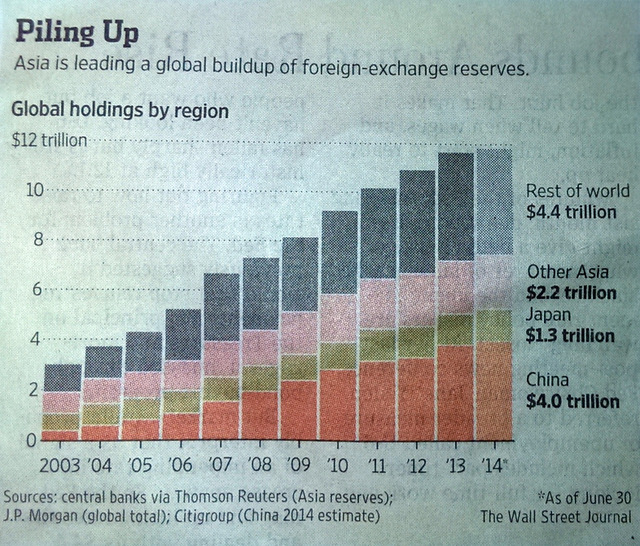
     

    Emissions

    Emissions


    Possible New Approaches to the CAP

    The Common Agricultural Policy remains a major budget item within the EU.  Although any predictions over the new shape it will assume in 2013 are necessarily imprecise, consider three scenarios that reflect varying degrees of attention to past entitlements, environmental objectives, and organic food production goals.
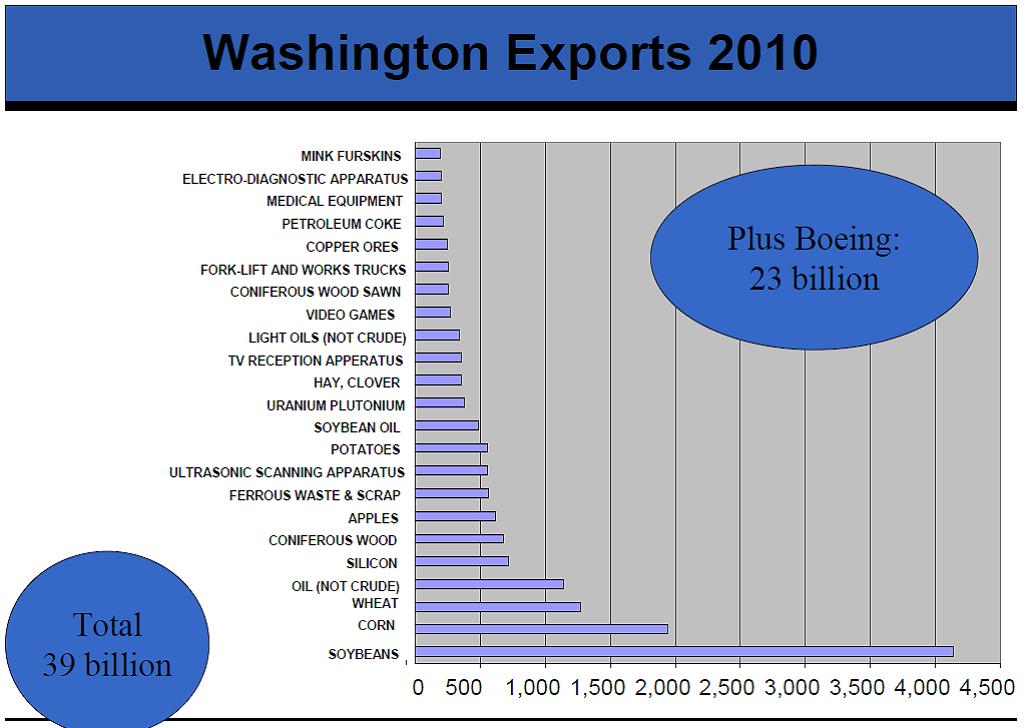
     

    Here are the provocative findings from the analysis of Valentin Zahrnt:

    Table 1. Scenarios for the distribution of CAP payments after 2013

    Source: ECIPE study; 2015 data for Bulgaria and Romania

    The results show that several traditional defenders of the CAP are
    indeed likely to lose from reform – France, Greece, Ireland, and
    Belgium. Other countries that defend the status quo would –
    surprisingly – gain from reform. This is especially striking in the
    case of Spain, which would reap the greatest absolute gains of all
    member states. Finland would get the third highest increase under all
    scenarios just after Sweden and Latvia. For both countries, the
    benefits of bolder reform would be greater. To a lesser extent, this
    also applies to reform-averse Portugal and Austria.