How are we Shifting Student Attitudes in Introductory Biology?
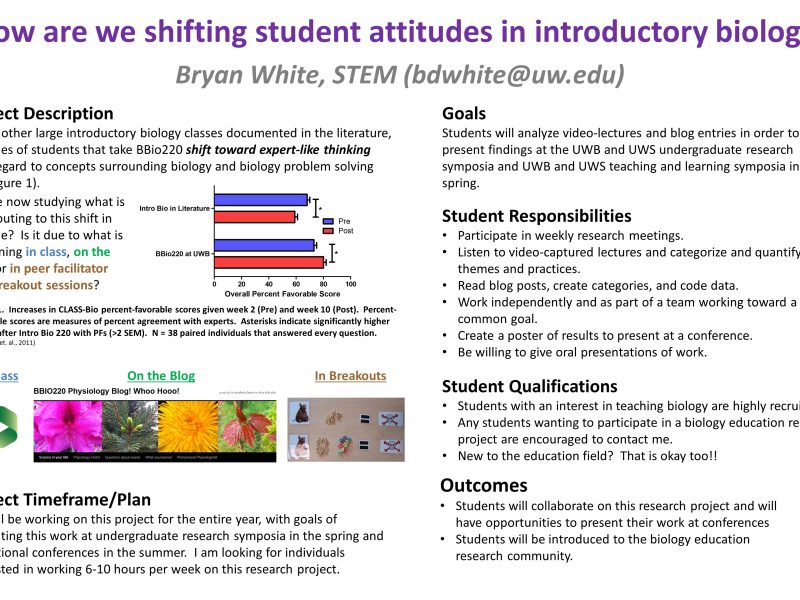
Unlike other large introductory biology classes documented in the literature, the attitudes of students that take BBIO 220 shift toward expert-like thinking with regard to concepts surrounding biology and biology problem-solving. We are now studying what is contributing to this shift in attitude. Is it due to what is happening in class, on the blog, or in peer facilitator lead breakout sessions?
Goal: Students will analyze video lectures and blog entries in order to present findings at the UWB and UWS undergraduate research symposia and UWB and UWS teaching and learning symposia in the spring.
Student Outcomes:
- Students will collaborate on this research project and will have opportunities to present their work at conferences.
- Students will be introduced to the biology education research community.
Requirements: Students with an interest in teaching biology are highly recruited. Any students wanting to participate in a biology education research project are encouraged to contact me.
New to the education field? That is okay too!!
- Listen to video-captured lectures and categorize and quantify themes and practices.
- Read blog posts, create categories, and code data.
- Work independently and as part of a team working toward a common goal.
- Create a poster of results to present at a conference.
- Be willing to give oral presentations of work.
Time Commitment:
- Participate in weekly research meetings
- We will be working on this project for the entire year, with goals of presenting this work at undergraduate research symposia in the spring and educational conferences in the summer.
- I am looking for individuals interested in working 6-10 hours per week on this research project.
Schools or Related Disciplines:
Educational Studies
Science, Technology, Engineering and Math (STEM)
STEM – Biological Sciences
Category: Research and Creative Projects
Time: estimated hours per week is 1hr – 3hrs
Credit/Compensation Notes: This is a volunteer or unpaid position
Contact: Bryan White, Ph.D., bdwhite@uw.edu
Go to project or opportunity website for more information