
Academic Programs

Explore our Degree Programs

Master's in Bioethics      Minor in Bioethics    


The department also teaches the ethics curriculum for University of Washington Medical Students, offers a scholarship opportunity for students of the social, ethical, and policy implications of health research and/or healthcare, and hosts an Interprofessional Ethics Lab. 


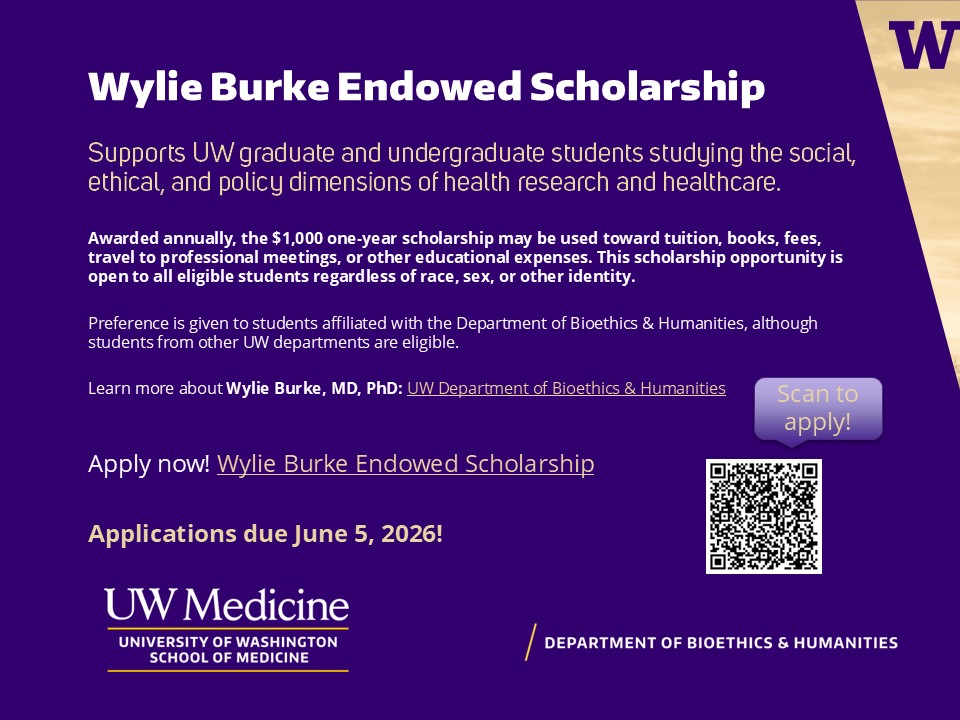
Wylie Burke Endowed Scholarship

The Wylie Burke Endowed Scholarship supports UW graduate and undergraduate students studying the social, ethical, and policy dimensions of health research and healthcare. Preference is given to students affiliated with the Department of Bioethics & Humanities, although students from other UW departments are eligible. Awarded annually, the $1,000 one-year scholarship may be used toward tuition, books, fees, travel to professional meetings, or other educational expenses. This scholarship opportunity is open to all eligible students regardless of race, sex, or other identity.

This scholarship honors Wylie Burke, MD, PhD who is Professor Emeritus and served as Chair of the Department of Bioethics & Humanities from 2000–2014. She led the Center for Genomics and Healthcare Equality for a decade, advancing efforts to ensure that developments in genomic science benefit all sectors of society, particularly communities experiencing health disparities. Central to her work has been a commitment to community engagement, inclusive partnerships, and creating meaningful learning opportunities for students, faculty, and community collaborators, including long-standing relationships with Native American and Alaska Native communities. By supporting students studying the social, ethical, and policy dimensions of health research and healthcare, this scholarship reflects Dr. Burke’s belief in education and collaborative research as pathways to meaningful change.

The 2026 application cycle is now open, apply by June 5, 2026

UW School of Medicine Ethics Theme Curriculum

Director: Gina Campelia, PhD HEC-C
Co-Directors: Maya Scott, MSW, LICSW and Jay Brahmbhatt, MD MA

The Ethics Theme is a 4-year curriculum that is woven throughout the UW School of Medicine, including over 15 sessions with the medical students across the WWAMI region. Ethics sessions take place independently in basic science blocks or clerkships, where ethical principles are applied to cases and topics relevant to the block or clerkship. In addition, the ethics theme is taught in a collaborative set of courses called Medicine Health and Society (previously Themes in Medicine, or Ecology of Health and Medicine), where ethics is taught in coordination with other themes, such as Health Systems Science and Health Equity. Ethics sessions are typically case-based and rely on small-group discussion. Topics covered over the course of the curriculum include critical thinking, foundations of justice, decision making capacity, moral distress, pediatric ethics, relational ethics, narrative ethics, shared decision making, research ethics, and more. You can find out more about the UWSOM Curriculum here.

Bodemer Interprofessional Ethics Lab

The Charles W. Bodemer Lectureship honors groundbreaking labors in the development of biomedical sciences, medical history, and ethics at the University of Washington. Dr. Bodemer was an Associate Dean of the UW School of Medicine and founded the Department of Biomedical History in 1967.

In 2018, the Bodemer Interprofessional Ethics Lab was established in collaboration with the UW Center for Health Sciences Interprofessional Education, Research & Practice.  These events are held up to three times per year, and feature evening seminars of current ethical issues in healthcare and science with small group breakout discussions. For more information, see “Clinical Bioethics Labs” in the IPE Core Curriculum.

Graduate Courses

The humanities offer important perspectives on the nature and practice of clinical medicine. Focuses on the intersection of multiple...

Explores how social inequality affects both public sentiment and public health measures during epidemics. Students develop a critical...
Understanding race and racism, their applicability to medicine, and their effects on marginalized communities. Explores the necessities of...
This course affords graduate students a professional development opportunity to build skills that lay the groundwork for becoming an expert...
This course examines problems in bioethics from diverse global standpoints, including East Asian, Sub-Saharan African and Western. Our...
This course is an examination of the ethical problem of allocating scarce medical resources. We will emphasize the fundamental principles of...
This course provides a survey of contemporary ethical issues that arise in the clinical and research environment when children are involved,...
This course examines the moral grounds for the view that social inequalities in health are unjust using contemporary literature from moral...
Examines and compares phenomenology, discourse analysis, and grounded theory. Reviews the history of ideas and critically reads examples of...
This course introduces students to select biotechnology innovations and invites consideration of the ethical and policy implications...
This course examines the relationship between bioethics and law. Reviews the basic concepts of both disciplines; their theoretical and...
This course studies the major normative ethical theories, including both teleological and deontological approaches. We emphasize moral...
This course entails a research project culminating in a scholarly paper suitable for publication in a peer-reviewed journal. MA...
Explores the ethical foundations, principles and concepts, and U.S. laws related to the conduct of research with human subjects. Required for...
This course introduces students to research methods in bioethics, ranging from qualitative to quantitative: interviews, focus groups, surveys...

Undergrad Courses

This course is an examination of the ethical problem of allocating scarce medical resources. We will emphasize the fundamental principles of...
This course examines the moral grounds for the view that social inequalities in health are unjust using contemporary literature from moral...
This course introduces students to select biotechnology innovations and invites consideration of the ethical and policy implications...
This course examines the history of ideas, policies, and practices associated with eugenics and human genetics from the late nineteenth...
This course examines problems in bioethics from diverse global standpoints, including East Asian, Sub-Saharan African and Western. Our...
This course studies the major normative ethical theories, including both teleological and deontological approaches. We emphasize moral...
This course offers a case-based approach to ethical topics in medicine, such as abortion, genetic testing, physician-assisted death, and...
This course introduces students to bioethical questions that arise in public health, population health, and global health, situating ethical...