| |
9. Plotting Measurements
| This section
reviews techniques for plotting infant length, weight, and head circumference
and will review the technique for plotting weight and stature measures
for children and adolescents. |
Appropriate use
of the charts requires that all measures follow procedures similar to
those used for the reference data. The Centers for Disease Control and Prevention (CDC) and the American Academy of Pediatrics (AAP) recommend using the WHO growth standard charts for children aged <24 months and the 2000 CDC growth reference charts for children aged 2 up to 2 years to monitor growth in the US.
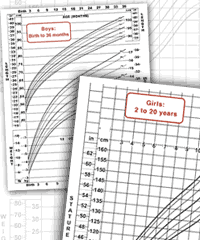
It is essential to select the appropriate chart for the age and sex of
the person measured.
The CDC and WHO Growth Charts are presented as:
 |
 |
 |
|
|
Gender
and age
|
Charts
|
|
Boys,
birth to 24 mos.
|
Weight-for-length (WHO)
|
|
Boys,
birth to 24 mos.
|
Weight-for-age (WHO)
|
|
Boys,
birth to 24 mos.
|
Length-for-age (WHO)
|
|
Boys,
birth to 24 mos.
|
Head
circumference-for-age (WHO)
|
|
Girls,
birth to 24 mos.
|
Weight-for-length (WHO)
|
|
Girls,
birth to 24 mos.
|
Weight-for-age (WHO)
|
|
Girls,
birth to 24 mos.
|
Length-for-age (WHO)
|
|
Girls,
birth to 24 mos.
|
Head
circumference-for-age (WHO)
|
|
Boys,
2 to 20 yrs.
|
BMI-for-age (CDC)
|
|
Boys,
2 to 20 yrs.
|
Weight-for-age (CDC)
|
|
Boys,
2 to 20 yrs.
|
Stature-for-age (CDC)
|
|
Girls,
2 to 20 yrs.
|
BMI-for-age (CDC)
|
|
Girls,
2 to 20 yrs.
|
Weight-for-age
(CDC) |
|
Girls,
2 to 20 yrs.
|
Stature-for-age (CDC)
|
|
Boys
2 to 5 yrs.
|
Weight-for-stature
(CDC) (optional)
|
|
Girls
2 to 5 yrs.
|
Weight-for-stature
(CDC) (optional)
|
|
|
 |
|
 |
In addition, the
measurement obtained must match the chart (e.g. if length is measured,
then length should be plotted, not stature).
 |
|
|
|
| |
 |
Select
the appropriate chart for the age, sex, and measurements of the person
measured |
| |
|
|
| |
  
|