College of the Environment | University of Washington Block W Logo
Library Home | Catalog | Calendar | College Home
Volume 10, Issue 11 | November 2023
Paintings and Prints by Molly Hashimoto
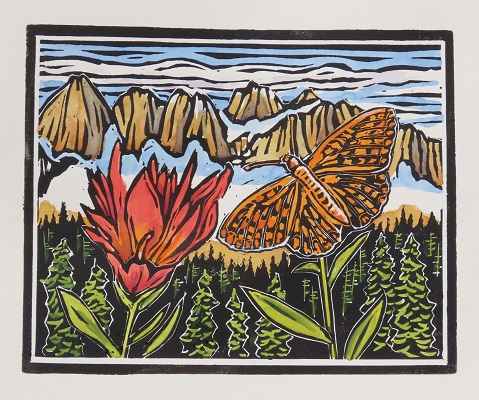
Scarlet Paintbrush and Northwestern Fritillary by Molly HashimotoMolly Hashimoto returns to the Miller Library this month with new paintings and prints featuring Northwest trees, landscapes, flowers and insects. Shown here: her block print "Scarlet Paintbrush and Northwestern Fritillary."

The exhibit is open during library hours. Meet the artist and learn about her techniques on Thursday, November 2 from 1:30 to 3:30 pm.

Molly's work will be in the library through December 29. She will joined by three more local artisans for our annual Arts and Crafts Exhibit and Sale, with an opening from 5-7 pm on Monday, December 4.
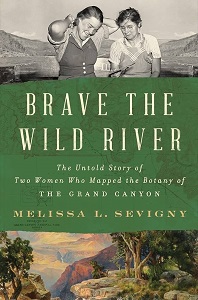
Brave the Wild River by Melissa L. Sevigny
Reviewed by Priscilla Grundy

book cover
Today raft trips through the Grand Canyon are common. Several companies offer choices of a few or many days. One specifies that the client must be at least nine years old. These trips differ greatly from the one Elzada Clover and Lois Jotter took in 1938. One difference is the Hoover Dam. Before the dam, the Colorado River challenged travelers with extreme rapids, rapids now slowed and sometimes covered by the water that rose behind the dam.

Brave the Wild River recounts how these two women, both affiliated with the University of Michigan botany department, overcame multiple challenges in addition to the river, to map and collect plants in the canyon before many of them were submerged.

Clover, an instructor at the university, was a generation older than Jotter, a graduate student. The trip was Clover’s passion. Opposition came from a chorus of voices proclaiming that the Grand Canyon was “no place for a woman.” She overcame reluctance in the Michigan botany department to approve the project and hesitation by Norman Nevills to guide the trip. He hoped to set up a business floating adventurers through the canyon but was reluctant to take women.

Sevigny takes the reader through the hair-raising trip in boats designed by Nevills, a national media frenzy accompanying the travelers, and Clover’s frustration that no one seemed interested in the plant collecting. She had to harass Nevills to make stops so the women could collect, and the media mostly failed to mention plants as the purpose of the trip.

Sevigny includes the history of the countryside the group passed, as well as biographies of those involved. The book is full of lovely details, like the women’s selection of brown overalls to wear, because Clover thought jeans too masculine. Or the gyrations required to maintain modesty while bathing in the river. (Four men accompanied the women in three boats. The women did the cooking.)

By the end the reader is amazed that any of the collected plants made it back to Michigan and a few to the Smithsonian. Those plants and the carefully detailed descriptions Clovis and Jotter wrote became useful botanic history as scholars have tried to create a picture of flora in the canyon before the dam.

Ask the Plant Answer Line: Is devil's club fragrant?
Researched by Rebecca Alexander
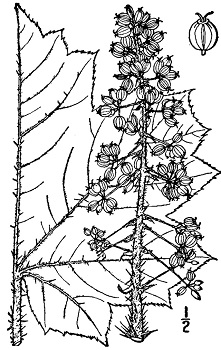
Oplopanax horridus from  Illustrated flora of the northern states and Canada by Britton and Brown, 1913.
I came across a reference to the aromatic scent of devil’s club, and wondered which part of the plant is fragrant, and how it is used.

Despite its daunting common name and repellent species name, the wood of Oplopanax horridus, particularly the inner bark, is said to be sweetly aromatic. According to an article, “Devil’s Club (Oplopanax horridus): An Ethnobotanical Review” from HerbalGram (Spring 2014, Issue 62), the Makah tribe has used an unspecified part of the plant much as one would use talcum powder for infants. This is elaborated upon by Erna Gunther’s Ethnobotany of Western Washington (1973), which says that Green River peoples dry the bark and pulverize it for use as a deodorant.

Other tribes have used an infusion of the bark as a skin wash. Nancy J. Turner’s Ancient Pathways, Ancestral Knowledge (2014), mentions that “bathing in a solution of devil’s club is said to make one strong,” and so the plant might be used prior to contests of strength or hunting.

By coincidence, there is a common perfume ingredient with a very similar name, opopanax, but it is derived neither from Opopanax (in the Apiaceae) nor Oplopanax (in the Araliaceae). Some say its source is the resin of Commiphora guidottii (a plant in the Apiaceae that is native to Ethiopia and Somalia), and goes by the names scented myrrh, bissabol, and habak hadi. Others say it is derived from the flowers of sweet acacia, Vachellia farnesiana (Fabaceae).
gardening answers
Search for garden wisdom with us. You'll find researched answers,
gardening tips, book reviews, and more.
Digital resources
   UWBG pine cone logo
cover of Diversity, ecology, and conservation of truffle fungi in forests of the Pacific Northwest / James M.
 Trappe [and others].  Miller Library book and flower logo
New to the library
cover image    cover image    cover image
cover image    cover image    cover image
cover 
image    cover image    cover image
cover 
image    cover image    cover image
cover image    cover 
image     cover image
cover image    cover image
  cover image    cover image
cover image    cover image
cover image
   cover image
  give     Miller_LibraryLogo293px.gif    
Facebook    Twitter    Instagram    Pinterest
Contact Us   |   Privacy   |   Terms
© 2023 University of Washington Botanic Gardens