
Applying to graduate school is really stressful. There’s an overwhelming amount of information and an overwhelming number of choices.
FREQUENTLY ASKED QUESTIONS
These FAQ are generated by faculty at the Center for Human Neuroscience based on questions we get regularly asked.
How do I find out about human neuroscience at UW?
At UW we recommend the following page which contains a list of faculty who do human neuroscience at UW.
Everyone says they don’t have funding!
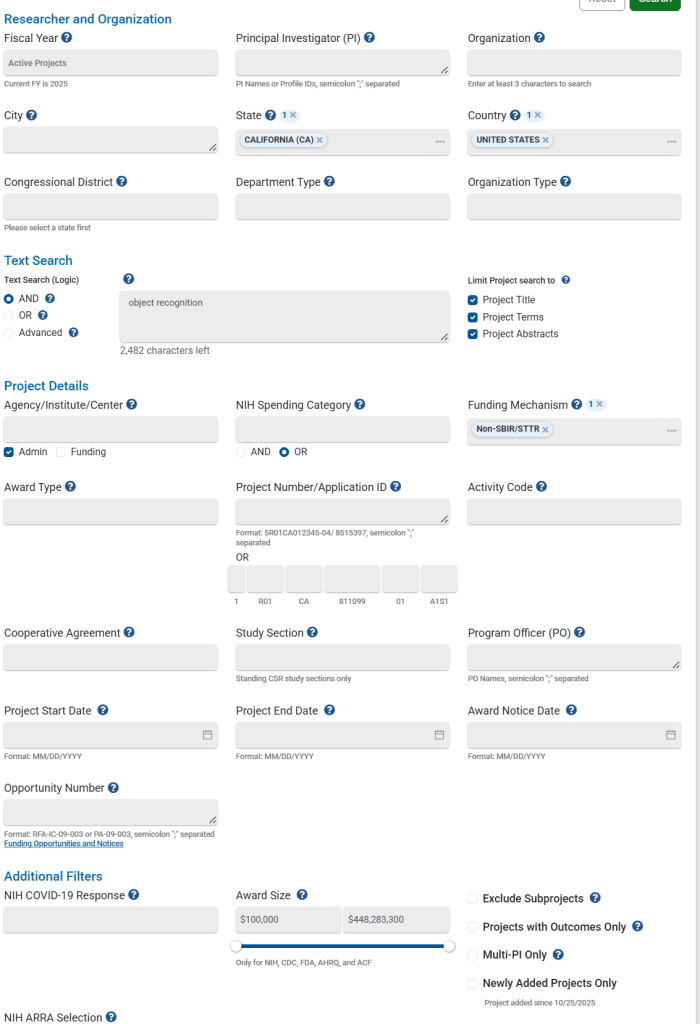
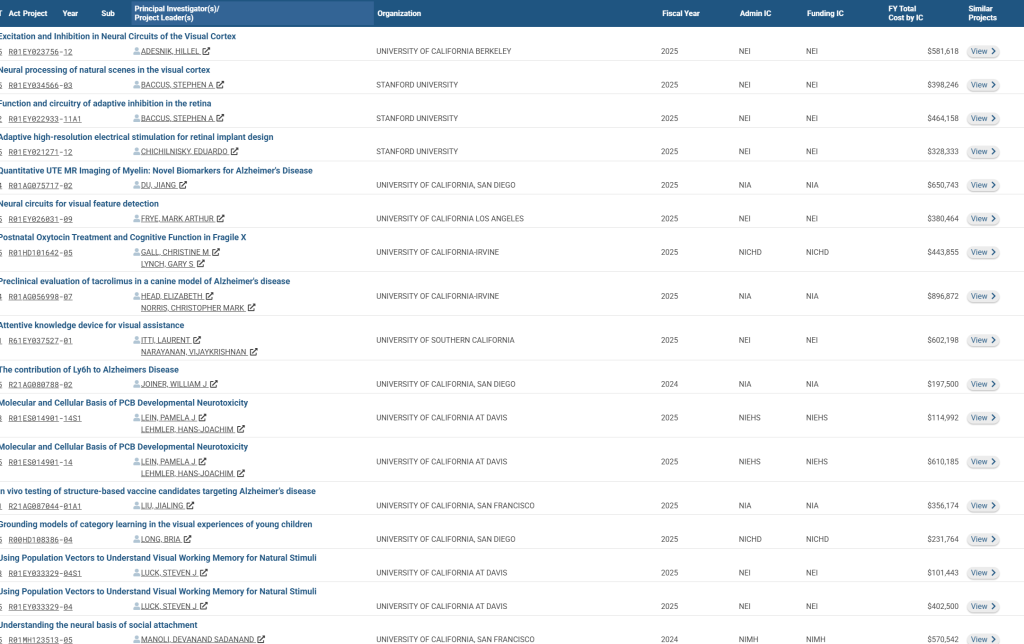
A great place to find labs that might have funding is NIH grant reporter (NSF has a similar site which you should look at if you interested in more engineering/CS focused research).
1. Click on advanced search

2. You can select a State (optional), one or two keywords, non-SBIR/STTR. Limit grants to those above 150K annually. Grants smaller than that are generally supporting an individual postdoc.
3. You will get a list of grants on that topic. So that’s a great way of finding labs that might potentially have funding.
What are faculty looking for?
While some labs will look for additional things, almost all labs will look carefully at four things
(1) Evidence of academic ability. In some programs (not UW) that will include GREs. In most human neuroscience programs we will interested in your performance in classes with some ‘meat’ (neuroscience, mathematics, etc.). We will generally not be too hung up by your overall GPA. For example, a student who struggled in their first year but finished strong doesn’t worry most PIs at all. (Similarly, for students who have some sort of ‘interruption’ in their undergraduate career.)
(2) Evidence of the person being a good match for the lab in terms of interest. If you’ve written a personal statement about your interest in memory and I study vision, then I am going to assume this laboratory isn’t the right match for you. Sending an application where your personal statement doesn’t match the faculty interests is a waste of time.
(3) Having a sense that you know what you are letting themselves in for/ have grit. Graduate school takes a long time, and it’s easy for students to get demoralized and unproductive. We usually want to see that you’ve done a significant research, so we feel confident that you know just how slow and boring the process is.
(4) Letters of recommendation. These will generally comment on your academic ability, ability to work productively in a lab environment and your committment to the field (i.e. 1-3).
Should I apply to neuroscience, psychology or both?
In general there are three considerations when deciding whether to apply to a departmental program (e.g. Psychology) or a general cross-dept. neuroscience program.
(A) Does the program do rotations or not? Rotations are great, especially for students where the admissions group might be concerned that you don’t have a totally clear idea of what you want to do. (I’d classify that as anyone who hasn’t done a year of post-bac experience in the area they want to apply for).
(B) Does the PI you want to work with accept students from both programs? Does your PI have a preference one way or another? Ask. If you don’t know which PI you want to work for you should prioritize programs with rotations.
(C) How are students supported? (See the answers FAQ below).
There’s no cost to applying to both (except the actual $) and you can apply to both in the same cycle. Faculty members don’t care if you apply to multiple programs.
Which is harder to get into? Neuroscience or Psychology?
Depends.
At UW Psychology students are basically accepted into a particular lab. So most PIs want to see a really good match between the student and advisor. We want to have a really clear idea of why YOU want to work with ME. So, when I evaluate applicants, most strong candidates will either have experience working my area of interest or there will be some other kind of compelling reason for me to believe that you are really interested in computational vision rather than you’ve just browsed the internet and thought … hmm that seems cool.
When entry is directly into a lab, the degree of competitiveness really depends on the individual’s laboratory. Junior PIs, or PIs with a smaller or less visible research program will have fewer applicants. It will be REALLY difficult to get into the lab of famous PIs.
In the UW Neuroscience program, students are accepted into the program and then do 3 (or sometimes 4) rotations. So the admissions committee will want to know that you understand what neuroscience is and what a PhD requires, but it’s OK if you are less clear whether you want to study single cell molecular biology or behavior in humans (though we really do prefer it if you are a little more clear than that).
Funding … I’m so confused! (What if I’m not a US citizen?!)
Most reputable programs will offer you funding throughout almost all your program – tuition and stipend. Personally, I would recommend against my child entering a MA or PhD program that didn’t offer significant tuition and stipend support.
But the way support works is complicated. Basically students are supported from four pots of money:
- Direct support from the department. So the neuroscience program at UW provides 1 year of direct support, psychology offers 1 qtr of direct support. Occasionally this support is available to international students, but not always.
- PI support from grants. We pay students to do research related to our grants. This is usually the primary source of support for international students.
- Student fellowships. These are awards that students apply for. (NIH/NSF are very committed to diversity fellowships {which includes low SES}, so if you qualify you should definitely look into those, some can be applied for before you are even accepted into grad school). This tends not to be a significant source of support for International students without a Green card.
- Teaching Assistant – this is where you get your stipend and tuition covered in return for providing support for a class. A single TA at UW covers one quarter of support. This source of support is usually also available to international students.
So, depending on the program and the research funds of the PI you end up working with you are likely to be covered from a combination of these sources throughout your time in the program.
The right question to ask for any program/PI is ‘historically, how many of your students are fully covered (tuition + stipend) up to their 5th year’.
You want them to say ‘everyone’. If they add onto that ‘but we can’t guarantee anything’, don’t let that worry you. For example, UW Psychology can’t make guarantees, because we patch together support from all these sources. But in 20years, good times and bad, we’ve successfully supported students up to their 5th year.
The second question is – how often can I expect to TA? TA-ing roughly once a year is optimal. TA-ing every quarter will really impact your productivity and will make it very hard to graduate on time.