
Step 1 of every FFT run is adding fuelbed(s) to the viewer/editor (currently server constraints limit the number of fuelbeds per run in the webtool to 5). Use the given filters to quickly winnow down the list of hundreds of fuelbeds in library to ones applicable to your use case.
The FCCS reference fuelbeds were named according to preset rules designed to convey dominant species and vegetation form. To help users find fuelbeds of interest, each fuelbed is assigned to various ecological classifications (given in the General > Other attributes section of the fuelbed editor).
Use the drop-down boxes in the ‘Filter fuelbeds by’ section to narrow the Fuelbed library listbox to fuelbeds meeting selected criteria.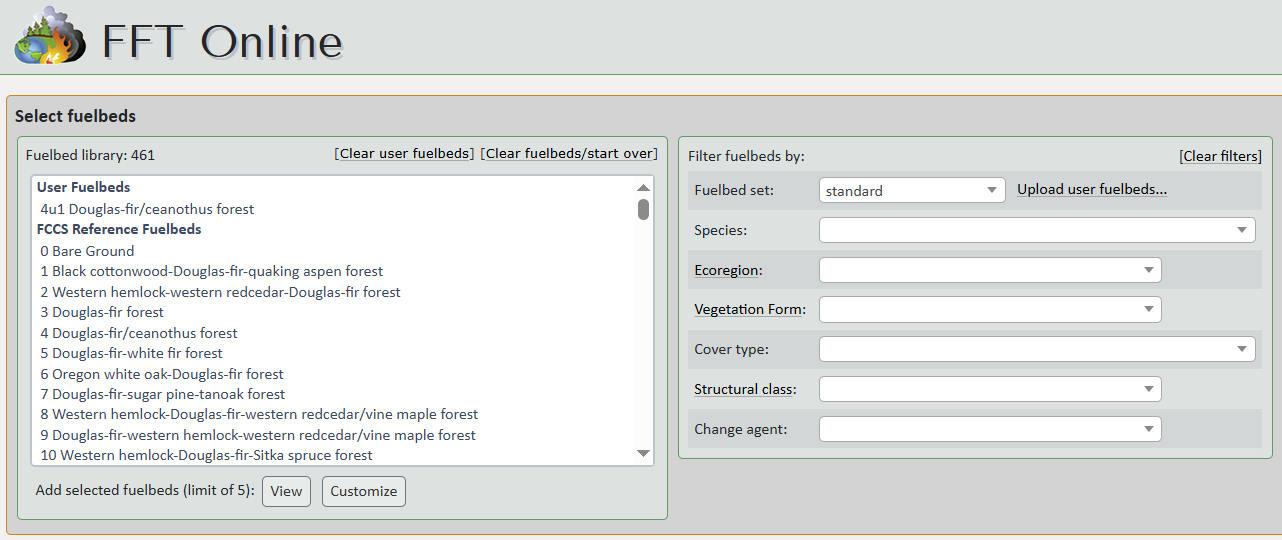
Fuelbed set
Select from:
Species
An exception to the explicitly-assigned ecological classification types, the species filter searches the reference fuelbeds for those in which the given species occurs, across all strata. The list contains over a thousand species and is searchable by scientific and common names.
Ecoregion
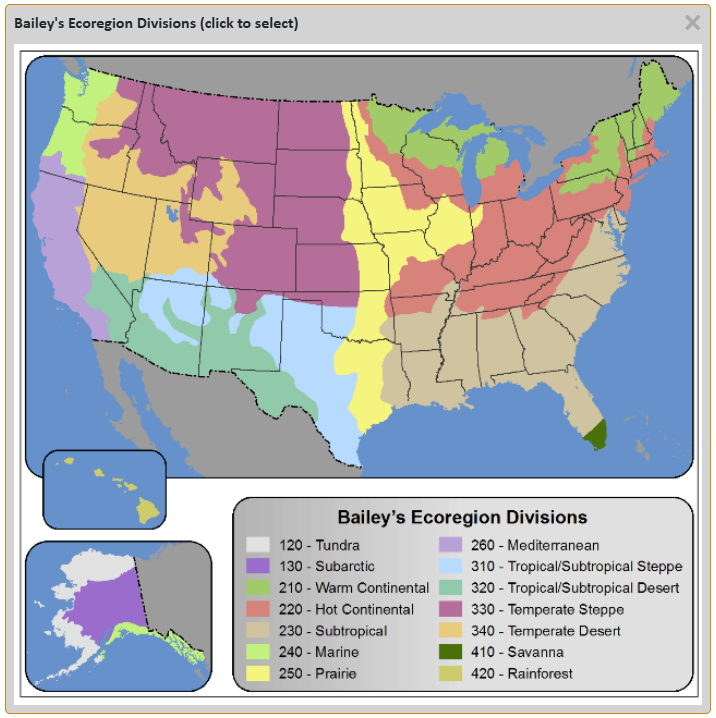
All FCCS reference fuelbeds are organized geographically according to Bailey’s 14 ecoregion divisions (Bailey 1989). Fuelbeds may span multiple ecoregions and have more than one ecoregion assigned to them. Select from the drop-down box or click the linked text to open a clickable map.
Vegetation Form
Each fuelbed is assigned to one of the following vegetation forms: broadleaf forest, conifer forest, mixed forest, savanna, shrubland, grassland, or slash. Mixed forests are defined as forests in which evergreen and deciduous species each contribute 25 to 75 percent of total tree cover in both overstory and midstory layers. Select from the drop-down box or click the linked text to open a clickable graphic.

Cover Type
Cover types represent the existing vegetation of an area based on the Society of American Foresters forest cover types (Eyre 1980) and the Society for Range Management rangeland cover types (Shiflet 1994). More than one cover type may apply to each fuelbed.
Structural Class
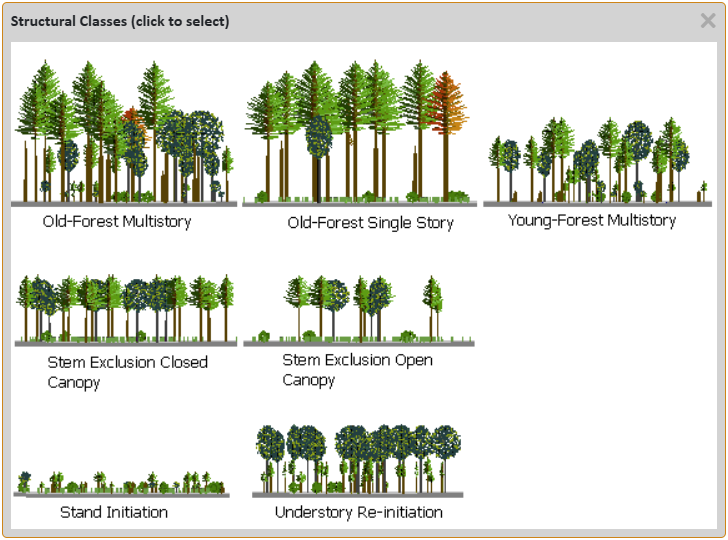
Fuelbeds with canopy layers are assigned one of seven stand structural classes (O'Hara et al. 1996). Select from the drop-down box or click the linked text to open a clickable graphic.
Change Agents
Change agents are natural or anthropogenic disturbances or management actions that affect fuelbed structure and composition, such as a clear cut or insects and disease. Multiple change agents may apply to a single fuelbed.
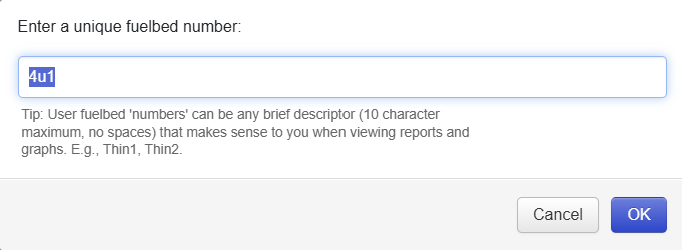
Once you've selected your fuelbed, add it to the run using one of the three buttons under the Fuelbed Library listbox:

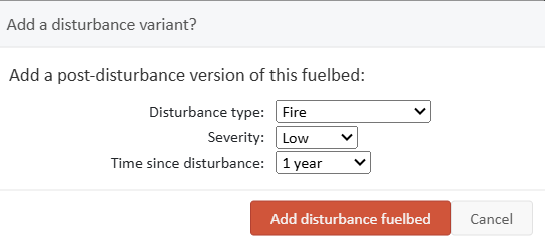
| DisturbanceCode | TypeCode | DisturbanceType | SeverityCode | Severity | TimeCode | TimeSinceDisturbance |
|---|---|---|---|---|---|---|
| 111 | 1 | Wildfire | 1 | Low | 1 | ≤ 1 year |
| 112 | 1 | Wildfire | 1 | Low | 2 | 2-5 years |
| 113 | 1 | Wildfire | 1 | Low | 3 | 5-10 years |
| 121 | 1 | Wildfire | 2 | Moderate | 1 | ≤ 1 year |
| 122 | 1 | Wildfire | 2 | Moderate | 2 | 2-5 years |
| 123 | 1 | Wildfire | 2 | Moderate | 3 | 5-10 years |
| 131 | 1 | Wildfire | 3 | High | 1 | ≤ 1 year |
| 132 | 1 | Wildfire | 3 | High | 2 | 2-5 years |
| 133 | 1 | Wildfire | 3 | High | 3 | 5-10 years |
| 211 | 2 | Mechanical Thinning - Add fuels (slash left) | 1 | Low | 1 | ≤ 1 year |
| 212 | 2 | Mechanical Thinning - Add fuels (slash left) | 1 | Low | 2 | 2-5 years |
| 213 | 2 | Mechanical Thinning - Add fuels (slash left) | 1 | Low | 3 | 5-10 years |
| 221 | 2 | Mechanical Thinning - Add fuels (slash left) | 2 | Moderate | 1 | ≤ 1 year |
| 222 | 2 | Mechanical Thinning - Add fuels (slash left) | 2 | Moderate | 2 | 2-5 years |
| 223 | 2 | Mechanical Thinning - Add fuels (slash left) | 2 | Moderate | 3 | 5-10 years |
| 231 | 2 | Mechanical Thinning - Add fuels (slash left) | 3 | High | 1 | ≤ 1 year |
| 232 | 2 | Mechanical Thinning - Add fuels (slash left) | 3 | High | 2 | 2-5 years |
| 233 | 2 | Mechanical Thinning - Add fuels (slash left) | 3 | High | 3 | 5-10 years |
| 311 | 3 | Mechanical Thinning - Remove fuels (slash extracted/burned) | 1 | Low | 1 | ≤ 1 year |
| 312 | 3 | Mechanical Thinning - Remove fuels (slash extracted/burned) | 1 | Low | 2 | 2-5 years |
| 313 | 3 | Mechanical Thinning - Remove fuels (slash extracted/burned) | 1 | Low | 3 | 5-10 years |
| 321 | 3 | Mechanical Thinning - Remove fuels (slash extracted/burned) | 2 | Moderate | 1 | ≤ 1 year |
| 322 | 3 | Mechanical Thinning - Remove fuels (slash extracted/burned) | 2 | Moderate | 2 | 2-5 years |
| 323 | 3 | Mechanical Thinning - Remove fuels (slash extracted/burned) | 2 | Moderate | 3 | 5-10 years |
| 331 | 3 | Mechanical Thinning - Remove fuels (slash extracted/burned) | 3 | High | 1 | ≤ 1 year |
| 332 | 3 | Mechanical Thinning - Remove fuels (slash extracted/burned) | 3 | High | 2 | 2-5 years |
| 333 | 3 | Mechanical Thinning - Remove fuels (slash extracted/burned) | 3 | High | 3 | 5-10 years |
| 411 | 4 | Windstorm (blow down) | 1 | Low | 1 | 1 year |
| 412 | 4 | Windstorm (blow down) | 1 | Low | 2 | 2-5 years |
| 413 | 4 | Windstorm (blow down) | 1 | Low | 3 | 5-10 years |
| 421 | 4 | Windstorm (blow down) | 2 | Moderate | 1 | ≤ 1 year |
| 422 | 4 | Windstorm (blow down) | 2 | Moderate | 2 | 2-5 years |
| 423 | 4 | Windstorm (blow down) | 2 | Moderate | 3 | 5-10 years |
| 431 | 4 | Windstorm (blow down) | 3 | High | 1 | ≤ 1 year |
| 432 | 4 | Windstorm (blow down) | 3 | High | 2 | 2-5 years |
| 433 | 4 | Windstorm (blow down) | 3 | High | 3 | 5-10 years |
| 511 | 5 | Insect Damage (bark beetle/wood borer) | 1 | Low | 1 | ≤ 1 year |
| 512 | 5 | Insect Damage (bark beetle/wood borer) | 1 | Low | 2 | 2-5 years |
| 513 | 5 | Insect Damage (bark beetle/wood borer) | 1 | Low | 3 | 5-10 years |
| 521 | 5 | Insect Damage (bark beetle/wood borer) | 2 | Moderate | 1 | ≤ 1 year |
| 522 | 5 | Insect Damage (bark beetle/wood borer) | 2 | Moderate | 2 | 2-5 years |
| 523 | 5 | Insect Damage (bark beetle/wood borer) | 2 | Moderate | 3 | 5-10 years |
| 531 | 5 | Insect Damage (bark beetle/wood borer) | 3 | High | 1 | ≤ 1 year |
| 532 | 5 | Insect Damage (bark beetle/wood borer) | 3 | High | 2 | 2-5 years |
| 533 | 5 | Insect Damage (bark beetle/wood borer) | 3 | High | 3 | 5-10 years |