Scanning Kelvin Probe Microscopy Reveals That Ion Motion Varies with Dimensionality in 2D Halide Perovskites
Abstract
We study ion migration in 2D lead halide perovskites of varying dimensionality using scanning Kelvin probe microscopy (SKPM). We perform potentiometry on micrometer-scale lateral junctions in the absence of injected charge, and we compare how ion motion varies between prototypical two-dimensional n-butylammonium lead iodide perovskites (BA(2)PbI(4), n = 1), and methylammonium-incorporated quasi-2D perovskites (BA(2)MA(3)Pb(4), I-13 similar to < n > = 4) under the effects of illumination and temperature. We attribute the observed slow dynamics to relaxation of the bias-induced ionic charge distributions at different N temperatures, and we extract the activation energies associated with the ionic motion in each case. Finally, we propose an explanation for these phenomena by hypothesizing that ion motion in purely-2D BA,Pb1, perovskite films is dominated by paired halide and halide vacancy, whereas for quasi-2D BA(2)MA(3)Pb(4)I(13) perovskites, the ion motion is a combination of both halide and methylammonium (vacancy) migration. These data show that dimensionality in these systems plays a critical role in ion dynamics.

Fangyuan Jiang
Postdoctoral Researcher

Rajiv Giridharagopal
Chief scientist at the Ginger lab
Raj is the ‘Cheif Scientist’ and a senior research coordinater at the Ginger lab
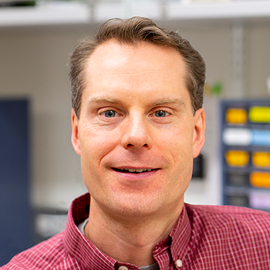
David Ginger
B. Seymour Rabinovitch Endowed Chair in Chemistry
David Ginger is the the B. Seymour Rabinovitch Endowed Chair in Chemistry at the University of Washington, and the PI of the ginger group