(3-Aminopropyl)trimethoxysilane Surface Passivation Improves Perovskite Solar Cell Performance by Reducing Surface Recombination Velocity
Abstract
We demonstrate reduced surface recombination velocity (SRV) and enhanced power-conversion efficiency (PCE) in mixed-cation mixed-halide perovskite solar cells by using (3-aminopropyl)trimethoxysilane (APTMS) as a surface passivator. We show the APTMS serves to passivate defects at the perovskite surface, while also decoupling the perovskite from detrimental interactions at the C-60 interface. We measure a SRV of similar to 125 +/- 14 cm/s, and a concomitant increase of similar to 100 meV in quasi-Fermi level splitting in passivated devices compared to the controls. We use time-resolved photoluminescence and excitation-correlation photoluminescence spectroscopy to show that APTMS passivation effectively suppresses nonradiative recombination. We show that APTMS improves both the fill factor and open-circuit voltage (V-OC), increasing VOC from 1.03 V for control devices to 1.09 V for APTMS-passivated devices, and leads to a PCE increase from 15.90% to 18.03%. We attribute the enhanced performance to reduced defect density resulting in suppressed nonradiative recombination and lower SRV at the perovskite/transport layer interface.

Rajiv Giridharagopal
Chief scientist at the Ginger lab
Raj is the ‘Cheif Scientist’ and a senior research coordinater at the Ginger lab

Fangyuan Jiang
Postdoctoral Researcher
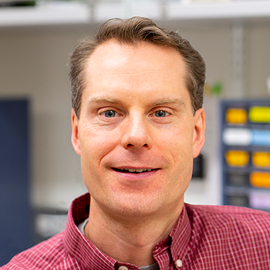
David Ginger
B. Seymour Rabinovitch Endowed Chair in Chemistry
David Ginger is the the B. Seymour Rabinovitch Endowed Chair in Chemistry at the University of Washington, and the PI of the ginger group