College of the Environment | University of Washington Block W Logo
A graphic with books in 
the background and the words: Leaflet, Elisabeth C. Miller Library
Library Home | Catalog | Calendar | College Home
Volume 11, Issue 4 | April 2024
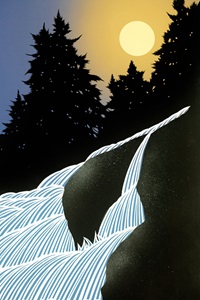
Walking in Nature: paper cutting by Aki Sogabe
Moonlight Falls 12 by Aki Sogabe
The Miller Library welcomes Aki Sogabe for her exhibit, Walking in Nature. From the artist’s statement:

My medium, paper cutting (kiri-e in Japanese), is an ancient and traditional art form. I have created my own style and made it a fine art. I like to use this art form to depict delicate Northwest nature scenes stylized with Japanese sensibilities.

Inspired by Edo period printmaster Hokusai, I began making paper cuts as a junior high school student. For a long time, I did it as a hobby for myself, and sometimes would give them to my friends, but never thought that I was going to be a professional artist.

I use an X-Acto knife to cut out a design and add hand-colored rice papers underneath the stencil. Next, the entire image is glued onto an illustration board.

I have a number of public art commissions in Washington and Oregon. Additionally, I have created five panel murals made of porcelain enamel for the Pike Place Market, commemorating the history of Japanese American farmers.

When I am cutting my work among the scattered bits of paper, I feel most content and happy.

The exhibit is open during library  hours April 2-29.

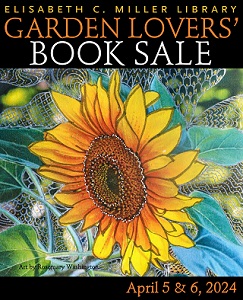
Garden Lovers' Book Sale April 5 and 6
book sale posterJoin us Friday and Saturday, April 5 and 6, for the Garden Lovers' Book Sale. Enjoy the company of fellow plant lovers, browsing thousands of gently used books for sale on gardening, plants, ecology and related topics.

An Opening Night event will take place Friday, April 5, from 5 to 8 pm. Admission includes the book sale, a silent auction, a new art exhibit by Aki Sogabe, food and drink. Tickets and more information can be found on our website.

No registration is required for the Saturday book sale, which runs from 9 am to 3 pm.

Interested in volunteering? Please contact Nick Williams at nickjpw@uw.edu to sign up. Shifts include setting up Friday morning, the opening night party, or takedown on Saturday afternoon.
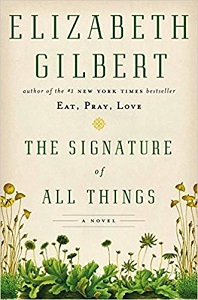
The Signature of All Things by Elizabeth Gilbert
Reviewed by Ashlyn Higareda

In The Signature of All Things, Elizabeth Gilbert weaves a narrative that follows the life of Alma Whittaker, a dedicated botanist driven by an insatiable curiosity for the world. The novel, encompassing elements of historical fiction, botanical exploration, and an unyielding pursuit of knowledge, immerses readers in Alma's journey as she grapples with love, loss, and the intricate facets of the natural world.

Gilbert's prose paints a picture of Alma's experiences across continents and decades, capturing the essence of an era marked by scientific breakthroughs and societal transformations. I will note that the book incorporates outdated and offensive terms prevalent in the 19th century, particularly in describing Black and Indigenous people, as well as gay men. While I personally was hoping for a more critical examination of colonization and historical injustices, the narrative predominantly reflects Alma's European-centric experiences. This focus may be regarded as both a reflection of the prevailing attitudes of the time—where Eurocentrism was prominent—and a limitation that, unfortunately, neglects the exploration of other diverse perspectives that existed during that historical period.

I did love Gilbert's portrayal of how Alma's unwavering passion and devotion to the botanical world shapes her entire existence. Rather than remaining a mere backdrop, botany becomes the cornerstone of Alma's life events, resulting in a narrative where nearly every moment is interwoven with her botanical pursuits. This centrality of botany offers a unique depth to the narrative.

I especially appreciated the contrast between Alma's exploration of moss and the portrayal of glamorous tropical plants, like orchids. Moss, with its associations of resilience and understated beauty, provides a window into Alma's character, revealing her preferring and embodying the overlooked and intricate. Meanwhile, the allure of orchids symbolizes exoticism and societal expectations, but also offers a reflection of cultural and historical values, adding depth to the broader context of the story.

In essence, the novel is an interesting blend of historical fiction and botanical fascination, offering a portrayal of Alma's life while prompting reflection on the societal issues of the era.
gardening answers
Search for garden wisdom with us. You'll find researched answers,
gardening tips, book reviews, and more.
Digital resources
   UWBG pine cone logo
detail from The Plums of New York, U.P.
 Hedrick, 1911  Miller Library book and flower logo
New to the library
cover image    cover image    cover image
cover 
image     cover image     cover image
cover image    cover image
cover image    cover image    cover image
give     Miller_LibraryLogo293px.gif
Facebook    Twitter    Instagram    Pinterest
Contact Us   |   Privacy   |   Terms
© 2024 University of Washington Botanic Gardens