 Q:
Washington’s Governor recently signed a bill replacing the word marijuana with cannabis in the text of all state laws because some say the word has racist undertones. But isn’t cannabis from Linnaeus’s system of plant-naming, and isn’t that system implicitly racist, too?
Q:
Washington’s Governor recently signed a bill replacing the word marijuana with cannabis in the text of all state laws because some say the word has racist undertones. But isn’t cannabis from Linnaeus’s system of plant-naming, and isn’t that system implicitly racist, too?
A: How people feel about use of a particular word is something that evolves over time, and has a complex cultural context. The current sense that marijuana is a
racist term is linked to the demonizing of Mexican immigrants and others outside the dominant culture and blaming them for ‘reefer madness,’ but the word on its own is not intrinsically racist. It was used in Mexico as early as 1840 for the plant called
Cannabis, and its linguistic origins are uncertain: homophone for Maria Juana (uncertain origin: derived from Spanish
mariguan, a non-native plant associated with other psychoactive plants known in Mexico), but potentially connected to a word for hemp used by Chinese laborers in Mexico, itself perhaps borrowed from Semitic and Indo-European words for marjoram—note the Spanish word
mejorana, and the Mexican slang term for cannabis,
mejorana Chino. West Africans, forcibly taken by the Portuguese slave trade to Brazil, used a term
ma-kaña that is similar to the Portuguese term
maconha.
Theories abound. Though some feel the term should be dropped, others believe that to do so suppresses a history that is worth remembering.
Isaac Campos, professor of Latin American history at University of Cincinnati, and author of the book
Home Grown: Marijuana and the Origins of Mexico’s War on Drugs (Chapel Hill: University of North Carolina Press, 2012), challenges the idea that the word marijuana is racist. “Marijuana is just the Mexican word for drug cannabis.” The dubious associations of marijuana with insanity and criminal behavior did not originate in the United States, but first appeared in the Mexican press. Marijuana was made illegal in Mexico nearly two decades before the negative associations of the plant and its use reached the U.S. In his opinion, “the more complete story of the word marijuana is a story about the influence of Mexican culture." He believes banning the word would erase that history. Undeniably, race and class have played a role in the enforcement of drug policies. NPR’s
Code Switch explored the subject.
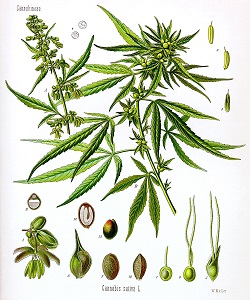
You are right that the scientific name
Cannabis is Latin. Linnaeus included it in
Species Plantarum (1753). He did not restrict his classification schemes to plants, and it is true that he had
theories about ‘varieties’ of human beings that we now recognize as wrong and harmful. Even the Latin name has a complex history. The Latin name comes from Greek
kannabis, which is derived from the Sanskrit root
canna, meaning cane. There is a connection to Semitic languages as well (Arabic
kunnab, Syriac
kunnappa, Aramaic
kene busma, etc.) In the book of Exodus 30:23, Moses receives instructions from god: “Next take choice spices: five hundred weight of solidified myrrh, half as much—two hundred and fifty—of fragrant cinnamon, two hundred and fifty of
aromatic cane [kaneh bosem]
, five hundred—by the sanctuary weight—of cassia, and a hin of olive oil. Make of this a sacred anointing oil.” This might refer to hemp stalks, which were known and used in the Near East in biblical times, or it could refer to another aromatic cane-like plant.
Because societal attitudes change, it is important to be flexible when communicating with each other, and recognize that we do not all feel the same way about words. Delving into the history and etymology of plant names is one way of arriving at a nuanced understanding of why alternative terms might be preferable.