College of the Environment | University of Washington Block W Logo
Library Home | Catalog | Calendar | College Home
Volume 9, Issue 2 | February 2022
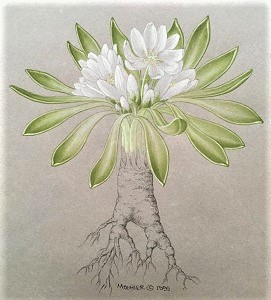
Micheal Moshier: Lewisias on display February 1-26
Lewisia brachycalyx by Micheal MoshierMicheal Moshier's family has generously donated his original artwork for LeRoy Davidson's 2000 monograph Lewisias to the Miller Library, and we are so excited to feature these plant portraits in our exhibit space this month. In the words of donor Jeff Uebel:

My uncle, Micheal Moshier, was a talented, prolific landscape and plant artist and a skilled, dedicated landscape designer and craftsman. He traveled and worked all along the West Coast and Hawaii, but his home base was the Puget Sound, especially right here in and around Seattle's Washington Park Arboretum. He is probably best known for his incredibly detailed pen, ink and graphite depictions of sun and cloud-drenched Cascade and Olympic peaks and waterfalls, rocky outcrops and islands in the Puget Sound, and placid scenes along Lake Washington. He was equally fascinated by and recorded the tiny components of these areas: mushrooms, flowers, leaves, kelp and stones.

He was particularly proud of his work with LeRoy Davidson to create the monograph Lewisias and asked that his illustrations for that work be kept together, to be shared and enjoyed by as many people as possible. We hope that you do enjoy them.

More on Lewisias from Brian Thompson
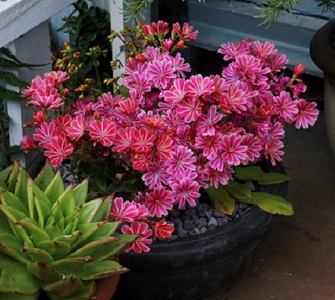
pot of lewisias photographed by Brian Thompson
I have a low pot of Lewisia cotyledon growing by my front door. It stays out year-round, but is protected from winter rains by the porch roof. A top dressing of gravel helps with drainage. Every May, now for several years, I’m rewarded with a dazzling display of sunset colored flowers.

The book Lewisias by B. LeRoy Davidson (1918-2000) is also rewarding, greatly enriching my appreciation of the genus. Known for his pursuit of rare alpine plants in our regional mountains, the author structured this book like a typical botanical monograph. However, he made his career in horticulture and developed a showpiece garden in Bellevue. This is evident by the cultivation anecdotes sprinkled throughout his book. He was well-acquainted with other keen gardeners and nursery owners in the area, making Lewisias read like a “Who’s Who” of local horticulture during the late 20th century.

The selections and forms of L. cotyledon are the easiest to grow as this native of the Siskiyou Mountains is very adaptable with good drainage, even in nooks of rockery walls. Once you’ve mastered this species, several other treasures wait to challenge your horticultural skills.

Perhaps the most famous is L. rediviva, the bitterroot that is the state flower of Montana. Brought back by the Lewis and Clark expedition, it surprised naturalists by its ability to sprout new leaves from an apparently dried up husk of root. “Later collectors were eager to find and introduce it, not just as a curiosity but as a potential food plant.” This didn’t prove viable, for while L. rediviva can come back to life from dried roots, it does not thrive in cultivation and it is a challenge to successfully coax into flower with its lovely chalices of bright whites and vivid pinks.

If you’re up for an even greater challenge, consider trying L. tweedyi, now moved by botanists into a closely related genus, Lewisiopsis tweedyi. This plant is known mostly in the Wenatchee Mountains. Considered by some to be the most beautiful alpine plant, Davidson wryly notes it “has been a smashing garden success almost nowhere but in its natural range. In the side yard of a house in Leavenworth, Washington, a magnificent old plant, staunch as rhubarb, opens as many as five hundred flowers each season.”
Ask the Plant Answer Line: Will black bamboo self-sow?
Researched by Rebecca Alexander
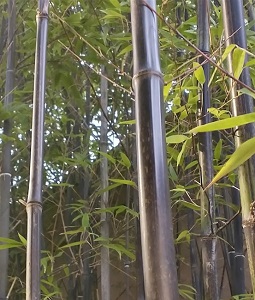
stand of black bamboo photographed by Laura 
Blumhagen at NHS Hall entry
Q: Our stand of black bamboo that has flowered is dying back. It was already escaping its barrier, but now I am concerned about the flowers producing seed that take hold everywhere. When we cut it down, should we be careful about not letting seeds scatter? I’ve heard that when one bamboo flowers, it coincides with other bamboos flowering. Is there going to be a massive die-off of bamboo?

A: You can certainly lay out a tarp for your cut bamboo, its flowers, and any potential seeds. If you are curious about seed viability, you can put some in containers and wait to see if they germinate. Some bamboo species have larger seeds that are easier to see, while others are small and easily obscured by decaying flower parts. Seeds collected before they are mature are unlikely to germinate. Based on all of these details, I don’t think your Phyllostachys nigra will be sowing itself all over the garden or the compost pile.

According to The Gardener’s Guide to Growing Temperate Bamboos (Michael Bell, Timber Press, 2000), flowering may be partial or complete. With partial flowering (which sometimes precedes full flowering), some culms will keep on going and not die. “When a bamboo flowers completely, most of the leaves are replaced by flowers, transpiration is largely interrupted, and this triggers natural responses that hasten the aging of the culm,” eventually resulting in death.

Depending on the species of bamboo, flowering is a fairly infrequent occurrence, and there are multiple theories about what prompts it. It can happen once every 30-60 years up to intervals of over 120 years. (There are just a few unusual species that flower yearly.) Bell says anecdotal accounts suggest that bamboos rarely if ever set seeds but, in his experience, “it is very rare that bamboos flowering in earnest do not set some seed during one of the years of their flowering cycle.” Clumping (sympodial) bamboo species will flower in winter and produce seed in spring, while running (monopodial) species like your black bamboo will flower in summer and produce seed in fall.

You mention the phenomenon of many bamboos flowering in unison. This is sometimes called mass synchronous flowering, or gregarious flowering, and can occur across the globe. According to Bamboo by Robert Austin and Koichiro Ueda (Weatherhill, 1970), “practically every bamboo of the same species, young or old and however widely separated they may be […] will flower in or about the same year.” Flowering in bamboo is complex and incompletely understood. A more recent scientific article, “The Bamboo Flowering Cycle Sheds Light on Flowering Diversity” by Xiao Zheng et al., classifies flowering into four categories: sporadic, massive synchronized, combined massive synchronized and sporadic, and partial flowering. Depending on the species of bamboo, regeneration can occur through sexual reproduction (seeds) or asexual reproduction (rhizomes forming small, weak shoots at first, as “the proportion of flowering bamboo generally first rises and then falls, while the proportion of non-flowering bamboo falls and then rises.” If your black bamboo dies, it is still possible you may observe some regeneration that follows this pattern.

gardening answers
Search for garden wisdom with us. You'll find researched answers,
gardening tips, book reviews, and recommended websites.
Digital resources
   UWBG pine cone logo
cover of Nonnative invasive plants of Pacific Coast Forests  Miller Library book and flower logo
New to the library
cover image    cover image    cover image
cover image     cover image    cover image
cover image    cover image    cover image
cover image    cover image    cover image
cover image    cover image
  give     Miller_LibraryLogo293px.gif    
Facebook    Twitter    Instagram    Pinterest
Contact Us   |   Privacy   |   Terms
© 2022 University of Washington Botanic Gardens