College of the Environment | University of Washington Block W Logo
Library Home | Catalog | Calendar | College Home
Volume 10, Issue 2 | February 2023
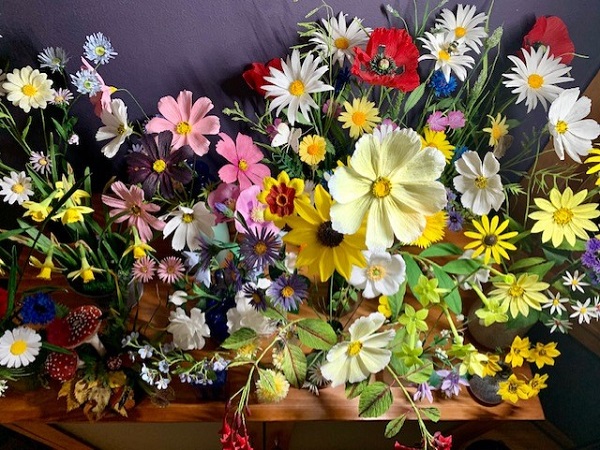
From a Paper Garden: Sculptures by Christina Hanson
The Artist's Work Bench by Christina Hanson
The Miller Library welcomes Christina Hanson with her botanically accurate wire and paper sculptures. Also a co-founder of the Pacific Northwest Vivarium Society and an orchid enthusiast, Hanson works for Edmonds College as lab manager in the department of Biology and Environmental Sciences.

Meet the artist at an opening reception in the Miller Library on Saturday, February 4, 2023, from 12:30-2:30.

The exhibit is open during Library hours February 1-25.
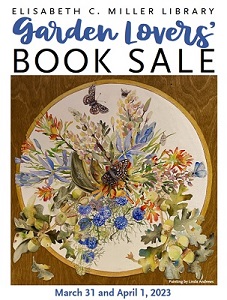
2023 Garden Lovers' Book Sale March 31 & April 1
Book Sale poster featuring art by Linda AndrewsOur Garden Lovers’ Book Sale will be early this year. Please mark your calendars for Friday, March 31st and Saturday, April 1st. Details will be in the March issues of Leaflet and Leaflet for Scholars, but plan on a party and the best selection on Friday evening, and a day of shopping for bargains on Saturday.

Can you donate gently-used gardening books this month to help the effort?  The last day for book donations is March 1st.

From March 31st through April 26th, the Pacific Northwest Botanical Artists will have their work on display and for sale, with twenty-five percent of the proceeds benefiting the library.

Volunteers are key to the success of the Book Sale.  If you’re interesting in helping with setup the morning of March 31, the party that late afternoon and early evening, or take down on the afternoon of April 1, please contact Nick Williams at nickjpw@uw.edu.

This is your opportunity to choose from hundreds of books on gardening, plants, and related topics. The Garden Lovers’ Book Sale only happens once a year – don’t miss it!
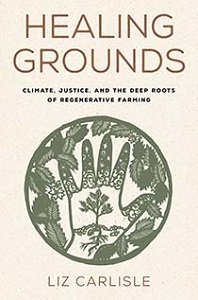
Healing Grounds by Liz Carlisle
Reviewed by Priscilla Grundy

Most readers know that America’s long history of racial discrimination has severely limited land ownership by people of color. In Healing Grounds Liz Carlisle shows how farming practices among four oppressed groups – Indigenous, Black, Latinx, and Asian Americans - have historically maintained and improved the land these people have been able to occupy, and how they continue to do so.

Their methods suggest a path to regenerative farming that could arrest climate change, if combined with major reduction in the use of fossil fuels.

Most surprising is Carlisle’s chapter on restoring the buffalo. In this, as in the other chapters, she builds her case by introducing the reader to individual experts. Here, Latrice Tatsey, a graduate student and member of the Blackfeet Nation, is stretched on the ground with her head in a foot-deep hole she has dug to begin her research into soil quality in buffalo grazing land. Next Carlisle interweaves conversation, references to other experts, and the story of an ambitious plan to bring back free-ranging buffalo herds. The result would be a healthier prairie, with a wider variety of plants and healthier soil that would sequester more carbon. No plowing, no land left uncovered between planting seasons, no monoculture. It’s very engaging reading.

Each chapter follows the same pattern. Some history of the discriminatory practices endured by each group leads into discussion of healthy farming methods used by each, and a suggestion of how each could lead to climate friendly regenerative farming.

In each case, the odds against widespread adaptation of these methods seem long. Nonetheless the author leaves us with lots of good reading about the intersection between agriculture, racism, and climate change, and with hope that those long odds can be overcome.

gardening answers
Search for garden wisdom with us. You'll find researched answers,
gardening tips, book reviews, and recommended websites.
Digital resources
   UWBG pine cone logo
cover of Restoring British Columbia's Garry Oak Ecosystems  Miller 
Library book and flower logo
New to the library
cover image    cover image    cover image
cover image     cover image    cover image
cover image    cover image    cover image
  give     Miller_LibraryLogo293px.gif    
Facebook    Twitter    Instagram    Pinterest
Contact Us   |   Privacy   |   Terms
© 2023 University of Washington Botanic Gardens