College of the Environment | University of Washington Block W Logo
Library Home | Catalog | Calendar | College Home
Volume 7, Issue 7 | July 2020
What's in my mason bee tubes?
Researched by Rebecca Alexander

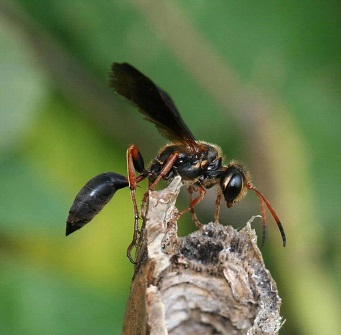
Sphecid wasp Isodontia exornata by Johnny N.
 Dell of Bugwood.orgQuestion: Who has moved into the tubes in my mason bee house? There are these strange bundles that seem to have dead crickets entombed in them. Do I need to remove them?

Answer: Your description and photos [not shown; this photo is by Johnny N. Dell of Bugwood.org] convince me that these bundles were made by grass-carrying wasps (Isodontia species) who store food (such as crickets!) with their cocoons to nourish the larvae when they emerge. Your mason bee house was a convenient location to nest. They look for any hollow cavities (such as stems, trees, or even window tracks), and the mason bee tubes were a perfect spot.

They would have built the nest in early summer, emerging later (late July through September) to visit flowers for pollen and nectar.

Grass-carrying wasps are beneficial insects just like mason bees, and serve as pollinators, too. This article from Heather Holm’s Restoring the Landscape with Native Plants (author of Bees: An Identification and Native Plant Forage Guide, 2017) mentions them visiting Solidago, Eupatorium, and Plantago.

As far as removing the grass-shrouded crickets or katydids, I would follow your normal mason bee housecleaning schedule. Usually, cleaning the tubes would be done between October and December. This page from David Suzuki's web page describes the process.

If you are curious to see a grass-carrying wasp in action, entomologist Michael Raupp's Bug of the Week page includes a video of a wasp creating its nest.
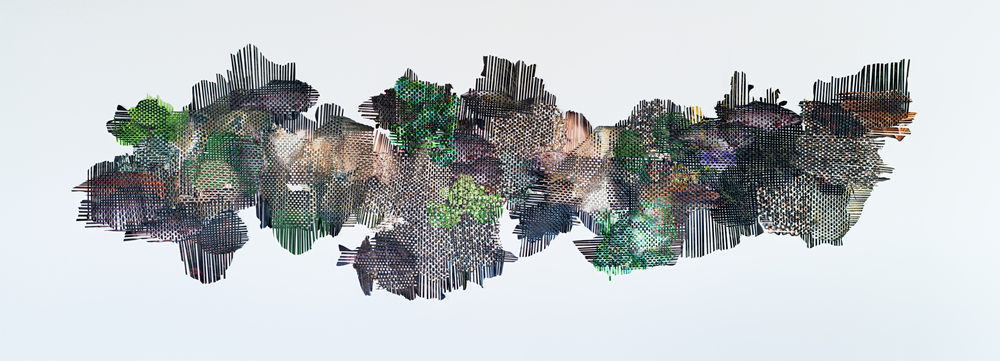
Virtual Exhibit: An Object Lesson by Markel Uriu
image of Markel Uriu's Human Dimensions of Biotic Homogenization Markel Uriu is an interdisciplinary artist based in Seattle. Her work explores impermanence, maintenance, and the unseen. Drawing from her Japanese and Irish-American heritage, she is particularly interested in liminal spaces, and explores these concepts through research, ephemeral botanical narratives, installations, and two-dimensional work. Her subjects of time, cycles, and cultural interchange have culminated in a fascination with invasive species. Her current work explores the nature of invasive species, their environmental impacts, and their links to humanity, colonialism, and globalization. 

Markel received her BA from Whitman College in 2011. She is the recipient of various awards and residencies, most recently with the Facebook AIR program, and 2018 Amazon Artist in Residence. She is a member of the Lion's Main Art Collective for Queer and Trans Artists, Seattle and SOIL Gallery, Seattle, and has shown throughout the United States.

Library reference questions on the rise; Master Gardener clinics running remotely
During the month of May, librarians at the Miller Library answered almost three times the usual number of plant and gardening questions. There were plant mysteries arising everywhere, weeds across Washington, wild and cultivated plants from north Capitol Hill to Nevada and Florida, ozone-afflicted city trees, voracious gastropods, sawflies and weevils, sickly kinnikinnick, plant selection in sunlight and in shadow, trailing plants for rockeries, sources for the pink sorbus and salmon-colored azalea varieties of yesteryear, and more. Wondering about something? Contact us at hortlib@uw.edu.

I n addition, King County Master Gardeners are now available to help you online. You can talk live with their trained clinicians, bring them your gardening questions, and even share images of problems or concerns you’re observing. For instructions on how to access the online clinic, go to http://www.mgfkc.org/ask-a-mg. These online plant clinics operate every Wednesday and Saturday, from 11 a.m. to 1 p.m. PDT, through the 2020 gardening season. 

The “Ask a Master Gardener” email clinic is also available daily. Send your messages with questions and photos to ask-a-mastergardener@live.com or use the form you’ll find online at http://mgfkc.org/e-clinic
subscribe to leaflet for scholars
The Miller Library publishes another newsletter each month: Leaflet for Scholars.
The July issue includes Tracy Mehlin's review of Big Lonely Doug as well as news about a University of Washington Information School capstone project
to preserve and organize our slide collection.
  give     Miller_LibraryLogo293px.gif    
Facebook    Twitter    Instagram    Pinterest
Contact Us   |   Privacy   |   Terms
© 2020 University of Washington Botanic Gardens