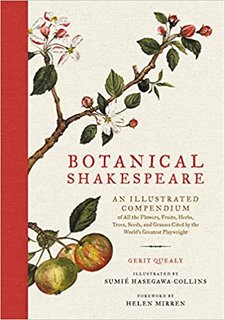
If you are attending outdoor Shakespeare plays this summer and enjoy plants,
this book is for you! With the collaboration of the noted Japanese artist Sumi
é Hasegawa-Collins, Gerit Quealy provides an alphabetical portrait gallery of plants –
The Botanicals. You can discover Shakespeare’s flowers, fruits, herbs, trees, seeds, and grasses. Quotations beside the drawings of the plants themselves allow us to experience their “faces” in fascinating and helpful ways. For example, cockle, a flowering weed found in wheat fields, is metaphorically used to describe corruption. It is mentioned by the frantic Ophelia in
Hamlet and the raving Jailer’s Daughter in
Two Noble Kinsmen.
The foreword is by Helen Mirren, who has taken on many Shakespeare roles, including switching up the male character Prospero in
The Tempest. Mirren notes her love of gardening began during her time with the Royal Shakespeare Company in Stratford.
This book is pure pleasure: you can thumb through and find a quotation about your favorite plant or learn something new in
Botanicals Defined: Syllabic Sketches at the back of the book. I learned that beans seem to suffer from a low reputation in Shakespeare, and are often used as horse feed or food only fit for the poor. The glossary illuminates the history of Shakespeare’s era with facts, plant lore, anecdotes, and clever illustrations. For example, the entry on the “Barnacles” mentioned in
The Tempest tells of a fourteenth century traveler’s tale, accepted by John Gerard, about geese that developed in barnacle-like pods on a tree. We now know that barnacle goslings are hatched by mother geese on islands in the Arctic, but Shakespeare’s “Barnacles” would have alluded to a strange plant/shellfish/bird chimera. The most impressive part of this book is how frequently plants arise in William Shakespeare’s work.
This labor of love was inspired in part by Gerard’s
Herball as well as
Shakespeare’s Plants and Gardens: A Dictionary by Nicki Faircloth and Vivian Thomas
. On our wish list, this 2014 dictionary is not currently available in local libraries. The author also cites Henry Ellacombe’s
The plant-lore and garden-craft of Shakespeare, which has been made available electronically at Archive.org by University College London.


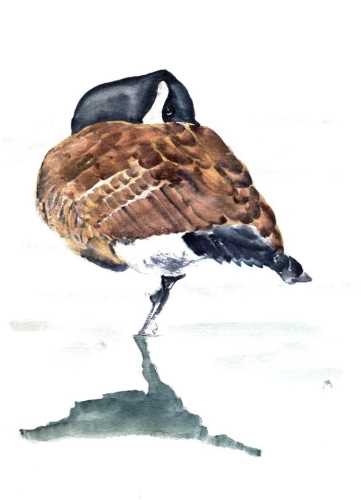 Rosemary Washington picked up a paintbrush and started painting when her daughter left home for college. Rosemary considers herself a true amateur, who paints for the love of it. She has lived in Seattle for over 35 years and calls the Pacific Northwest her home. In 2017 Rosemary was awarded a week-long art residency on Mallard Island through the Ernest C. Oberholtzer Foundation. She was the poster artist for the Miller Library's 2018 Garden Lovers' Book Sale. In addition to painting, Rosemary loves books and reading, taking photographs, and working at the Seattle Public Library. See more of her artwork, photographs, and writings on her