College of the Environment | University of Washington Block W Logo
Library Home | Catalog | Calendar | College Home
Volume 7, Issue 6 | June 2020
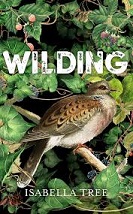
Wilding: The Return of Nature to a British Farm
Reviewed by Tracy Mehlin

Isabella Tree and her partner Charles Burrell own the 3,500-acre property known as Knepp Castle Estate. Her book Wilding: The Return of Nature to a British Farm recounts the Knepp Wildland Project that took place over 18 years starting in 2000 after a failed effort to make the farm profitable with modern, intensive techniques. Their idea, inspired by a similar project in the Netherlands, was to undo many centuries of land management by introducing hardy large herbivores and then stepping back to see what would happen. The author defined it as: “Rewilding -- giving nature the space and opportunity to express itself – is largely a leap of faith.” Take a look at a 15-minute video of Tree introducing the concept.

This book was enjoyable to read because Tree describes various wildlife, birds, insects, mammals, and livestock from an amateur's enthusiastic perspective rather than with a dry, dispassionate scientific voice. Tree keeps the pace of the narrative moving, yet provides enough details of animals, ecology, history and even governmental regulations that the reader understands why they choose to rewild despite considerable obstacles.

Her narrative of the slow evolution of rewilding their large property takes place over 3 decades. The story of the farm pasture and woods, neighbors, various national agencies and the wider economy is interspersed with detailed accounts of rare birds, land-use history, heritage breeds of livestock, and the inner workings of ecological interdependence. Tree’s special fondness for the turtle dove is appropriate: nearly extinct in Britain, it is thriving at Knepp.

The role of plants is integral to animal habitat. Tree learns that animals, specifically large herbivores and predators, directly contribute to remaking plant communities which then evolve to support even more species of wildlife. Their philosophy could be boiled down to: increase biodiversity, stay hands-off, build resiliency -- repeat!

Neighbors and their notions of a tidy, well-cared-for, pastoral landscape proved to be the most vociferous opponents of allowing their land to revert to a wild state. Tree attempts to understand their unease by looking into the social and psychological impact of living in a controlled, tidy, managed environment. Neighbors saw the Knepp project as abuse and gross negligent abandonment. The author remarks how the oldest neighbors remember the hedgerows and all the birdsong now absent in the agriculturally productive countryside. She also repeatedly points out how their land is marginal and even with modern equipment, chemicals and “improved” breeds they could never make a profit. She wonders why farmers, and governments through subsidies, spend so much on producing food when so much of it wasted, thrown away, uneaten by consumers or worse, never even making it to market because of the low prices received for commodity crops.

Readers interested in regenerative agriculture, ecological restoration and climate change mitigation will find Wilding an inspiring source of hope.

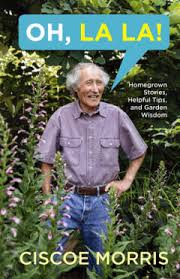
Review of Ciscoe Morris' Oh la la! by Brian Thompson
“I am a storyteller.”

Ciscoe Morris is an expert gardener, eager to share his knowledge with those at all levels of gardening ability. But this self-assessment from the introduction of his new book is also very accurate. He grew up in a large family of storytellers and that skill came first. Later, gardening became the framework for his tales.

“Oh, La La!” is a fine collection of short essays, each no more than a few pages. You can open the book anywhere and immediately be engaged, no matter the topic. Later, you’ll realize how much you learned.

There are three main settings: his home garden, the Seattle University campus where he worked for many years, and the many locations from his travels. While the plants take center stage, the interactions of the gardener with other people and with animals – especially beloved dogs – are the memorable highlights.

I have several favorite stories.  One of the longer chapters lays out the many – usually unsuccessful – ways to control moles, concluding “if nothing else works, you can learn to live with moles.” Another lesson confirms my personal experience with the Colorado blue spruce (Picea pungens var. glauca). It belongs in Colorado, safe from the spruce aphids that devastate this species in our mild, maritime climate.

Ciscoe promises this is not his last book. “I already have an idea for the next one. Oh, la la: I can’t wait to get started!” I can hardly wait to read it.

Ask the Plant Answer Line: Celandine: what is it, really?
Researched by Rebecca Alexander
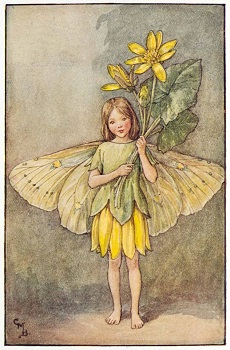
Lesser celandine illustration by Cicely Mary Barker
Q: Last year I purchased a plant at a plant sale. The tag said simply 'celandine.' It is flowering now, and its flowers are like yellow poppies. The leaves are attractive and very distinctive—deeply cut margins, kind of like oak leaves. But when I think of celandine, I think of the Cicely Barker flower fairies books from childhood. I am not sure this is the same plant.

A: You are not alone in experiencing 'celandine confusion,' discussed in this article from The Scott Arboretum of Swarthmore College. The confusion rests on the use of that common name to describe a plant that is a Washington State-listed Class B noxious weed in the buttercup family, and two different plants in the poppy family.

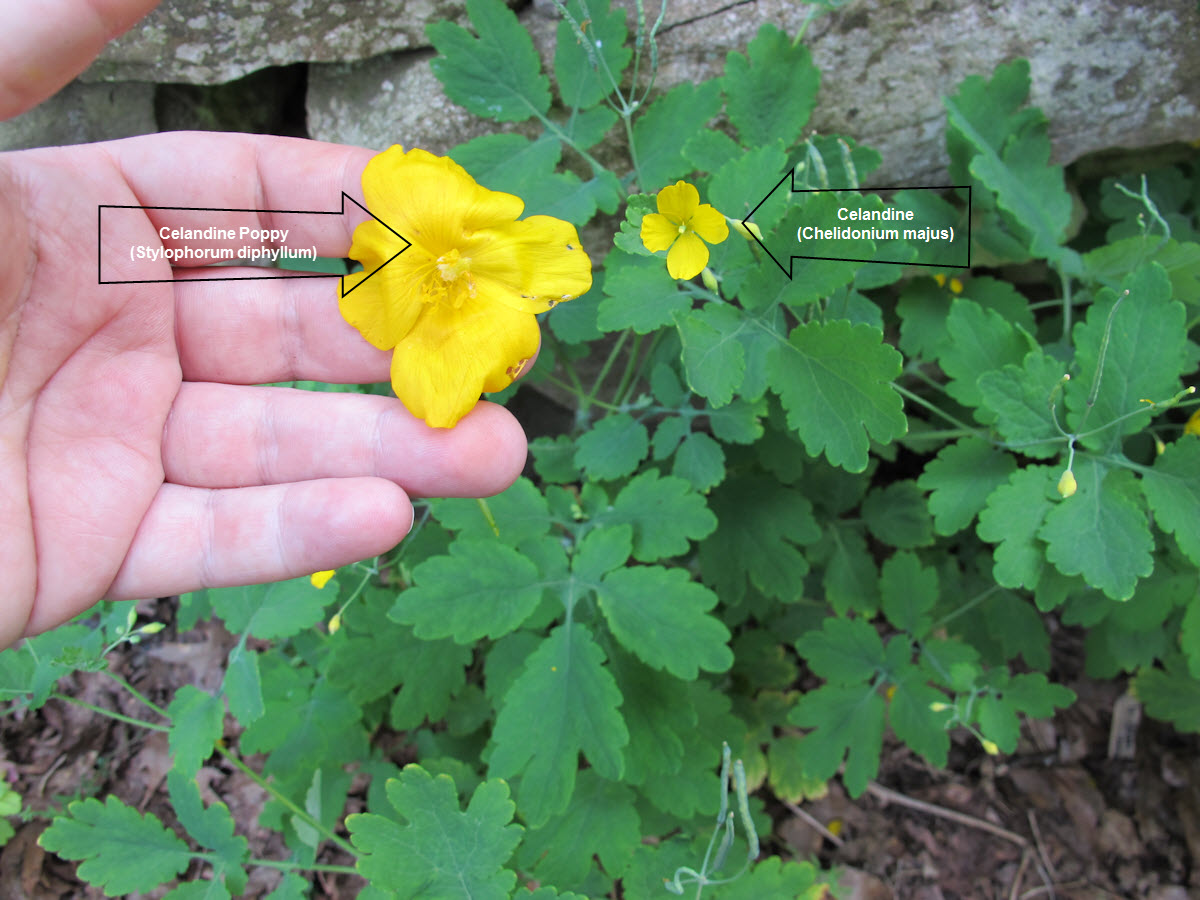
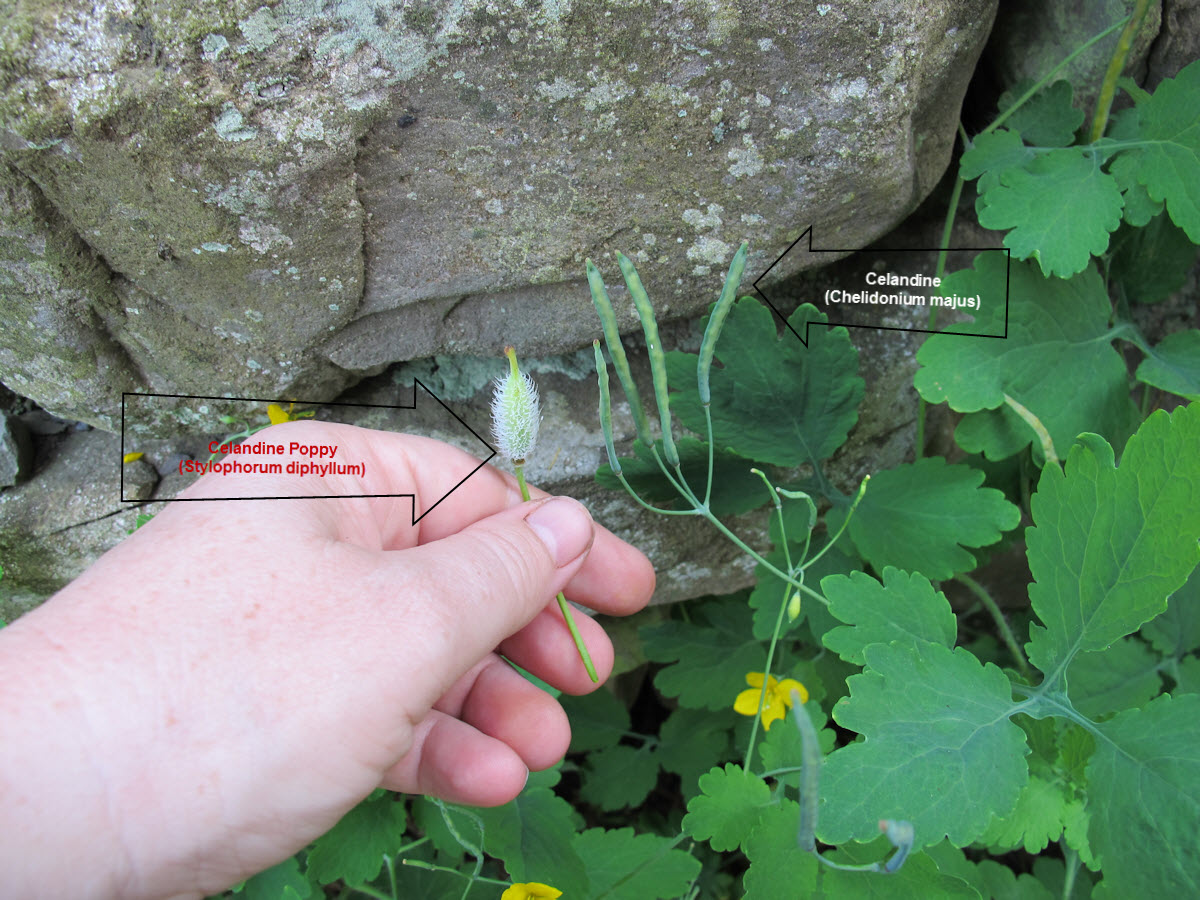
If you remember the illustration for "The Song of the Celandine Fairy" depicting 'the lesser celandine,' the illustration shows Ficaria verna (also called Ranunculus ficaria). There is also a 'greater celandine' fairy in Barker's books, and that image looks more like Chelidonium majus which is in the poppy family and is a native of Europe. It is a bit harder to tell the difference between Chelidonium and Stylophorum diphyllum. Your plant is most likely one of these. Other common names for Stylophorum are 'celandine poppy,' and 'wood poppy.' Stylophorum is native to moist woodlands of eastern North America. Here's what will help you tell one from the other:

According to Andrew Bunting, curator of the Scott Arboretum, "Stylophorum has broader leaves and Chelidonium leaves are more dissected. Also, the flowers are smaller on Chelidonium." These images from Kathy Purdy’s Cold Climate Gardening blog neatly illustrates the differences in flower and leaf size. Further, when they reach the phase of producing seed pods, the difference is striking.

For additional information about Stylophorum, including suggestions of plant combinations for gardens, see this advice from University of Wisconsin-Madison's Master Gardener Program, and this web log entry from Bruce Crawford, director of Rutgers Gardens, on the plant that launched his career in horticulture.
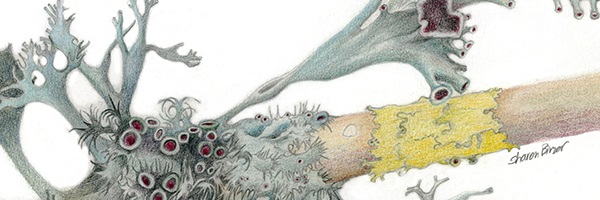
Ramalina panizzei detail copyright Sharon Birzer
June virtual exhibit by Sharon Birzer
This month, Sharon was scheduled to show her work featuring lichens of Alaska’s Tebenkof Wilderness Area in the library. Until that exhibit can be rescheduled, we invite you to enjoy her finely honed observations of nature by visiting her online exhibit, Gathering from the Land. Her keen sense of color, line, and composition reveals the defining characteristics of her subjects (lichen, plants, insects, birds, sea creatures) in drawings and paintings that are startlingly beautiful.
  give     Miller_LibraryLogo293px.gif    
Facebook    Twitter    Instagram    Pinterest
Contact Us   |   Privacy   |   Terms
© 2020 University of Washington Botanic Gardens