College of the Environment | University of Washington Block W Logo
Library Home | Catalog | Calendar | College Home
VOLUME 10, ISSUE 4 | April 2023
Ask the Plant Answer Line:
Why do cottonwood twigs hold stars?
Researched by Rebecca Alexander
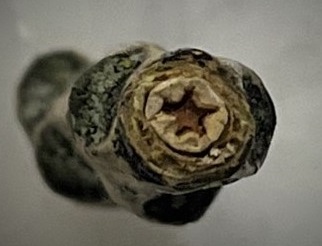
image of star inside cottonwood twigQuestion: I learned about the star shape inside cottonwood twigs from a Lakota story.  The stars were not always in the sky. They originated in the earth, seeking roots from which they could be born. The sound of water drew them to the cottonwood roots (since this tree often thrives near water). They traveled upward into the trees, waiting for wind to snap the branches, releasing the stars into the sky. The story made me wonder if other trees have this star shape inside their twigs and branches, and what purpose does the star pattern inside the twigs serve (other than cosmological)?

Answer: In exploring winter twig keys and a story by Deb Mowry of the Montana Natural History Center, I learned that this five-pointed (also called five-angled) star shape is common in Populus (aspen, poplar, cottonwood) and Salix species (members of the willow family) but is also found in oaks (Quercus), and chestnut (Castanea). The pith inside a stem is made of parenchyma (large, thin-walled cells), which are often a different color than surrounding wood (xylem). The pith’s function is to transport and store nutrients. Pith is usually lighter when new, but darkens with time (as seen in images like these of cottonwood “stars”).

Mowry’s story notes the importance of cottonwood to the belief systems of Native American tribes: the Lakota, the Cheyenne, the Arapaho, and the Oglala Sioux. Pacific Northwest naturalist and poet Robert Michael Pyle’s essay, “The Plains Cottonwood” (American Horticulturist, August 1993, pp.39-42),  describes an Arapaho version of the story of the stars that you told above: “They moved up through the roots and trunks of the cottonwoods to wait near the sky at the ends of the high branches. When the night spirit desired more stars, he asked the wind spirit to provide them. She then grew from a whisper to a gale. Many cottonwood twigs would break off, and each time they broke, they released stars from their nodes.” Cottonwood twigs sometimes snap off without the assistance of wind, a self-pruning phenomenon called cladoptosis. Pyle suggests looking for twigs that are neither too young nor too weathered if you want to observe the clearest stars: “The star is the darker heartwood contrasting with the paler sapwood and new growth.”

Pacific Northwest Botanical Artists exhibit
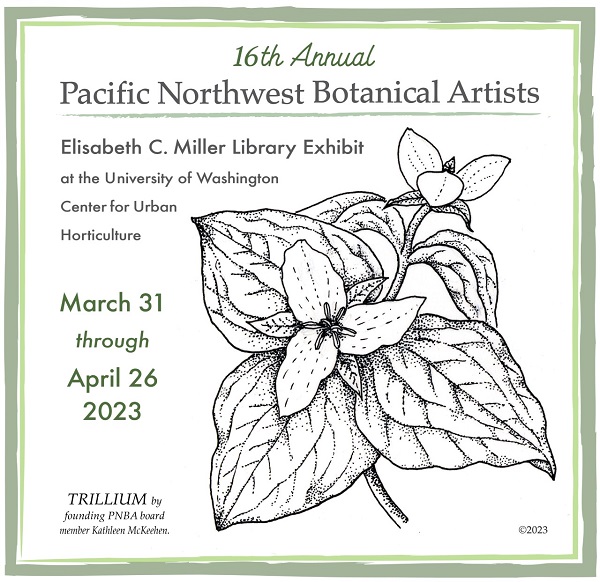
Pacific Northwest Botanical Artists 2023 show poster
The Pacific Northwest Botanical Artists (PNBA) are pleased to present their 16th Annual Elisabeth C. Miller Library exhibit.

PNBA is a chapter of the American Society of Botanical Artists, a nonprofit organization dedicated to promoting public awareness of contemporary botanical art, honoring its traditions and furthering its development.

The in-person exhibit runs March 31 through April 26 during Library open hours. Artwork will be for sale throughout the month, with a portion of the sales benefiting the Library.
Plants & People display of resources
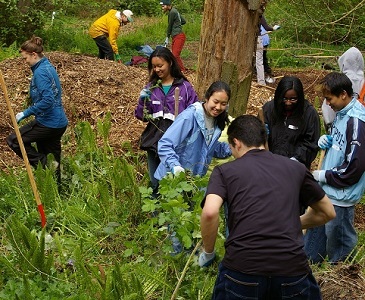
Earth Day volunteers
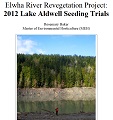
Connections between people and plants are on the syllabus for students in Environmental Science and Resource Management (ESRM) and the School of Environmental and Forest Sciences (SEFS) this spring, and on everyone's minds as Earth Day nears. We're featuring some of our best resources on this wide-ranging topic. Theses such as Rosemary Baker's Elwha River Revegetation Project appear alongside regional favorites such as Douglas Deur and Nancy J. Turner's Keeping It Living: Traditions of Plant Use and Cultivation on the Northwest Coast of North America and many other titles.

Browse the display near the library's north windows. Most items can be borrowed directly from the display-just ask a librarian.
garden lovers' book sale
Thank you for your support during our 2023 Garden Lovers' Book Sale. Remaining book sale inventory will be available at discounted prices (some even free) in the Library Program Room during our open hours April 3-29. Cash and checks only.
Digital resources
   UWBG pine cone logo
detail from The Plums of New York, U.P.
 Hedrick, 1911  Miller Library book and flower logo
New to the library
cover image    cover image    cover image
cover image     cover image    cover image
cover image    cover image    cover image
cover image   cover image
cover image    cover image    cover image
Donate to the Miller Library Fund    Miller_LibraryLogo293px.gif
  Facebook    Twitter    Instagram     Pinterest
Contact Us   |   Privacy   |   Terms
© 2023 University of Washington Botanic Gardens