College of the Environment | University of Washington Block W Logo
Library Home | Catalog | Calendar | College Home
VOLUME 7, ISSUE 12 | December 2020
December Arts and Crafts Exhibit and Sale by local artists
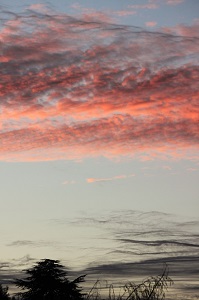
Sunrise by Kathleen Ashby AtkinsThis month we are pleased to announce that Northwest artists and Miller Library supporters Linda Ann Vorobik, Molly Hashimoto, and Kathleen Ashby Atkins, whose photograph entitled Sunsets appears here, will be participating in our Virtual December Arts and Crafts Exhibit and Sale. In addition to photographs and prints, you'll find beautiful cards, knitwear, and botanical illustrations. Please support the wonderful work of these artists. In turn, they will be offering a portion of their sales in support of the Miller Library.

Molly Hashimoto spoke about her work in an interview with Jessica Moskowitz recently. Viewers can learn what inspires her and see what techniques and materials she uses.
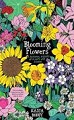
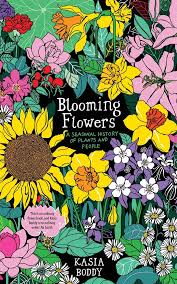
Kasia Boddy's Blooming Flowers reviewed by Tracy Mehlin
Blooming Flowers cover
How did the chrysanthemum move through history, associated in its native China as an elixir of youth to symbolizing Japanese imperial power and then transform as an invitation to join a protest march against the Vietnam war in 1967? Read the delightful Blooming Flowers: A Seasonal History of Plants and People to find out.

Blooming Flowers is a work that documents how horticulture permeates society with both symbolism and literal enthusiasm for colorful displays. Author Kasia Boddy, professor of American literature at the University of Cambridge, takes a deep dive on the historic, cultural, literary, culinary, medicinal, and scientific background on common garden flowers, such as geraniums and marigolds. She also includes a few less commonly grown flowers like saffron, almond and lotus. Boddy relates why flowers are so significant to human culture:

"One reason we love flowers is because they help us talk to each other about the big and small questions of life: about love, death, class, fashion, the weather, art, disease, an allegiance to a nation, religion or political cause, the challenges of space and the passage of time."

Divided into four seasons, each with four representative flowers, Boddy's book entertains us with literary quotes and color images of floral depictions in famous paintings and illustrations. She unearths the earliest mentions of the flower and traces how symbolism of some flowers changed over the centuries in Asian and European cultures. The sheer breadth of her knowledge is engaging, and the pace is steady. Just as she starts to get into details on one example in art history she moves smoothly on to the next example in art or politics. The chapter on the winter blooming almond starts with words from D. H. Lawrence while he lived in Tuscany: "pink houses, pink almond, pink peach and purply apricot, pink asphodels". Also included is van Gogh's painting of a blooming almond twig in a glass inside his modest room in Arles, France. The chapter concludes with observations of how much water California's million acres of almond orchards require and notes that despite how toxic bitter almonds are to human health, internet quacks peddle the poison as a cancer cure.

I've grown twelve of the sixteen flowers explored in Boddy's book and I now appreciate the hidden meanings and cultural connections lurking in my garden. I found Blooming Flowers pleasurable reading that provides many interesting tidbits of lore.

Sahlab: How is this orchid-based beverage made?
Researched by Rebecca Alexander
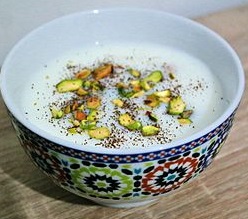
bowl of sahlab
Q: When I lived in the Middle East, there was a warm drink we enjoyed called sahlab (spelled with variations in different countries, such as salep in Turkey) that is made from dried powdered orchid roots and milk. It can be sweetened, flavored with rosewater and sprinkled with cinnamon and finely chopped pistachios. The powder made from the roots was ubiquitous in markets in my country, but is hard to find here. I don't know which kinds of orchids are used traditionally. Do all orchids have tubers that are edible (or drinkable)? Are there Pacific Northwest native orchids that could substitute for the wild orchids used in Middle Eastern sahlab?

A: The use of orchid tubers, whose stored starches are nourishing both to the orchid plant and to humans, goes back many centuries, and over time, sahlab/salep in one form or another migrated across Europe. In the Middle East, people typically use tubers from wild native orchids. In Israel, the family Orchidaceae is referred to as Sahlavim [plural], and the genus Orchis is called Sahlav. In Greece and Turkey, the drink is often made from the tubers of Orchis mascula, Orchis militaris and Anacamptis morio. Other sources include Dactylorhiza and Ophrys species. By the 18th century England, salep or 'saloop' was made from Orchis mascula, and was sold by street vendors as a lower cost alternative to tea and coffee. It also went by the name 'dogstones' because of the tubers' resemblance to testicles. In his 1640 book Theatrum Botanicum, John Parkinson lamented that "our pharmacists are wont to adjudge every sort of orchid root an aphrodisiac," possibly a throwback to the notion that a plant's appearance indicates its medicinal uses (the Doctrine of Signatures).
An important consideration is the conservation status of some orchids, including species which have been harvested for making sahlab. CITES, the Convention on International Trade in Endangered Species of Wild Fauna and Flora, restricts importing all orchids, because of the difficulty in distinguishing one from another, especially by looking at tubers alone. This may account for the scarcity of sahlab powder.

Many orchids have edible properties--just think of vanilla, made from the pods of Vanilla planifolia. It is hard to say which locally native orchids have tubers best suited to making sahlab, and harvesting wild orchids is problematic from a conservation standpoint. For clues about edible uses of orchids in this country, I searched the Native American Ethnobotany Database. Numerous tribes (including some in the Pacific Northwest) have used a wide variety of orchid species for edible, medicinal, and spiritual purposes. Those which grow here include: Corallorhiza maculata, Goodyera oblongifolia, Platanthera dilatata, Platanthera stricta, and Spiranthes species. Goodyera, for example, is mentioned in Erna Gunther's Ethnobotany of Western Washington as a tonic among the Cowlitz.

Rather than try to find or grow and harvest orchids to make your own sahlab, the best thing would be to look for prepared sahlab powder that is made from sustainable sources.
For more information, see the full question and answer in our Gardening Answers Knowledgebase.
THANKS FOR YOUR SUPPORT
Thanks to community support, the Miller Library continues to offer the best in horticultural reference assistance and outreach in the face of challenging times.
We appreciate your generosity!
Digital resources 
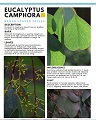
Cultivated Eucalypts of Seattle and the greater Pacific Northwest : a field guide / Robert Edward Wrench.
     cover image    Miller Library book and flower 
logo   
New to the library
cover image     cover image    cover image
cover image      cover image    cover image
cover image    cover image     cover image
cover image    cover image    cover image
cover image     cover image    cover image
cover image     cover image    cover image
cover image
   cover image       cover image
cover image     cover image
Donate to the Miller Library Fund    Miller_LibraryLogo293px.gif
  Facebook    Twitter    Instagram     Pinterest
Contact Us   |   Privacy   |   Terms
© 2020 University of Washington Botanic Gardens