College of the Environment | University of Washington Block W Logo
Library Home | Catalog | Calendar | College Home
VOLUME 6, ISSUE 2 | February 2019
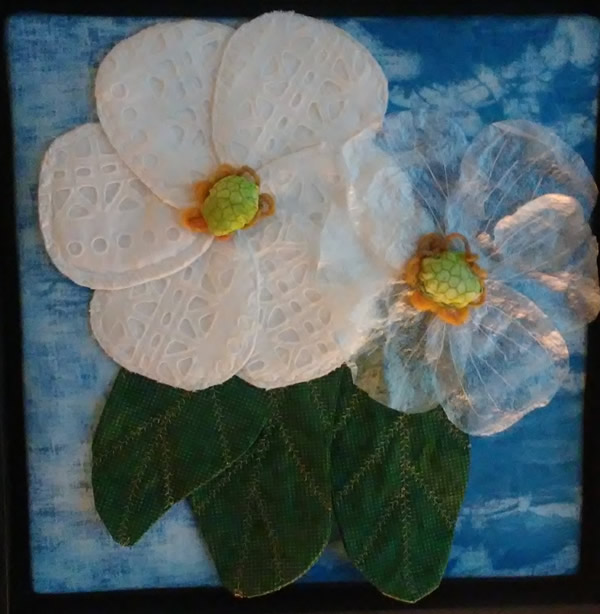
Fabricated Foliage by fiber artist Kaylin Francis
in the Miller Library February 4-27
Kaylin Francis skeleton flower imageLocal artist Kaylin Francis brings her fiber-crafted portraits of eight different plants to the Miller Library February 4-27. With many years of experience in cross-stitch, quilting, and needlepoint as well as formal training in felting, dyeing, weaving, and screen-printing, she has been exhibiting her work at group and solo shows in Washington and Oregon since 2009.

Her 'Skeleton Flower (Diphylleia grayi)'  is pictured here. This unusual flower turns translucent when wet. The plant is found in Japan, China, and the Appalachian Mountains.

Kaylin welcomes readers of  Leaflet for Scholars for an opening reception at the library from 5 to 7 pm on Thursday, February 7.
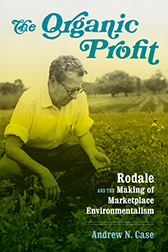
The Organic Profit: Rodale
by Andrew N. Case

reviewed by Brian Thompson
The Rodale name has long been associated with organic gardening, and books from Rodale Press make up a significant part of the Miller Library’s section on this subject. The company’s magazine Organic Gardening, under that name and similar titles, was a mainstay of garden periodicals from the mid-20th century until it ceased publication in 2017.

What is the bigger story behind this name? The Organic Profit, written by Andrew Case and published by University of Washington Press, delves into this history. In part, this is a biography of J. I. Rodale (1898-1971) and his son, Robert Rodale (1930-1990). It also is an analysis of the mid- to later 20th century movement, in many ways sparked by this family effort, for self-improvement through healthy life choices, including gardening practices and diet. Reading this history, I particularly enjoyed a study of the etymology of the word “organic."

As the play on words in the title would suggest, the family’s story is not completely altruistic. There was a market for their products and they were eager to meet and promote customers' demands. However, this grew out of zeal for sharing their personal beliefs. “In his [J. I. Rodale's] estimation, soils, plants, animals, and people all had a proper diet. Those proper diets were disrupted in the age of chemical fertilizers and pesticides, and the health of people, plants, animals, and soils was breaking down as a result.”

The author also analyzes the role the Rodales played in the broader environmental movement of the 1960s and 1970s. For all who are researching or working in fields that were affected – or even created – by the changes in societal attitudes towards our collective stewardship of the environment at that time, this is an important history to know.

Welcome, Students!
book imageNeed some pointers for navigating your first research project of the quarter? We're happy to help you find materials on a drop-in basis whenever the library is open. Saturdays the library is open 9 am to 3 pm, and Mondays we're open 9 am to 8 pm. Tuesday-Friday you'll find librarians on duty 9 to 5. If you'd like a one-on-one meeting with a librarian who can teach you how to find journal articles and other resources to pursue your topic efficiently and successfully, please email hortlib@uw.edu or call 206-543-0415. Faculty and returning students, please share this information with those who are new.
visit the library
The Miller Library is open for browsing and research 49 hours each week.
You'll find the full schedule and information for visitors on our website.
New to the library
cover image     cover image    cover image   
cover image     cover image     cover image    cover image
cover image    cover image    cover image
cover image    cover image    cover image    cover image
cover image
Donate to the Miller Library Fund    Miller_LibraryLogo293px.gif
  Facebook    Twitter    Instagram     Pinterest
Contact Us   |   Privacy   |   Terms
© 2019 University of Washington Botanic Gardens