College of the Environment | University of Washington Block W Logo
Library Home | Catalog | Calendar | College Home
VOLUME 8, ISSUE 2 | February 2021
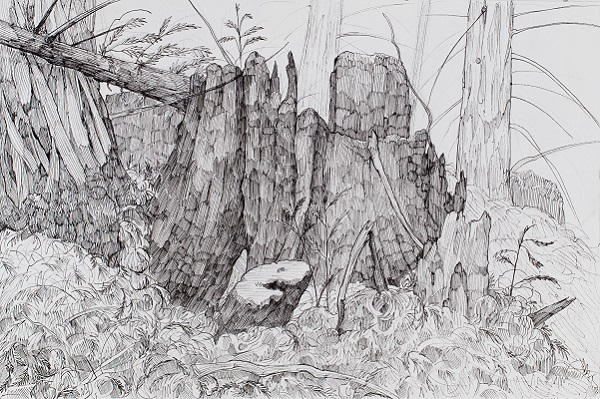
Topography by Adrianne Smits
Redwoods 3 by Adrianne Smits
Adrianne Smits is primarily a painter. She seeks immersive experiences in natural ecosystems, creates works on paper directly in this environment and uses these materials to inform studio compositions (www.artstudies.com). She often works on a large scale to recreate feelings of immersion and envelopment and embraces the distortion introduced by working partly from memory to transform complex organic forms into patterned, flattened spaces. She was also trained as an ecologist at UW Seattle, graduating from the School of Aquatic and Fisheries Sciences in 2016. Dual perspectives in the arts and natural sciences drive her interest in organizing structures and forms in landscapes that appear chaotic. Her scientific research explores how climatic and human forces shape natural ecosystems.

Smits moved from Seattle to central California in 2017. In California, as elsewhere on the west coast, wildfire is the most obvious manifestation of climate change, confronting us every year with greater ferocity. She has evacuated her home twice in the last three years due to wildfires, an increasingly common experience in the western U.S. Her recent work focuses on fire in the landscape.

Topography: This series of drawings is an exploration of the organic terrain created by remnants of large trees. Left behind after commercial logging operations, these stump landscapes are simultaneously ghosts of an old forest and substrate for a new one. The burned-out remains of old-growth redwood and Douglas fir, almost submerged beneath debris from second growth timber stands, record both damage and regeneration. The current form of these tree remnants results from a long history—centuries of intentional burns by Native Californians, timber extraction, decay, and re-sprouting. The young forests that hide these older remnants grow more densely than old growth forest, and thus are primed to burn in catastrophic fashion, as they did this summer. The lightning-sparked firestorm that burned 2 million acres in California this past summer, including some of the areas shown in the drawings, started the same day Smits began working on ‘Redwoods 9’ in Big Basin State Park. How long will this topography last in a warmer, drier future?
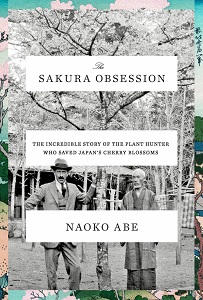
The Sakura Obsession
Reviewed by Brian Thompson
book image
In Japan, “the sakura, or cherry-blossom, culture of the twentieth and twenty-first centuries revolved around the flower’s short life and swift, predictable death. The cherry blossom was ephemeral, like life itself.”
 
Naoko Abe wrote about this tradition in her native Japanese in a book published in 2016. It was very well received and there was immediate interest in an English translation. She decided instead to do further research, especially into the British roots of her story. In 2019 she published the largely newly-written Sakura Obsession, the source of the quotation above, in English. For this more global audience, she included the history of many societal practices likely unknown outside of Japan.
 
She also describes the wild species and the many cultivars and selections of Prunus made over the centuries in Japan. By the late 1800s, these had largely been pushed aside from gardens by Prunus x yedoensis ‘Somei-yoshino’ that as a clone, provided the uniformity desired for Japanese ceremonies. This is the cherry tree of the University of Washington Quad and the dominant variety planted at the Washington, D.C. Tidal Basin.
 
In a parallel storyline, Abe writes the biography of Collingwood ‘Cherry’ Ingram (1880-1981), who rescued many out-of-favor cherry selections by bringing them from Japan to his English garden, later reintroducing them to their home country. It is also the study of the close relationship between two island nations and colonizing powers, Japan and Britain, and how horticulture was a common language.
 
There is a somber side to this history. As is possible in any culture, the symbolism of the flowers changed, especially for Japanese children, including Abe’s father, in the 1930s. “Rather than focusing on cherry blossom as a symbol of life, the songs, plays and school textbooks now focused more on death.” During World War II, branches of cherry blossoms were used to wave farewell to kamikaze pilots as they took off in their planes, going to their deaths.
 
On the whole, however, this is a book of hope and international goodwill. I didn’t expect to get hooked by this story, but I did. I recommend it for the engaging narrative of intellectual exchange and horticultural history.

Looking closely at Echium plantagineum
Researched by Rebecca Alexander
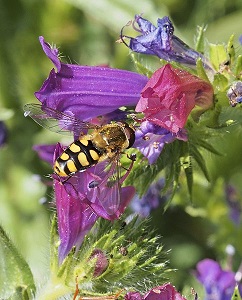
Eupeodes sp. onEchium plantagineum photo by Luis Fernández García
Q: What can you tell me about Paterson's curse? It's a weedy plant with blue flowers mentioned in an Australian novel about an Aboriginal community and their ongoing struggle with the effects of colonization.

A: Paterson's curse is a common name for Echium plantagineum, also known as Salvation Jane, purple viper's bugloss, Lady Campbell weed, blueweed, and Riverina bluebell. It is invasive in Australia, where it has overtaken pasture land. It is toxic to horses and other grazing livestock. (There is a similar plant, Echium vulgare, which is invasive in Washington State.)
The source of the name is said to come from the Patterson family (the plant dropped the second T through common usage over time) who introduced it to their garden in Cumberoona, New South Wales around 1880. However, according to Australian author Roger Spencer, the plant's presence was first recorded in Australia in 1843, in the garden of John Macarthur, near Sydney. It began appearing in nursery catalogues by 1845, and by 1890 it was entrenched in New South Wales and South Australia.

There are two theories about the name Salvation Jane. In times of drought, when native pasture plants died back, Echium plantagineum was seen as a ‘salvation’ because it grew when nothing else would. The hooded shape of the flowers call to mind the bonnets of 19th century Salvation Army missionaries.

You might be interested in reading more about indigenous Australian uses of plants that predate colonization.
ASK A LIBRARIAN
The Miller Library's Plant Answer Line provides quick answers to gardening questions.
You can reach the reference staff at hortlib@uw.edu or through our website, www.millerlibrary.org.
Digital resources
A seedling identification guide for common plants on Mt.
 Rainier and the North Cascades / by Kyra Kaiser.
     cover image
Miller Library book and flower 
logo    2013 urban forest stewardship plan / City of Seattle Urban Forestry Commission
New to the library
cover image   cover image    cover image
cover image     cover image    cover image
cover image    cover image
cover image     cover image    cover image
cover image    cover image    cover image
cover image      cover image    cover image
cover image    cover image
Donate to the Miller Library Fund    Miller_LibraryLogo293px.gif
  Facebook    Twitter    Instagram     Pinterest
Contact Us   |   Privacy   |   Terms
© 2021 University of Washington Botanic Gardens