College of the Environment | University of Washington Block W Logo
Library Home | Catalog | Calendar | College Home
VOLUME 7, ISSUE 11 | November 2020
Molly Hashimoto's card and print sales to benefit the Library
Molly Hashimoto's 2021 mini Trees calendar
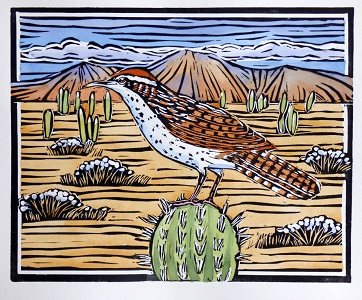
We are thrilled to announce that acclaimed Seattle artist and teacher Molly Hashimoto will be giving back to the Miller Library once more with her 2020 virtual exhibit, opening this week. During the month of November, she will donate twenty percent of the proceeds of card and print sales to the Miller Library. Buyers can arrange no-contact pickup directly from the artist.

Molly's work draws on her experience at the North Cascades Institute, with iconic landscapes and animals interpreted in paintings, block prints and etchings. Many of the bird prints appear in her 2019 book, Birds of the West: An Artist's Guide, a part of our Pacific Northwest Connections Collection.
The book drop is open!
book imageGood news: we have now reopened our book drop so you may return borrowed books!  Library staff are preparing to offer no-contact pickup of holds during limited hours. In order to enable picking up new holds, you will need to return any items you still have at home.

To place holds, go to www.millerlibrary.org and browse the catalog. If you do not know your login name and password, please email us at hortlib@uw.edu . Watch our website, Facebook page, and Leaflet for Scholars for announcements of when and how no-contact lending will begin.

Thank you for your patience during this long closure!
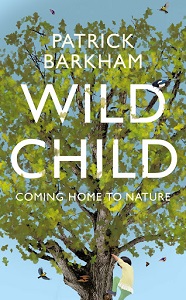
Wild Child: Coming Home to Nature by Patrick Barkham
Reviewed by Laura Blumhagen
Patrick Barkham's Wild Child: Coming Home to Nature chronicles his year as a parent volunteer at the his children's forest school, interwoven with memories of his own childhood and musings on the role of nature in our lives, especially while we are young. Childhood has changed since Barkham's youth in 1980s Norfolk (UK), when he and neighboring kids roamed every day, inventing outdoor diversions. Most parents today feel a responsibility to provide constant supervision, or at least keep kids in out of the weather. Something has been lost, Barkham believes, and enrolling his three children at Dandelion outdoor nursery helps to restore it, grounding them in the natural world around them. As he says, "Formative experiences resonate throughout our lives."

For me, one of the highlights of this book was the opportunity to learn new words and new usages. Some, like "reception year" (which refers to the first year of primary school), "clodgy," "gubber," and "slub" (all words for mud), and "sallow" (another word for the pussywillow tree), are new words for known concepts. Others are novel concepts for me. Soft fascination, which describes the power of forests and other natural environments to keep our senses gently engaged without wearing out our attention spans or tiring us, was a revelation to me. Coined by environmental psychologists Rachel and Stephen Kaplan in 1989, soft fascination is a hallmark of restorative environments, distinct from a state of "directed attention" such as listening to a lecture or watching TV. Environments rich in soft fascination help to recharge us, making them ideal for learning. Some educators in the UK have taken advantage of this fact by offering some outdoor lessons to upper primary school students who struggle in the classroom. The author is impressed with what he learns visiting two of these outdoor experience programs. In one forest school program for English language learners, many of them refugees, students who participated had improved test scores and attendance as well as harder-to-quantify improvements in confidence and attentiveness.

As an appendix, Barkham provides plenty of fresh ideas for outdoor engagement, including hapa-zome (a Japanese method of transferring leaf colors and patterns to fabric with a hammer) and seaweed cyanotypes. He reminds parents and teachers that it's not knowledge but love of nature we need to impart. Young people will gather their own knowledge, once they have a chance to get outdoor experiences.


ASK A LIBRARIAN
The Miller Library's Plant Answer Line provides quick answers to gardening questions.
You can reach the reference staff at hortlib@uw.edu or from our website, www.millerlibrary.org.
Digital resources
Youth and Nature collection listing    cover image    Miller Library book and flower 
logo    
New to the library
cover image     cover image    cover image
cover image     cover image    cover image
cover image    cover image    cover image
cover image    cover image    cover image
cover image     cover image    cover image
cover image     cover image     cover image
cover image     cover image    cover image
cover image    cover image    cover image
cover image    cover image    cover image
cover image    cover image     cover image
cover image    cover image    cover image
cover image
   cover image    cover image
cover image    cover image    cover image
cover image    cover image    cover image
cover image
   cover image    cover image
cover image    cover image    cover image
cover image   cover image   cover image
cover image    cover image    cover image
Donate to the Miller Library Fund    Miller_LibraryLogo293px.gif
  Facebook    Twitter    Instagram     Pinterest
Contact Us   |   Privacy   |   Terms
© 2020 University of Washington Botanic Gardens