College of the Environment | University of Washington Block W Logo
Library Home | Catalog | Calendar | College Home
VOLUME 10, ISSUE 11 | November 2023
Ask the Plant Answer Line: What is fragrant oud?
By Rebecca Alexander
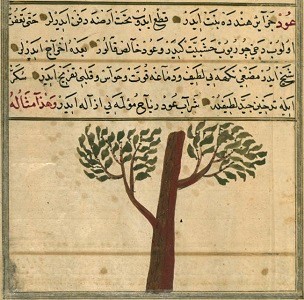
detail from a manuscript by Zakariya al-Qazwini  (1203–1283); scribe Muhammad ibn Muhammad Shakir Ruzmah-'i Nathani  (active in 1717); Walters manuscript W.659 depicting an aloeswood tree ('ud), courtesy of the Walters Museum, Baltimore. I am reading a book set in India, and the word ‘oud’ is used to describe a substance used for fragrance inside a house. Is it from a plant? Is it related to the musical instrument?

Oud is one name for a fragrance derived from an evergreen tree called Aquilaria, also known as aloeswood, aloes, eaglewood, or the Wood of the Gods. There are a number of species, and several are listed as threatened or endangered (primarily because of overharvesting to meet high demand). The tree is called agar in Hindi (agarbati, the word for incense, means ‘lighted aloeswood’). Small chips of the wood are burned to release the resinous aroma, and have the added benefit of repelling mosquitos. The resin can also be processed into an essential oil. The fragrance has been used (in ritual and as a sign of status) since as far back in time as 1400 B.C.E., in Egypt, Mesopotamia, Greece, Rome, China, and India. It is mentioned in the Hebrew Song of Songs and Psalms, in ancient Indian Vedas, in the Materia Medica of Dioscorides (65 C.E.), and Buddhist and Islamic texts.

Stress or damage to the tree is the reason the wood is so aromatic. According to Elise Pearlstine’s Scent: A Natural History of Perfume (Yale University, 2022), “they are not important timber trees […] but sometimes a tiny invading fungus, a small injury, or perhaps a boring insect sets in motion a mysterious protective process that produces a dark and aromatic resinous feathered pattern within the living wood.”

The word ‘oud literally means wood, and it is also the source of the name of the wooden stringed instrument. In fact, the English word lute and its European variants are also derived from ‘ oud, by combining the Arabic definite article al with ‘ oud.
Paintings and Prints by Molly Hashimoto
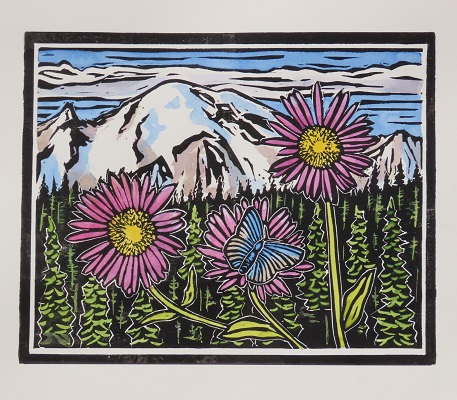
Cascade Aster and Blue by Molly HashimotoMolly Hashimoto returns to the Miller Library this month with new paintings and prints featuring Northwest trees, landscapes, flowers and insects. Her block print "Cascade Aster and Blue" is shown here.

The exhibit is open during library hours. Library visitors can meet this prolific artist and learn about her printmaking techniques on Thursday, November 2 from 1:30 to 3:30 pm.

Molly's work will be in the library through December 29. She will joined by three more local artisans for our annual Arts and Crafts Exhibit and Sale, with an opening from 5-7 pm on Monday, December 4.
Five Centuries of Women & Gardens by Sue Bennett
Reviewed by Priscilla Grundy
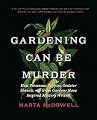
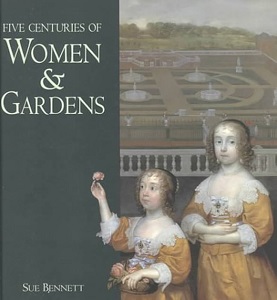
book coverThe National Portrait Gallery in London reopened this June after three years of closure due to Covid (and refurbishing). To celebrate, readers can pick up this excellent book from 2000, written to support an exhibition at the Gallery.

The women and gardens of the title are British women and British gardens, each account supported by elegant portraits and some fine garden views. Sue Bennett manages to include in each brief text biographical information, clear descriptions of the gardens, and just enough social history to place everything in context. The reader learns how gardens changed over the centuries, as well as how women gradually gained legal and social control over their gardens and their lives.

The subjects begin with Queen Elizabeth I and end with Beth Chatto. The Elizabethan gardens were created for and about the Queen, not ordered by her. Nobles currying favor developed gardens symbolically worshipping her as the Virgin Queen, using topiary, fountains, and privet hedges. 

Queen Caroline, wife of George II, developed gardens at Hyde Park, Kensington, and especially Richmond Lodge. Each focused on supporting the legitimacy of the Hanoverian kings, recently imported from Germany and not very popular. At Richmond her garden included a hermitage with a live hermit and “Merlin’s Cave,” a thatched cottage and grotto meant to connect the royal family to Merlin’s prophecy. Alas, the public response was ridicule.

In the 20th century Miriam Rothschild (1908-2005) turned very unlikely fields into meadows full of wildflowers, restoring medieval views. Rothschild, a scientist sometimes called “Queen of the fleas” because of her research into them, also decoded at Bletchley during World War II. In 1970, as a retirement project, she scattered wildflower seeds collected from a derelict airfield over the remnants of a tennis court on her property. In ten years her meadow had nearly 100 species of flowers and grasses  She then sent out her seeds for use in other areas of the country. The National Trust adopted some of her ideas, and Prince Charles (now Charles III) worked with her on a wildflower garden at his estate at Highgrove.

“Five Centuries of Women and Gardens” gives surprisingly complete pictures of the connections women have had with their gardens. Each woman appears as a lively personality, accompanied by a dazzling portrait.

ASK A LIBRARIAN
The Miller Library's Plant Answer Line provides quick answers to gardening questions.
You can reach the reference staff at 206-UWPLANT (206-897-5268),
hortlib@uw.edu, or from our website, www.millerlibrary.org.
Digital resources
   UWBG pine cone logo
detail from Mapping and managing urban ecosystems : a summary of 
the 2018-2019 Urban Ecosystems graduate internship and methodology case study from Seattle Pulibc Utilities Urban Ecosystems group / Scott Brekke Davis.  Miller Library book and flower logo
New to the library
cover image    cover image    cover image
cover image    cover image    cover image
cover 
image    cover image    cover image
cover 
image    cover image    cover image
cover image    cover 
image     cover image
cover image    cover image
  cover image    cover image
cover image    cover image
cover image
   cover image
Donate to the Miller Library Fund    Miller_LibraryLogo293px.gif
  Facebook    Twitter    Instagram     Pinterest
Contact Us   |   Privacy   |   Terms
© 2023 University of Washington Botanic Gardens