This interview first appeared as an episode of the Science Positive podcast. You can check it out here on Youtube or here on Spotify!
Leigh: Yeah, happy to be here. Thank you for having me.
Emma: Welcome, everyone, back to another episode of Science Positive, or SciPos for short. Today we’re joined by the wonderful Leigh West. Thank you so much for joining us today.
Emma: Amazing. So let’s get to know you and introduce yourself a little bit. So what do you do? What are your research interests? And how did you get to the UW?
Leigh: Yeah, I’m a fifth year PhD student in the biology department at UW in Brianna Abrams’ lab. So I study climate impacts on wildlife, kind of like the very broad topic, and kind of more specifically thinking about how drought is impacting large carnivores in Africa and what repercussions that has for human wildlife coexistence.
Emma: That’s amazing. And is this something that you were doing right off the get-go? Have you always worked with large carnivores, or is this something that you fell into during your PhD?
Leigh: I kind of knew what the project would be as I was in the process of applying to PhD labs. So both kind of generally, even when I was considering other universities, I knew that I was interested in the themes of climate and movement, ecology. And I mean, I had a preference for large carnivores, like large vertebrates or species that have human wildlife conflict issues, I suppose, because that element was something I was interested in. And I applied to the NSF GRFP before getting into graduate school and worked with Brianna on that application. So it was kind of the intent from early in the process, but I’ve had a theme of working on large carnivore projects previously before my PhD, but I’ve also worked on oceanography and seabird research and primate stuff. And so I kind of have worked in a lot of different systems and with a lot of different species.
Emma: Yeah, it’s pretty interesting, because I think that your research is encapsulating of the large system, and the large questions that you’re interested in apply to so many different types of species. And that gives you such a breadth of experience with different– like you said, large vertebrates, but also, I think you previously worked with invertebrates, right?
Leigh: Yeah, I did field research in Antarctica where I wasn’t leading the research. I was a field assistant or research technician, but with zooplankton and krill and things like that. And so yeah, I think that arriving at the threads and research interests that came together for my PhD was learning, doing a lot of different kinds of research and learning what was interesting to me about those projects. So the invertebrate research was in Antarctica, and that project was a long-term ecological research project funded by NSF. And I feel like I ended up pivoting to the system I’m in for my PhD, because I wanted to do work that did feel more applied and conservation relevant directly. But that work in Antarctica was working with long-term data sets, understanding how climate is impacting marine food webs and ecosystems. And that was definitely a theme that translates to my PhD work.
Emma: That’s awesome. When working with the amount of climate data and the climate systems that you’ve looked at, what kind of types of data sets do you rely on? I mean, you just said that you worked with long-term data sets in Antarctica, but I guess with your current research with large carnivores, do you look at time scales, or are you looking more at current in the moment?

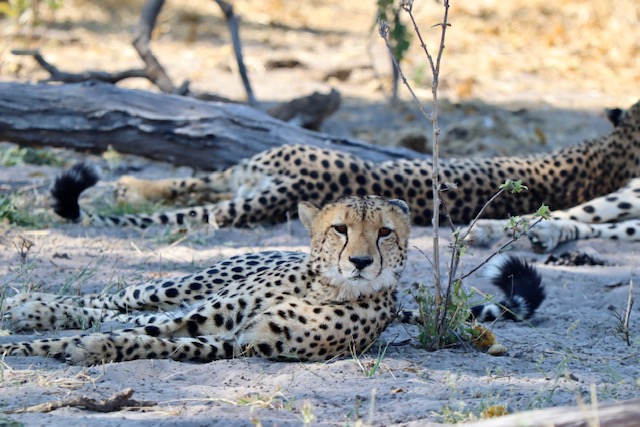
Leigh: Yes, so we partner with, for the ecological data that we use, we partner with a local conservation organization called Botswana Predator Conservation, or Wild and Trust is the kind of umbrella name for that organization. And they’re an amazing research group that’s been based in Botswana for over 30 years. They started by collecting data on African wild dogs, because they’re a very endangered species. They’re the most endangered large carnivore in Africa. But over the years, that’s expanded in breadth to focus on the other large carnivore species there, so lions and leopards and cheetahs and hyenas. And so we’re very privileged to have access to this historic GPS data set and also behavioral data that’s been collected for decades. And then kind of coupling that with temperature data that’s publicly available and also precipitation data. So that data has also been collected at the field site. So we have precipitation data kind of specifically for this really specific location that’s kind of the center of our GPS data set. But there’s also kind of more public repositories of precipitation data as well. So it’s kind of, yeah, the main data sets I’m using are GPS data, precipitation data, and temperature data for the kind of ecological questions that I’m asking.
And then I also, for one of my PhD chapters, am looking at government conflict reports. So I’m interested in human-wildlife conflict between carnivores and people. And in Botswana and in a lot of countries, there is kind of systems of conflict reporting where if you have a negative interaction with wildlife, that kind of has livelihood repercussions, like if a carnivore kills a cow, for example, or if an elephant tramples your fence or crops, you can report that to the government to get compensation in certain cases. And so part of my research is also looking at those conflict reports and relating them to climate variables. So is there more conflict when there are droughts or when there’s a heat wave, those kinds of things?
Emma: That’s so fascinating. And just as a spoiler, are there?
Leigh: Yeah, I’ve just kind of finished that analysis. And during a drought, you do see, for most species, most carnivore species, an increase in conflict. And then there’s also some– I feel like I’m kind of in the process of disentangling what my results mean, but there’s also an impact of temperature that kind of interacts with drought. That’s kind of– I’m trying to wrap my head around. It’s a little bit complicated. But it’s interesting to think about how– not just how is heat or how is drought impacting these interactions between wildlife and people, but also when all these things happen at the same time, how does that result– how does that influence interactions between people and wildlife?
Emma: That’s fascinating. Inherently, conservation ecology tends towards applied science. But what you just described as your last chapter, it seems like the most applied in terms of looking at human to wildlife interaction. Is applied work something that you’ve always done? Or is it something, again, that you found and grew an interest in later on in your career?
Leigh: I think it’s always been something that I’ve been interested in. I think that getting into research and science, I think the basis of that has always been just loving animals. And I think at a really early age, that was loving my dogs and wanting to be a veterinarian. But I think that as I became interested in research and science and seeing the biodiversity and climate crises unfold, it’s been wanting to protect wildlife and wild places and systems and the people that coexist with animals. I think that that’s hard. I think that even as a graduate student and trying to do work that feels applied, it can be hard within the structure of graduate school to find the time and resources that you need to have real on the ground applied impacts. So I think that that’s something, as I move forward in my career and have the space to focus on that more rather than having the priority needing to be your research and finishing your dissertation, that’s something that I want to apply or pursue more concretely. But it’s always been an interest that I’ve had and why I chose this graduate program in this lab.
Emma: Yeah, UW does have an amazing emphasis on applied research, which I feel is not really common for a massive state school as well. I guess, what is something that you learned in the process of doing applied work that maybe you didn’t realize or didn’t consider at all when you were first beginning?
Leigh: Yeah, I think– well, I guess some of it was what I was referencing of the difficulty of doing that work, or I guess the difficulty of balancing the different priorities that there are in research. So it’s like when I’m– especially in graduate school where you have limited resources, but even later on in your research career, I think you’re trying to collect the data that you need. And that takes massive amounts of– especially when you’re working with species like large carnivores, that it’s difficult to collect data from these animals. It’s a lot of effort and time and funds to do that part of the work. And it’s a lot of time and effort to clean and analyze data and write papers. And that’s an important precursor to the applied work, because you need to understand the behavioral pathways that are connecting these changes we’re seeing in the climate to those applied outcomes. So it’s like you need to understand, OK, with my research, when there is a drought, how does that change how animals are moving? How does that change how animals are moving in relation to villages and human settlements? How does that translate into actual observed conflicts that we’re seeing on the ground? So it’s a whole process to answer those questions. And that’s a job in itself, right? And then kind of a whole separate job to then translate those scientific findings to policy.
And so I think that learning about the collaboration that is necessary there of, it can’t just be one person or one research group that’s kind of doing all the pieces of the puzzle, because you usually don’t have the capacity for that. Especially because I think that to do conservation work responsibly, it involves spending a lot of time on the ground at the site that you’re working at and developing close relationships with local stakeholders and governments and communities to make sure that the conservation work that you’re doing is grounded in local priorities and creating solutions that work for both people and wildlife. And I think that you need to have the space and time and manpower to have people physically present at your field site building those relationships. So I think I guess the importance of interdisciplinary teams and bringing together all these different kinds of expertise to achieve those goals is something that I’ve learned a lot about.
Emma: That’s amazing. That was wonderfully said. And I’m someone who also values applied work in my own research, and it’s something that I’ve felt conflicted about earlier on in my career where I’m like, oh, how do I do this but also do research? I guess something that I’m curious about is before you came to UW, you did a master’s in science communication. How did that master’s in science communication set you up to be able to relay information that you get from your research effectively and efficiently?
Leigh: Yeah, that’s a great question. So I did my master’s in the UK, and part of the reason for that or the main reason for that was because there are a lot of– I mean, not a lot, several great science communication programs in the US. There’s one at MIT, there’s one at NYU, there’s one in Santa Cruz, a few others, but they’re very focused around journalism, and not exclusively, but largely print journalism. And I’m interested in that. But I’m also interested in podcasting and radio and– I don’t know– different modalities of science communication. And the programs in the UK are more open to that. So the course that I took or the master’s that I did had a podcasting and radio kind of module. It had a digital media campaigning one. There was documentary filmmaking. There was narrative writing. So there’s all these different kinds of different programs to kind of dip your toe in and learn about these different ways of communicating science, as well as taught courses and where you kind of learned about the history of media representation of science across time. And you were thinking about whose voices are shaping how we think about science in popular media, or whose voices and perspectives have decided what the process of doing science looks like, like how was the process of doing Western science created.
And so I think that– I don’t know, on the one hand, I think because I learned so many different things, I didn’t get strong training in how to do one thing very well. But I did kind of learn how the importance of putting your audience first and centering your audience when you’re communicating about science and thinking about– and just how to talk about something in a way that’s accessible, but not framing it as dumbing it down. You’re just kind of meeting people where they’re at and trying to find their connection to the work that you do, I think, which can be hard sometimes. I think that my PhD research studying how drought is impacting human-wildlife conflict in the Okavango Delta and Botswana, it’s like, why should someone in Seattle care about that? And so I think that kind of general practice of thinking about how to communicate something in an engaging and accessible way was an important skill that I learned. Yeah, and I think that it also kind of– it gave me kind of– I produced a podcast episode during that program. So I have that kind of in a portfolio that I’m able to, as I’m applying to jobs, to be able to say, look, I’ve produced things. I’ve produced creative things. So yeah, it was a great experience.
Emma: That’s awesome. And I guess a question that I have kind of building off of that is, having worked in so many different continents, different countries, how is science communication valued? And how do you kind of go into work in different places with– and how do you– let me rephrase that. How do you shape science communication based off of where you are and where you’re conducting research?
Leigh: Yeah, that’s a great question. I think maybe just kind of framing each– because I think that maybe before doing my PhD, or before kind of having both this experience in science communication and this experience doing research, I maybe framed science communication as, OK, there’s research that has been completed in this kind of academic bubble and then there’s the general public and science communication is translating the kind of academic or research findings to people who aren’t necessarily connected to that world. And that can be what science communication is and that’s really an important part of science communication, is allowing research and science to reach those who might not otherwise learn about it. But I think it also is– science communication is part of the research process. So when I was working in Botswana the past couple of summers, I gave a couple of talks and workshops to the local research institute. It’s the Okavango Research Institute in Maun in Botswana, which is the nearest kind of city to where my field site is. And I think– I don’t know– thinking about trying to connect to the community and give back to the community where I’m working and talk about– because I think that, at least in that group of students that I was working with, they don’t really get training in how to communicate their research, even giving a scientific presentation, or how to talk about their research, or make a PowerPoint that’s accessible, rather than just having a lot of text on a slide and reading off of the slide, for example. So, I think maybe it’s thinking about, with each community or place that you’re living in or working with, how can your expertise and your knowledge help– how can you connect that to what people need? And either that could be what people need to understand or know and me telling you what I know in a way that’s accessible. Or that could be teaching a skill, like how to present something. So I think trying to think about how you can share your experience and knowledge with people in a way that’s going to benefit them best.
Emma: Amazing. That’s really interesting. I think that the relationship between scientists and the public is such an amazing dynamic. And that is completely flexible and changes all the time. As you move forward in your career, and you’re defending so soon– congratulations.
Leigh: Thank you.
Emma: It’s going to be so exciting. Maybe you might be a doctor when this comes out. I mean, you will be, for sure. Moving forward in your career, how are you going to apply the things that you’ve learned in this PhD program, and even the things that you’ve learned in your general research, to what you want to do and the kind of impact that you want to have on conservation?
Leigh: Yeah. I mean, I think that I’ve worked with so many amazing people and learned so much throughout the process of my PhD. I think my advisor, Brianna Abrams, has taught me so much. I think that, as I was talking about earlier, I came into the program– like, I’ve always had an interest in science itself and research and a curiosity about asking questions and understanding how the world works. At the same time, I do think that my motivation of, I guess, the fulfillment I’m going to feel in doing science is more tied to that applied outcome of feeling like you’re making an impact– yeah, kind of an applied impact in conservation and protecting species and that kind of thing. But I think I’ve learned a lot from Brianna about the importance of grounding all of your research in ecological theory and kind of how to frame your questions and your research in order to make sure that you’re understanding the kind of basis of the ecological pathways and behavioral pathways that are driving the patterns that you’re seeing. Because you kind of need to understand those things to be able to– as climate change intensifies and changes how communities interact, and both human communities and ecological communities, you need to understand the process of how that happens in order to develop really targeted mitigation strategies. And I think I have learned a lot from her about how to kind of connect ecological theory to conservation in powerful ways. I think I’ve also just learned a lot from her about how to be a good colleague and how to think critically and how to be a good scientist. So yeah, I have a lot of gratitude for her.
So yeah, I think that that is some of it. And I think that some of it is also– I think that I have a big passion for science communication and have found opportunities or made opportunities to pursue that in my PhD, but I think have felt limited in how big of a part I’m able to make outreach, public engagement, communication part of the work that I do as a graduate student. So I think some of it has also been kind of learning the parts of the kind of research and conservation work that I value and enjoy and want to keep doing, and also learning that I really do want to make space to do more kind of creative outreach and communication work. And I think, yeah, trying to think about roles that blend those two things, or figuring out if those roles don’t– if not that many of those roles exist, how to carve out a space where I can do those things.
Emma: That’s amazing. Well, I’m personally so excited to see what you do after this. In our last minute, just as we wrap up, do you have any advice for people who are wanting to get into science or even wanting to get into some sort of higher education for research?
Leigh: Yeah. I don’t know. I feel like there are so many things that I could say. I think maybe something that was big for me was not– I mean, this is related to doing science, especially to, like, in an academic context or in graduate school where the boundaries between, like, your work life and your personal life can be kind of blurry. It’s not really, like, advice about how to do science well, I guess, but I think that I struggled with a lot of burnout during my PhD, and I think that some of that was because of those kinds of fuzzy boundaries between work and your personal life. And I think that if I started over again, I would try to treat it more like a 9 to 5 job, you know? And set aside focused work hours of, a full day of work every weekday and then be able to fully turn off in the evenings or on the weekends. I think kind of– I forget, I think it might have been Alex McInturff, who’s in the School of Environment and Forestry Studies, had said something along the lines of I mean, this isn’t always possible, but you should try to either be working and in the mindset of I’m on, I’m working, I’m focused on the work that I’m doing, or you should be not working. Yeah. You know? You should be doing something that feels positive and recharging and enjoyable. And I think I spent a lot of time in the space of I should be working, but I’m too tired to– so I’m not going to give myself permission to turn off, but also I’m not being productive and kind of just living in the space in between where you’re not really getting the benefit of either one. And yeah, so I think maybe trying to really intentionally create clear boundaries between work time and not work time and know that it—not that you need to center productivity as the end all be all, but if you are kind of figuring out how to be productive while also taking care of yourself, knowing that taking time to rest makes you able to be productive, you know? It’s, part of the process of, like, being able to do good, focused work and make a difference or do all the things that you want to do you have to take care of yourself first.
Emma: Amazing. That’s great advice and I think something that people of all levels in academia could benefit from remembering. Well, thank you so much for joining us for this episode of SciPos. This was so fun. And hopefully we’ll see you again soon or even just check up on you in a little bit and see what you’re up to.
Leigh: Yeah. Thank you so much for having me. It was so fun to chat with you.
Check out the previous SciPos Podcast interview with William Albers here!