

Published and edited by Sol Krems, the Jewish Voice of the Pacific Coast offered a mix of local, regional, national, and international news. The paper stressed the dual identity of Jewish Americanism in articles like the two below:

(Feb.4, 1916)
(July 14, 1916)
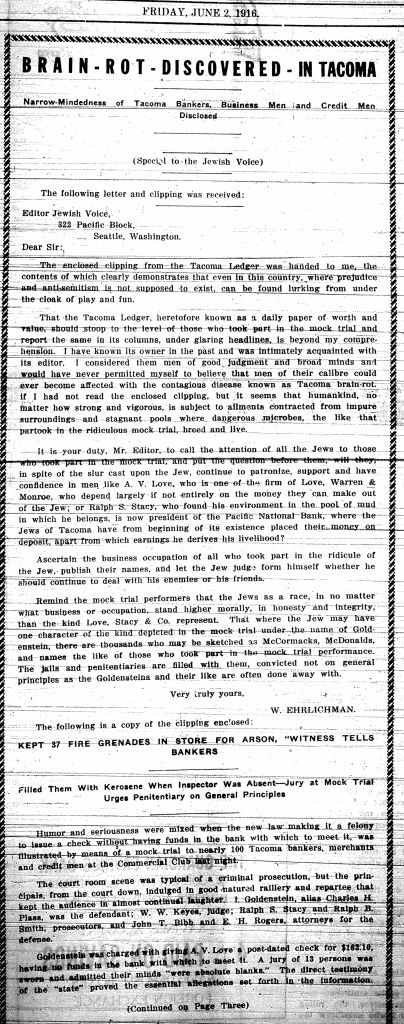
The paper said little about anti-Semitism in Seattle and nearby communities, but did respond to an incident involving disparaging remarks made at a gathering of Tacoma businessmen (6-2-16)
More common were stories about social and religious activities. Here the newspaper heralds the opening of Seattle's Jewish Settlement house (community center) August 11, 1916.

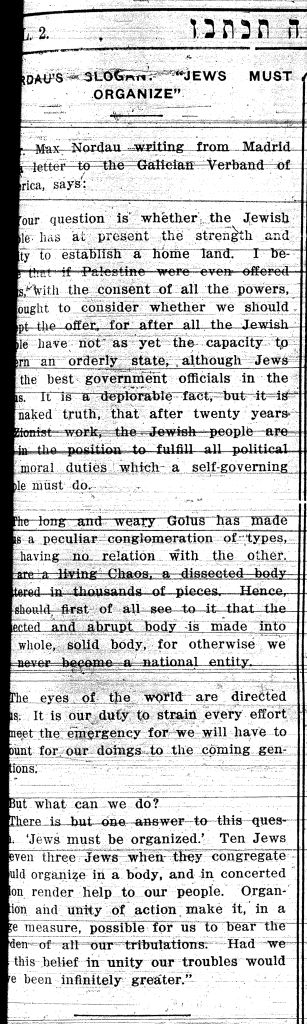
The newspaper covered both Zionist and anti-Zionist activities while supporting the goal of a Jewish homeland
 (9-29-16)
The Jewish Voice also spent time on political and moral issues. Here it examines Proposition 24 on the November 1916 ballot, which restricted the sale and use of alcohol. Below a reader takes aim at the Gary Plan, a New York proposal to allow religious instruction in the public schools.

(10-27-16)

(11-19-16)
Jennifer Speidel helped with newspaper research and image digitalization for this essay.
Abstract
The Jewish Voice of the Pacific Coast was published weekly from October 1915 to October 1919. Although the paper purported to cover the entire Northwest, much of the Northwest coverage devoted attention to events in Seattle, Washington. Other cities in Washington— including Spokane, Aberdeen, Tacoma, and Gray’s Harbor— along Vancouver and Victoria, British Colombia. and some Alaskan towns all received occasional coverage. The paper was reported a great deal of news from beyond the Northwest: each issue included articles of national scope as well as a digest of international news of interest to the Jewish community.
Stories with recurring coverage in the first year of the paper included articles about World War I; the state of Jewish populations in Western Europe and Russia; Zionism; and the place of Jewish populations in the American immigrant experience. Confounding stereotypes of the Jewish immigrant as politically radical, very little coverage was devoted to articles focusing on labor movements, working class issues, or detailing discrimination faced by Jews—although one story discussed below is notable both for its coverage of this issue as well as for its coverage of an issue of local importance.
The _Jewish Voice_’s lack of labor movement stories may have reflected the interests of the paper’s targeted audience. The paper focused on local social and entertainment events, and national and international political news. As a weekly, the paper was probably not the sole source of news for its readers; however as WWI intensified, the paper may have offered a unique and valuable perspective. The growth of the paper, the spread of the war, and the expansion of war-related coverage are all linked temporally, if not commercially. Overall, the paper projected the image of a prosperous and secure Jewish community in Seattle, and one deeply engaged with events beyond the Northwest.
Dates: October 1, 1915, through October 24, 1919, weekly Editor, Publisher, and Owner: Sol Krems
Cost: Five cents per copy, or one dollar per year
Pages: 12-15 pages (approx 8.5 x 11 inches) until a layout change with the January 7th 1916 issue (approx 8.5 x 17.5 inches) which shrunk the average pages to 6-10.Affiliation: The paper does not state an affiliation with any particular branch of Judaism and appears to cover the congregations and events of varying branches of Judaism. Business Address: 322 Pacific Block, Seattle, WA
Collection: University of Washington, Suzzallo Library Microfilms. Library call number: A6255, incomplete
Introduction
In its founding issue on October 1, 1915, the weekly The Jewish Voice of the Pacific Coast boldly asserted that it was “the pride of Seattle” and that it was “here to stay.” While the first claim may have been true, the second is contested by failure of the paper to publish any issues after October 24, 1919. This analysis of the _Jewish Voice of the Pacific Coast_offers a critical reading of the first year of the paper’s publication. This year, contrary to later misfortunes, saw the paper grow and expand: during the time period under examination, the paper changed format from a pamphlet-style news bulletin, with an illustration on the front page and news found inside the paper, to a more standard newspaper format with several stories on the front page. The paper gradually focused less on regional events and more on Seattle events and national and international news. This year also saw the paper expand its advertising, gradually attracting not only more community businesses, but also political advertisements.
The paper stressed, in the September 26, 1916, issue, that it was “the only Jewish paper published and printed in Seattle.” The paper’s Seattle focus had always been clear. Starting with the first issue in October of 1915, the Seattle Young Men’s Hebrew Association received space— eventually growing to half a page per issue—to detail its events. In addition, each issue of the paper published reports from various Seattle Jewish community groups and religious societies, as well as a listing of all their upcoming meetings. Twice in its first year the paper also printed a list of all the Yiddish books bought by the Library Board, available at the Yesler branch of the public library (then located in the heart of Seattle’s Jewish neighborhood, the Central District). The society page (entitled “Doings in the Social Whirl”) covered mainly Seattle parties, engagements and weddings, and the travels of Seattlites; although notable events from beyond Seattle, such as the wedding of the daughter of Moses Alexander, the Governor of Idaho (the country’s first elected Jewish governor), also garnered coverage. (10/29/1915) Both the theater column and show listings, which appeared in each issue, covered Seattle exclusively.
The Seattle focus was evident in advertisements as well. With the two exceptions of an advertisement for Crescent Cream Coffee (“ask your grocer”) and Penn Mutual Life Insurance Company, all the advertising was for Seattle businesses. These advertisements offered the services of lawyers, an accountant, music instruction, a jeweler, a mortuary, clothing and shoe shops, banks, restaurants and delicatessens, and printers and stationers. Most of the early advertisers seem to have been from within the community, although as the paper grew, it attracted merchants from outside the community. However, these advertisers may not have fully understood their market, as the December 3, 1915, issue featured an advertiser soliciting Christmas shoppers. The paper also advertised for itself, not only encouraging readers to subscribe, but also selling the use of its printing machines for those who needed to print in non-English script, as the paper had occasional Hebrew words in it and had the ability thus to print in Hebrew. Indeed, Nathan Krems, son of Jewish Voice founder Sol Krems, recalled that “I remember very well troops of Yiddish players coming to Seattle… and they would come to [my father’s] printing plant, some I recall, in the traditional actors’ garb of fur-trimmed coats and top hats… for him to set up the posters, advance posters, because he had the [Hebrew] type.”1
The newspaper issues leading up to the 1916 elections also included advertisements and advocacy for both candidates and initiatives. Engagement with electoral politics began first with local offices and drew upon linkages with the Jewish community. Thus, the December 3, 1915, issue featured a school board member, Nathan Eckstein, urging community members to support a fellow board member, George Spencer, in the latter’s campaign for re-election to the school board. In Edward Brunini’s city councilman advertisement the paper had what appears to be the first political advertisement in the Jewish Voice that lacked a stated community connection. (2/2/1916) It is possible, however, that Brunini was such a well-known member of the small Seattle Jewish community that he did not need an introduction to remind community members of his faithful service to their interests.
The paper subsequently ran many advertisements for local and state government, profiles of candidates in key races, and seemed to have leanings toward progressive-era reform. It endorsed the Republican candidates for coroner and prosecuting attorney. (8/4/1916; 8/25/1916) As the 1916 Presidential election approached, the paper had an advertisement for Wilson. (11/3/1916) The paper also featured several full-page advertisements in support of Measure 24 in the November 1916 election. (10/6/1916; 10/13/1916; 10/27/1916) Measure 24 was a response to the nascent prohibition movement. Unlike dry laws, which banned all alcohol, Measure 24 was, according to its advocates, “a true temperance measure,” restricting, but not banning alcohol, and punishing bootleggers severely. (10/27/1916)
The fact that the paper claimed to be regional in scope, yet mainly focused on Seattle, may have been a function of the relative size of the Jewish community in Seattle, areas as well as the regional significance of that community to smaller ones in the northwest. However, each issue starting with the October 29, 1916, issue began with a list of local Jewish organizations (covering Seattle, Tacoma, Aberdeen, Everett, Vancouver BC, and Spokane, respectively) and articles occasionally highlighted events in Vancouver and Victoria BC, as well as in Spokane, Gray’s Harbor, and Alaska. These stories were written by Rabbis from these areas and profiled their progress in developing local Jewish communities.
As the months passed these regional stories were reduced in favor of expanded national and international coverage. The most notable exception, discussed below, came to attention of the paper courtesy of a clipping sent in by a reader, and not through its own reporting. Although the November 5, 1915, issue and several issues thereafter included an advertisement from the paper soliciting local correspondents, it is unclear if the paper successfully recruited new correspondents. The regional claim seemed more of a wish than an enduring reality.
The paper was particularly successful in its coverage of national and international news. These news stories were almost certainly reprints from other papers, though they are not attributed as such. With these stories, the paper helped foster and develop a national and even transnational Jewish consciousness. In particular, stories on events that transpired within the Jewish communities on the east coast, especially in New York City, connected the relatively isolated Northwest Jewish community with a larger Jewish community. Debates over how Jewish religious and cultural practices intersected with American political culture were especially notable. For instance, the paper covered the debate surrounding the Gary system New York City public schools in the Bronx. The Gary system provided for both a longer school day as well as for religious instruction during school hours at an off-site location designated by parents. (11/19/15) One article held that religious instruction as part of the school day was helpful, since:
many Jewish and still a large proportion of Protestant parents are too much engrossed in the pursuit of wealth and pleasure, or too selfish and lazy to do more for their children than provide for their material wants and their education in the secular branches of learning. (11/19/1915)
The article did note the potential church-state separation issues, but argued that judgment ought to be suspended until the system had been implemented. (11/19/1915) A later article, however, offered a strident critique of the Gary plan because of the mingling of church and state: “the church and the home must remain the place for religious instruction and activity, and the public school room must be the last place in which discussions on religious distinctions shall be made possible or tolerated.” (12/17/1915)
The paper also covered the lives of prominent American Jews. The October 29, 1915 issue celebrated the birthday of a prominent Jewish jurist and philanthropist, Simon Wolf; the issue reprinted the congratulatory telegram the paper sent to him in Washington D.C… The paper wrote that “the whole country, Jew and Gentile, should honor [Simon Wolf].” Likewise, the paper also allotted much space to the funerals of national Jewish figures, such as that of Solomon Schechter of the Jewish Theological Seminary. (10/16/1915) Notably, the paper reported that Isadore Strauss, a Jew who perished on the Titanic, had an estate worth 3.5 million dollars. (7/14/1916) In addition to reporting on those who were well-known, the paper also ran profile pieces on less-known Jewish individuals. For example, the first issue of the paper contained a portrait of a “little-known, but extremely powerful” financier in Pittsburgh.
The Jewish Voice also printed short fiction and non-fiction book excerpts. The November 5, 1915, and November 12, 1915, issues of the paper carried the story “The Jewish Hussar” by Max Levin. The January 14, 1916, issue carries a short story on military reinforcements written by S. Roth. Fictional stories with war themes were quite popular, perhaps since the paper dared not engage directly with the war. Not all of these reprints were of fiction. For example, the first issue contained a reprint from a book written by three Rabbis from Los Angeles. The book, and this article, discussed the “Secret of Happiness,” ultimately concluding that true happiness was not for mortals.
While religious stories were not the bulk of the paper’s coverage, stories with religious themes or messages were often found in the middle pages of the paper, and each issue carried a listing of the Roman calendar dates of all Jewish holidays. Locally, the paper devoted several articles to the preparation for and the celebration of congregation Bikur Cholim’s 1915 Chanukah service. (11/12/1915; 11/19/1915) In the summer of 1916, the paper devoted portions of three issues to chronicling the life of Rambam (also known as Maimonides), a prominent Spanish/North African Jewish thinker from the twelfth century. (7/14/16; 7/21/1916; 7/28/1916)
Thus, the paper did not shy from religious content, but was sensitive of the need for tolerance. The Jewish Voice concluded that “there is a need for religion, but not religious bigotry,” noting the troubles the latter has caused in Russia. (quote in 12/101/1915; 7/25/1916) The paper also called for a greater study of Jewish history, for moderate leaders for religious communities, for lay speakers to occasionally occupy the pulpits, and for all to join a congregation to fulfill their duties to Judaism, and for greater religious observance. (11/12/15; 11/5/1916; 11/19/1916; 6/30/1916) Other issues also expressed displeasure over the possibility of inter-marriage with non-Jews. (1/7/1916; 1/28/1916) The paper also printed exegeses of biblical stories with clearly laid-out lessons. For example, in the December 17, 1915, issue, an article focused on the book of Exodus, extracting the message of loyalty to one’s elders and heritage. In addition, The Jewish Voice of the Pacific Coast was not above using religious parables to promote itself, as it did in the October 29, 1915, issue. First telling the story of Abraham’s peace-making efforts with Lot, then noting “the Jewish trait of the self-sacrifice for the sake of harmony,” the paper concludes that “the Jewish Voice has been organized and started for the purpose of bringing harmony and peace” to the Jews of the region. (10/29/1915) Later, the paper noted that “The Jewish press can be a great factor in strengthening Judaism if it only receives the proper personal and financial support that enables it to accomplish this great mission.” (8/25/1916)
In the November 1915 issues of the paper, there was a three-part editorial on the historical development of commerce, bemoaning the rise of commercialism in the trades. The paper noted that “every line of human effort today, especially in America, is conducted on lines entirely at odds with those of a generation ago … [for example,] where formerly a weaver of woolen or linen owned one loom, and personally operated the same, the modern weaver runs a mill of tens of thousands of spindles …” (11/12/1915) In particular, the editorial argued that commercialism was a modern curse, brought on by the development of money and transportation. (11/19/1916) The results, according to the editor, were not good: “so deeply has this spirit of commercialism permeated the fabric of modern society that teachers, lawyers, doctors, preachers, artists … are all more or less affected by the blight of this modern curse.” (11/24/1916)
The November 12, 1915, issue also tackled the issue of keeping a Sabbath different from that of the larger economy: the paper pled for Friday night observance, conceding that the economic necessity made Saturday observance difficult. Despite having noted the difficulties of modern work, an editorial on September 8, 1916, concluded that work was a blessing, as “it is not good to be idle.”
Overall, however, the paper did not deeply engage with labor activism. The first mention of organized labor was an article commending the generosity of New Yorker Nathan Strauss, who had provided free milk to the children of striking cloak makers in New York. (7/21/1916) Given the ethnic identity of garment-makers in New York, many of those striking workers were likely Jews themselves. The paper, however, did not engage with this dimension of labor politics. The second mention of organized labor came in a short article that summarized a speech by Samuel Gompers, President of the American Federation of Labor, in which he reported that wages had increased while the prices of essential goods had fallen, noting the success of his efforts and those of organized workers. (4/14/1916) Gompers was also promoting a bill that would create compulsory social insurance. (4/14/1916) The paper neither promoted nor disparaged plan, but did promote Gompers at the expense of Socialists who had an alternate plan for social insurance.
Zionism
Although the paper had little coverage of labor activities or actions of solidarity, the September 29, 1916, issue featured a call for Jews to organize for their homeland. Thus, the organizational efforts of community significance, according to The Jewish Voice of the Pacific Coast were those concerning local social groups, such as the Young Men’s Hebrew Society, and those concerning action on behalf of Zionism. The second issue of the paper, on October 29, 1915 engaged directly with Zionism, reporting on the upcoming visit of a prominent New York City Rabbi, Stephen Wise, who would be making a tour of western cities to organize Zionist societies. Rabbi Wise’s visit received much press: he was on the cover of the November 5, 1915, and November 26, 1915 issues, and a large advertisement announced his upcoming visit in the latter issue. The paper also printed all of his Seattle speaking engagements as well as information about who would entertain him while he was in town. After Rabbi Wise’s Seattle visit, the paper reported that the Jews of Seattle gave five thousand dollars for relief work in Palestine. (12/3/1915)
While the majority of coverage and speakers were pro-Zionist, anti-Zionist speakers also received attention. The visit of Rabbi Samuel Koch, an anti-Zionist, was extensively covered. (12/17/1915; 12/24/1915; 12/31/1915) Rabbi Koch argued that Zionism only offers fodder to anti-Semites. (12/31/05)
World War I and the U.S.
The war and the Jewish Voice grew together. The U.S. did not join the war until April 6, 1917; thus, during the time period covered by this analysis, the U.S. was neutral party. Yet the country was making military preparations as early as 1915. The paper reported on military ordnance ordered from the Puget Sound Navy Yard in Bremerton, noting that the order in and of itself “means very little,” but for the fact that the requesting officer was a Jewish Admiral who had family ties in Seattle. (12/10/1915) As war preparations continued, the local Jewish community, mirroring the national populace, engaged in debates about the benefits of preparedness. In a report on one such incident, Rabbi Koch is quoted as definitively against such measures, characterizing them as “militarism.” (4/14/1916; quote in 6/30/1916) U.S. official neutrality as well as the conflicted national debate over entry to the war may have accounted for the circumscribed way in which the paper treated the war, preferring to avoid reports from the battlefields altogether and focus on relief efforts.
Another factor that predisposed the paper toward such a muted tone was that Jews were fighting on both sides of the conflict. For example, the November 26, 1915 issue quoted the Chief Rabbi of Berlin saying that “the loyalty of German Jews [is] to the fatherland in the present war.” (11/26/1915) The Rabbi reported that there were Jews fighting for Germany and that these Jews were doing well:
There are more than 50,000 German Jews in arms, and they are met with nothing but praise from their officers. Three hundred and fifty Jewish privates in the Prussian army have been advanced to the position of officers… In the face of such achievements the disadvantages which had formerly been experienced by Jews have nearly all disappeared. (11/26/1915)
War relief also was also a large topic. The October 29, 1915 issue noted that a large donation was made to local relief fund by a Seattleite. War relief efforts in other cities were also covered: the November 5, 1915, issue reported that the Jewish communities in Vancouver and Victoria, BC had been cooperating with the Jewish communities in Britain and Poland, respectively, to help war refugees. The November 12, 1915, issue further reported on Jewish relief work in Britain for Russian Jews. Following on the heels of these efforts in other countries, the paper also ran articles urging American Jews to do more to help Jews in the war zone, particularly since:
The Jews in this country are more prosperous than they have ever been before. There have never been such opportunities for the accumulation of wealth. We are enjoying all the luxuries of life while our brethren in the war zones are suffering the bitter pangs of starvation … The poor and the middle classes are doing their share, but there are many who are blessed with great wealth who are not giving anywhere near what they should. (8/11/1916)
Perhaps to facilitate this, the paper covered the way in which American Jews called upon the American legal system to help mobilize support for charitable donations via the creation of a National Jewish Relief Day. (1/7/1916) A national effort may have been the preferred strategy, as the paper had previously noted that the war relief effort was extremely divided among Jewish communities of varying nationalities: “Instead of internationality and a cosmopolitan feeling, there reigns, between the relief committees themselves, antagonism and hatred. The German Jew hates the Russian Jew; the latter hates the Galician; he, the Hungarian …” (12/3/1915) Thus, the paper triumphantly reported that President Wilson had declared January 27, 1916, as National Jewish Relief Day. (1/14/1916) In the weeks following that proclamation, there were many appeals for aid. (1/21/1916) The paper also reported that the Foreign Remittance Bureau, which can send money to Russia, Poland, and Palestine, had reopened, for those who wish to send money directly to family members in these areas. (4/21/1916)
The November 12, 1915, issue is notable because that issue had the first instructions on how to send mail to Russian Poland, then in German hands. A second mail advisory was printed in the March 3, 1916, issue, stating that all letters to occupied lands must now be sent via Berlin. On April 21, 1916, the paper reported that letters bound for Russia were unlikely to reach their final recipients if the letters had been written in Yiddish, and that it was best to write them in Russian. On April 28, 1916, the paper reported that the Austrians were now allowing mail forwarding to occupied lands. The front page of the June 9, 1916, issue contained a detailed accounting of how a representative from the Hebrew Sheltering and Immigrant Aid Society had secured the right “for both Jews and non-Jews to write to their friends in America with the understanding that the letters be on a certain form prepared by the [German and Austrian] military.” Further instructions stated that in addition to a simple request for funds, “it is also permitted to report the death of a member of the family. All other information is strictly forbidden.” (6/9/1916; emphasis in original) The article emphasized that the delegate had persuaded military authorities to deviate from their initial policy and allow information about the exact date of deaths of family members so that the necessary prayers could be recited for the proper amount of time. (6/9/1916) As if to underscore the importance of correspondence, an article in the June 23, 1916 issue reported the arrival of mail from the war zones.
The uncertain future of Jews in Eastern Europe became an increasingly important issue. (12/31/1915) Subsequent articles note that for the duration of the war, all Yiddish presses in Russia had been closed. (1/7/1916) The February 11, 1916, issue of the paper carried an editorial accusing United States news sources of silence on the suffering of Russian Jews due to implicit American support for Great Britain, and thus, for Britain’s ally, Russia. This was the only negative comment about of the U.S. in the entire first year of the paper’s publication.
The November 26, 1915, issue ran a story on war suffering with a link to Zionist issues. The story examined the destruction caused by the war, noting the lands of Palestine were not immune to such suffering, and that Jews in Palestine were suffering the most. The paper reported that the American Jewish community had responded to the need for aid: the Joint Distribution Committee of Funds for Relief of Jewish War Sufferers sent a large shipment of medicines to Palestine. (9/8/1916) In a front page story, the paper also argued that the increased attention the war had brought to Palestine was beneficial: “the war has brought Palestine more in the eyes of government officials than fifty years’ agitation during peace. In the two years of the war a new road has been completed and laid down, benefiting many towns in Palestine …” (10/6/1916)
The Jewish Community in America and Worldwide
The first issue of the paper carried a story entitled “The Jew is Coming into His Own,” reprinted from an “Albony [sic], New York” paper. The article stated:
At last, after centuries of persecution, slander, and abuse, the Jew is coming into his own … the Hebrew finally receives the crown of recognition and honor which he has so long and patiently earned. Memories of racial animosities, accumulated and aggravated through many centuries, are passing away … The world is beginning to discover its debt to the Jew. America is finding out how much it owes to him … And Gentiles everywhere, exemplifying the spirit of the Nazarine who taught charity rather than condemnation, are extending the hand of friendship to the wandering children of the far-off Palestine. (10/1/1915)
This passage—eerie and perhaps unsettling to contemporary readers—exemplifies the optimism of the early issues of the paper. The horrors and scope of WWI were not yet known, and America still appeared as the land of unbridled opportunity in a hopefully ever-increasing liberal world order.
However, working out the position of Jews in modern states in general and America in particular would not be easy. The December 24, 1915 issue of the Jewish Voice featured an historical examination of the quality of Jewish citizenship written by a Rabbi from Vancouver BC. The story concluded that “the excellence of the citizenship of the Hebrew people is universally conceded and has been a well-established axiom.”
Overall, the paper ran many articles on the place of Jews in America. For example, the paper detailed the obligations of American Jews, reporting that they must call attention to the suffering of Jews in other lands:
We Jews in America who are enjoying all the blessings of freedom and prosperity must not only contribute our money to alleviate the distress of these unfortunates, but we should make an earnest endeavor to arouse public sentiment against these evils and thereby secure their eradication. (11/19/1915)
Yet, not all such articles were so outward-looking. An editorial in the December 31, 1915 issue of the paper proclaimed that “the editor of this paper says emphatically that there is no such person as a hyphenated Jew.” The editorial continued:
… everywhere [a Jew] is a subject of the land that gives him a home, first, and after giving his loyalty to his country he bestows his sympathy to his religion, and thus Jewishness comes second in consideration. This condition of loyalty to the state first, and to Judaism afterward is in accord with the Talmudic teaching of the Rabbis … A Jew who lives in America and makes America his home is in the first place an American, and a Jew afterward. (12/31/1915)
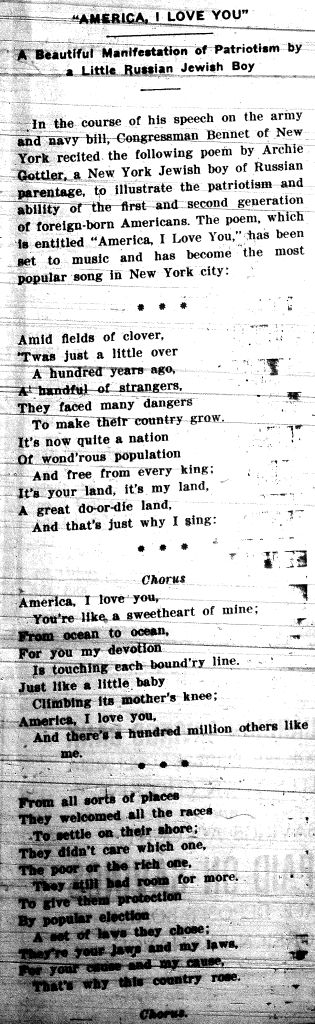
To underscore this point, and to “illustrate the patriotism and ability of the first and second generation of foreign-born Americans,” the paper reprinted a poem entitled “America, I love you,” written by Archie Gottler of New York City. (7/14/1916) The paper termed the poem “a beautiful manifestation of patriotism by a little Russian Jewish boy,” noting that it had been set to music and was now the most popular song in New York City. (7/14/1916) The last two stanzas read:
America, I love you,
You’re like a sweetheart of mine;
From ocean to ocean,
For you my devotion
Is touching each bound’ry line.
Just like a little baby
Climbing its mother’s knee;
America, I love you,
And there’s a hundred million more like me.From all sorts of places
They welcomed all the races
To settle on their shore;
They didn’t care which one,
The poor or the rich one,
They still had room for more.
To give them protection
By popular election
A new set of laws they chose;
Their your laws and my laws,
For your cause and my cause,
That’s why this country rose.
However, the relationship between national identity and religious identity was not free of tension. The same editorial referenced above also noted that:
The real fact is that in his zeal to show and display his loyalty to the land of his adoption, the Jew displays rather more patriotic feeling at the expense of his religious fealty, than even the most exacting demand of any country could call for. (12/31/1915)
Another article, contributed by Rabbi Greenburg of Dallas, Texas asserted that in order to serve one’s country, religious loyalty ought to occupy a place of primacy: “the better Jews we are, the better Americans we are capable of being … He can serve his country best who serves his God best, and he serves his God best who remains true to the ideals of Moses and the prophets.” (2/4/1916)
In attempting to find some balance between the privileging of religious or shared national identities, the same Rabbi from Texas proffered an understanding of a separate religious sphere, but a shared American life in all other aspects: “the separateness of the Jew can only be spoken of from the religious standpoint. In every other respect, whether economic, social, financial, or political” the Rabbi deemed the Jewish people identical to others. (1/7/1916)
More broadly, the paper also ran laudatory stories about the abilities of Jews worldwide. The December 3, 1915, issue featured a story entitled “Jews of Talent Numerous,” which detailed various Jewish luminaries in science, literature, and government. The same themes were revisited in later stories on the intelligence of the Jewish people (12/17/1915), on “How Jews Contribute to Civilization” (8/4/1916), and on the specific contributions that Jews have made to medicine. (8/25/1916) Connecting with immigration issues, the paper also reported “Jewish Immigrants Superior to Others.” (12/10/1915) Likewise, in the above-referenced story on Jewish soldiers fighting in the German army in WWI, the bravery and skills of Jewish soldiers were highlighted. (11/26/1915)
Germany was not the only country to tout Jews as model soldiers, however. A May 19, 1916, obituary for William Colfen, a U.S. soldier who was killed in Texas by Mexican bandits, reported that his eulogy “emphasized the loyalty of the Jew to his adopted land.” A second article also highlighted the commitment of local Jews to the U.S. military, reporting that young Jewish men, including some of prominent Seattle families, had enlisted in the Washington National Guard for service on the Mexican border. (6/30/1916) Continuing with the military enlistment story, the paper offered a flattering portrait of Jews as soldiers, reporting that the Jewish soldiers were ready for what a tour on the Mexican border would bring. (7/21/1916) Their preparedness and the presumed battlefield skills were connected with the ancient “Maccabbean spirit.” (7/21/1916)
Jewish-American identity became more salient as Louis Brandeis began to garner fame as a possible Supreme Court nominee. The paper ran its first editorial about Brandeis on February 11, 1916, and introduced him to readers who would read much more about him in the coming months. In fact, Brandeis’s nomination received almost as much coverage as debates over Zionism. Each step in his confirmation process was celebrated as a victory, such as when his name was passed out of the Senate subcommittee. (4/7/1916) When his nomination appeared to stall after leaving the sub-committee, the paper pushed for his nomination to be taken up by the wider Senate. (4/14/1916;4/21/1916) His eventual hearings in the full Senate were also a cause for much news coverage. (4/28/1916; 5/19/1916) Brandeis’s eventual confirmation garnered a front-page headline and picture. (6/2/1916) He became a community hero whose every move generated new articles; the paper covered his resignation from the board of a Jewish relief organization and his refusal to sit on the U.S.-Mexico Border Resolution Commission. (8/4/1916; 8/11/1916)
Although the bulk of the articles focused more on the place of Jews in America rather than engaging directly with the question of discrimination against Jews, the paper did cover the latter in a limited manner. In addition to the Tacoma incident discussed below, the paper ran two articles about the discrimination faced by the Jewish board member of community organization in St. Louis, and two articles about a hotel in Ohio whose advertisement stated “only gentiles taken.” (5/26/1916; quote in 6/23/1916) With respect to the Ohio hotel, the paper printed an article with the following advice:
The best way to do on these occasions is to avoid such places. When making plans for a summer trip it is the wisest thing in making arrangements to ascertain what places do not deserve Jewish patronage, then all unpleasantness will be avoided. It is unwise to insist upon going to places that do not want you. (7/14/1916)
Thus, discrimination, while a serious issue, was portrayed as external to Seattle, either on a national or regional scale.
Additionally, the paper was sensitive to the plight of other parties facing discrimination; while still engaging with the complex place of Jews in America, the paper also noted the folly of persecuting Germans:
Alas, even our Americans, who prided themselves with their tolerance … have allowed themselves to be influenced by a causeless movement of hyphenanatism [sic], and are hunting the pro-German Americans to death. If, Heaven forbid, one should allow himself the liberty to express his opinion against the Allies, he is immediately condemned as a traitor to the American nation. (12/3/1915)
However, neither articles about discrimination facing other groups in America, nor articles chronicling discrimination against Jews were regular topics in the paper.
Immigration to the Pacific Northwest
The very first issue of the paper profiled Jewish aid to immigrants in the U.S. west:
A society was formed on the Pacific Coast to extend a helping hand to all Jewish immigrants reaching San Francisco and other Coast ports, and to assist the newcomers in every possible way … it is planned to establish an employment bureau in connection with the society. Trained experts in immigrant aid work will impart to the newcomers all necessary information as to the best means of assimilating American ideas. A school for immigrants is also in contemplation, and able teachers will be secured to aid those immigrants who are in need of education. (10/1/1915)
While the phrase “assimilating American ideas” in the above quotation is somewhat unclear and has a perhaps problematic ring, other immigration articles had quite a less nativist reading of the general immigration situation:
The true American is the Indian who lived here many centuries before the Europeans came to this country. The early settlers who laid the foundation of this great republic were immigrants … [today’s immigrants] have brought with them in many instances much of value from their native land … and though many of these newcomers may be unskilled workers and illiterate they are essential to our industrial development … (11/26/1915)
Starting with the November 19, 1915 issue, the paper reached out to its readers directly on behalf of newcomers to Seattle, running an advertisement asking for work for Russian Jewish mechanics newly arrived to Seattle. These Russian Jews became a community cause célèbre as their story gradually unfolded. In the December 31, 1915 issue, the paper revealed that these Russian immigrants were, in fact, deserters from the Russian Army, and would be subject to capital punishment if they were forced to return to Russia. At press time, their extradition had been postponed due to illness, and a local Congressman was appealing to the immigration commissioner on their behalf. (12/31/1915) The following issue, the paper retraced their journey from the Russian front overland to Japan and from Japan to Seattle by ship. (1/7/1915) Later issues reported that the Russian immigrants were well-cared for in Seattle, owing to the support of local relief organizations. (4/21/1916)
While the Russian immigrants received a fair amount of news coverage, they were not the only Jewish immigrants making their way to Seattle. From the simple appeal for work for mechanics, the paper later ran announcements from the Hebrew Emigrant Aid Society seeking work on behalf of many Jewish professionals. Selected professions included: barber, candy-maker, merchant, watch-maker, engineer, leatherworker, and lumberman. (2/4/1916) To give a sense of the scope of immigration, the April 14th 1916 issue noted that 21 Jewish immigrants had arrived in Seattle “recently.” Overall, the Jewish Voice reported that from July of 1915 to January of 1916, 574 male Russian immigrants and 63 female Russian immigrants had arrived in Seattle. (5/19/1916) In September of 1916, courtesy of the Immigrant Aid Society, the paper reported that 154 immigrants had arrived on the west coast in the last week. (9/15/1916) Not all of these immigrants stayed in Seattle, however: the paper reported that various aid societies provided the women—some of whom were not Jewish—with onward train fare so that the women could rejoin their husbands in Chicago and New York. (5/191/1916; 8/25/1916)
For those who did stay in Seattle, however, there was a new settlement house. (8/11/1916) The settlement house served as a community center for new immigrants, helping to “meet their bodily needs” and to “make good American citizens” of them. (11/3/1916) The settlement house supposedly allowed the community to “care for these unfortunates who through no fault of theirs were forced to leave their homes and country; who most of them were not financially poor nor mentally destitute but who suffered from the worst form of poverty a human can ever suffer from: the want of some place to call home.” (11/3/1916) Mixing advocy with paternalistic pity, the Jewish Voice portrayed newly arrived immigrants as well-meaning refugees seeking safe harbor from political and economic repression.
Discrimination in Tacoma
In late May in 1916, the city of Tacoma passed a new law making it a felony to bounce checks. (6/2/1916) In order to publicize this new law, prominent Tacoma businessmen held a mock trial in which a defendant was tried for bouncing checks on a local merchant. (6/2/1916) The _Tacoma Ledger_covered this incident, portraying it as moment of “raillery and repartee” in the face of a stiff new law. (quote from Tacoma Ledger, reprinted in 6/2/1916 of The Jewish Voice of the Pacific Coast)
However, a Jewish reader of the Ledger, W. Ehrlichman, was offended and wrote to The Jewish Voice of the Pacific Coast, enclosing the article and noting that the described costume, accent, accessories, and last name of the mock defendant all played on negative Jewish stereotypes. (6/2/1916) The Tacoma Ledger faithfully reported that the mock defendant was “dressed like a Hebrew gentleman … wearing a wig of wiry black hair and a long flowing beard.” (quote from Tacoma Ledger, reprinted in 6/2/1916 of The Jewish Voice of the Pacific Coast) The Voice ran a front-page article on the incident, with the headline “Brain-Rot Discovered in Tacoma: Narrow-mindedness of Tacoma Bankers, Business Man, and Credit Men Disclosed.” (6/2/1916) The paper reprinted the letter to the editor from Ehrlichman as well as the article from the Tacoma newspaper. (6/2/1916) In his letter, Ehrlichman urged a boycott of all the merchants involved in the trial, concluding his letter by noting:
Ascertain the business of occupation of all who took part in the ridicule of the Jew, publish their names, and let the Jew judge for himself whether he should continue to deal with his enemies or his friends … Where the Jew may have one character of the kind depicted in the mock trial under the name of Goldenstein, there are thousands who may be sketched as McCormacks, McDonalds, and names the like of those who took part in the mock trial performance. The jails and penitentiaries are filled with them, convicted not on general principles as the Goldensteins and their like are often done away with. (6/2/1916)
The paper added its own comments:
There is no Jew living that could pass an insult of this nature unnoticed. We do not have to remind the Jew what his duties in the matter are. The Jew has learned in his past how to deal with the kind found in Tacoma. We are not personally acquainted with the so-called bankers, merchants, and credit men who have disclosed their narrow-mindedness in the performance of the mock trial and we cannot therefore express our opinion whether they are Jew haters or not, but their act satisfies us that if this was done in jest and sport only, it proves them to be a class who have no business judgment and are unworthy of the titles, bankers, business men, or credit men (6/2/1916)
Two issues later, The Jewish Voice printed a letter of apology from those involved in the incident. (6/16/1916) The letter stated that there was no ill-intent in portraying the defendant in that manner, that those organizing the mock trial were merely thoughtless, and that they apologized for their actions. (6/16/1916) The paper also printed a letter from a Seattle-based Jewish community organization that stated “it is best to drop the matter, especially on the advice of the executive committee of the Anti-Defamation League.” (6/16/1916) Although their bid was unsuccessful, this letter indicates that some Seattle Jews were concerned enough to ask for help from a national Jewish defense organization. However, with this apology, the incident died, and no reports of anti-Semitic discrimination in Seattle are reported in the paper during the rest of the year.
This brief incident, however, brought home to the readers of the paper the situation of Jews in much of the rest of the world. Although the paper did not connect this incident to larger acts of persecution, the fact that the same issue also reported on increasing prejudice toward Jews in Russia, Poland, and Spain would not have gone unnoticed by some readers. (6/16/1916) Perhaps the paper shied from any direct likening of the United States with foreign countries in order to avoid exacerbating the debate surrounding the place and loyalty of Jews in America.
Summary and Conclusion
During its first year, The Jewish Voice of the Pacific Coast came to report a unique mix of news. On one hand, the paper remained heavily tilted in its local coverage toward that of the Jewish community in Seattle. Seattle social events and socialites were heavily featured in its society pages, and to the extent that it engaged in local news reporting, this was centered on Seattle. The paper’s early goal of covering the entire Pacific Northwest region largely foundered, perhaps because it was unable to attract enough regional reporters or subscribers. The paper was very successful in attracting local business and political advertisers, however.
Beyond this Seattle focus, the paper also acquired an increasingly national and international focus. This was no doubt helped along by world events, as the growing crisis of World War One became apparent. Many Jews had family members in states touched by the war, and Jews also served in the militaries of both the Triple Entente and the Triple Alliance powers. As war spread, the paper stepped in to fill an important niche, reporting on both the suffering of the Jewish people in various lands as well as the historical success and triumphs of the Jewish people. Although the paper did not engage directly with significant labor issues, it did engage with major—and enduring—debates in Jewish America: the relationship of Jews to larger political and cultural trends and identities, and to Zionism.
©Copyright Kate Marshall 2005
HSTAA 353 Spring 2005
1 Molly Cone, Howard Droker, and Jacqueline Williams. Family of Strangers: Building a Jewish Community in Washington State. Seattle: Washington State Historical Society, in association with the University of Washington Press, 2003. p. 171. Cited from an interview transcript in the Nathan Krems Papers, University of Washington Library Special Collections.