Beginning in the 18th century, collecting exotic trees became a national passion in Britain. Country gentlemen (yes, male landowners) strove to outdo each other in assembling trees from faraway sources. In The Tree Hunters, Thomas Pakenham takes the reader to visit the resulting arboreta and to accompany the tree hunters on the sometimes perilous expeditions to collect the seeds that grew into those arboreta.
Kew Gardens earns a substantial notice as an early site. Princess Augusta and her son George III supported efforts to make Kew a center for multiple varieties of trees. The first arboretum open to the public was not Kew but Glasnevin in Dublin. The Dublin Society opened the site by 1800. It included representatives of Linnaeus’s 23 botanical classes, as was thought appropriate, and in addition some examples of attractive variations of each, such as “all kinds of oddities among the fruit trees” (p. 126). Walter Wade, who selected them may have shocked purists by these choices, “but Wade knew when it was time to play to the gallery.”
Of the many tree hunters in this book, David Douglas may be the most amazing. He collected in South America, in the U.S. on both coasts, and finally in Hawaii. His seeds gave Britain the Douglas fir and the noble fir among many dozens of others. In searching he drove himself to exhaustion repeatedly. In the end, in Hawaii, he died by falling into a hidden pit designed to trap cattle. Or was he murdered? Pakenham tells stories well.
The Tree Hunters recounts many fascinating adventures; it also includes much specific information. The excellent index, for instance, has 19 subtopics under “oak.”
 As a resident of Montreal, Linda Rutenberg does not qualify as a Pacific Northwest author, but the collection of her photographs in the 2007 publication “The Garden at Night: Private Views of Public Eden” includes PNW subjects. The Washington Park Arboretum and the Butchart Gardens are both featured, as are several other west coast gardens. The Italian Garden at Butchart is particularly enchanting at night, and one simply must experience Azalea Way — after dark!
 “My father, John Bartram, is a botanist. He studies plants and trees. I help him with his work. My name is William, but everyone calls me Billy. Father calls me his ‘little botanist.'”
 “4 Gardens in One,” by Deni Bown is an excellent source for learning about the four sites of the Royal Botanic Gardens Edinburgh. Written with passion and an eye for lively history — Bown took the photographs, too — in her details about the Younger Botanic Garden at Benmore, I learned the full truth of Rhododendron ponticum. “Even today one will encounter areas in the far west of the garden which are yet to be cleared; these are still ponticum territory and virtually impenetrable.”
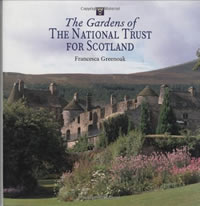 How I wish “The Gardens of The National Trust for Scotland,” by Francesca Greenoak had been available when I visited Scotland gardens, as nearly every garden on my short list was part of the Trust. I would have known before my visit that Inverewe is indeed a rhododendron haven with over 2,000 different types, and that the founder was known as “bigleaf” Osgood for his love of large-leaf rhodies. Greenoak is skilled at teasing out these life-giving facts for her garden descriptions. Of equal importance are the photographs of Brian Chapple. Much more than coffee table filler, his images tell a story, such as the rejuvenation of the massive and ancient yew hedges at Crathes Castle. I gasped at seeing stately walls of green cut back to bare stumps, but subsequent images show the gradual regrowth and restoration of these 300 years old masterpieces. The gardening staff knows their craft!