Garden designer Nigel Dunnett uses two contrasting slogans in his work: “planting design is an art form” and “planting design is essential.” The former captures the impact a successful design has on our emotions. The latter expresses the necessity to create healthy human environments, especially in cities. His book “Naturalistic Planting Design: The Essential Guide is an excellent introduction to these creative principles.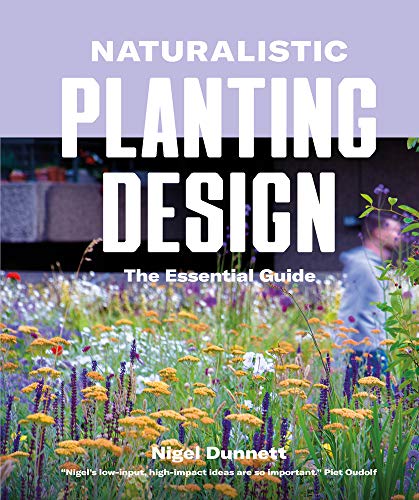
He defines naturalistic planting design as inspired by nature, but not a recreation of a particular ecosystem. The book goes deeply into the historical development of this practice, while also providing pragmatic step-by-step guides. Examples are shown in all stages from planting – often a mix of seeding and starts – to the succession of the gardens through the seasons and subsequent years.
Dunnett’s gardens won’t appeal to everyone. He’s very limited in his use of woody plants and his herbaceous plantings are mingled rather than in solid blocks. Imitating nature, his projects grow and change, meaning there is no single climax or season when everything is in bloom. Instead, he aims to have something of interest year-round, using a general rule that no more than three plants need to be at a peak at any one time.
I recommended enjoying the exuberance of the photographs first, and then read the text. To Dunnett, “the future is all about planting that’s exciting, uplifting, dramatic, beautiful, breath-taking, bold and adventurous. Wild too, and not just in the sense of it being natural but wild because it has an edge to it, it’s challenging, it’s not safe, and it’s not always tasteful.”
Published in Garden Notes: Northwest Horticultural Society, Winter 2020
![[The Living Jigsaw] cover](https://depts.washington.edu/hortlib/graphix/living_jigsaw.jpg)
I read a lot of gardening books – one of the joys of my profession! Somehow, the British author Val Bourne had escaped my attention until now, but I will watch eagerly for her future writings. Her new book, The Living Jigsaw, is a delight. I had a hard time putting it down.
Reading this book is like looking at your garden with a close-up lens. As suggested by the title, Bourne is very interested in the inner workings of and the interplay between plants, insects, and other animals, especially as they influence the health and robustness of her garden. Her pesticide free garden – she is opposed to even so-called ‘natural insecticides’ – thrives with careful planning and management.
Many of her gardening principles were tested when she moved from an established garden that was dry and stony, to a new, unmanaged garden with fertile soil and underground springs. She had to make new choices of plants and plant combinations – some old favorites didn’t succeed in the new conditions.
Of course, the animals in her garden are UK natives. Try as I might, nothing I do in my garden will encourage hedgehogs. However, Bourne’s garden practices are very applicable to the Pacific Northwest, and her annotated listing of “Top 100 Plants for an Eco-Friendly Garden” has many worthwhile selections for our gardens.
Published in the December 2017 Leaflet, vol. 4, issue 12
![[Sowing Beauty] cover](https://depts.washington.edu/hortlib/graphix/SowingBeauty.jpg)
James Hitchmough is the chair of the Landscape Architecture department at the University of Sheffield in England. On his faculty website, he describes his research as focused on the “ecology, design, and management of herbaceous vegetation.”
In his new book, Sowing Beauty, he emphasizes the practical application of this research, especially for developing naturalistic meadows in public spaces. He is a strong advocate of sowing carefully designed seed mixes, using established plants only as supplements or embellishments.
I recommend this book to all who are designing restoration sites, especially larger sites where sowing seeds is advantageous to manage costs. Hitchmough has considerable understanding and practice with the creation of new herbaceous plantings, including restoration of native grass communities in Western Australia.
Much of this hefty tome is a handbook to the many steps required in the design, installation, and future maintenance of any new planting. He includes several case studies. While many of his installations include non-invasive, exotic species, he also provides charts using natives from various regions of the world that are effective in restoration projects.
For projects that fall under public scrutiny, Hitchmough considers “how human beings interpret and value” naturalistic plantings, concluding that “human responses are generally very complex, but there are patterns.” Fortunately, he provides insights on how to work with these patterns.
Published in the December 2017 Leaflet for Scholars Volume 4, Issue 12.