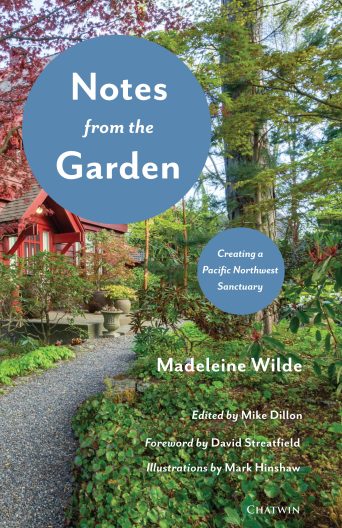
 Madeleine Wilde was the author of a gardening column in Seattle’s “Queen Anne & Magnolia News” that ran for over 20 years. Near the end of her life in 2018, she asked her publisher, Mike Dillon, to compile and edit those columns into a book. “Notes from the Garden” has recently been published, a treasure to be cherished by all local gardeners.
Wilde’s husband, David Streatfield, professor emeritus in Landscape Architecture at the University of Washington, provides a forward that describes the structure and history of their shared garden. He notes the significant trees and garden places, but also portrays the emotional space their garden provided. It was a sanctuary. It was also a place of remembrances, including plantings that were gifts from her parents, memorials to beloved family cats, or evoke places enjoyed on their travels together. According to her husband, this was also where Wilde “contemplated the issues she wrote about. These ranged from philosophical musings to seemingly mundane garden management issues.”
These mundane issues are typically very practical advice. I learned that re-planting annual nasturtiums in the mid-summer as a way to eliminate an infestation of black aphids. To enjoy early spring ephemerals, bring them inside, washing off bulbs, roots, and all. This extends the life of the flowers with the added bonus the plant can be restored to the garden without harm, allowing the leaves to naturally mature. I noted that bulbs, especially those that are spring blooming, are a frequent component of these essays, with several columns providing guidance for the heady rush of shopping for the best selections before planting in the fall.
As I read Wilde’s articles, in my head I was responding to her ideas as I would with any friend who is also a keen gardener. Most often, this was agreement over shared experiences. Sometimes, I felt the need to disagree, but I might do that with any friend I trusted not to take offense. Throughout, it was a healthy dialog, very much alive and vibrant.
Spring is celebrated for its exuberance, but this is not always a good thing. “The brilliant dandelions appear to double in numbers and showiness every hour. The chickweed mats ooze across the terrain, while that perky pest, named shotweed, seems to be in fast-forward on its second go-round…All dedicated gardeners have their special choice of vigorous thugs to conquer. The ridiculous absurdity is that each year we think we can control all this extravagantly beautiful spring growth. I try to stay amused.”
Excerpted from the Spring 2022 issue of the Arboretum Bulletin
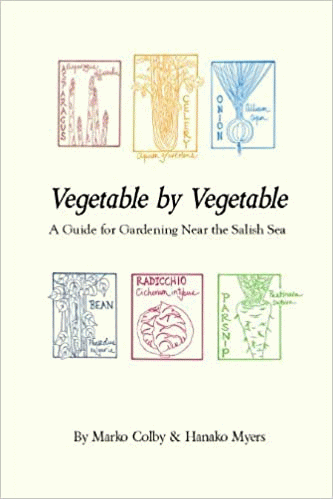 Marko Colby and Hanako Myers are organic gardeners in Quilcene, Washington, growing both vegetables to sell in markets and vegetable starts for home gardeners. From their experiences answering the questions of their seedling buyers, they have put together a small (83 pages) but very useful book titled “Vegetable by Vegetable: A Guide for Gardening Near the Salish Sea.”
 Pat Roome has been a gardener for almost all of her 87 years, has lived and gardened at the same Bellevue home for 56 years, and has been a Master Gardener for 45 years. That’s a lot of experience, and she decided it was time to share her accumulated knowledge in a self-published book, “Legacy of a Passionate Gardener.” We are all the beneficiaries.
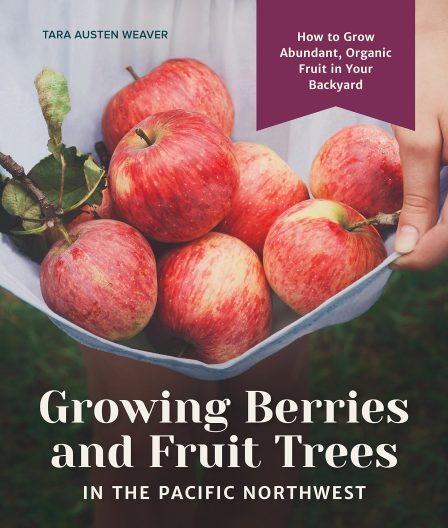 Tara Austen Weaver became smitten on growing fruit in Seattle after planting raspberries during an extended summer visit. Later, she moved here permanently to a house with nine mature fruit trees and proceeded to add 14 more plus many berry plants. Her new book, “Growing Berries and Fruit Trees in the Pacific Northwest,” is based on that experience and is an excellent choice for the beginning fruit grower in Washington, Oregon, or British Columbia, especially west of the Cascades.
![[Oh, La La!] cover](https://depts.washington.edu/hortlib/graphix/Ohlala!.jpg)
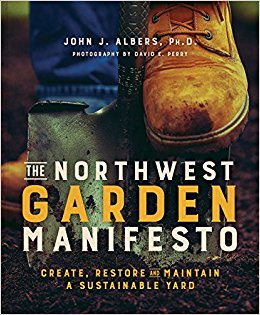 “The Northwest Garden Manifesto” by John Albers is a new book for our region. While the title may conjure up images of gardeners marching rake-to-rake for their causes, this instead is a very solid and comprehensive gardening book that keeps closely in mind the bigger ecosystem surrounding any private garden. Divided into three broad sections, the book asks you to assess what you have, then make changes that are sustainable (for your garden) and healthful (for you), and finally – for all your actions – think outside the property line.
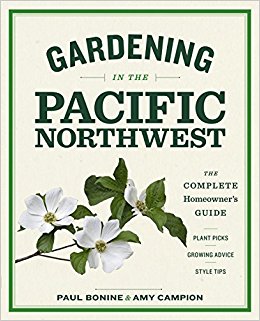 I always look forward to new books intended for Pacific Northwest gardeners. Paul Bonine and Amy Campion’s “Gardening in the Pacific Northwest” has been long anticipated, and it doesn’t disappoint. As explained in the introduction, this book is mostly from Bonine’s perspective, as he grew up here and has gardened in this region for many years. Campion did most of the excellent photography.
 Amidst the bumper crop of new food-gardening titles, Backyard Bounty : The Complete Guide to Year-Round Organic Gardening in the Pacific Northwest by Salt Spring Island, B.C. resident Linda Gilkeson stands apart. I put three recent edible plant titles by Northwest authors to the test by trying to find answers to commonly asked questions in them. Whether you are a beginning gardener or an experienced (or jaded!) old hand, this book will neither insult your intelligence nor blind you in a blizzard of technicalities. If you want to know about soil in raised beds, what to grow over the winter, or how to protect your grapes from predacious raccoons, this is the place. Though it lacks photos of primped and prinked up fruit and veggie glamour, the information is well-organized and clearly presented. I learned enough from reading it that I may just have to own a copy.
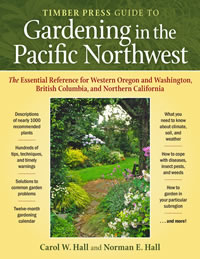 When authors Carol and Norman Hall started gardening in the Pacific Northwest in the 1970’s they had to learn to grow their plants by trial and error, because most gardening books of the time addressed only East Coast weather conditions, such as summer rain and winter freezing.
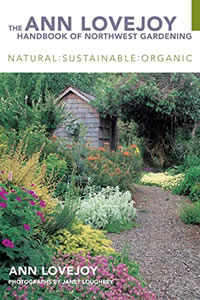 Ann Lovejoy has updated her popular 2004 “Handbook of Northwest Gardening,” with a new appendix entitled “What’s New in Sustainable Gardening.” Here she discusses rain gardens (that capture as much of naturally occurring water as possible), dry gardens (plantings that survive and even thrive with no supplemental watering once established), and the importance of bees and their current peril — and ways that gardeners can help their cause. All good additions.