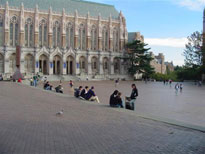
Transfer Thursdays
Thinking about transferring to the UW? If you are, Transfer Thursday is your gateway to transfer information. At a Transfer Thursday session, you can speak to an admissions counselor who will tell you all about applying to the UW. You can also meet with an undergraduate academic advisor who will help you prepare for your intended UW major. Bring your questions and your unofficial transcript(s). It’s one-stop shopping for the prospective transfer student.
Where:
University of Washington
171 Mary Gates Hall
When:
Every Thursday
1:00 to 4:00.
Admissions sessions
begins at 2:30!
For more information:
(206) 543-2550 or click here.
Credits
James Meadows
Editor
Jamie Yaptinchay
Technical Designer
Contributors to this Issue:
Judi Clark
Kathleen A. Elkins
Deanna Fryhle
Susan Inman
Sylvia Kurinsky
Mary F. Lampe
Tamara Leonard
Kate Long
James Meadows
Mariko Navin
Melissa Wenzel
The Transfer eNewsletter is a project of the UW Undergraduate Advising Gateway Center.
Undergraduate
Gateway Center
171 Mary Gates Hall
Weekdays 8 a.m. - 5 p.m.
By Mary F. Lampe, Ph.D., Director, Medical Technology Program, Department of Laboratory Medicine, UW School of Medicine
Medical Technology (MT) is a profession of highly knowledgeable and skilled individuals who perform clinical laboratory tests on blood, other body fluids, or tissue samples. The results obtained by these laboratory tests are a vital tool for physicians in their diagnosis, treatment, and prevention of disease and provide a critical component of health care.
The Medical Technology Program (MTP) is an undergraduate degree program within the Department of Laboratory Medicine in the School of Medicine. The four-year course of study leads to a Bachelor of Science degree in Medical Technology, and is divided into two major parts, the pre-professional/prerequisite phase and the professional phase.
See below for information about the pre-professional/prerequisite phase of the program.
The last two years of study constitute the professional phase. Courses in the first year of this phase are designed to provide students with an appropriate theoretical background and with the basic technical skills that will enable them to function effectively in the clinical laboratory. The curriculum includes coursework in immunology, clinical chemistry, hematology, medical microbiology, transfusion medicine, and selected topics in laboratory education, research, and management.
The final year takes place 40 hours per week learning one-on-one with working medical technologists in the clinical laboratories of the University of Washington Medical Center and its affiliated hospitals throughout the Puget Sound region.
The first two quarters are spent in core rotations in the major scientific disciplines of hematology, clinical chemistry, medical microbiology, and transfusion medicine, while the final quarter offers students the opportunity to pursue additional specialized training in one of these clinical disciplines, or to complete an additional general rotation, or alternatively, to collaborate on a research project with one of over 70 faculty members in the Department of Laboratory Medicine.
In general, what interests students who enter the Medical Technology major?
Successful Medical Technologists (also known as Clinical Laboratory Scientists) are individuals who enjoy studying the biological, chemical, and physical sciences, and who find personal satisfaction and intellectual reward in applying scientific methods in the laboratory diagnosis and evaluation of disease.
What are the prerequisites, the minimum requirements, and how competitive is it to enter the Medical Technology major?
All students, whether on-campus, transfer, or post-baccalaureate students, apply for competitive entry into the Professional Phase of the program. Applications to the program are due by April 15 th of each year. Note that transfer and post-baccalaureate students must make a separate application to the University as well (see Registrar for deadlines). Because of the sequencing of required courses, all students start the major Autumn Quarter. Approximately 25-30 students are accepted each year.
Prerequisite courses may be taken at the UW, or at another university, college, or community college. All courses need not be completed at the time of application to the program (application deadline is April 15 for entry in Autumn Quarter). However, the applicant must show a specific plan for completion of all prerequisite courses prior to entry in the Professional Phase of the program. If courses are not complete at the time of application, admission will be with the condition that all course work will be completed prior to Autumn Quarter.
If coursework is taken at some other school, it is important to verify that courses equivalent to those offered at the UW are taken. For Washington community college courses, check the Transfer Course Equivalency Guide.
An overall cumulative grade point average of 2.00 is required for consideration. In addition, the applicant must have a 2.00 cumulative grade point average in the prerequisite science and mathematics courses. However, the average cumulative GPA for the most recent entering class was 3.36.
UW Prerequisite Courses include the following:
15 credits biological sciences – UW General Biology 180, 200, 220
**Human Physiology (UW Biology 118) also highly recommended
22 credits chemistry – UW General Chem 142, 152, 162 and Organic Chem 223, 224 (Chem 237, 238, and 239 series also OK)
5-10 credits math and/or statistics – UW Statistics 220 or Math 124 or 144
43-48 credits general subjects, including completion of University writing, reasoning, and general-education requirements
It is highly recommended that all general University requirements, including writing courses and English composition, be completed prior to entry into the program.
Are there difficulties for transfer students? Is it challenging for a student transferring as a junior to complete the major in two years?
Because the MT Program is a highly structured 7-quarter professional program, all students meeting University and program requirements and making satisfactory progress will complete the major within two years of entry into the professional phase.
In addition, it should be noted that either Biology 180, 200, 210 or Biology 201,202,203 are acceptable as Biology prerequisites. However, because of differences in sequencing of topics, individual courses are not interchangeable – the entire sequence should be taken either at the UW or at the other institution (for example: if a student takes Bio 201 at a community college, s/he should complete Bio 202 and 203 before coming to the UW).
Are there structures in place in your major that facilitate peer interaction?
One of the benefits of the UW MTP is that it is a small program within a large university. MT students continue through the program with the same small cohort of students, typically 25-30 students per class. While some of the first year courses are larger, Laboratory Medicine courses are limited to MT students only, with laboratory sections as small as 8-10 students in some courses. In this setting, students get to know each other and MTP faculty and staff very well. There are also opportunities during orientation and throughout the program for entering students to interact with 2 nd year students to ask questions and seek advice.
What employment opportunities exist for students who graduate with a degree in Medical Technology?
Men and women trained as medical technologists may work in a variety of settings. Many work in clinical laboratories in large medical centers, hospitals, and clinics. Others do research in industrial, public health, and medical laboratories; and teach in hospitals, colleges and universities. An MT may practice as a generalist, using knowledge in several of the scientific disciplines, or may specialize in one scientific area in larger hospitals.
Following successful completion of the program, students are eligible to take national certifying exams offered by the American Society for Clinical Pathology (ASCP) and/or the National Certifying Agency for Clinical Laboratory Professionals (NCA), making them eligible for employment as clinical laboratory scientists/medical technologists almost anywhere in the United States.
It is important to note that certified clinical laboratory professionals are in critically short supply. The federal Bureau of Labor and Statistics estimates that approximately 12,000 new laboratory practitioners will be needed each year, yet only 4,500 are entering the workforce annually. Most UW MTP students have multiple job offers prior to graduation.
The Medical Technology Program
206-598-6131
medtech@u.washington.edu