The post STUDIO: BUILD OUR WORLD – Meet Our Mentors for Fall 2015 appeared first on 3DL Partnership.
]]>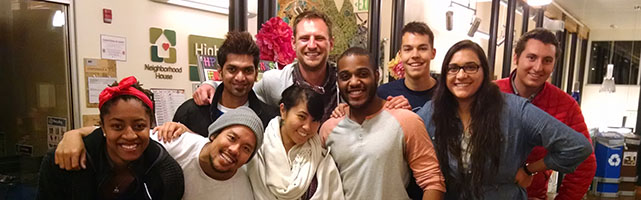
Studio is pleased to welcome returning and new mentors for 2015! Our mentors come from many different backgrounds and are UW STEM majors in science fields, mathematics, and engineering. We are so grateful for their dedication!
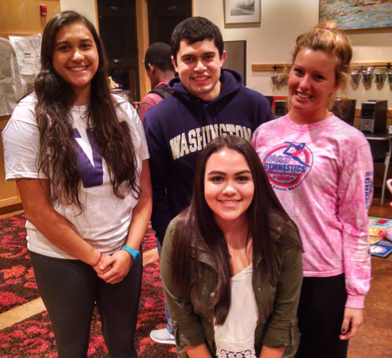 They travel each week to Neighborhood House in West Seattle to engage in STEM learning together with Neighborhood House Youth. Our Mentors express many motivations for joining STUDIO and come with a variety of personal experiences that help them connect to NH Youth in so many ways. Let’s hear directly from them about why they joined STUDIO:
I’ve been lucky enough to have everyone support me and show me what I need to do to achieve my goals, and I want to be able to be that person for someone. I think everyone should be able to go to college and follow their dreams with no apprehension; coming from a very low income family, I understand what it’s like to have another stress and worry added on top of a college/career, and think I have a lot to offer to a class like this.
I joined because I wanted to give students who, due to a confluence of sociological factors, both past and present, may not have the courage or the resources to take steps towards STEM careers. It is not that I believe everyone should be in STEM, but I do believe that everyone, NH students included, should know that they CAN and are indeed good enough to pursue careers in STEM, should they choose to do so.
I joined STUDIO because of the long- term goal I think it’s trying to achieve. For me, I hope STUDIO ultimately manages to give middle and high schoolers the notion that the STEM community has a spot for them in any form that might take on. The way in which we go about that can be approached very differently, whether it be through discussion about science or college, or just leading by example. Either way, I hope students can realize their potential and pursue higher education/career in any field they choose, although bonus points for a STEM field.
I joined STUDIO because I was looking for a positive way to impact students in the area. I have come a long since high school, coming to the University of Washington. I had a lot of help getting here and in my time here. I knew I was put in a lucky position to have friends, family, and teachers who were passionate about my education and who helped me work towards my dreams. I hope that I could be that for somebody else.
What I hope to achieve in STUDIO is to be able to have the students accept the idea that their goals in STEM and life are not only fun and exciting but also very much achievable. I want to help them be able to get through their struggles in STEM and life and put them in a position in which they are able to succeed.
One of the reasons I joined Studio was because I watched my sister struggle in life and the education system. My sister had an illness that resulted in a learning disability and mild short-term memory loss. Although some people helped her along, there were many people, even some teachers and counselors, who said she would not make it to college or beyond. My sister had to work twice as hard as everybody else just to get the same grades and at the same time was being told she wasn’t going to get anywhere and might as well quit. My sister ended up going to a university and graduating with a STEM degree and is now in graduate school studying to be a physician’s assistant. From these life experiences I want to help NH youth get through their own struggles in life and succeed with the dreams they have for themselves.
I was looking for something to get involved in, but for me it had to be important to somebody/a community. I joined STUDIO because the idea of being in a mentor position really appealed to me because there is so much to learn from that type of mentor-mentee experience and it’s was an added bonus that it was surrounding STEM related activities.
The post STUDIO: BUILD OUR WORLD – Meet Our Mentors for Fall 2015 appeared first on 3DL Partnership.
]]>The post The Big Breath – Adding Social-Emotional Skills to the Learning Equation appeared first on 3DL Partnership.
]]> “Have you heard of pushing someone’s button?” Ana Garcia asks the students in Room 107. “It’s what happens when someone knows what annoys you and does it anyway.” The fourth-graders nod their heads. They’ve all been there. Maybe it’s the big kid at recess who won’t stop teasing you, maybe a classmate who takes your pencil without asking, then grabs your eraser. “What can you do when someone pushes your buttons?” the animated teacher asks. “You can take a deep breath, a belly breath.”
Ms. Garcia leads the fourth-graders in a big collective breath. One breath, two breaths, three breaths. Eyes are closed. Hands are on thighs. There are a few giggles when someone snorts. But the fourth-graders at Ardmore Elementary School in Bellevue know this is serious business. They’re used to talking about real emotions in front of each other, and they’re thoughtful and engaged when the discussion moves to the mined emotional territory between annoyance and anger.
“Anger escalates faster than you think,” says one boy. Another mulls: “If you’re annoyed,” he says, “there are a few seconds before it turns to anger.”
Those few seconds, Ms. Garcia tells them, are the perfect time to step back, pause, and take a “Meta-Moment,” reflecting on how their very “best selves” would respond to a difficult situation. The kids are soon pumping arms in the air, eager to share adjectives describing how they feel when they are their best selves: respected, happy, honest, friendly, humble, caring, patient, forgiving.
 The students in Garcia’s class are learning sophisticated social-emotional skills and vocabulary through a researchbased curriculum called RULER (Recognizing, Understanding, Labeling, Expressing, and Regulating emotion). The curriculum, developed by the Yale Center for Emotional Intelligence, is being implemented in third through fifth-grade classrooms throughout the Bellevue School District under the research eye of the University of Washington’s 3DL Partnership, which provides support and feedback on RULER implementation and expert guidance in assessing program effectiveness.
“We know how to measure student growth in academic areas, but we are still learning about how to measure social and emotional skills. That’s why the UW partnership is so important,” says Michelle Proulx, social-emotional learning curriculum developer for the Bellevue School District.
The 3DL Partnership is a collaboration between the UW’s College of Education and School of Social Work. The 3DL Partnership directors say education has, for too long, focused on one dimension, the intellect, overlooking the importance of social and emotional development in student success. “Motivation, persistence in the face of difficulties, social interaction skills, communication skills, emotion regulation, belonging – these are all things students need to learn and school is one of the institutions where they can learn them together,” says College of Education Professor and 3DL Partnership Co-Director Leslie Herrenkohl, a developmental psychologist and learning scientist.
A growing body of research shows that teaching students social-emotional skills can reduce bullying, violent aggression, and other problem behavior while boosting intellectual growth. A 2011 meta-analysis of 213 studies looking at the impact of school-based social-emotional learning projects found that students not only exhibited improved attitudes and behavior, but had, on average, an 11 percent academic achievement gain.
Social-emotional skills are critical for all students, including high-pressured high-achievers and strugglers who may experience serious stressors at home. In some Bellevue RULER classes, students have opened up about divorces at home, parents in jail, or, in one case, feeling “overwhelmed” after being abandoned at a shelter by a parent. “Children’s emotions impact their ability to learn. If they are angry or worried, that affects their ability to stay focused, receive information, and learn from instruction,” says Proulx.
Equal access to learning opportunities in all three dimensions is critical to developing positive, life-long social-emotional skills, say researchers. “There is absolutely no question that kids from more affluent backgrounds have more opportunities to gain skills in social-emotional domains. If we don’t create opportunities for social emotional learning as a part of the regular process of schooling, we run the risk of furthering educational disparities,” says School of Social Work Professor Todd Herrenkohl, whose research has focused on preventing youth violence and bullying and on understanding and promoting resilience in vulnerable children and families.
Todd and Leslie Herrenkohl co-direct the 3DL Partnership. Their interdisciplinary partnership began in 2012 as a way to investigate the effects of three-dimensional learning on students’ near- and long-term success in life. “We decided to join our collective areas of expertise in ways that more intentionally address issues we have both cared about for a very long time,” he says.
Leslie Herrenkohl brings expertise gleaned from extensive work in urban science classrooms to the 3DL arena. Her research has revealed the powerful role social-emotional skills can play in classrooms where teachers emphasize group work and open discourse – 21st-century skills essential to equitable, ambitious instruction. In these active settings, students must manage social interactions and emotional responses as they discuss each other’s ideas, says the researcher. “To understand whether or not you agree with someone else’s scientific theory, you have to understand their point of view,” she says. “If you don’t, you have to ask them questions. How do you ask other students to clarify their theory? How can you offer a suggestion to someone? What do you do if the theory they offer doesn’t align with yours? How do you manage your emotions when someone publicly disagrees with your ideas? It’s important to provide students scaffolding to do that.”
Those supports will be critical this new academic year as the Bellevue School District begins weaving RULER into STEM (science, technology, engineering, mathematics) classes and other regular Common Core content areas. “We’ll be cueing students to practice the skills they have learned as they consider the feelings and perspectives of their classmates,” says Proulx.
It’s not just students in need of social-emotional learning strategies. Clayton Cook, an assistant professor in the college’s educational psychology department, is investigating how adults working with children can benefit from mindfulness-based practices and other skills, habits, and routines that promote their resilience. “It’s a real turn to take into consideration the well-being of educators, whose levels of stress have been ignored for so long,” says Cook. “The kids can only do well if the adults are doing well.”
Too often, the adults aren’t doing well. Each year, an estimated 30 percent of educators leave the field, citing stress and burnout as primary causes. Stressed-out adults can sow a negative classroom climate and suffer strained relationships with students. Overwhelmed, they may resist fresh ideas and change. “Stress eats away at people and leaves them less open to adopt new practices. The kids suffer as a result,” says Cook. “If we want educators to be as effective as possible, then they have to come from a powerful social-emotional position themselves.
Then they can model that behavior for their students and effectively teach important social, emotional, and academic skills.” Cook and College of Education Professor Gail Joseph have co-developed an Achiever Adult Resilience Curriculum for educators; his team is piloting it online and with groups in the Seattle area. He plans to scale the program out to evaluate its impact and look at different outcomes by geographic area. Curriculum activities include such practices as gratitude journaling and mindful, stress-reducing breathing. “We train providers to envision a stop sign, take a deep breath, and bring awareness to the present moment. Are they missing what’s right in front of their face? We’re helping them manage how they pay attention, and how they stay connected to the moment in a nonjudgmental, open way,” says Cook.
Cook is also part of a team conducting a three-year, 61-school randomized control trial of the Second Step curriculum, a socialemotional program designed for pre-kindergarten through middle school. This social-emotional learning program, one of the most widely adopted in the nation, teaches students skills for learning, empathy, emotion management, problem-solving, and other methods for negotiating interpersonal conflict. “We’re looking at the effects on elementary students’ social-emotional skills, as well as the effects on skills such as learning to pay attention and to be organized.”
Critical to program success, his research team has found, is having in place teachers with pro-active classroom management strategies that increase academic engagement and minimize behaviors that are disruptive to learning.
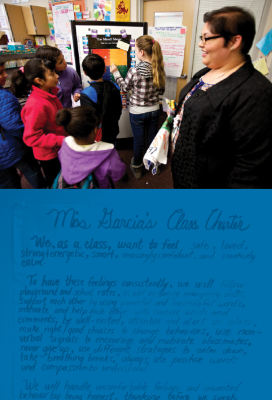
Ms. Garcia is a pro-active pro at Ardmore Elementary, a low-income high-diversity school where more than half of the students speak a first language other than English. When her fourth-graders enter her class, the first thing they do is check in with RULER’s “Mood Meter,” tracking on a magnetic board how they are feeling that day.
On the wall is a chart where the students describe the “virtue of the month”; this month it’s courage, the thing that helps you stand up for friends at recess and voice what’s right. Hanging near the windows is the official classroom charter they created together, a colorful document that describes how they want to feel in their environment. “We as a class want to feel safe, loved, strong and energetic, smart, amazingly confident, and creatively calm.”
One of the hardest things she has had to do, Ms. Garcia tells a visitor in a quiet moment, is to learn to leave students alone to sort out problems by themselves. Someone says something hurtful. There are tears. But now there are tools: the feeling words, the self-check, the deep breath. “They can tell themselves ‘I have to turn it around,’ and they are able to selfmanage now,” she says.
The RULER implementation in Bellevue is still in its early stages. It began in the 2013-14 school year. But already, educators are seeing the impact. “Teachers say this has radically changed their classrooms, because we’re letting the whole child into the classroom, not just the academic child,” says Proulx. “And it’s all for a purpose: to help them do their best academic work.”
For More Information
RULER: ei.yale.edu/ruler Herrenkohl, L.R. and Mertl, V. (2011). How students come to be, know, and do: A case for a broad view of learning. Cambridge UK, New York City: Cambridge University Press.
Cook, C.R., Frye, M., Renshaw, T., Lyon, A., & Slemrod, T. (in press). Integrated Approach to School-based Universal Prevention. School Psychology Quarterly.
Iizuka, C, Barrett, P., & Cook, C.R. (2014). The FRIENDS Emotional Health Program for Minority Groups at Risk. Journal of School Health.
Iizuka, C, Cook, C.R., & Barrett, P. (in press). Evaluation of an online professional development training on school-based mental health for teachers in rural and remote areas. Australian Journal of Rural Health.
The post The Big Breath – Adding Social-Emotional Skills to the Learning Equation appeared first on 3DL Partnership.
]]>The post The Power of Community – Full-Service School Meets Multiple Needs appeared first on 3DL Partnership.
]]> Students at Roxhill Elementary School don’t have to look far to get help. Adults are everywhere. There are parents in the crosswalks, the hallways, the lunch room, and the classroom, guiding teachers in what’s best for their child. There are visiting doctors and dentists, social workers and mental health counselors, and the nurse-practitioner who has a health clinic set up in a converted closet. There are lots of nice community workers and big kids from the high school to tutor, help with homework, make it better when you’re sad, and call to check that you’re OK if you don’t show up for school.
“Our students see Roxhill as a safe place where all these people are here to encourage and support them,” says Jonathan Aldanese, the school’s house administrator and a graduate student in the University of Washington’s Danforth Educational Leadership Program. When he arrives at school two hours before the morning bell, the West Seattle school is already full of children. “Instead of being home alone, they can be here, in a place where people really care about them, help them catchup, find them enrichment, refer them to programs, and seek opportunities to ensure they are successful.”
This nurturing, wrap-around environment is built on a matrix of powerful partnerships bringing together UW researchers, school educators, families, and community organizations. “It’s a way to think about what education could be and should be,” says College of Education Professor Leslie Herrenkohl, a developmental psychologist and learning scientist who directs the college’s 3DL Partnership with School of Social Work Professor Todd Herrenkohl.
In 2012, the 3DL team and Associate Dean of Professional Learning Elham Kazemi, with funding from the state’s Collaborative Schools for Innovation and Success program, entered into a five-year partnership to support Roxhill in becoming a full-service community school.
Roxhill draws from a rich and diverse community with more than 10 primary linguistic and cultural groups. Nearly one in five students receives special education services and approximately three of four children qualify for free or reduced lunch. Principal Sahnica Washington and her staff crafted a Roxhill mission: “to foster a climate of compassion, academic excellence, problem-solving, creativity, and cultural awareness where the school, families, and the community are working together for the social, emotional, physical, and intellectual development of each child.”
UW researchers joined a 20-person advisory team that guided the transformation, including school leaders, teachers, a librarian, a city of Seattle representative, parents, and partners from community-based organizations. The team worked from research showing that students at schools similar to Roxhill perform better academically when their basic needs are met. “Children thrive and flourish in an environment in which they are supported around their multiple needs. When schools become the hub of activities within which they can get those physical and mental health needs met, students can better attend to high-quality academic work,” says Todd Herrenkohl.
As districts, local governments, community and business partners better understand students’ broader needs, they often seek to place resources into schools. The full service community school model provides an organizational structure to coordinate and channel those resources and create a coherent action plan for meeting the needs of students and families, as well as school staff. At Roxhill, lead teams oversee and track ongoing activities and monitor progress: the teams address academic excellence, extended learning, health and wellness, and family and community engagement.
Family and community engagement are critical factors in boosting academic performance in high-needs schools. At Roxhill, more than 40 community-based partners work with students and families, providing everything from social and medical services to intensive tutoring, mentoring from business leaders, after-school and weekend program assistance, and leadership in activities such as winter coat giveaways, attendance campaigns, and family fitness nights.
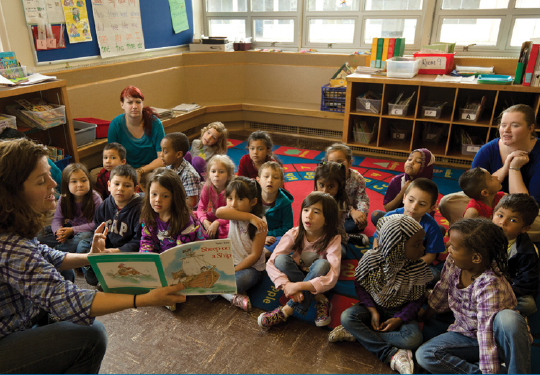
Families engage with the school in ways that reach far beyond bake sales or car washes or back-to-school nights. They volunteer in the school, attend weekly coffee hours, share a family resource room, organize off-campus events to bring teachers into their community, and attend on-campus classes, including twice-weekly adult English Language Learning sessions. Many have become fierce advocates for their children. “We engage with the families and learn from them,” says Aldanese. “What are the needs of your students? What are some things you want us to learn about you and your culture? These inform our decisions as practitioners. I can’t imagine not having the parent piece there.”
Alejandra Diaz, a Latina mother of two, is a driving force behind increased teacher-parent engagement. Diaz initially shied from taking part in school because she worried that her English skills needed to be stronger and a sense that teachers didn’t have time for her. After joining the advisory team in visits to full-service community schools in California and seeing non-English speaking parents involved in activities, she was determined to come home and create a welcoming climate for Roxhill’s multicultural, multilingual mix of families. “The more time I spent at school, I noticed my English is getting better. I thought if that is working for me, maybe I’ll bring in more parents and the same thing will happen to them, and that is how we can be more close to the teachers and become more involved,” says Diaz.
She is now president of the school’s diversifying and expanding Parent-Teacher Association, where Spanish speakers try out their English and English speakers try out their Spanish during meetings. “We feel happy and comfortable in those meetings now. We don’t see the language barrier anymore,” says Diaz. She reports her children are improving academically in the new school climate.
High expectations for all students – including students who do not currently meet grade level expectations – drive the UW’s professional development strategies at Roxhill. Kazemi, together with her colleagues Ruth Balf and Emily Shahan, conduct intensive day-long Math Labs that bring together classroom instructors, special education and bilingual specialists, volunteers, and researchers to collaboratively observe, study, try out, and refine teaching practices that support deep mathematical thinking for diverse students. At the same time, UW elementary teacher education students are learning these practices in their mathematics methods classes – preparing them from the start with strong instructional routines, even as they are learning to become “community teachers.”
Together with Professor Ken Zeichner, graduate students Kate Napolitan and Michael Bowman, Director of Elementary Teacher Education Jennifer Lindsay, and other Elementary Teacher Education faculty, 3DL team members support future teachers to develop practices such as family visits and conferencing techniques that build and sustain partnerships with families and communities.
As “community researchers,” 3DL Partnership team members work shoulder-to-shoulder with practitioners in the field, building and assessing new strategies to re-envision education for all students in diverse urban schools. “It’s exciting to take these beginnings at Roxhill and see how we can position them very visibly to the outside, and shape the way others think about this work on a national and international scale,” says Todd Herrenkohl.
For More Information:
The Collaborative for Academic, Social, and Emotional Learning: casel.org
The post The Power of Community – Full-Service School Meets Multiple Needs appeared first on 3DL Partnership.
]]>