Research

The Environmental Fluid Mechanics group at the University of Washington studies the mechanics of fluid flow as it relates to transport and mixing in rivers, estuaries and the coastal ocean. Our work includes geophysical fluid dynamics, sediment transport, hydraulics and stratified flows. We are particularly interested in the dynamics of the river-ocean interface. We approach scientific and engineering fluid mechanics problems using a combination of field observations and laboratory experiments.

Current projects
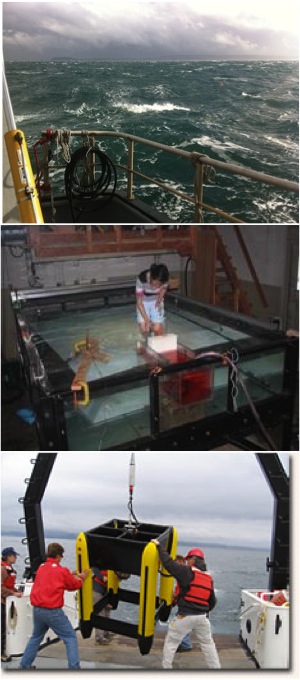

Sediment dispersal in river plumes

Triaxus deployment

River plumes are an important and dynamic component of the coastal landscape—delivering and distributing nutrients, contaminants, marine organisms, and sediments in shelf waters and shaping habitats that support diverse and productive ecosystems. As part of a large multidisciplinary study, we are investigating the mechanisms responsible for transport, resuspension and removal of sediment in the Columbia River plume.

People: Dan Nowacki, Alex Horner-Devine
Funding: National Science Foundation, Royalty Research Fund


Coherent structures in estuaries

Boil

Coherent structures, such as boils and eddies are ubiquitous in fast moving rivers, estuaries and narrow passages. These structures enhance lateral and vertical transport of contaminants, sediments and other water-borne particles. They are generated by strong hydrodynamic forcing over dunes and sills on the river bottom, around regions of high channel curvature and other bathymetric irregularities. We are investigating the generation of coherent structures in the Snohomish River Estuary. This study is part of a collaborative effort with the UW Applied Physics Lab and Stanford University to relate the surface signature of remotely observed coherent structures to subsurface flow characteristics.

Over a three week period in September 2009 on the Snohomish river, WA, the COHSTREX project made co-located measurements of near surface velocity (using multiple instruments) and infra-red video of the water surface. Our analysis will focus on relating the surface signature to in-situ vortex dynamics and turbulence statistics, with the ultimate goal of relating remote measurements to properties of the flow and the bed.

People: Stefan Talke, Alex Horner-Devine, Andy Jessup
Funding: Office of Naval Research

Further project information (general); UW CEE-specific project information.


Merrimack River plume (MA)

Merrimack

The Merrimack River discharges into New England coastal waters in northern Massachusetts. We are working with investigators from the University of Massachusetts and Texas A&M to better understand the dynamics of this mid-size plume. As a team, we use a combination of laboratory, field and numerical model experiments to understand how the plume, which initially enters the ocean as an inertial jet, is transformed into a geostrophic coastal current.

People: Yeping Yuan, Maggie Avener, Alex Horner-Devine

Funding: National Science Foundation


Wave Supported Gravity Currents

Triaxus deployment

Gravity currents can be one of the most significant mechanisms for sediment transport on continental shelves dominated by river discharge. Until recently, it had been assumed that these currents develop only if the shelf slope exceeds a certain value. However, recent observations suggest that wave energy can augment current-induced bottom shear stress, and support currents across a flatter shelf. Efforts to model the wave supported gravity currents (WSGC) have been relatively successful in predicting sediment deposition, but there is a lack of observational data verifying these models. Field experiments are not able to fully resolve the details of WSGC due to the thinness of the layers, the limitations of ocean-going instrumentation, and the episodic nature of gravity currents.

Our laboratory experiments are being conducted in a 5-m flume with a wave- generating piston constructed expressly for these experiments. The tank is equipped with bottom slope control and a sediment re-circulation system. The experiments employ silt- and clay- sized sediment, including mechanically sorted fine-grained sediment and a natural distribution from flood deposits cored on the Eel River shelf, CA. We make detailed measurements of the sediment flux and the structure of the velocity and suspended-sediment concentration fields at temporal and spatial scales inaccessible in the natural environment.

People: Adam Price, Abbas Hooshmand, Alex Horner-Devine
Funding: National Science Foundation


Coherent structures and the distribution of age

Residence Time

The transformation, growth and decay of chemical and biological species in environmental flows depend on the time history of these species within a fluid body. For example, the water quality in a lake depends on the residence time distribution (RTD) and path of each water parcel as it passes through the lake. However, most current laboratory fluid mechanical measurement techniques return Eulerian velocity and species concentration fields, which can only be used indirectly to infer residence time. We are developing a new technique that directly resolves the residence time field in laboratory experiments and is well-suited to linking fluid dynamics to environmental and ecological applications.

The image above shows the age field in a river plume experiment using the new technique on our rotating table. The colors correspond to the fluid age, normalized by the table rotation period (equivalent to days). Download the video . (5Mb, .wmv)

People: Melyssa Nagamine, Shawn Bevan, Alex Horner-Devine


River plume dynamics

Plume dynamics graphs

Despite the significant role of plumes in coastal circulation, much remains to be determined about their fundamental dynamics. We conduct laboratory experiments modeling the combined influence of buoyancy and the earth's rotation to understand the transport mechanisms in river plumes. The experiments are carried out on a 2-meter rotating table using a combination of Particle Image Velocimetry and Laser Induced Fluorescence to measure the velocity and density fields, respectively.

People: Yeping Yuan, Alex Horner-Devine


Previous projects


Fish Passage

Fish passage culvert

Recent research suggests that culverts form barriers to the upstream passage of juvenile salmonids, thereby limiting habitat availability. We are conducting hydraulic tests in a full-scale culvert test bed to determine how baffles modify the flow through the culvert and influence its navigability for juvenile salmonids. We are collaborating with biologists from Pacific Northwest National Labs, who are testing fish passage rates directly using stock from an adjacent hatchery.

People: David Thurman, Alex Horner-Devine
Funding: Washington State Department of Transportation


Sediment transport on
mixed sand and gravel beaches

Rich Passage

In the early 2000s fast ferry service between Seattle and Bremerton was shut down due in part to erosion of beaches along the ferry route. We are working with Pacific International Engineering to understand the sediment transport on these mixed sand gravel beaches so that the impact of future fast ferry projects can be accuarately determined.

People: Greg Curtiss, Alex Horner-Devine
Funding: Pacific International Engineering