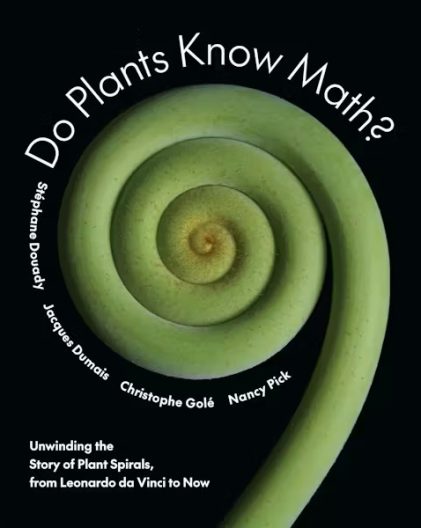
As an undergraduate in college, I was a math major. My career has not made much use of this education, but I do like mathematical puzzles. When we received a review copy of Do Plants Know Math?, I was intrigued.
Is this a math book? There are some scary-looking equations here and there. But it is mostly a biographical history book, presenting the very human stories of observing and documenting the spiral patterns of plant growth using mathematical principles.
 Some of these were known in ancient times but forgotten, only to be rediscovered much later. For example, the famous Fibonacci sequence, named after a 13th century Italian, is really much older, dating back to Sanskrit poets in India in the 3rd century BCE.
The four authors are multi-international, being from Algeria, Canada, France, and the United States. Unlike many books with multiple authors, the overall voice is very consistent and clear.
It is also fun to read, as the authors are deeply enthralled with the subject. “In building their spirals, plants obey fundamental laws of science—and why shouldn’t that gradual unfolding strike our brains as utterly entrancing and thrillingly beautiful?”
At the end of each chapter, there are “Try Your Hand” exercises, ways to test the theories with simple projects. Once example walks you through the steps to make a kirigami maple leaf and suggests comparing it with the real thing. Both are beautiful.
Presented at the end of the book is “A Spiral Dinner” with all the recipes needed from drinks to dessert. As you prepare, you’ll observe the patterns in pineapples, cabbages, artichokes, and even strawberries. Delicious!
Each chapter begins with poetry:
Don’t
you
wonder,
Broccoli,
Whether you repeat
yourself? I mean, really repeat
your self? How much self-similarity is enough?
Reviewed by Brian Thompson
Excerpted from The Leaflet, Volume 13, Issue 1, January 2026