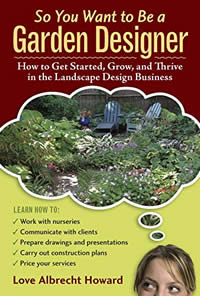
 Love Albrecht Howard’s first book fills a gap in our collection. To my knowledge, it is the only recent book on running a garden design business that is written for plant lovers who may not have formal horticultural or business training, but who do have a fair amount of common sense and are willing to get their hands (and feet!) dirty learning. The author certainly approves of formal education, recommending that prospective designers take courses, but she knows firsthand that hands-on experience gained through internships, volunteer work, and garden shows, as well as time spent with gardening books and magazines can be even more valuable than coursework. Indeed, fifteen out of twenty chapters focus on day-to-day operations, including best gardening practices, rather than on estimating costs, hiring staff, and other money-related aspects of the business.
To its credit, this book has a comprehensive index, with topics ranging from accent plants to Rocky Mountain spotted fever to zone creep. Albrecht Howard offers a wealth of knowledge gained from real-world experience, along with basic guidelines to help ensure the fledgling business does well financially. The underlying message is one most readers will want to hear: if a new designer can perfect skills in garden design, plant care, and customer relations, the money is secondary, and it will come.
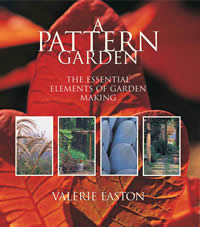 Val Easton’s warm and clear writing style is very familiar, but her subject matter in this book breaks new ground as she applies the architectural concepts of patterns, or putting “human instincts into words,” to garden setting. Throughout she “helps us to understand why we feel comfortable in a space” and why, in other places, we don’t. The patterns are not unfamiliar: Scale, Garden Rooms, Ornamentation, Containers, etc., but some associations may be new, such as grouping Patios, Sheds and Focal Points under destinations. This makes it important to read the book as a whole, even though you’ll return to favorite sections again and again for specifics. A short review of favorite plants concludes the book, but these are just one more pattern in the larger design.
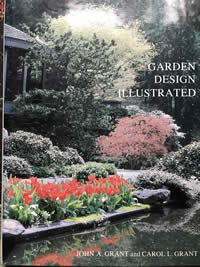 John A. and Carol L. Grant’s “Garden Design Illustrated” is a historical gem. This husband and wife team is better known for “Trees and Shrubs for Pacific Northwest Gardens”, first published in 1948 with help from the Arboretum Foundation. But their 1954 design book is perhaps more relevant today, teaching time-honored basics that haven’t become outdated.