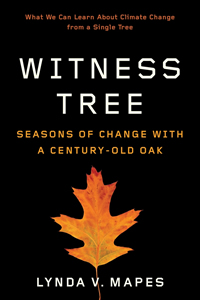
 How would it be to spend a whole year observing a forest, the changing seasons and all the beings – plants and animals – that lived there. This is exactly what Lynda Mapes, a science reporter for “The Seattle Times,” decided to find out. She lived on the edge of the Harvard Forest, a 3,000 acre managed research forest in Petersham, Massachusetts, over 60 miles west of the main Harvard campus. “The Witness Tree” is the story of this undertaking.
To focus her attention, she concentrates on one tree, a northern red oak (Quercus rubra), of early middle age for this species. She examines this tree in every conceivable way, and with the help of experts from many professional and avocational perspectives. She also considers the humans that interact with the tree and the forest, including the cultural history of the area, and its impact on the natural history.
Throughout there is an ongoing consideration of climate and other changes in the forest. Both from the long view over millennia, and the more recent changes, such as the increase of the hemlock woolly adelgid (Adelges tsugae), and near demise of such forest stalwarts as the American elm (Ulmus americana) and the American chestnut (Castanea dentata). Some of this is told from the supposed perspective of her beloved hundred-plus-year-old red oak.
Mapes stayed in New England during the winter of 2014-2015, one of the coldest and snowiest on record. She writes, “While I froze in the Northeast, my husband at home in Seattle was cutting the grass and watching flowers burst forth in the warmest winter on record.” Contrasts like this, and the author’s gentle role in teasing them out of the world around her, makes this a very satisfying book.
Excerpted from the Fall 2017 Arboretum Bulletin.
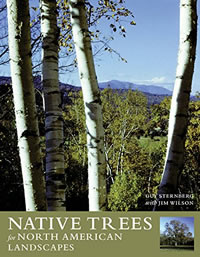
In Native Trees for North American Landscapes: From the Atlantic to the Rockies , the sub-title is very important as trees native only west of the Rockies are excluded. But almost all trees that are included can be found in the Arboretum, and many are widely planted in our region and are available in nurseries.
As the title suggests, authors Guy Sternberg and Jim Wilson address their book to gardeners and landscape designers, but there is also much here to interest those who love trees for their place in the natural landscape and as interwoven with human history. The quality and diversity of the photography is impressive, and well linked with the engaging text.
Excerpted from the Summer 2012 Arboretum Bulletin.
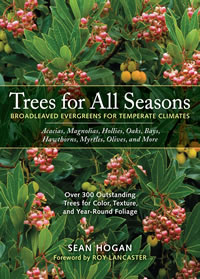 Portlander nurseryman Sean Hogan addresses a neglected part of the garden palette in “Trees for All Seasons: Broadleaved Evergreens for Temperate Climates”. And he does it with great enthusiasm; being quite candid that one of his goals is increased planting of these excellent but underused plants.
First, he defines his scope. Conifers, or monocots such as palms, are not included. He’s also strict about evergreen, subjects must “…keep their leaves year-round, or nearly so, but also remain attractive while doing so.” Icons with each entry give size and shape, and emphasize these are trees, not shrubs (he’s saving those for his next book).
The typical A-Z encyclopedia — with some bunching of closely related genera — is written for horticulturists (not botanists!) in temperate zones, and gives considerable gradation to the cold-hardiness and other exacting, cultural needs. For example, I learned that a favorite tree of mine from trips to the southwest, the Texas mountain laurel (Sophora secundiflora) would “…experience imperceptibly slow growth, or even lose ground…” in my Seattle garden without heroic efforts to match its preferred “swamp-cooler” climate.
Always the nurseryman, Hogan gives detailed notes about propagation and the habits of young nursery stock, always written in an easy to understand manner. Need to propagate your olive? Historically this was done by “chopping the heavily burled bases into pieces, pulling chunks out of the ground, then dragging them to the next area where, eventually, an olive tree would grow.” He goes on to say that with less effort similar results can be obtained from well-ripened cuttings with a high…ish level of hormone…along with a steep wound.”
This book will certainly enhance your appreciation of the Arboretum’s collection of broadleaved evergreens.
Excerpted from the Fall 2009 Arboretum Bulletin.