For millennia farmers and gardeners everywhere have saved seeds from their best plants each season to improve the next year’s crops. In The Accidental Seed Heroes Adam Alexander argues that in the quest for food crops that can survive climate change, “Indigenous farmers, independent local breeders, and obsessive and passionately committed amateurs and professionals who believe in freely sharing their work” are the best ones to keep us alive. They can maintain and develop traditional crops and breed new cultivars that use little or no chemical fertilizer and, he stresses, taste delicious.
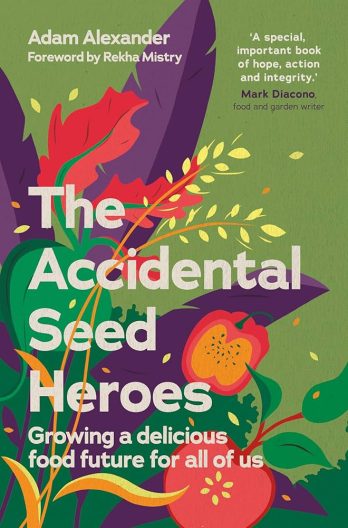 Many contemporary people and places already doing that work appear in this book. Each chapter describes challenges and successes relating to a different plant, mostly vegetables. Throughout Alexander argues against the planting of monocultures, which are particularly likely to be afflicted by disease, and against the practices of the giant seed companies that promote those monocultures and control new cultivars by patenting them.
In the chapter “A Future Full of Beans” the author follows the search for improved varieties of several kinds of beans – lima, fava, greasy, soy, navy. Local variants called Farmers’ Varieties lead the way, as they do in every chapter. He cites his own practice with greasy beans, traditionally grown in Appalachia. Due to climate change they now grow well in his garden in southern Wales.
Navy beans figure in climate change, too. To make Heinz baked beans in Britain, 52,000 tons of navy beans are imported every year to a single factory. It produces three million cans of baked beans every day. Brits do like their baked beans. Most of the imports are from one source, the U.S., which is worrisome. With climate change and perhaps development of new Farmers’ Varieties, navy beans may soon grow in Britain.
Look to other chapters, on wheat, peas, apples, eggplant, and other crops for many more tasty seed stories of hope for the future.
Reviewed by Priscilla Grundy
Excerpted from The Leaflet for Scholars, Volume 12, Issue 12, December 2025