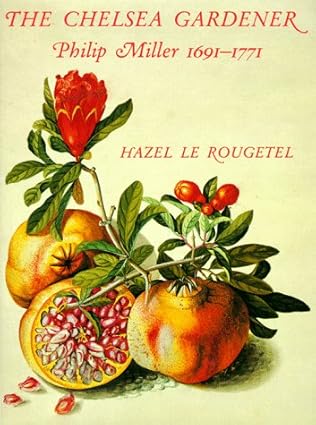
 “Philip Miller (1691-1771) was the most distinguished and influential British gardener of the eighteenth century.” This high praise is by Hazel Le Rougetel, the author of “The Chelsea Gardener,” a biography of Miller. She explains this admiration is “for his practical skill in horticulture and his wide botanical knowledge of cultivated plants.”
Miller’s father had a market gardening business near London and young Philip developing a liking for this occupation. At his father’s encouragement and financing, he traveled widely throughout England, Holland, and Flanders, learning the science, the literature, and the business of kitchen and ornamental gardening.
The Chelsea Physic Garden was established in the late 1600s, but it languished through several directors before Miller was hired in the position in 1722, a post he held for 48 years. During his tenure, Miller developed the Physic Garden into one of the most highly regarded botanic gardens in Europe. It is still a must-see for any gardener visiting London.
Much of that reputation was built on Miller’s publications, the most important being “The Gardener’s Dictionary,” first published in 1731. Based on methods established at the Physic Garden, it became an authoritative text in both Britain and America for the next one hundred years. Miller published eight editions during his lifetime, and it was translated into Dutch, German, and French.
This was a large book and could only be afforded by the wealthy, or for academic libraries. Miller recognized that the average gardener, who he came to know very well during his travels, could not afford it. To remedy this need, he published abridgements that still retained the practice and the plant specific information. The Miller Library has a facsimile of the 1771 abridgement.
Le Rougetel summarizes Miller’s accomplishments as a “coordinator of half a century’s discoveries and conclusions, became a counsellor for every cultivator of the day and stands as a prominent figure in the world’s history of gardening.”
Reviewed by: Brian Thompson on February 23, 2024
Excerpted from the Spring 2024 issue of the Arboretum Bulletin