College of the Environment | University of Washington Block W Logo
Library Home | Catalog | Calendar | College Home
VOLUME 9, ISSUE 4 | April 2022
Ask the Plant Answer Line: Which grasses tolerate salt?
Researched by Rebecca Alexander
Question: What ornamental grasses can I plant near salt water, and is there a local nursery that specializes in grasses?

Answer: As far as nursery sources, I think a full-service nursery is your best bet for finding ornamental grasses. The only “specialist” in grasses I could find is Walla Walla Nursery, which seems a long way from Seattle to go. King County’s interactive native plant guide also includes a page on marine (saltwater) shoreline plants. At the bottom of the page, note the three native grasses which are recommended:
  • Lyngbye’s sedge (Carex lyngbyei)
  • tufted hairgrass (Deschampsia cespitosa)
  • dunegrass (Elymus mollis)
cover imageAccording to the Minnesota Storm Water Manual and a ranked list (no longer available online) from the University of Minnesota Extension , there may be some ornamental grasses that will do well with salt exposure. Here are some to try:
  • Calamagrostis acutifolia ‘Karl Foerster’ (Karl Foerster reed grass): high tolerance
  • Schizachyrium scoparium (Little bluestem): high tolerance
  • Elymus arenarius (Blue Lyme grass): high tolerance
  • Pennisetum alopecuroides (Fountain Grass): high tolerance
  • Festuca ‘Elijah Blue’ ‘Elijah Blue’ fescue: moderate tolerance
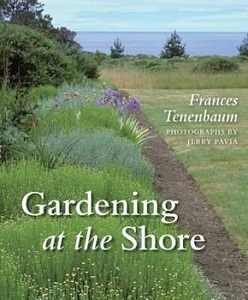
In her book Gardening at the Shore (Timber Press, 2006, pictured here), Frances Tenenbaum lists a number of ornamental grasses (in addition to dune grasses):
  • Festuca glauca
  • Miscanthus sinensis
  • Muhlenbergia capillaris
  • Stipa tenuissima [now renamed Nassella tenuissima–in my experience, this grass is aggressive, seeding itself everywhere; the seedheads stick to people and pets who walk past it]
There are many attractive cultivated varieties of some of the plants listed above, and most local nurseries will carry them.
Join us for the Pacific Northwest Botanical Artists exhibit, Riz Reyes book signing, and Garden Lovers' Book Sale
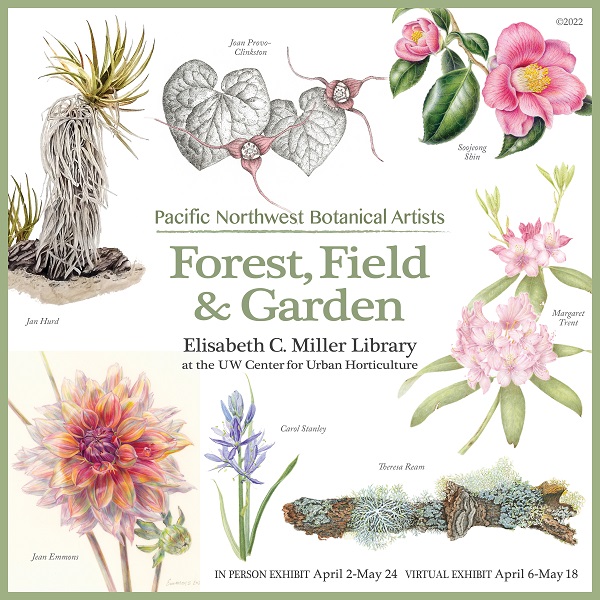
Forest, Field & Garden posterWe are excited to announce that the Pacific Northwest Botanical Artists are back at the Miller Library this month. Their exhibit Forest, Field & Garden will be offered in person and online. PNBA members from across the region are bringing exquisite work to this group show, and some artists will be present Friday, April 8, from 4 to 7 pm and Saturday, April 9, from 9 am to 3 pm.

The first Friday and Saturday of the show coincide with our Garden Lovers' Book Sale. This year's celebration of plant-related books and community includes a book signing and author appearance by Riz Reyes. He'll showcase his new book for young readers, Grow, which introduces the botany and superpowers of familiar plants, including apple, daffodil, aloe, and many more. New in our collection this month, the book includes hands-on projects kids can try at home, whether they have a backyard garden or not.
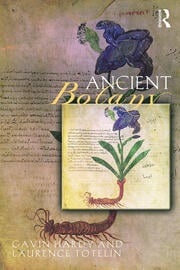
Ancient Botany by Gavin Hardy and Laurence Totelin
Reviewed by Priscilla Grundy
People in classical Greece and Rome knew a lot about botany. As Hardy and Totelin make clear, modern readers just need to adjust their understanding of botany to fit the lenses through which the ancients were looking.

This book plumbs the works of an amazing number of Greek and Roman authors for descriptions of and references to plants. Hardy and Totelin place this information in the social, economic and cultural context of the times the texts were written, using an impressive multidisciplinary approach.

Ancient Botany is organized into chapters on how ancient authors knew about plants (for instance, by reading previous authors, personal observations, and hearsay); how they understood the organization of the plant world; how they named and described plants; how they described a plant’s life cycle; and how they understood the connection between a plant and its location. Each chapter is clearly organized, well developed, and supported by copious attribution of sources.

Hardy and Totelin make clear throughout where there are problems with the sources. They note when a text uses an older text for its information, and where previous scholars have assigned a text to the wrong author.

They also note where ancient scholars warn readers about earlier authors’ incorrect information. In one example, Theophrastus, a major Greek source of plant information, notes that the idea that it is necessary to dig peonies at night to avoid being attacked by woodpeckers “seems ludicrous and far-fetched” (p. 45).

Ancient Botany includes brief discussion of modern controversies related to the study of botany. The text also includes many places where questions are still unanswered and more work needs to be done — helpful hints for Ph.D. candidates looking for dissertation topics.

Another helpful aspect of this book is how it connects ancient understanding to modern. For instance, some ancient texts include lichens and fungi in the plant world. Hardy and Totelin explain why modern science has removed them, partly because of our knowledge of chemistry the ancients did not have. The book makes a good case for the value of the ancients’ organization and description of plants, given the information available at the time.

For the ancients, plants were valued and described primarily for their practical value. These texts focus on the medical value of plants, their usefulness as food sources, and as sources of construction material and fuel. An example of this value is that the Romans were “fascinated (obsessed even)” (p. 134) by grafting to improve fruit production. Several authors use sexual analogy to describe the process, common anthropomorphizing in ancient writing about plants.

Of particular interest to ornamental gardeners, the section on Roman gardens describes serious competition among gardeners. The wealthy developed very elaborate gardens as symbols of their wealth and power. Pliny the Elder attacked these “useless” gardens because they produced no food and thus robbed the poor of the food that might have been grown there. Martial praised a farm for its focus on crops and animals. He wrote approvingly that it “Is not ordered with idle myrtle-groves,/Widowed plane trees, and clipped box-rows” (p. 165). Here he alludes to topiary art, reportedly perfected during the reign of Augustus Caesar.

Much intriguing detail can be mined from this book. It provides a convincing picture of how the Greeks and Romans understood the plant world. The reader can learn about what people knew then, where their knowledge differed from modern understanding, and where traces of that classical knowledge remain with us.

garden lovers' book sale

Friday, April 8, 4 - 7 pm & Saturday, April 9, 9 am - 3 pm
Thousands of gently used plant books for sale. Cash and checks preferred. The Pacific Northwest Botanical Artists will be showcasing their work. Also, Riz Reyes will launch his new book, Grow: A Family Guide to Plants and How to Grow Them.

Remaining book sale inventory will be available at discounted prices in the Library Program Room during our open hours April 11 - 30.

Digital resources
   UWBG pine cone logo
Cover of Common Insect and Mite Galls of the Pacific Northwest  Miller Library book and flower logo
New to the library
cover image    cover image    cover image
cover image     cover image    cover image
cover image    cover image     cover image
cover image    cover image    cover image
cover image    cover image
Donate to the Miller Library Fund    Miller_LibraryLogo293px.gif
  Facebook    Twitter    Instagram     Pinterest
Contact Us   |   Privacy   |   Terms
© 2022 University of Washington Botanic Gardens
This email was sent to {{lead.Email Address}}
Unsubscribe or change your email preferences
Forward this email to a friend