College of the Environment | University of Washington Block W Logo
Library Home | Catalog | Calendar | College Home
VOLUME 6, ISSUE 8 | August 2019
From the Plant Answer Line: what are these red bumps?
a question from library volunteer Kylie Snyder
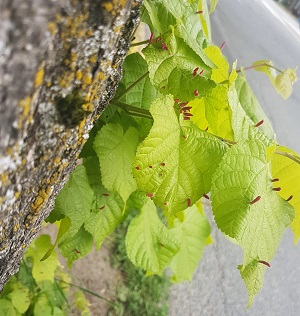
Tilia gall photo by Kylie SnyderQ: On my walk this morning, I saw bizarre lipstick-red protrusions on leaves near the bottom of the tree, where bright green new shoots had sprouted. The tree had kind of sticky heart-shaped leaves, some of them about the size of the palm of my hand. Are these insects? A fungus or disease?

A: Your photos show new growth on a linden tree, possibly large-leaved linden (Tilia platyphyllos). The red things are called nail galls (Eriophyaes tilia) and they are caused by the red nail gall mite.

According to Margaret Redfern's book Plant Galls, this type of gall (in the form of a pouch) is "initiated in the spring by the fundatrices, females that have overwintered in cracks and crevices in the bark or under the scales of dormant buds." The mite will wander over a new leaf's underside and feed on individual cells which then collapse and die. The leaf domes up into a pointed pouch around that area. When the pouch is partly formed, the female mite lays her eggs inside it. The larvae hatch and feed there. Tilia nail galls have a thick nutritive layer, and each gall can contain 100-200 mites by summer. In fall, they disperse and overwinter.

Tools for finding historical sources online
Researched by Jessica Moskowitz
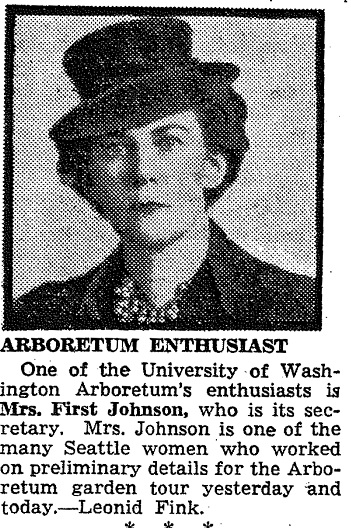
newspaper clipping image
I was recently handed a large stack of newspaper clippings from the 1930s about the beginnings of the Washington Park Arboretum in Seattle. The photocopies lacked specific dates and I wanted to find the original sources. Did you know that there are indexes to newspapers going back to the 1850s? You can find old newspapers by date or keyword using premium online databases through the UW Libraries subscription.

On your computer, head to the UW Libraries research guides and click on News. At the bottom of the page you will see Starting Points for Historical News. The Seattle Times index ranges from 1900 to 1984 and the New York Times spans 1851-2009. These historical newspapers are rich with information. You can search by keywords, date, or phrase. From the research guide, you can click on Seattle Times and you will enter into the Newsbank database.

By searching online in the database, I found the dates that correspond to the newspaper clippings, making them available for our archive housed at the Miller Library that contains the rich history of the Washington Park Arboretum for future researchers to access.

Here is the link to the LibGuide for your reference: http://guides.lib.uw.edu/research/news.

Keep in mind that UW database access is restricted to UW students, faculty, and staff. Seattle residents without UW connections can access the database through the Seattle Public Library at https://www.spl.org/online-resources/magazines-and-newspapers.
This View of Life by Sandra Schulze
in the library August 2-29

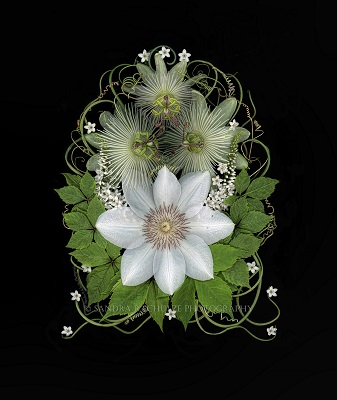
Sandra Schulze passionflowers and clematisSandra Schulze teaches Biology at Western Washington University, and in her spare time likes to scan flowers and foliage to create images reminiscent of the 17th century Dutch floral art masters and mistresses. Flatbed scanners have the capacity to produce images at astonishingly high resolution, revealing details on an almost microscopic level. Her images range from a baroque excess of detail to dizzying plunges into minimalism. All her work recalls the awe expressed by Charles Darwin in the last statement from the Origin of Species: “There is grandeur in this view of life…from so simple a beginning endless forms, most beautiful and most wonderful, have been, and are being, evolved.”

Follow Sandra on Facebook, Instagram, and Fine Art America:
https://www.facebook.com/SandraRSchulzePhotography/
https://www.instagram.com/sandra_r_schulze_photography/
https://fineartamerica.com/profiles/sandra-schulze.html
plant answer line
The Miller Library's Plant Answer Line provides quick answers to gardening questions.
You can reach the reference librarians at 206-UWPLANT (206-897-5268),
hortlib@uw.edu, or from our website.
New to the library
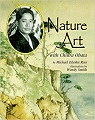
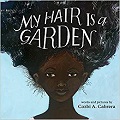
cover image   cover image    cover image
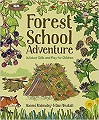
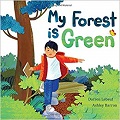
cover image      cover image    cover image    cover image
cover image    cover image    cover image
cover image

Donate to the Miller Library Fund    Miller_LibraryLogo293px.gif
  Facebook    Twitter    Instagram     Pinterest
Contact Us   |   Privacy   |   Terms
© 2019 University of Washington Botanic Gardens