Skip to content

The Backyard Bird Chronicles

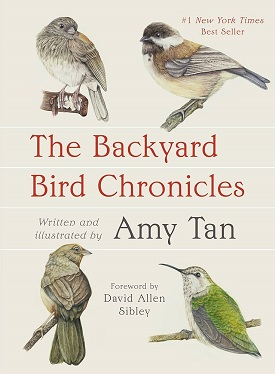
The Backyard Bird Chronicles is a winsome account of six years in Amy Tan’s obsession (her word) with the birds behind her house. Mostly she stays indoors, watching the action in her yard. She describes what she sees each day (not all days are included) and sketches bird portraits for each entry. Yes, Tan the best-selling novelist has learned to create attractive art as well as lively avian episodes. She first took drawing lessons at age 64 (now she is 72) and has here produced some accurate and attractive bird portraits.

She convinced a hummingbird to drink from a tiny feeder she held in her hand. As someone excited to see a hummingbird hover just once over my apartment window box geraniums, I’m awed – and a little jealous.

Tan chronicles the many tactics she uses to attract birds to her yard – the bird houses, perches, and especially the feeders. Finding something the squirrels could not figure out took many tries. What foods work best was also a challenge, and discovering that some birds eat only on the ground added complications.

Tan’s entries often describe an encounter and then ask questions about it, often questions she does not or cannot answer. Her entry for October 29, 2019 begins with a quotation from the Cornell Lab of Ornithology: “Hermit Thrushes rarely visit backyards and generally do not visit feeders” (p. 89). Then she tells how a Hermit Thrush spent three and a half hours trying to find a way into three of her feeders. It kept trying even when the same food was easily available in a flowerpot on the ground below the feeder. Tan then asks five questions about why the bird acted this way. For example, was it young? Migrating? Just curious? She ends by deciding that Hermit Thrushes are not shy, but “solitary nonconformists.”

The May 6, 2019 entry describes an Oak Titmouse encountering live mealworms where it was expecting to find suet balls. The three drawings show stages of the bird’s bafflement and eventual acceptance, each with an imagined bird comment in a cartoon balloon: “What?! No suet balls? It’s alive!” “The food keeps moving.” And eventually, when it accepts the mealworm, “What are you looking at?” Then Tan reports the bird ate many mealworms and carried many more back to the nest.

Tan says her obsession with birds has some similarities to her work as a writer: She regards herself as an observer who asks questions about the lives, deaths, and surroundings of what she sees. Add that to her success in attracting dozens of birds to her backyard, and this book emerges in full feather.

Reviewed by Priscilla Grundy in The Leaflet, Volume 11, Issue 10, October 2024

In Search of Meadowlarks: Birds, Farms, and Food in Harmony with the Land

[In Search of Meadowlarks] cover

Professor Marzluff sets the scene for his exploration by camping in a cornfield in Illinois to survey birds. After an early morning walk he reports: “It takes me an hour and a half before I hear my first meadowlark—an eastern—belting forth a high-pitched, if simple tingaling from an abandoned grassy field.” After 3 hours he counts only 6 meadowlarks, the lowest count ever on that stretch of road. In North America, in fact, “the estimated population [of meadowlarks] has decreased by 71 percent since 1966.” Yikes! The reasons for the decline are complex, from habitat loss to decrease of prey insects due to pesticides. In Search of Meadowlarks: Birds, Farms, and Food in Harmony with the Land covers case studies and field trips to farms, vineyards and ranches from Montana to Costa Rica and Washington to California in order to discover which agricultural practices sustain birds.

What more can farmers do to help the environment than just avoiding pesticides? I’ve never thought about how farms could provide habitat to wildlife and support birds. I assumed wildlife conservation was something that happened in wilderness areas or abandoned fields. Marzluff points out that creatures also inhabit farms and ranches, albeit in declining numbers. Pasture and fallow fields can resemble natural grasslands while hedges resemble forest edges. Regenerative agriculture is a new buzzword to describe practices on farms and ranches that might build soil health, sequester carbon, prevent storm water pollution or support wildlife. The regenerative practices must also produce food and be economically sustainable. That last part is tricky, but the example farms that Marzluff visits have managed to make it work.

One simple example employed by California vineyard Tres Sabores involved installing bird boxes to house nesting owls. Research shows an owl family consumes more than a thousand rodents over a summer. This saves vineyard managers considerable time and money controlling grape-damaging voles, rats and gophers. Another example that surprised me was how tightly-controlled cattle grazing in Montana improved river ecosystems. Cows eat invasive grasses and compact the ground to allow vernal pools to last longer into early summer, providing habitat to amphibians.

Marzluff explores how some farmers spare land on the margins to support wildlife while others embrace sharing the land, by delaying pasture mowing, for example, to allow birds to fledge their young. The book concludes with a hopeful chapter on actions consumers and policy makers should take to assist the farmers who provide for birds.

In an ideal world, farms and ranches practicing sharing and sparing methods would form networked corridors to wild lands to boost biodiversity and reduce the risk of localized extinction. Readers wanting to dig deeper into the scholarly background of themes revealed in this book should also read Nature’s Matrix: Linking Agriculture, Conservation and Food Sovereignty by Ivette Perfecto, John Vandermeer and Angus Wright (2009). In Search of Meadowlarks is enjoyable reading for anyone interested in wildlife conservation or regenerative agriculture.

Published in the Leaflet for Scholars, August 2020, Vol. 7, Issue 8.


Garden Tip #117

As spring returns, so do migrating birds. If you would like to see and hear more birds read Attracting Birds to your Backyard: 536 Ways to Turn Your Yard and Garden into a Haven for Your Favorite Birds by Sally Roth (Rodale, 1998). Roth suggests providing nesting birds with extra supplies, such as yarn, pet hair, dried grass and straw. Watch robins and other birds choose their favorite nest building items.

Identify the birds around your neighborhood with help from Chris Fisher, author of Birds of Seattle and Puget Sound (Lone Pine, 1996).

Birds of the Pacific Northwest

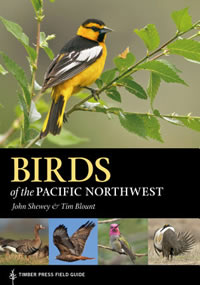
Birds of the Pacific Northwest book cover The popularity of birding in our region sparked the release of two new birding books with nearly identical titles by major regional publishers. “Birds of the Pacific Northwest: A Photographic Guide” by Tom Aversa, Richard Cannings, and Hal Opperman was published in 2016 by the Seattle Audubon Society and the University of Washington Press. In 2017, Timber Press continued their Field Guide series with this book, “Birds of the Pacific Northwest,” by John Shewey and Tim Blount.
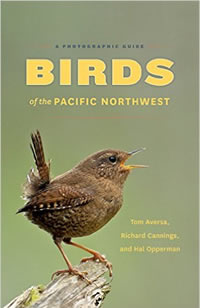
Confusing? Yes, and as a minimal birder, I don’t feel qualified to make a recommendation between the two, especially as to my eye there are more similarities than differences. If you are serious about identifying the birds in your garden or on your local travels, you clearly need both books!

The photography is one of the outstanding features of both, and the photos capture a very wide range of species, often with multiple images to show variation in sexes, juveniles, breeding plumage, and other color forms. Throughout there is help with identification between near look-alikes, and the authors address behaviors, bird songs, specifics on where to find rarer birds, and conservation status.

The Timber Press book includes helpful and practical introductions to most species. For example, in discussing the American Crow (Corvus brachyrhynchos) and the Northwestern Crow (C. caurinus) the authors conclude “… they are indistinguishable” and if you want to add the latter to your life list, going to the right location “…is the safe bet.” While on the large size for taking into the field, this book’s heavy cover will help protect it from the weather.

Excerpted from the Fall 2017 Arboretum Bulletin.

Birds of the Pacific Northwest : a photographic guide

Birds of the Pacific Northwest book cover The popularity of birding in our region sparked the release of two new birding books with nearly identical titles by major regional publishers. This book was published in 2016 by the Seattle Audubon Society and the University of Washington Press. In 2017, Timber Press continued their Field Guide series with “Birds of the Pacific Northwest,” by John Shewey and Tim Blount.
Confusing? Yes, and as a minimal birder, I don’t feel qualified to make a recommendation between the two, especially as to my eye there are more similarities than differences. If you are serious about identifying the birds in your garden or on your local travels, you clearly need both books!

The photography is one of the outstanding features of both, and the photos capture a very wide range of species, often with multiple images to show variation in sexes, juveniles, breeding plumage, and other color forms. Throughout there is help with identification between near look-alikes, and the authors address behaviors, bird songs, specifics on where to find rarer birds, and conservation status.

The Audubon book includes an excellent essay on the climate, geology, and ecology of different sub-regions, especially as it pertains to the birds found there. It covers a bigger area, extending the region eastward to the continental divide. I like that each photograph includes both the location by county and the month taken.

Excerpted from the Fall 2017 Arboretum Bulletin.

Urban Roosts: Where Birds Nest in the City

Urban Roosts: Where Birds Nest in the City cover

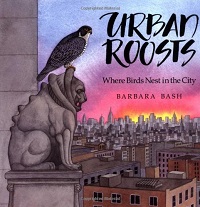
After you read this book to a child, go for a walk in the urban landscape and ask, “Where could birds roost?” Children will be eager to look up and around for the kinds of nesting spots described and pictured in Urban Roosts. Barbara Bash has chosen a dozen species and multiple city sites to tell how pigeons, finches, crows, and falcons have adapted to the city, finding tiny but sheltering niches to call home. The colors are soft, mainly pastels, and the bird sketches clearly identifiable. Although this is aimed at the picture book set, adults may find themselves searching for city nests, too, after sharing this book with a child.

Published in the July 2017 Leaflet Volume 4, Issue 7.

Look Up! Bird Watching in Your Own Backyard

Look Up!: Bird Watching in Your Own Backyard cover

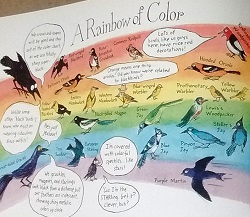
This looks like a comic book with bird commentary, but it packs a barrelful of information for budding bird watchers. Annette LeBlanc Cate lures young readers with wisecracking robins and sparrows (and people). In the page on A Rainbow of Color, for instance, the European starling explains, “I’m covered with colorful speckles . . . like stars. ‘Cuz I’m a STARling. Get it?” Her goal is to encourage young readers to watch carefully, to see details, and to place birds in context. She also urges sketching birds as a way to increase focus and create a personal record. Cate begins the book by saying you don’t really need equipment to begin bird watching, and if you want binoculars, they needn’t be costly. By mid-book, she suggests it’s time for a field guide, and she lists several in the bibliography. So she moves the reader from a boy saying that bird watching “Looks kinda boring” to several pages on rather scientific bird classification at the end. The reader (of any age) who follows the book all the way through will have a solid start on the enjoyment of birding. And if you never go beyond reading the book, you will still have had a good time.

Published in the July 2017 Leaflet Volume 4, Issue 7.

Creating Your Own Healthy Habitat

Chapter 3, Audubon At Home in Seattle : Gardening for Life by National Audubon Society and the Seattle Audubon Society (2003). This chapter focuses on how to design a garden that will attract birds. It also includes a plant list.

Washington Ornithological Society

“The Washington Ornithological Society was chartered in 1988 to increase knowledge of the birds of Washington and to enhance communication among all persons interested in those birds.”