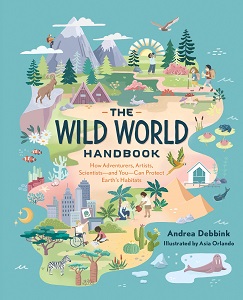
The Wild World Handbook offers something special for all ages, though it’s aimed at ages 8-12. Part biography, part nature guide, part workbook, it’s a visually appealing book you’ll want to dip into over and over.
The nine chapters each feature a particular habitat: mountains, forests, deserts, polar regions, oceans, freshwater, cities, rainforests, and grasslands. For each ecosystem there are two adventurers, scientists, or artists featured, some more familiar than others. George Washington Carver, Frederick Law Olmsted, and Wangari Maathai are among the better-known people featured. The diverse group includes Robin Wall Kimmerer, Almir Narayamoga Suruí, Margaret Murie, Rue Mapp, and many others whose work may be new to readers. Each chapter features conservation success stories, field trips, and do-it-yourself projects, including stewardship ideas and gardening tips.
At a time when hope is more vital than ever, this book reminds us that anyone can do something to help conserve habitats. Check it out!
Published in the Leaflet, Volume 9, Issue 1, January 2022
“This Thornton Creek Watershed Characterization Report presents background information about the Thornton Creek watershed. It is the first step in developing a Watershed Action Plan that will guide actions by government agencies, citizens and businesses to: reduce non-point source pollution; protect biological resources; preserve, enhance and restore fish and wildlife habitat.”
“Plant Talk was founded in 1995 and was designed as an independent voice to help and support all those fortunate people who work in the conservation of plants; either professionally or as amateurs.”
“Audubon’s mission is to conserve and restore natural ecosystems, focusing on birds, other wildlife, and their habitats for the benefit of humanity and the earth’s biological diversity.”
“Weeds Gone Wild: Alien Plant Invaders of Natural Areas is a web-based project of the Plant Conservation Alliance’s Alien Plant Working Group, that provides information for the general public, land managers, researchers, and others on the serious threat and impacts of invasive alien (exotic, non-native) plants to the native flora, fauna, and natural ecosystems of the United States.”
The National Wetlands Research Center (NWRC) “is a source and clearinghouse of science information about wetlands in the United States and the world for fellow agencies, private entities, academia, and the public at large.” The site contains technical reports and species profiles, as well as: a Habitat Suitability Index Models Series and a Waterfowl Management Handbook produced by the U.S. Fish and Wildlife Service.
from the World Wildlife Fund. A collection of biodiversity data from 26 major habitat types.
Rare Care Plant Conservation Program is dedicated to conserving Washington’s native rare plants through methods including ex situ conservation, rare plant monitoring, reintroduction, and education.