Skip to content

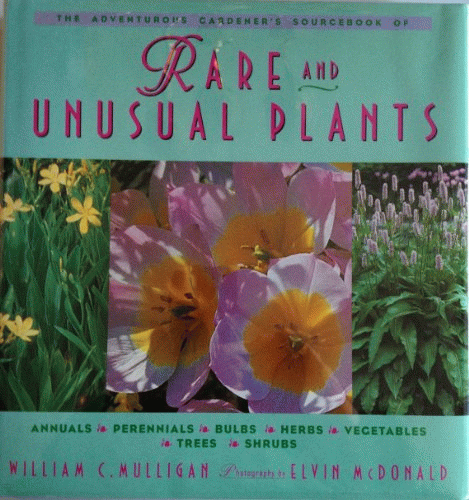
The Adventurous Gardener’s Sourcebook of Rare and Unusual Plants

Elvin McDonald was a precocious horticulturist.  In order to learn more about growing gloxinias, he started what is now the Gesneriad Society and its journal “Gesneriads when he was only 14, while still working on his family’s farm in Oklahoma.  After studying opera performance at Mannes School of Music in New York City, he embarked on a long career in horticulture as a writer and a photographer.  He has authored or contributed to upwards of 100 books.
In a 1978 column of Plant Talk published in the Chicago Tribune, McDonald tells of an adventure with his friend William Mulligan, visiting orchid greenhouses.  Mulligan was also an accomplished author of horticulture books, best known for his writing on lattices and trellises, and on prominent North American gardens.  In Mulligan’s 1995 obituary in the New York Times, after dying from complications of AIDS at age 52, he is described as being survived “by his companion and frequent writing collaborator, Elvin McDonald.”

Most notable of these collaborations is “The Adventurous Gardener’s Sourcebook of Rare and Unusual Plants,” written by Mulligan with photographs by McDonald and published in 1992.  One of the treasures of my personal library is a copy of this book inscribed by both men.

As the title promises, this book is a source for both viewing and purchasing remarkable plants.  Unfortunately, 30 years later, these resources are often out of date, but this is still a book I recommend.

Why?  For the many great ideas of new plants to try!  While some have become commonplace in subsequent years, many have not and are worth seeking out.  Mulligan addresses any concerns you might have about this habit.  “By only pursuing esoteric species is the adventurous gardener a snob?  Not at all.  Just curious, opinionated, and appreciative of details.”

McDonald was profiled in the March/April 2022 issue of “The American Gardener” by Kelly D. Norris.  Now 85, he has continued an active career in horticulture, including work that was instrumental in the development of the Greater Des Moines Botanical Garden in Iowa, where he lives with his husband, John Zickefoose.


Excerpted from Brian Thompson’s article in the Fall 2022 issue of the Arboretum Bulletin


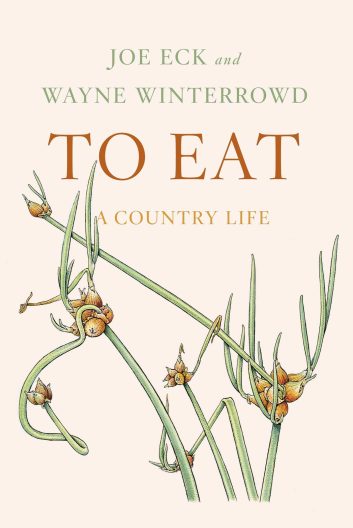
To Eat: A Country Life

Joe Eck and Wayne Winterrowd shared over 40 years together, most of it at a home they called North Hill in Readsboro, Vermont.  This is a long time for any couple, but especially noteworthy for gay men.  Their garden inspired many books, written by each singly or by both.  The Miller Library has eight of their titles on subjects that include annuals, tender perennials, roses, and garden design.   Winterrowd’s “Annuals for Connoisseurs” (1992) is one of my personal favorites.

Eck and Winterrowd met in a gay nightclub in Boston during the late 1960s.  Often such encounters are brief, but they spent much of the night talking together and walking the Boston Common.  They never parted.  Eager for a rural life, they found their Vermont home a few years later, initially making their living as school teachers before transitioning to full-time garden designers and authors.

Most of their books celebrate the many aspects of their life together at North Hill, including raising a son.  Their final book, “To Eat: A Country Life” was started jointly in 2010, but after Winterrowd died suddenly that fall, Eck was left to finish it alone.  The book was published in 2013.  The men shared many passions, but eating had “always been central.”

Bobbi Angell, a noted botanical artist who lived near North Hill, provided the illustrations for “To Eat.”  She also has an essay in the book about a lunch with the couple shortly before Winterrowd’s death.  In a conversation musing about their place in rural Vermont, she concludes: “Wayne and Joe’s life–their plants, their friends, their stories–came from around the world, city and country alike.”

Excerpted from Brian Thompson’s article in the Fall 2022 issue of the Arboretum Bulletin

Specialty Gardens

Theodore (Ted) James, Jr. (as writer) and Harry Haralambou (as photographer) were prolific producers of gardening books.  Beginning in 1985, they shared a home, dating from 1740, and a garden in Peconic, New York at the east end of Long Island.  Their garden was featured in several of their books, many available in the Miller Library. The best in my judgment being “Specialty Gardens.”

James was a writer on a wide range of topics, including for the travel section of the New York Times and comedy material for theater and cabarets.  His October 2006 obituary in the Times described him as having “a colorful life.  His career took him all over the world.  He loved people, parties and telling stories.”

The writing in “Specialty Gardens” showcases this latter skill, weaving fascinating tales of gardens and gardeners from around the world, always complimented by Haralambou’s photographs.  James had a keen insight to the fanaticism of a special-interest gardener, and encourages the reader to consider joining their ranks.  “Perhaps one of these will interest you, then preoccupy you, and then even addict and possess you.  But not to worry, for gardening is a healthy, relatively inexpensive and rewarding pastime.”

A graduate of Princeton University in 1957, the obituary for James in the Princeton Alumni Weekly referred to his life-partner Harry Haralambou.  “His dear friend Harry was his partner to the end. The class sends its sympathy to all those who knew this gentle man.”  After his partner’s death, Haralambou published his first solo book in 2007, “North Fork Living,” about the community where he and James lived.


Excerpted from Brian Thompson’s article in the Fall 2022 issue of the Arboretum Bulletin

Stories from the Leopold Shack: Sand County Revisited

Even if you have never read A Sand County Almanac by the famous conservationist Aldo Leopold, you will enjoy and learn from this memoir by his youngest child.
In the first half of the book, Estella Leopold recounts the family acquisition of Wisconsin farmland, long abandoned, and the remodeling of a decaying barn on the site, so it could be used as a shelter on weekends. They named the barn The Shack.
Aldo Leopold developed the idea of ecological restoration. On his property he wanted to restore the soil and bring back the plants native to the area. The whole family, including the five children, worked on that project, beginning in 1936. Estella describes how her dad filed a sharp edge on the shovels each day before they all dug holes and planted hundreds of pine trees. For this and many other tasks, she makes it sound like they all had fun.
In chapters on each season of the year, the author combines these work activities with experiences with nature they all enjoyed. She tells of skating on the frozen river and seeing a muskrat swimming along under the ice with her. She recounts the many hours she savored being alone in the woods, and the times the children hid to watch the woodcock courtship dance. Aldo Leopold was a professor at the University of Wisconsin in Madison. The Shack was just a few hours from the family home, so the family could visit regularly and invite friends. These had to be tolerant friends, as amenities at the Shack were few. Water came from a hand pump outdoors. The outhouse earned the majestic name “The Parthenon.” Estella describes many nights of singing and guitar playing, with much Spanish music from her mother’s past.
Aldo Leopold set out to restore the prairie to its state before the land was plowed for farming in the mid-1800s. One springtime activity to that end was transplanting wildflowers (springtime because they had to be in bloom to be identified). Sources were unmown places along railroad tracks and country roads, and even private property that had been left unplowed. The family dug up, transported in a tub by car, and planted in their old cornfield prairie grasses and many perennial wildflowers.
In Chapter 7 the author describes the ecological restoration as well as the glacial history of the property. The parents and some of the children learned and recorded the Latin names of all the plants on the property, including the wildflowers they transplanted. The Leopolds had personal relationships with some plants. A few non-natives, like a lilac bush, were allowed near the Shack, because Mother (also named Estella) loved them. Natives they loved included wahoo, serviceberry, trillium, and aspen. Others they were proud to collect and see thrive: turkeyfoot, Indian grass, switchgrass, prairie phlox, and purple coneflower.
Concerned that a fire might wipe out all their planting, Aldo devised a system of protective fire lanes. The family, with helpers, laid tin sheets and supervised the flames with water buckets. Then they noticed that the prairie grasses grew better where they had burned. Years later they adopted the current practice of regular burning.
Chapter 8 recounts the “Continuing Process of Restoration” after Aldo’s death in 1948. He had acquired about 350 acres. Another 1500 acres have been added to what is now the Aldo Leopold Memorial Reserve. Several other Wisconsin prairies have been restored. There is an active study center on the property, and the Aldo Leopold Foundation now meets in the LEED-certified Leopold Center.
Each of the five Leopold children followed in their father’s footsteps by creating a Shack-like project in whatever state they lived. Estella’s work in Colorado led to the establishment of the Florissant Fossil Beds National Monument. She is now a professor of botany emerita here at the University of Washington.
The federal government recently announced plans to plant a billion trees to counteract global warming. It’s fun to think it all may have started with the Leopold family laboring over pine seedlings in the 1930s.
Reviewed by Priscilla Grundy for the Leaflet, September 2022, Vol. 9, Issue 9

The Crevice Garden: How To Make The Perfect Home For Plants From Rocky Places

In May 2022, I visited the Denver Botanic Gardens.  After I tore myself away from the array of tall bearded iris at the peak of bloom, I found nearby different renditions of the traditional rock garden.  The rocks were not the smooth, roundish boulders but instead craggy slates, positioned vertically and close together, with only a limited cracks for the plants.

This was my introduction crevice gardening.  This design expands the plant palette for gardeners in the dry, high altitude of the Rockies, but also in our own cool Mediterranean climate, by providing protection from wet winters that kill many plants.

It is appropriate that the new, and almost only, book on this topic – “The Crevice Garden” – has two authors that represent these climate extremes.  Kenton Seth is from western Colorado.  Paul Spriggs understands the needs of Seattle area gardeners from his crevice garden in Victoria, B.C.  Both have careers as gardeners, and discovered their passion for alpine plants in part through backpacking and mountain climbing.

A crevice garden has more rocks than a traditional rock garden, covering at least half of the surface and typically raised to resemble an outcropping of rock.  This keeps the plant tops and roots widely separated and in conditions they both prefer.  The roots need the deep run with dependable moisture and even temperatures.  The leaves and flowers stay dry and free of excessive moisture.

How do you do it?  The design process is somewhat complex, but a detailed guide will take you through each step, from calculating how much of each material (rock, soil, dressing) to design and garden placement.  And yes, planting!  Some 250 plants are recommended, many new to me, but all sound intriguing.  Most important is a location where you can watch your (often tiny) treasures from close by.

Several case studies display beautiful examples, including the garden at Far Reaches Farm in Port Townsend, Washington, appropriately titled “alpines in wet winters.”  The authors appreciate that “gardening continues to be our most common connection to nature” and hope readers will embrace crevices to explore plants previously only available to keen specialists.


Reviewed by Brian Thompson for Garden Notes: Northwest Horticultural Society, Fall 2022

The Beginner’s Guide to Growing Great Vegetables

Not just for beginners, Lorene Edwards Forkner’s latest vegetable gardening book is chock full of good advice for all gardeners. If you are a beginner, I suggest reading the opening chapter, “Gardening 101.” For everyone, the chapter entitled “Garden Planning” will help you decide what type and especially how much food growing is realistic for you, including options if you do not have garden space. Like ornamental plants? These are encouraged for edible fruits or flowers, or to attract beneficial insects to protect or pollinate your food crops.The book’s core is a month-by-month calendar showing both the planning and the doing for the time of year, including seasonal essays. For example, September is the time to plan for your fall and winter garden, planting cover crops and saving seeds. October is about cleaning and feeding the garden for the future, especially after the first frost, and creating or enhancing your process for making home compost.Forkner encourages experimentation and keeping a journal of the results. She happily shares her personal experiences, good and bad. “Over the years I’ve experimented with sowing ornamental corn, winter wheat, and fancy French melons. Ultimately, I decided that homegrown popping corn is highly overrated, and my cat took up napping in the middle of my ‘wheat field.'” She concludes that the two tiny Charentais melons her efforts produced “were absolutely delicious–well worth the time and garden space they occupied all summer.”While similar in some ways to her 2012 publication The Timber Press Guide to Vegetable Gardening in the Pacific Northwest, this book incorporates nine more years of Forkner’s experience. Check it out!

Reviewed by Brian Thompson for the Leaflet for Scholars, August 2022, Volume 9, Issue 8.Editor’s note: A longer version of Brian’s review was originally published in the Autumn 2021 issue of Northwest Horticultural Society’s Garden Notes.

The Great British Tree Biography

Read this book to have fun with tales, myths, legends, and historical facts about British trees. Mark Hooper says the book aims “to explore the space where social history meets natural history” (p. 9). Along the way he ties events familiar and unfamiliar to many individual trees.
The first short section consists of superstitions and symbolism associated with various types of trees. The birch, for instance, is associated with witchcraft, apparently because household brooms were made of birch twigs bundled with a handle of hazel or hawthorn. Brooms, witches – they go together.
The main body of the book is “An A-Z of British Trees,” one- or two-page accounts of fifty individual (or sometimes multiple) trees in England, Wales, Scotland, or Northern Ireland. Most are English. Many of the trees are very long-lived. The Ankerwycke Yew has survived since King John signed the Magna Carta in 1215, supposedly under its branches. Later Henry VIII is rumored to have courted Anne Boleyn in the same spot. 
Lest you think these associations are all from long ago, the Bolan Tree, “an unprepossessing sycamore” (p, 42) in London, was the site of a 1977 car crash that killed T. Rex lead singer Marc Bolan when his car collided with it. A statue and a plaque serve as a memorial.
Of the fifty entries on trees, 19 are oaks and nine are yews. Some individual trees are identifiable; some are not. In “The Knole Oak and the Strawberry Fields Tree,” an oak on the Knole estate in Kent can only be described as a likely candidate for the oak featured in Virginia Woolf’s Orlando. But definitely known is the specific oak on the same estate used in a promotional video for the Beatles’ “Strawberry Fields.”
Some entries include multiple trees. The account “The ‘Trees to Remain’” explains the many curves in the A303 highway by way of a 1969 hand drawn plan for a bypass marked “trees to remain.” The builders just had to bend the highway around the trees. No species names are given.
These sample summaries are enough to whet the reader’s appetite. Amy Grimes has illustrated the tales with impressionistic art in saturated hues, adding to the liveliness of these stories.
Reviewed by Priscilla Grundy for The Leaflet, August 2022, Volume 9, Issue 8.

Spring and Summer Wildflowers of the Northeast, two books

cover image“This book is written for all who share an interest in wildflowers.” Carol Gracie writes this statement in the preface for each of her two books: Spring Wildflowers of the Northeast (published in 2012) and Summer Wildflowers of the Northeast (published in 2020), both with the subtitle “A Natural History.”
 
This subtitle is key, because these are not typical field guides. Instead, they are collections of both charming and rigorous essays about key plant groups in the northeastern United States and adjacent parts of Canada. They are a bit large for a backpack, but instead best for reading at home after seeing the plants in the wild. Unlike most guides, these are very enjoyable to read cover-to-cover.
Of course, most readers of the Leaflet do not live in the Northeast, but I still recommend these books. The selected genera or plant families often have northwestern representatives and the Gracie refers to these to compare similar natural histories.
 
The author has another stated purpose. “I’m certain that as you become more familiar with the natural history of wildflowers, you will want to become an advocate for their protection and conservation. Many of our once common wildflowers are now rare for many reasons.”
cover imageThese books are also beautiful, with photographs (by the author) that are both artful and well-chosen to enhance the surrounding text. Further research is encouraged by an impressive appendix of references.
Best of all, Gracie was a wonderful story-teller and these books will increase your love of wildflowers, their pollinators and other animal associates, and your appreciation of the impact on human medicine, gardening, and lore. Sadly, these are the last such books by this author as she died in the fall of 2021. It is a fitting tribute to her memory that in 2022 “Summer Wildflowers” won an Award of Excellence for Natural History and Field Guides from the Council on Botanical and Horticultural Libraries.


Reviewed by Brian Thompson for the Leaflet, July 2022, Volume 9, Issue 7.
,

Gilbert White

“The language of birds is very ancient, and, like other ancient modes of speech, very elliptical: little is said, but much is meant and understood.”

With this quotation from a letter by Gilbert White, Richard Mabey opened this biography when it was first published in 1986. It offers a nice glimpse into White’s ability to observe and understand nature.

This new edition, with a new foreword but the same opening quotation, brings back to print the man whose single volume, The Natural History of Selborne, helped revise the public view of nature. Published in 1789, Selborne arrived as the rational focus on a well-ordered universe was beginning to clash with Romanticism’s view of nature as wild and alternately terrifying and inspiring. White instead focused on careful and often affectionate observation of natural detail, placed carefully in the setting of an English village. The book marked the beginning of nature writing as we know it.

Gilbert White spent many years recording his observations around the rural village of Selborne in Hampshire. A graduate of Oxford, when that degree alone qualified him to be ordained as clergy, he spent his life in the village where he was born. Mabey records his occasional adventures farther afield in England, usually accompanied by “coach sickness.” He never left England. On a few occasions he acquired a short-term position as curate in a nearby parish, but whenever a permanent place was available, he made little effort to obtain it. He lived on a small inheritance, without paid employment, in the family house in Selborne.

Part of the pleasure of Mabey’s biography is his description, via White’s notes, of Selborne and its neighborhood. The dominating feature is a huge hill Mabey calls “a louring whaleback” that rises 300 feet above street level.

In 1788 the village had 686 inhabitants and was almost totally isolated from the surrounding countryside. White was fascinated by its “hollow lanes,” roads had had sunk below their surroundings due to centuries of wear on the chalk soil beneath them, sometimes by sixteen or eighteen feet. He wrote they “exhibit very grotesque and wild appearances” due to “tangled roots that are twisted among the strata” and from the “torrents rushing down,” especially when frozen. “These rugged gloomy scenes affright the ladies when they peep down into them from the paths above” and “make timid horsemen shudder” (p. 26).

White was also an enthusiastic gardener. He recorded his activities in what he called “The Gardener’s Kalendar.” ( The Garden Diary of Dr. Darwin, reviewed in the Leaflet in May describes a similar, later record by an English amateur gardener.) White planted and tended flowers, often in borders and climbing vines, but he mainly devoted himself to vegetables – more than forty varieties: “including artichokes, endives, mustard and cress, white broccoli, skirret and scorzoner [both root vegetables], marrow fat peas, ‘a remarkable long leek,’ squashes, cucumbers, all manner of lettuces,” plus onions He experimented with maize, wild rice, potatoes – even sea kale (p. 55). The Kalendar records it all.

In 1787, after much delay and prodding from friends and relatives to finish, White sent the first sections of The Natural History of Selborne to the printers He chose an epistolary form. Epistolary novels like Samuel Richardson’s Pamela were extremely popular in the 18th century. White used many letters he had written to friends, but he also created letters he had never sent, and he edited often, cutting some passages, moving parts of others so similar topics appeared together, and added new material. After a flurry of editing and proofreading, with help from friends, at last his book was published in 1789. It received positive reviews, but only in the 1830s, after White’s death, did its sales soar, and its fame make it the quintessential volume of English rural life.

White never married, but he regularly entertained friends and family, including multiple nieces and nephews. After Selborne’s publication he continued keeping his journal and welcoming visitors to his home until his death a few years later in 1793.

In this winsome account of a quiet life, Mabey shows how The Natural History of Selborne emerged from the ever-curious mind of White and the natural and intellectual world around him.

Reviewed by Priscilla Grundy for the Leaflet for Scholars, July 2022, Volume 9, Issue 7.

You Grow, Gurl!

Known to Instagram followers as an ‘influencer,’ Plant Kween grows over 200 houseplants (the ‘gurls’ of the book’s title) in a small Brooklyn apartment. Christopher Griffin dedicates this book to the grandmother whose love of plants and gardening made a strong impression on him at a tender age.

Written in a conversational style, and providing the expected horticultural details one might need to keep a plant alive indoors, there are many unexpected aspects to this book: it is the first houseplant book I’ve encountered that comes with a playlist! Griffin is the opposite of snobbish, not a seeker of the rarest of plants for their own sake. Plants that can thrive and whose beauty brings delight are the important thing.

While anthropomorphizing plants, Griffin also phytomorphizes humans: “We are basically houseplants with complex emotions.” Caring for plants is inextricably linked to caring for one’s own well-being. He reflects on the ways that we might judge ourselves as ‘not having a green thumb,’ and recounts an apocryphal tale about the term’s origins which puts things in perspective.  Griffin takes a forgiving and encouraging stance on gardening as an ongoing learning experience that is open to anyone.

As someone immune to the allure of Instagram who mainly grows plants outdoors, I was nevertheless charmed by this book’s ebullient enthusiasm for growing green ‘gurls.’ To quote the author, “This book is filled with that Black queer nonbinary femme plant parent joy!”