Northwest Perennial Alliance
“The Northwest Perennial Alliance (NPA) is one of the largest nonprofit gardening organizations in Washington. Their mission is to help gardeners learn more about perennials and horticulture in the Pacific Northwest.”
Northwest Horticultural Society
The NHS mission is “to provide a forum for gardeners and plant lovers in the Pacific Northwest to share their interests and learn about horticulture.” NHS features lectures, symposiums, workshops and classes, funding for horticultural education, plant sales, and garden visits.
Society for Ecological Restoration – Northwest
“The Society for Ecological Restoration – Northwest Chapter (SERNW), a private non-profit organization, is a dynamic interactive professional society dedicated to the art and science of restoration. Members of SERNW are actively protecting and restoring ecosystems throughout the Cascadia bioregion which includes Washington, Oregon, Montana, Idaho, Alaska and Northern California.”
Northwest Fuchsia Society
Rare Plant Care and Conservation
Rare Care Plant Conservation Program is dedicated to conserving Washington’s native rare plants through methods including ex situ conservation, rare plant monitoring, reintroduction, and education.
King County Iris Society
Reinventing the Chicken Coop
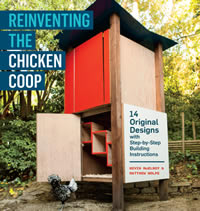 As a new graduate of the University of Washington’s Library and Information Science Master’s program, I began volunteering at the Miller Library in July 2011. I had some experience in academic libraries, and had worked as a student assistant in the UW’s Natural Sciences Library. After I began volunteering, I started reading and checking out several books on fruit and vegetable gardening. The books were great, and really helped me learn how to grow food.
I decided to add chickens to my urban garden, making it a small urban farm. One of the best books that helped me prepare for my chickens was “Reinventing the Chicken Coop” by Kevin McElroy and Matthew Wolpe. The book contains 14 coop designs. It covers chicken coop essentials including space requirements, roosts, ventilation, and nesting boxes. This information was very helpful to me as I was learning what it would take to keep chickens in my yard. In the Coop-Building Basics chapter the authors explained, “One of our goals for this book was to keep things simple, using ordinary shop tools and building with similar materials and repeatable processes as much as possible” (p. 21). In the end, my husband and I built our coop using their design, SYM, which is “much more than a chicken coop; it’s a symbiotic urban farming system” (p. 106). This was exactly what we needed. The step by step instructions were easy to follow and it didn’t take too long to build this simple yet stable coop for our new flock. “Reinventing the Chicken Coop” is a great resource for building chicken houses with ease and low cost. Most pre-built coops cost twice as much as the materials used for building your own coop. I enjoyed the collection of contemporary designs and my chickens love their little home in my city backyard.
Now, I am a librarian at the Miller Library, with two years of experience in chicken husbandry and a growing knowledge of year-round vegetable and fruit gardening. I take pleasure in being knowledgeable on these subjects and plan to continue learning, expanding my understanding of urban farming.
Published in the November 2015 Leaflet Volume 2, Issue 11.
Checklist of Online Vegetation and Plant Distribution Maps
This site organizes links to maps by continent, and then by country or region.
Botanical Explorations in the United States and Canada [Bibliography]
A professor emeritus whose research specialty is botany in North America recommends a series of technical sources relating to North American sites.