“The IUCN Red List of Threatened Species provides taxonomic, conservation status and distribution information on taxa that have been globally evaluated using the IUCN Red List Categories and Criteria. This system is designed to determine the relative risk of extinction, and the main purpose of the IUCN Red List is to catalogue and highlight those taxa that are facing a higher risk of global extinction (i.e. those listed as Critically Endangered, Endangered and Vulnerable).” Records include classification, assessment information, geographic distribution, summary documentation, detailed documentation and data sources. Advanced searching allows for limiting by region, country, marine region, or biome. Records do not contain images, but the site does refer visitors to a list of links organized by organism (i.e. mammals, fish, birds, plants).
Integrated Taxonomic Information System
An easy to use database for discovering and viewing the complete taxonomy of any given plant or animal in a hierarchical format.
International Plant Names Index
“The International Plant Names Index (IPNI) is a database of the names and associated basic bibliographical details of all seed plants. Its goal is to eliminate the need for repeated reference to primary sources for basic bibliographic information about plant names. The data are freely available and are gradually being standardized and checked.”
Gymnosperm Database
“The Database provides basic information on the classification, description, ecology and uses for all species and higher-ranked taxa of the gymnosperms, i.e., conifers, cycads, and their allies. You enter the taxonomic tree at the Family level and then navigate to the Genus, Species or sometimes Variety levels. At each level, information on the taxon at hand is provided, along with bibliographic citations that will take you to more detailed information about the taxon.”
Gesneriaceae Research and World Checklist
Developed by researchers at the Botany Department of the National Museum of Natural History of the Smithsonian Institute, this web site includes two databases relating to bibliographic references and taxonomic citations of the Gesneriad family.
Distribution of Vascular Plants in Europe (Atlas Flora Europea)
“The principal aim of the AFE is to offer complementary maps with taxonomic notes of species and subspecies for the Flora Europaea.” The data are chorological.
Convention of International Trade in Endangered Species database
The species database allows you to gather information about species CITES qualifies as endangered. You can combine country of origin with phylum, class, order, family, genus, species, or common name. Choose a listed plant for detailed information, such as its habitat distribution and legal status, to name a few.
Deer in My Garden, Volume 1: Perennials & Subshrubs
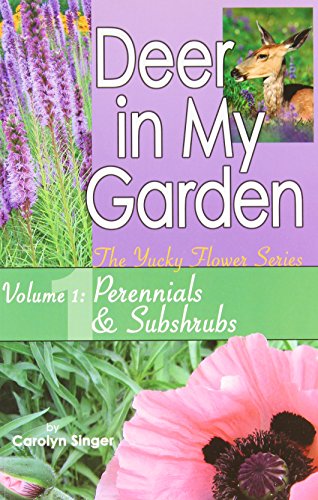 Grass Valley, California is on the outer rim of our region, but the resident gardening columnist Carolyn Singer is worth knowing about, especially for gardeners in the foothills of the Cascades. She is very experienced with the ravages of deer, and address this concern in two books. “Deer in My Garden” (2006), was largely written while the author spent the summer of 2005 in Seattle and focuses on perennials and subshrubs. “Deer in My Garden: Volume 2” (2008) considers the impact on groundcovers and garden edge plants.
Both books are part of “The Yucky Flower Series,” honoring the advice of her then 3-year-old grandson: “The deer wouldn’t eat yucky flowers!” So that is what she planted. Her deer-resistant recommendations are based on her own experience, or those of gardeners who grew trial plants for her, knowing that in the interest of science (or cervid consumer selection), the trial plants might disappear.
While yucky to deer, the selected plants are all quite lovely to gardeners and would make many other recommended plant lists. Most are drought tolerant and adapted to a wide temperature range. Best of all, the author enthusiastically rates the maintenance requirements of most as “EASY!” to “VERY, VERY EASY!” Deer or no deer, these are great garden plants.
Excerpted from the Spring 2015 Arboretum Bulletin
Washington Native Plant Society: Landscaping with Native Plants for Wildlife
Native plants provide the food, shelter, and nesting habitat favored by our local wildlife. Make your garden a sanctuary for songbirds, hummingbirds, butterflies, bees and other wildlife using native plants.
Dr. Sun Yat-Sen Classical Chinese Garden
A garden in Vancouver, B.C., “providing insights into Chinese culture, life during the Ming Dynasty, architecture, horticulture and a rare cultural experience.”