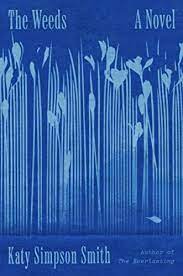
It’s hard to imagine a more botanical novel than Katy Simpson-Smith’s The Weeds, which takes its narrative structure from Richard Deakin’s 1855 book Flora of the Colosseum of Rome, or, Illustrations and Descriptions of Four Hundred and Twenty Plants Growing Spontaneously upon the Ruins of the Colosseum of Rome. The primary characters are two intentionally unnamed women, one in 2018 and the other in 1854, and the occasional refrain of a ghost, the unsettled spirit of Richard Deakin hovering over the Colosseum.
The contemporary woman is a graduate student from Mississippi, gathering plant observations for her thesis advisor. She is a keen observer of plants and people, and we soon learn she has recently lost her mother (who also had a strong connection with plants). As she works on the Rome Colosseum project, she develops an idea for a thesis exploring climate change through the plant life in Jackson’s Mississippi Coliseum. The 19th century woman has transgressed the norms of society: she is eager to avoid an arranged marriage and takes up petty thievery to make herself unmarriageable. The “you” addressed in her narrative is her lover, a woman. She works as Deakin’s indentured assistant, observing and describing the plants.
Both women consider the wild plants in context (how are they used by humans and animals, how they fit in an ecosystem, how climate affects them). For this, both are rebuked. The thesis advisor is dismissive, telling his student she has “an anecdotal mind,” whereas true scientists (men) are rational, and do not allow sentiment to intrude. Her role is to record and learn, his role is to interpret and author. The fictional Deakin tells his assistant that science is knowledge freed from emotion, and she wonders “how many days or centuries it will take for him to be proven wrong.” Whenever either woman mentions mystical, medical, or agricultural associations of the plants, they are told these things are irrelevant. But the 19th century woman believes “there is a bias against time here, and I must fault science for its disregard of history. Does it think knowledge is not accumulated but sudden?”
By turns furious, hilarious, and botanically erudite, this deeply feminist novel shines a light on the relative invisibility of women’s contributions to botany in particular and science in general. The women characters are never named because that has so often been the case in real life. Nothing in the historical record suggests a resemblance between the fictional Richard Deakin and the real one, but there are undoubtedly many instances of women overlooked and omitted as co-authors and researchers, whose contributions to the pool of knowledge remain unrecognized. Their absence from the record is a ghost that should haunt us.
The book includes a dozen exquisite graphite drawings by Kathy Schermer-Gramm, depicting selected plants of the character’s proposed Flora Colisea Mississippiana. If you want to explore Deakin’s book, a digitized copy is linked here and in the catalog record.
Reviewed by Rebecca Alexander, published in the Leaflet for Scholars, Volume 10, Issue 10, October 2023.
 One of my favorite books in the Miller Library collection is
  Jeff Lowenfels was immersed in gardening and small-scale farming as a child in upstate New York. He completed an undergraduate degree at Harvard in Geology, and later earned a law degree at Northeastern University focused on environmental law. With this background, it is perhaps surprising that he has lived most of his adult life in Anchorage, Alaska. Now retired from practicing law, he continues to write a long-running (over 45 years) gardening column in the “Anchorage Daily News.”
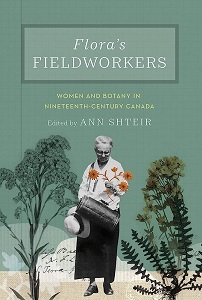 In the nineteenth century, Canadian women got their hands dirty in lots of botanical projects.
 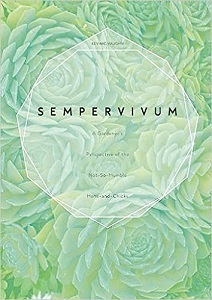 Hens-and-chicks were one of the first garden plants I came to recognize in childhood. However, compared to the brightly colored tulips and glads I favored; I didn’t think much of them. I was amused by the offsets (the “chicks”) that formed easily around the central plant (the “hen”), but the leaves were typically a dull green and the plants only occasionally sent up undistinguished flowers.
 “Julia” is a graphic biography of Julia Henshaw (1869-1937), who published the first book on the wild flowers of the Canadian Rockies in 1906. This was a relatively small aspect of her colorful life and author/illustrator Michael Kluckner chose her later role as an ambulance driver in World War I for his book’s cover.
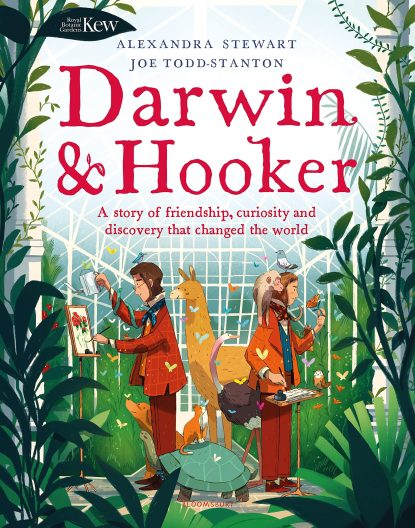 Charles Darwin (1809-1882) and Joseph Dalton Hooker (1817-1911) were both major figures in 19th century British biology. Darwin is famous for his work on evolution, and Hooker was an important plant explorer and director of Kew Gardens, following his father William Jackson Hooker in that position.
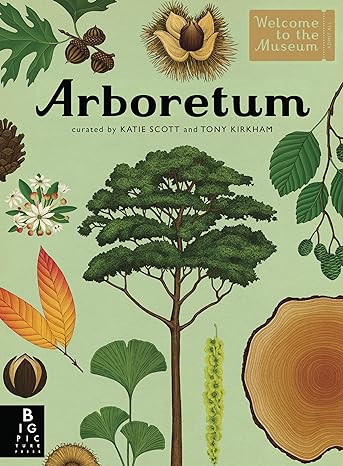 “Arboretum” is a new book this spring in the “Welcome to the Museum” series from Big Picture Press. The Miller Library has three titles in this series, all illustrated by Katie Scott, collaborating with different text authors.
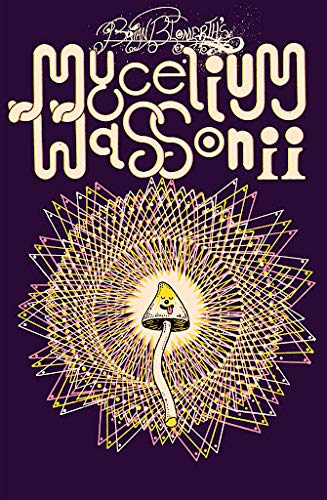 The most distinctive of the graphic nonfiction books in the Miller Library collection is “Mycelium Wassonii” by Brian Blomerth. It is a biography of R. Gordon Wasson (1898-1986) and Valentina Pavlovna “Tina” Wasson (1901-1958). Their careers were in banking and pediatrics, respectively, however they are best known for the passionate interest in the significance of mushrooms to different cultures around the world and as pioneers in the study of ethnomycology.
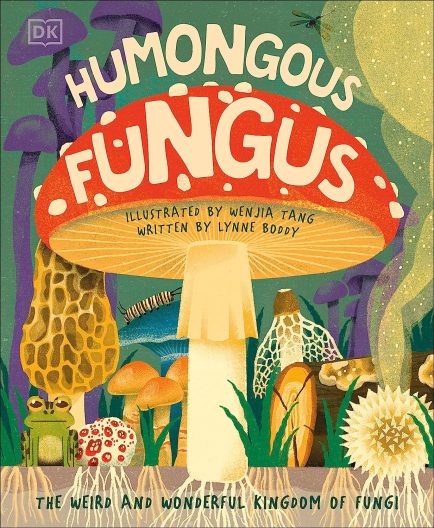 All members of the plant kingdom are supported by members of the kingdom of fungi. To learn more about these sometimes very different lifeforms, read “Humongous Fungus,” illustrated by Wenjia Tang and written by Lynne Boddy.