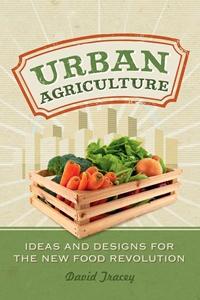
 Though I personally am cheered by the sight of a P-Patch, a front garden, or a tiny apartment balcony resplendent with edible plants, there is still resistance to seeing raised beds replete with tomatoes and lettuce overtake a lawn or other underutilized space. Activist and arborist David Tracey’s Urban Agriculture: Ideas and Designs for the New Food Revolution opens with an account of conflict over creating a community garden in his native Vancouver, B.C. Despite this negative note, the book is an antidote to despair. Tracey’s informal and humorous style diminishes the sense of helplessness we feel in the face of corporate control over our food supply, and its attendant environmental devastation and cost to human health. Tracey does not provide detailed directions on how to grow various vegetables from seed, or how to make your own compost; his purpose is to inspire and empower the reader to begin or continue the worthwhile work of growing food (as opposed to “fuud,” the term he coins for the products of Big Ag). You may not think you are engaged in agricultural pursuits but by the author’s definition, anyone who grows edible plants is a farmer.
The book is explicitly organized from the smallest to largest scale of edible cultivation (sprouts on the kitchen counter to full-scale farming). There are some unusual inclusions here, such as sections on aquaponics (in case you want to grow fish and greens together!) and school farms, the self-sufficiency model of Cuba’s urban farming project, and a checklist of questions to ask politicians before the next election (ask where she or he stands on the use of public space to grow food by raising the concept of usufruct, the legal right to use and enjoy the fruits or profits of something belonging to another). There are numerous quotable lines in this book, such as: “It takes food to grow a village,” and “The seed knows what to do.” The library also has his previous book, Guerrilla Gardening: A Manualfesto.
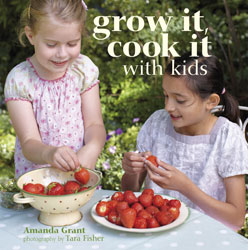 Parents of enthusiastic young gardeners, and farmers’ market shoppers alike will love this useful guide to home-growing and cooking. It features easy, photo-illustrated recipes grouped by their main ingredients, so that chocolate zucchini cake is right next to zucchini salad and stir fry, allowing cooks to choose a recipe based on what they have on hand. Better yet, each chapter begins with step-by-step instructions for growing children’s favorites like herbs, peas, beans, and berries.
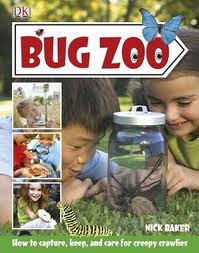 Does someone you know want an earwiggery? How about a wormery or a dragonfly den? If you know a child who loves bugs, this illustrated handbook of bug habitats will teach him or her how to capture, observe, and learn from these tiny animals respectfully, with an understanding of their delicate biology.
 Amidst the bumper crop of new food-gardening titles, Backyard Bounty : The Complete Guide to Year-Round Organic Gardening in the Pacific Northwest by Salt Spring Island, B.C. resident Linda Gilkeson stands apart. I put three recent edible plant titles by Northwest authors to the test by trying to find answers to commonly asked questions in them. Whether you are a beginning gardener or an experienced (or jaded!) old hand, this book will neither insult your intelligence nor blind you in a blizzard of technicalities. If you want to know about soil in raised beds, what to grow over the winter, or how to protect your grapes from predacious raccoons, this is the place. Though it lacks photos of primped and prinked up fruit and veggie glamour, the information is well-organized and clearly presented. I learned enough from reading it that I may just have to own a copy.
![[The Gossler Guide to the Best Hardy Shrubs] cover](https://depts.washington.edu/hortlib/graphix/gosslerguide.jpg)
I have long enjoyed the folksy but information packed annual catalogs from Gossler Farms Nursery in Springfield, Oregon. It is a great pleasure to now have the first book by the family (mom Marjory and sons Roger and Eric Gossler), The Gossler Guide to the Best Hardy Shrubs. Here the very practical, learned-by-experience descriptions of the catalog are expanded to 350 of their favorites, and all would make a good choice for local gardens.
The highlight of the introductory chapters is “How Not to Kill Your Plants” with lots of advice on how to select, buy, plant, and nurture your new shrubby children. “Consider it an open adoption: you want to know about the birth parents, what neighborhood the plant came from, whether drugs were involved, and so on.” This same professional insiders advice continues in the A-Z listings, where I learned that a favorite of mine, Enkianthus perulatus, is rarely found in nurseries “…because it grows too slowly to be profitable.”
Excerpted from the Fall 2010 Arboretum Bulletin.
![[In My Nature] cover](https://depts.washington.edu/hortlib/graphix/inmynature.jpg)
“In My Nature: A Birder’s Year at the Montlake Fill” describes the wonderful bird life of the area also known as the Union Bay Natural Area at the Center for Urban Horticulture.
Excerpted from the Fall 2010 Arboretum Bulletin.
![[Living with Bugs] cover](https://depts.washington.edu/hortlib/graphix/livingwithbugs.jpg)
“Living With Bugs” concentrates on the critters that find their way into your house, but there are valuable tips on co-existing for gardeners, too.
Excerpted from the Fall 2010 Arboretum Bulletin.
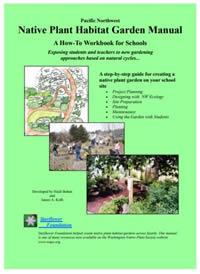
“Pacific Northwest Native Plant Habitat Garden Manual” is a short, loose-leaf bound notebook intended to give the basics for teachers and students establishing school gardens using natives.
Excerpted from the Fall 2010 Arboretum Bulletin.
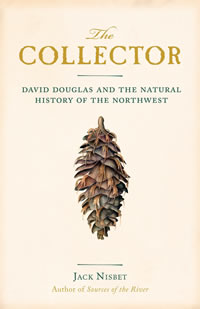 For a total change of pace, pick up Jack Nisbet’s “The Collector.” Although written in the third person, the story-telling is so good that it reads like a memoir by one of the most influential of the early plant explorers to our region. David Douglas was a keen observer of all things in the natural world, but especially the plant kingdom, and had a natural talent for the recording, collecting, and preserving what he found. And what energy! From 1823 until his tragic death in 1834, Scotsman Douglas was almost constantly exploring the new world, risking many hazards of travels and meeting many interesting people in both academic and frontier life.
Excerpted from the Fall 2010 Arboretum Bulletin.
 “The law condemns the man or woman