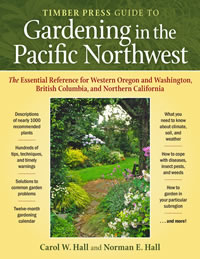
 When authors Carol and Norman Hall started gardening in the Pacific Northwest in the 1970’s they had to learn to grow their plants by trial and error, because most gardening books of the time addressed only East Coast weather conditions, such as summer rain and winter freezing.
However, perhaps it’s just as well the authors had to figure it out on their own because their depth of understanding how the Pacific Northwest climate affects plants is impressive. Although the question of where the boundaries of the Pacific Northwest lie is open to debate, the Halls define them as: the areas stretching between the ocean coast and the Cascade Range, and between latitude 51° in British Columbia and latitude 41° in northern California. The northern boundary was chosen because north of latitude 51° the “difference between high and low temperatures become smaller and light intensity starts to diminish even on clear days… gardening conditions beyond this point are not those of the Pacific Northwest, but those of coastal Alaska.” The southern border seems a bit more arbitrary, especially on the coast, but the authors note: “It’s only after negotiating the steep descent from [the Cascade Range] to the valley floor and seeing the palm trees lining the streets of Redding, California, that you know you’ve suddenly entered a whole new gardening world.” The unifying climatic conditions that defines the region are wet, mild winters and dry summers.
This large format book with 351 pages and a liberal use of color photographs is divided into 4 sections: the region, 12 month maintenance calendar, recommended plants and common problem & solutions.
Detailed descriptions of climate, soils and horticultural conditions are given about the region’s seven sub-regions, which include: the Georgia Basin/Puget Trough, the Olympic Rain Shadow, Puget Sound, Pacific Coast (northern section), Pacific Coast (southern section), the Cascade Slopes/Outflow Valleys and Willamette. The authors recommend their favorite plants that grow well in the Pacific Northwest according to plant types such as: ornamental trees, shrubs, bulbs, and others. Instructions on caring for the recommended plants always refer to specific Pacific Northwest climate considerations. For example, heaths and heathers need supplemental water during our typical regional summer droughts for the first two years, until they become established.
This is an excellent general gardening reference that focuses on the Pacific Northwest climate like no other.
Excerpted from the Winter 2009 Arboretum Bulletin.
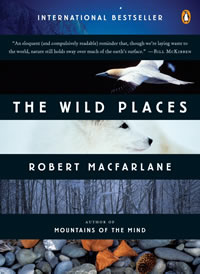 Though I will probably never survey my surroundings from the top of a tall beech tree, or climb a frozen waterfall in the dark, I thoroughly enjoyed discovering unspoiled natural areas of Britain through Robert Macfarlane’s book
 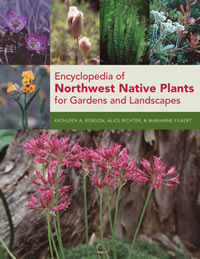 For gardeners, the most important new book of the year will be the
 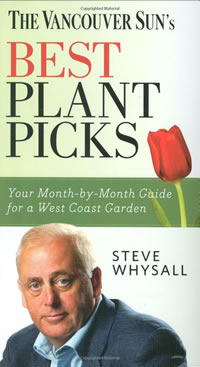 Steve Whysall has been a regular garden writer for the Vancouver Sun for 15 years.
 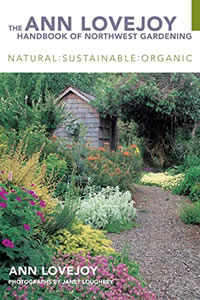 Ann Lovejoy has updated her popular 2004 “Handbook of Northwest Gardening,” with a new appendix entitled “What’s New in Sustainable Gardening.” Here she discusses rain gardens (that capture as much of naturally occurring water as possible), dry gardens (plantings that survive and even thrive with no supplemental watering once established), and the importance of bees and their current peril — and ways that gardeners can help their cause. All good additions.
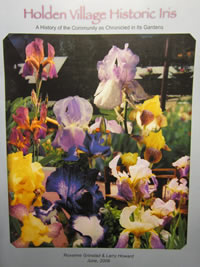 One of the most unique books in the Elisabeth C. Miller Library collections is “Holden Village Historic Iris,” the accounting of the surviving garden iris from the village of a mining camp that operated near the upper end of Lake Chelan from 1937 – 1957. Now established at a nearby Lutheran ministry known as Holden Village, these irises are a living history. Grown by the wives of the miners, many survived untended for more than 40 years in abandoned gardens.
 “My father, John Bartram, is a botanist. He studies plants and trees. I help him with his work. My name is William, but everyone calls me Billy. Father calls me his ‘little botanist.'”
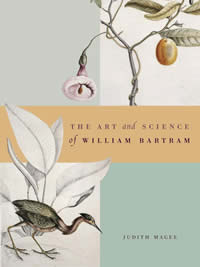 Children’s books may lead to some interesting discoveries in adult literature. The story of Billy, the little botanist, grows up in “The Art and Science of William Bartram” by Judith Magee. Here the simple leaf-drawing boy is revealed as more than an intrepid explorer and skilled artist of nature.
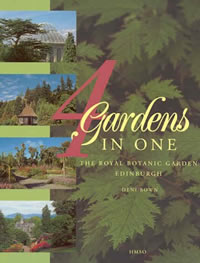 “4 Gardens in One,” by Deni Bown is an excellent source for learning about the four sites of the Royal Botanic Gardens Edinburgh. Written with passion and an eye for lively history — Bown took the photographs, too — in her details about the Younger Botanic Garden at Benmore, I learned the full truth of Rhododendron ponticum. “Even today one will encounter areas in the far west of the garden which are yet to be cleared; these are still ponticum territory and virtually impenetrable.”
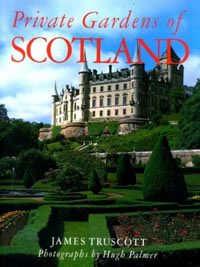 James Truscott states in the introduction to Private Gardens of Scotland his hope to transport the reader to “…a temporary withdrawal from humdrum everyday life into a cloistered world of scents and colours, where half-forgotten feelings of wonderment and awe can be rediscovered.” An ambitious goal, but he succeeds by having one of the best pens for garden description I’ve ever read. The photographs of Hugh Palmer compliment the writing, but they are not the stars. This book is meant to be read — even if you never visit the gardens, Truscott’s nuance of detail and narrative style of “touring” will teach you much, especially about design, as is befitting for an author who is also a landscape architect. He’s full of fun facts, too: Did you know that Mary Queen of Scots, the Crown Prince of Imperial Japan, and Margaret Thatcher have all planted trees at Scone Palace near Perth?