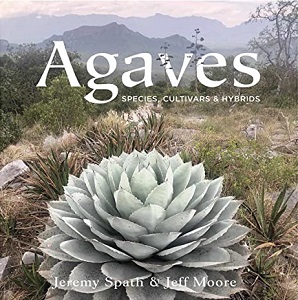
When I visit desert gardens in conservatories, or in captivating places such as the Desert Botanical Garden in Phoenix, I’m always drawn to the agaves. My favorite is Agave victoriae-reginae, a native of the Chihuahua Desert of Mexico that enchanted me the first time I visited my parents when they lived in Arizona. The precise white lines on the leaves look as though they were applied with a fine paintbrush.
On subsequent visits, I learned there are many other agaves with fascinating foliage patterns, forms, and textures. I also glimpsed the infrequent towering inflorescences; one final performance before the central plant dies, although often with offsets ready to carry on.
Agaves: Species, Cultivars & Hybrids is a new book in the Miller Library by Southern California authors Jeremy Spath and Jeff Moore. There are other books that discuss the botanical aspects of the genus, or uses by humans (tequila, anyone?) and animals. This instead is a horticultural review of the many forms emphasizing their aesthetic and cultural traits, beautifully illustrated in both nature and cultivation. Before you dismiss the possibility of growing these in Seattle, because it’s too cold, and especially too wet in the winter – think again.
Although primarily native to Mexico, several species are from high altitudes and with proper siting and protection from being waterlogged can make spectacular garden or container subjects in our area. An example is the story of Monte, an Agave montana plant growing in Portland, as told in an essay and photographed in the book by its owner, Lance Wright.
This species is from the eastern Sierra Madre Mountains in southern Chihuahua, where it receives significant rainfall, which may explain its ability to survive for 18 years in the ground in the Pacific Northwest. Like all in its genus, Monte gave one final farewell performance by blooming, but what a performance!
The first emergence of a bloom stalk was in late September, eventually reaching a flowering height of 15 feet the following spring. “The City came out on May 9 to do traffic control as crowds were standing in the street slowing traffic to take pictures.” If you want a media star in your garden, this is your plant!
Reviewed by Brian Thompson for The Leaflet, Volume 9, Issue 11 (November 2022).
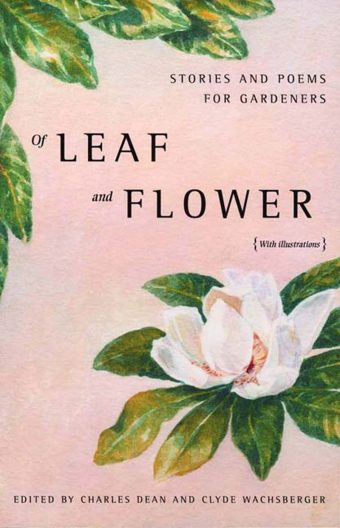 Clyde Wachsberger became an avid gardener in his mid-30s after acquiring a small house and property at the eastern tip of Long Island, New York. While the garden was his passion, it was a lonely pursuit and he longed to share it with someone. However, his efforts to find a relationship with another man, “a friend who shared my deepest yearning to be someone special for someone special,” were not successful.
 Clyde Wachsberger became an avid gardener in his mid-30s after acquiring a small house and property at the eastern tip of Long Island, New York. While the garden was his passion, it was a lonely pursuit and he longed to share it with someone. However, his efforts to find a relationship with another man, “a friend who shared my deepest yearning to be someone special for someone special,” were not successful.
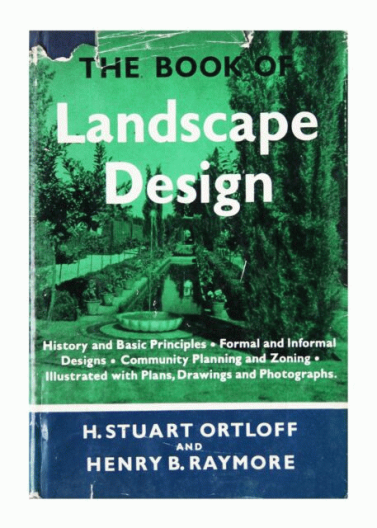 Henry Stuart Ortloff and Henry Bond Raymore established a landscape architectural firm in 1924, when both men were in their late 20s. They lived and worked for over 40 years at Apple Green, a late 18th century house in Huntington, New York on Long Island that was their combination home and office. According to Steve Whitesell, a landscape architect who completed a
 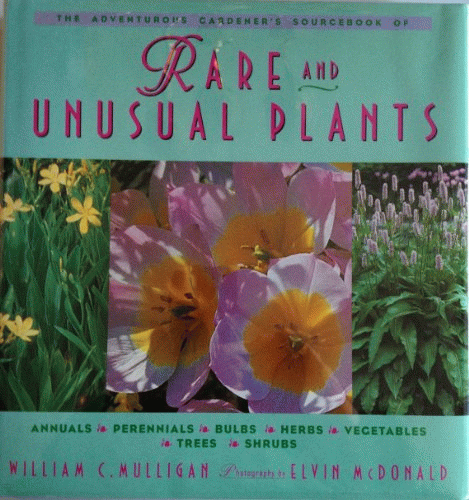 Elvin McDonald was a precocious horticulturist. In order to learn more about growing gloxinias, he started what is now the Gesneriad Society and its journal “Gesneriads” when he was only 14, while still working on his family’s farm in Oklahoma. After studying opera performance at Mannes School of Music in New York City, he embarked on a long career in horticulture as a writer and a photographer. He has authored or contributed to upwards of 100 books.
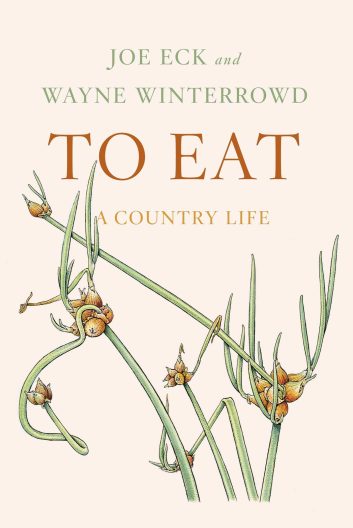 Joe Eck and Wayne Winterrowd shared over 40 years together, most of it at a home they called North Hill in Readsboro, Vermont. This is a long time for any couple, but especially noteworthy for gay men. Their garden inspired many books, written by each singly or by both. The Miller Library has eight of their titles on subjects that include annuals, tender perennials, roses, and garden design. Winterrowd’s “Annuals for Connoisseurs” (1992) is one of my personal favorites.